-
Whatsapp: +86 15516933785
-
Email: hanlin@hanlinplayground.com
-
Address: Shangjie District, Zhengzhou City, Henan Province, China
-
Whatsapp: +86 15516933785
-
Email: hanlin@hanlinplayground.com
-
Address: Shangjie District, Zhengzhou City, Henan Province, China

10 Creative Commercial Outdoor Playground Ideas for Community Parks
What are the most effective creative ideas for commercial outdoor playgrounds in modern community parks?
Creative commercial playground ideas focus on nature-integrated designs, high-adventure agility courses, immersive custom themes, and technology-driven inclusive play to transform standard parks into community destinations. These concepts blend aesthetic appeal with developmental benefits, ensuring accessibility for all abilities while maximizing dwell time and safety through strategic zoning and phased installation.
Nature-Integrated Playscapes that Blend with Landscape
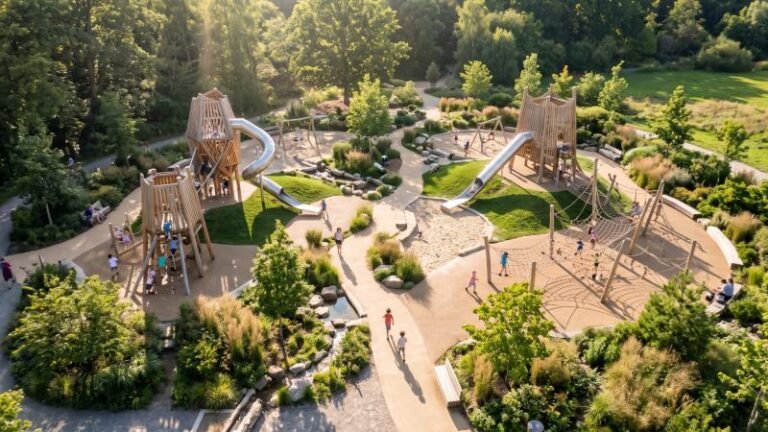
Nature-integrated playscapes utilize organic shapes, site topography, and engineered natural materials to create environments that stimulate open-ended play while reducing visual clutter. Unlike bright plastic structures, these designs seamlessly merge with the existing environment, offering sensory-rich experiences that traditional modular structures cannot replicate, often increasing park usage time by encouraging exploration and imaginative interaction.
1. Engineered Natural Boulders and Log Scrambles
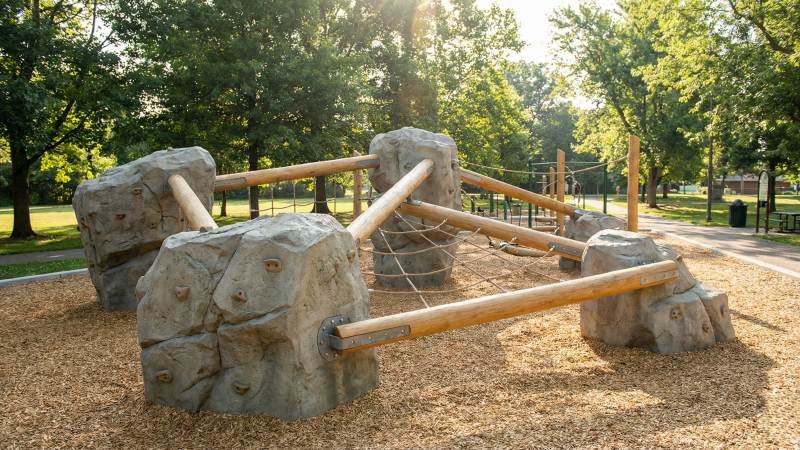
Commercial parks require equipment that offers the aesthetic of nature but the durability of public infrastructure. Therefore, landscape architects rarely use actual fallen logs or random rocks found in the woods for public playgrounds, as these materials are prone to rot and lack certified fall ratings. Instead, the industry standard relies on Glass Fiber Reinforced Concrete (GFRC).
GFRC allows manufacturers to cast molds from actual rocks and trees, capturing every bark crevice and mossy texture. However, the final product is a hollow, steel-reinforced structure. This is directly comparable to a commercial climbing wall using synthetic holds to mimic granite; it provides the grip and sensory feel of nature but with the calculated structural integrity required for public liability. To achieve this look with compliant materials, planners often opt for natural log climbing scrambles that mimic fallen timber while ensuring long-term safety.
Key Advantages of Engineered Materials:
- Predictable Safety: Unlike a real tree, an engineered log does not rot, splinter, or change shape over time. This consistency allows installers to maintain precise fall zones.
- Pest Resistance: Real wood attracts termites and wasps. Concrete composites do not offer a home for insects, reducing maintenance calls.
- Grip Consistency: Real rocks can become dangerously slick when polished by thousands of shoes. Engineered boulders often feature grit-blasted textures to ensure consistent traction in wet and dry conditions.
When selecting these pieces, verifying the Load Bearing Capacity is essential. A high-quality commercial climbing boulder is engineered to handle significant live loads, accounting for multiple children jumping simultaneously.
2. Sensory Water and Sand Tables with Hydraulic Pumps
Nature play is not just about climbing; it is also about manipulation. Sensory tables bring the “creek bed” experience into a controlled, accessible environment. In a commercial setting, digging a simple hole and filling it with water is not viable due to drainage complications and hygiene standards.
The professional solution involves elevated stainless steel troughs connected to manual hydraulic pumps. This setup teaches children about cause and effect mechanics. They must physically pump a handle to generate water flow, which then travels through channels, dams, and weirs before draining into a recirculating system or drain.
Why Stainless Steel?
Plastic trays often crack under UV exposure or become brittle in freezing temperatures. Stainless steel serves as the industry benchmark for wet environments. It resists rust and withstands the abrasive friction of sand mixed with water—similar to how commercial kitchen surfaces are designed for constant heavy use and cleaning.
The Flow System:
- The Pump: Usually a heavy-duty hand pump or an Archimedes screw. It draws water from a mains line or a recirculating reservoir.
- The Troughs: These act like a canal system. Kids use gates to stop or release water.
- The Accessibility: By elevating the sand and water, children in wheelchairs can roll right up to the fun. This removes the barrier of a traditional sandbox curb.

3. Outdoor Musical Instruments and Acoustic Panels
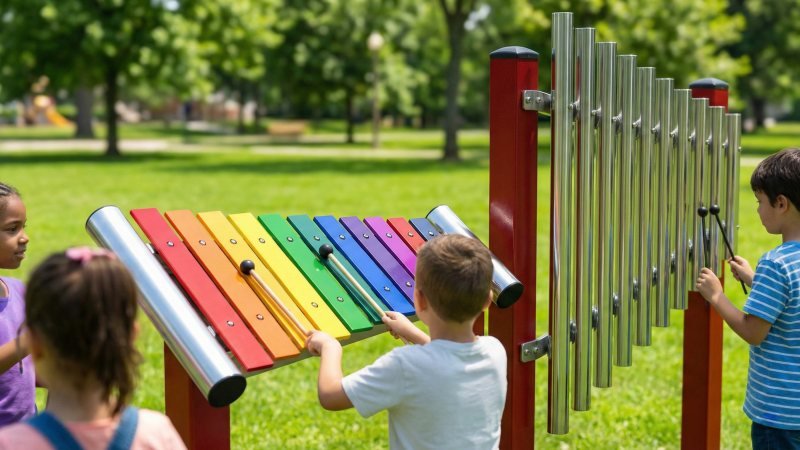
Integrating sound into a park adds a layer of sensory engagement without requiring physical exertion. However, community planners often hesitate due to potential noise complaints from neighbors. To solve this, high-end commercial park instruments utilize Pentatonic Tuning.
A pentatonic scale consists of five notes per octave. No matter which notes a child strikes together, the resulting sound is harmonically pleasing. There are no dissonant or “clashing” chords. This ensures the playground sounds like an ambient wind chime rather than a chaotic drum session.
Material Durability and Specifications
| Component | Recommended Material | Function |
|---|---|---|
| Resonating Bars | Anodized Aluminum | Resists corrosion and maintains pitch stability in extreme heat or cold. |
| Mallets | Polyurethane / TPO | Soft enough to produce warm tones, hard enough to resist chewing or tearing. |
| Tethers | Stainless Steel Aircraft Cable | Prevents theft or removal of the mallets. |
Vandalism Resistance
Commercial outdoor instruments differ significantly from indoor music equipment. They have no hollow boxes or strings to break. The keys are often mounted on high-density polyethylene (HDPE) posts. This construction mirrors the durability of solid park benches, capable of withstanding impact and weather.
Note: Since acoustic range depends on local wind patterns and surrounding barriers, manufacturers can often provide sound map data to help position these instruments appropriately relative to nearby homes.
High-Adventure and Agility Courses for Active Play
High-adventure courses engage older demographics (ages 5-12+) by simulating extreme sports environments within compliant safety zones. These structures prioritize physical literacy, requiring users to utilize upper-body strength, balance, and strategic planning to navigate obstacles. By offering “perceived risk”—where the activity feels dangerous but is statistically safe—commercial parks can effectively extend dwell time for age groups that typically outgrow standard modular playgrounds.
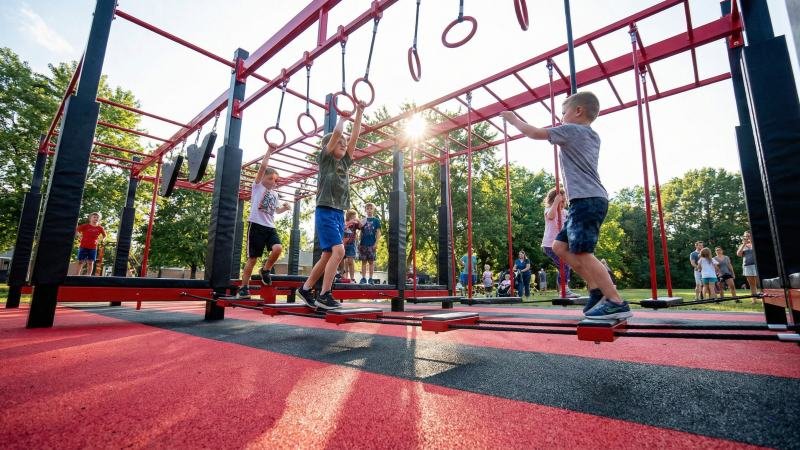
4. Ninja Warrior Style Obstacle Circuits
Modern playground design has shifted away from isolated equipment toward continuous movement flows. Inspired by obstacle competitions, these climbing net playgrounds act like outdoor fitness tracks for children. The goal is not just to play, but to complete a sequence without touching the ground.
The Mechanics of Flow
In this setup, equipment is arranged linearly. A child starts at a “launch pad” and moves to overhead rings, then to balance beams, and finally to a landing platform. This layout logic is similar to a manufacturing workflow; one station must feed naturally into the next without bottlenecks. If the spacing is too wide or the transition awkward, the “flow” breaks, and the equipment loses its appeal.
Critical Design Elements:
- Surfacing Depth: Because these courses encourage jumping and potential falls, the impact-attenuating surface (like rubber mulch or poured-in-place rubber) usually requires a greater critical fall height rating than standard zones.
- Modular Progression: Commercial suppliers often design these as modular units. You can add a “warp wall” or “floating steps” later as budgets allow.
- Competitive Element: Many parks install durable, button-activated timers at the start and finish lines. This encourages repeat use as children try to beat their personal bests.
5. Free-Floating Cableways and Dual Zip Lines
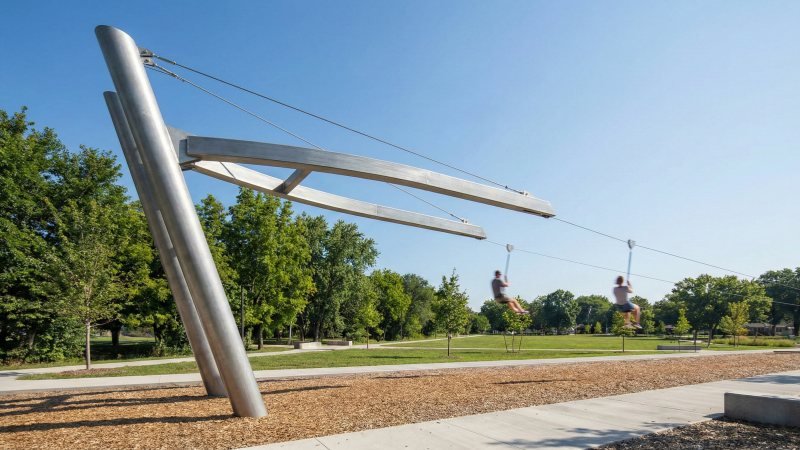
Zip lines, technically known as cableways, are often the highest-traffic feature in a commercial park. The “free-floating” or cantilever design is a modern evolution that uses a single, robust support arm rather than a traditional A-frame structure. This reduces the footprint and visual obstruction in the park.
Dual Tracks for Social Play
Installing a single cableway creates a long queue. A dual-track system allows two children to race side-by-side. This simple change transforms a solo activity into a social, competitive event, effectively doubling the throughput capacity without doubling the wait time.
Technical Components:
- The Trolley: This is the carriage mechanism containing wheels that roll along the cable. Commercial trolleys use sealed bearings to resist sand and grit ingress.
- The Brake System: A spring or rubber buffer is located at the end of the cable. It decelerates the rider safely before they reach the anchor post.
- The Cable Tension: Steel cables will stretch over time, especially in hot weather. Commercial systems include tensioning mechanisms at the anchor points to tighten the line.
Comparison of Cableway Styles
| Feature | Cantilever (Free-Floating) | Traditional A-Frame |
|---|---|---|
| Footprint | Minimal (Single Post) | Large (Requires spread footings) |
| Aesthetics | Modern, sleek | Functional, structural |
| Installation | Requires deeper, massive concrete foundation | Spread load, shallower foundation |
6. Sky-High Rope Towers with Enclosed Tube Slides
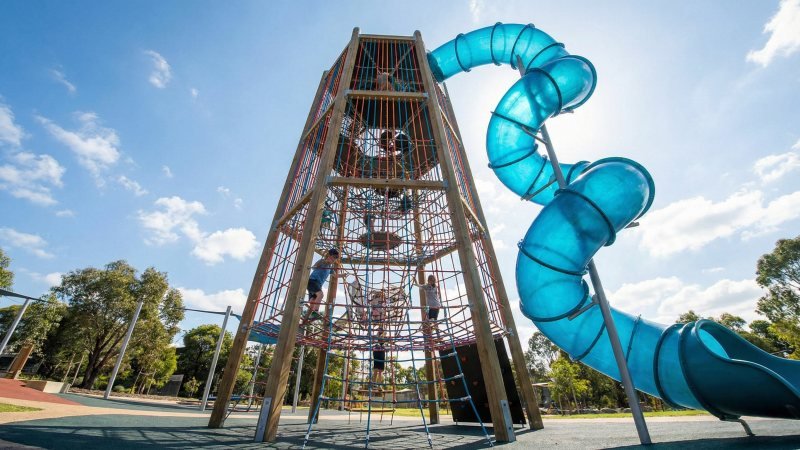
To maximize play value in a small footprint, commercial designs are going vertical. Rope towers, often exceeding 20 feet in height, serve as visual landmarks for the park.
The Structural Web
These towers function like a suspension bridge. A central steel mast supports a complex web of steel-reinforced ropes (often called Hercules rope). The tension in the ropes provides the structural integrity. Children climb through this internal web, which acts as a fall arrest system. If a child slips, they only fall a few feet onto the next layer of netting, rather than falling to the ground.
The Exit Strategy
The reward for the difficult climb is the descent. High-speed, enclosed stainless steel slides or plastic tube slides are attached to the top levels.
- Why Enclosed? An enclosed tube prevents users from standing up or falling out during the slide, which is critical at heights above 6 feet.
- Sensory Experience: Some manufacturers add translucent rings or “portholes” to the dark tubes. This creates a strobing light effect as the child slides down, adding to the thrill without adding mechanical complexity.
Immersive and Sculptural Design Concepts
Immersive and sculptural designs elevate playgrounds from simple recreational spots to significant community destinations by integrating local culture and artistic expression. These structures serve a dual purpose: they provide compliant active play opportunities while acting as visual centerpoints that enhance the architectural value of the surrounding public space.
7. Custom Themed Structures Reflecting Local History
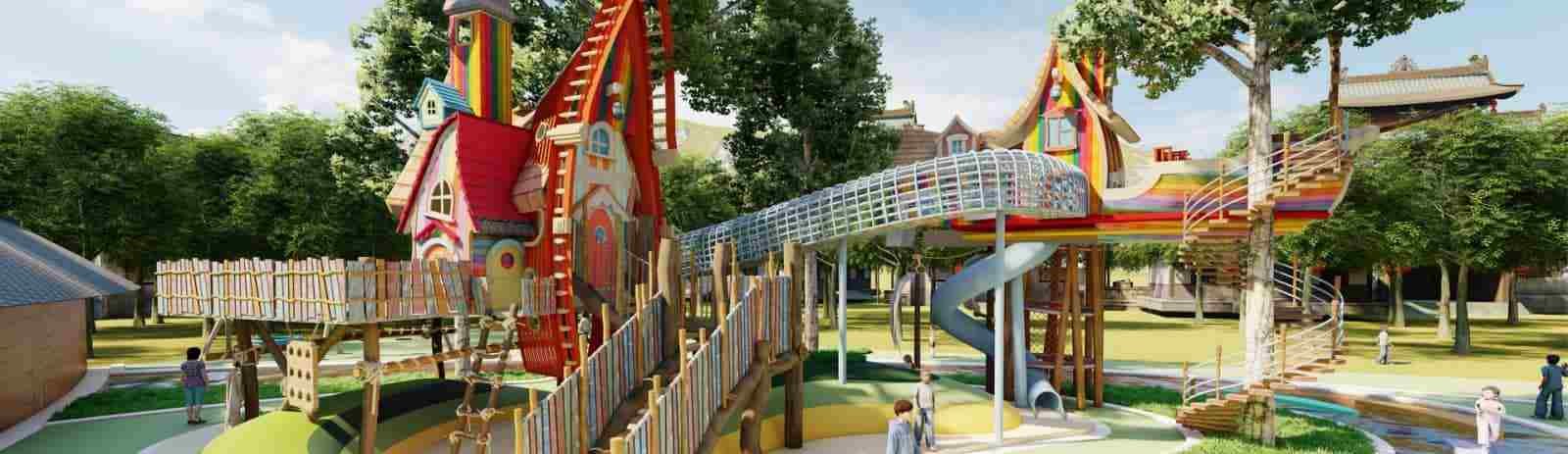
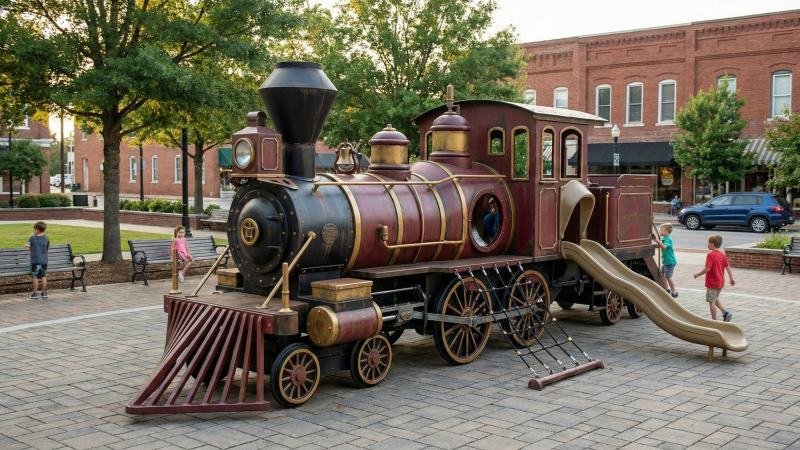
Standard catalog equipment, such as generic pirate ships or castles, is common. However, communities increasingly demand “place-making” designs. This approach uses the playground to tell a specific story about the town’s heritage or geography.
The Fabrication Process
Creating these structures involves more than just picking colors. It requires a collaborative process similar to architectural modeling:
- Concept Phase: Designers sketch ideas based on local icons (e.g., a famous local lighthouse, a historic locomotive, or a custom airplane-themed outdoor playground).
- 3D Modeling: Engineers use CAD software to convert sketches into buildable structures. They must ensure the artistic shape does not create safety hazards like head entrapments or pinch points.
- Material Selection: Most high-end custom props use Glass Fiber Reinforced Concrete (GFRC) or heavy-gauge steel. These materials allow for precise detailing, such as mimicking the rivets on an old airplane.
Strategic Benefits
A custom landmark acts as a free marketing tool for the municipality. Families are more likely to travel to a “Train Station Park” than a generic “Slide Park.” This increases foot traffic, which can benefit nearby local businesses. Note that custom-designed projects typically require significantly longer lead times for engineering and fabrication compared to modular “off-the-shelf” equipment.
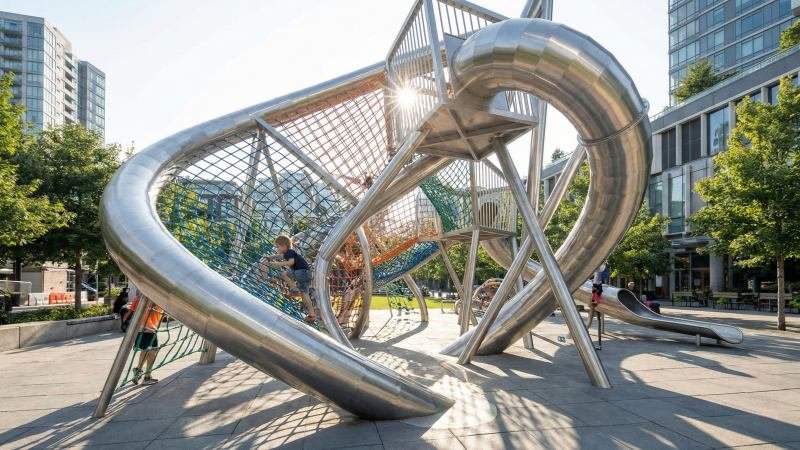
8. Abstract Sculptural Pieces that Double as Public Art
In urban environments or high-end housing developments, bright primary colors (red, yellow, blue) often clash with modern architecture. Abstract sculptural play offers a solution. These pieces look like modern art installations when idle but function as climbers when children arrive.
Form Meets Function
Unlike a traditional slide with a clear entry and exit, sculptural play is “non-prescriptive.” A geometric steel structure does not tell the child how to play. One child might climb inside it, while another climbs over it. This ambiguity encourages cognitive decision-making.
Material Durability in Urban Settings
Sculptural pieces often utilize high-grade materials to maintain their aesthetic appeal over decades.
| Material | Application | Benefit |
|---|---|---|
| Stainless Steel | Climbing arches, twisted geometric forms | Extremely resistant to rust and urban pollution; requires no paint touch-ups. |
| Architectural Rope | Internal netting within steel frames | Adds softness and texture; allows transparency so parents can see through the sculpture. |
| High-Density Polyethylene (HDPE) | Accent panels or carved details | Provides color without the risk of paint chipping or fading. |
The “Museum Quality” Approach
Think of these structures like heavy-duty industrial machinery designed for public interaction. They feature hidden welds and tamper-proof fasteners. The goal is to create a seamless silhouette that appeals to adult aesthetics while providing the grip and footing necessary for safe child play. This bridges the gap between a landscape architect’s vision and a child’s need for activity.
Technology and Inclusive Innovation
Modern commercial playgrounds integrate electronic gaming systems and flush-to-ground engineering to bridge the gap between digital entertainment and physical inclusion. Electronic gaming pillars utilize human-powered energy and interactive LED nodes to gamify exercise, competing with sedentary screen time. Simultaneously, advanced inclusive designs, such as flush-mounted carousels, eliminate physical barriers entirely, allowing mobility devices to enter play structures seamlessly without requiring transfer, thereby meeting and exceeding current ADA standards.
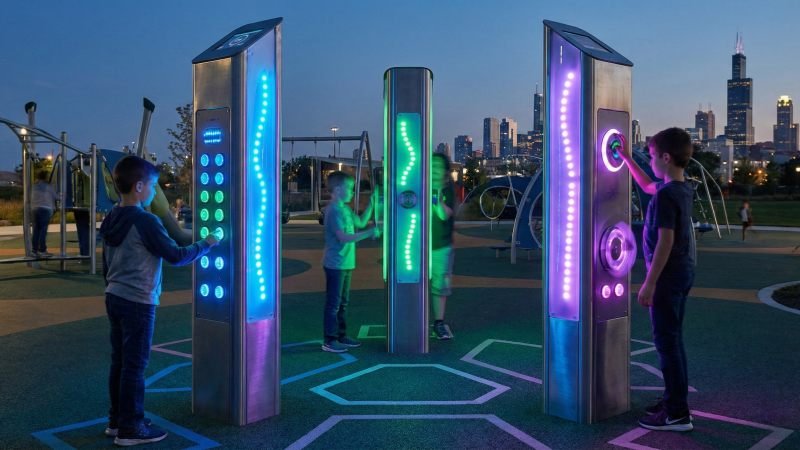
9. Electronic Interactive Gaming Pillars for Modern Kids
Park planners often struggle to engage children aged 7 to 14. This demographic often abandons traditional slides for video games. Electronic gaming pillars address this by bringing the “arcade” dynamic outdoors. These units act as vertical consoles where players must run, jump, and tap lighted buttons to score points.
Human-Powered Energy Systems
A major concern for municipal parks is electrical infrastructure. Trenching power lines to a playground is expensive and requires permits. To solve this, leading manufacturers use kinetic energy technology.
- Mechanism: When a child spins a handle, jumps on a platform, or rotates a wheel, an internal dynamo generates low-voltage electricity.
- Result: This power activates the LED lights, speakers, and computer processors.
- Benefit: The equipment requires no external power grid, reducing installation costs and eliminating monthly utility bills.
Ruggedized Durability
These are not fragile touchscreens. The interface consists of high-impact, weather-sealed buttons, functionally identical to the pedestrian crossing buttons found at busy intersections. The internal electronics are potted (sealed in resin) to prevent moisture damage from rain or humidity.
Game Dynamics
The internal software usually contains multiple game modes, such as “Speed Tag” or “Memory Match.” This variety ensures the equipment remains fresh. Some advanced models allow park operators to update game settings via Bluetooth or USB, ensuring the content does not become obsolete.
10. Wheelchair-Accessible Gliders and Flush-to-Ground Carousels
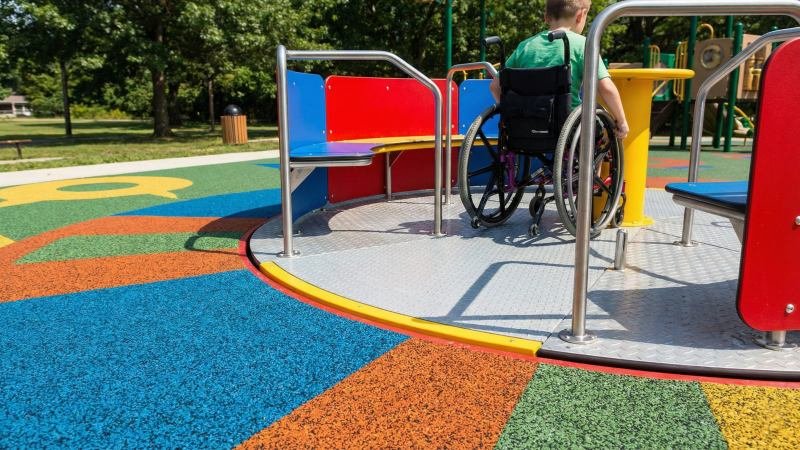
True inclusion goes beyond adding a ramp to a mulch pit. It requires equipment that accommodates a wheelchair user and a non-wheelchair user playing side-by-side. The industry has shifted toward “Flush-to-Ground” engineering to achieve this.
The Engineering of Flush Mounting
Traditional merry-go-rounds sit on top of a central post, creating a step up. In contrast, accessible carousels are installed into a recessed concrete pit. The deck of the carousel sits level with the surrounding safety surfacing.
- The Transition: This seamless transition allows a wheelchair to roll directly onto the unit without needing a ramp or assistance.
- The Analogy: Think of this like a recessed loading dock leveler in a warehouse. It bridges the gap between the ground and the platform perfectly, allowing wheeled traffic to flow without obstruction.
Sway Fun and Glider Mechanics
Accessible gliders function like a pendulum. They provide a swaying motion rather than a spinning one.
- Integration: These units feature a large table or rail system in the center.
- Function: Passengers typically use their upper body strength to push and pull the central table, building momentum.
- Capacity: They are engineered with heavy-duty bearings to support the combined weight of multiple wheelchairs and standing passengers simultaneously.
Safety Governors
Because these units carry heavy loads, inertia is a risk. Commercial accessible spinners utilize a centrifugal governor. This mechanical device limits the maximum rotation speed. If the spinner moves too fast, brake pads expand against the housing to slow it down, ensuring the ride remains safe for all ability levels.
Comparison of Spinning Features
| Feature | Standard Merry-Go-Round | Flush-to-Ground Accessible Carousel |
|---|---|---|
| Entry Point | 12-18 inch step up | Zero-entry (Level with ground) |
| Speed Control | Free spinning (High speed) | Governor-controlled (Limited speed) |
| Seating | Outward facing bars | Wheelchair bays + Seating |
| Installation | Single central footer | Large recessed concrete pit |
Strategic Site Planning for Commercial Installations
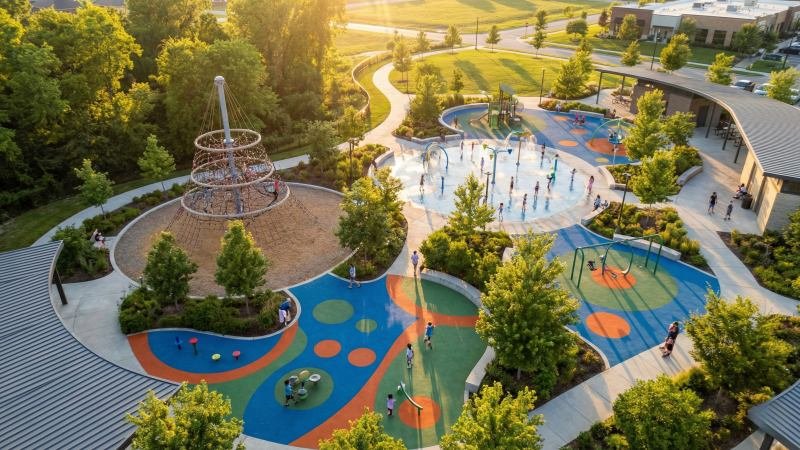
Strategic site planning ensures playground longevity and safety by establishing clear functional zones that prevent overcrowding and mitigate accidents between different age groups. By integrating essential infrastructure like shade systems and seating early in the design phase, planners can extend user dwell time and accommodate phased construction, allowing municipalities to align project milestones with available fiscal budgets.
Zoning Areas by Age Group for Safety and Flow
Safety in commercial playgrounds relies heavily on separation. You generally cannot mix toddlers (ages 2-5) with older children (ages 5-12) in the same high-energy space. Industry standards, such as those from the CPSC (Consumer Product Safety Commission), recommend distinct zones. To ensure full compliance with these regulations, understanding the specifics of commercial outdoor playground equipment safety standards is essential for any project manager.
The “Traffic Lane” Analogy
Think of a playground layout like a warehouse floor plan. In a warehouse, you separate heavy forklift traffic from pedestrian walkways to prevent collisions. Similarly, in a park, you must separate high-speed areas (like zip lines) from low-speed areas (like sandboxes) to prevent cross-traffic accidents.
Critical Design Zones:
- The Tot Lot (Ages 2-5): This area features smaller steps and lower platforms. It should be positioned closest to the seating area so parents can hover nearby.
- The Junior/Senior Area (Ages 5-12): This zone allows for faster movement and higher climbing. It should be visually distinct, perhaps separated by a walkway or landscaping buffer.
- The Buffer Zone: This is the empty space between equipment, known technically as the “Use Zone.” Equipment with motion, like swings, requires a much larger buffer than static climbers.
Sightlines for Supervision
Effective zoning maintains clear lines of sight. A parent sitting on a central bench should be able to scan both the toddler area and the older child area without obstruction. Avoid placing large, solid structures in the middle of the park that block this view.
Incorporating Shade Structures and Parent Amenities
Commercial playgrounds often fail if they ignore the parents. If the adults are uncomfortable, the family leaves early. Therefore, amenities are not just “nice to have”; they are operational necessities for maximizing facility usage.
Shade is Critical Equipment
Shade structures protect both the children and the investment.
- Temperature Control: In direct sunlight, plastic slides and vinyl-coated decks can reach temperatures capable of causing contact burns. Shade keeps surfaces touchable.
- UV Protection: Constant UV exposure fades colors and degrades plastics over time, making them brittle. A fabric shade canopy acts like a shield, extending the lifespan of the equipment beneath it.
Types of Commercial Shade:
- Hip Shades: These look like traditional roofs with four posts. They offer the most coverage for large play structures.
- Cantilever Shades: These use two posts on one side to support a canopy. This keeps the poles out of the play area, reducing collision hazards.
Seating Placement Strategy
Do not place benches randomly. Position them along the perimeter of the “Use Zones.” This encourages parents to stay off the safety surfacing while remaining close enough to intervene if necessary.
| Amenity | Strategic Function |
|---|---|
| Perimeter Benches | Provides rest for guardians while maintaining supervision sightlines. |
| Trash Receptacles | Reduces maintenance labor by encouraging users to keep the site clean. |
| Bike Racks | Encourages green transportation and prevents bikes from cluttering play zones. |
Phasing Installation to Manage Municipal Budgets
High-quality commercial playgrounds represent a significant capital expenditure. Often, a community board desires a massive park but only has the budget for half of it. The solution is Master Planning with Phased Installation.
Building the Foundation First
In construction, you would not build the second floor before the foundation. Similarly, in playground phasing, you should prepare the entire site first.
- Phase 1 (Site Prep): Grade the entire land, install drainage, and pour the concrete sub-base or curbing for the entire future park.
- Phase 2 (Core Play): Install the main play structure and the safety surfacing.
- Phase 3 (Expansion): In the following fiscal year, add independent items like swings, spinners, or shade structures into the pre-planned spaces.
The Modular Advantage
Most commercial play systems are modular. You can install a main tower now and add a connecting bridge and a second tower three years later.
Avoiding Costly Rework
The most expensive mistake is digging up new safety surfacing to install a post you forgot. By installing the concrete footers for Phase 3 during Phase 1 (and burying them temporarily), you save the cost of bringing heavy excavation machinery back to the site.
Conclusion
Designing a successful community park requires more than just filling a space with equipment; it demands a balance of creativity, engineering, and strategic planning. By moving beyond generic solutions and embracing nature-integrated designs, inclusive technology, and immersive themes, municipalities can create lasting landmarks that serve diverse populations. Whether it is through high-adventure courses for teens or shaded sensory areas for toddlers, the most effective playgrounds are those that plan for safety, durability, and future expansion from day one.