-
Whatsapp: +86 15516933785
-
Email: hanlin@hanlinplayground.com
-
Address: Shangjie District, Zhengzhou City, Henan Province, China
-
Whatsapp: +86 15516933785
-
Email: hanlin@hanlinplayground.com
-
Address: Shangjie District, Zhengzhou City, Henan Province, China

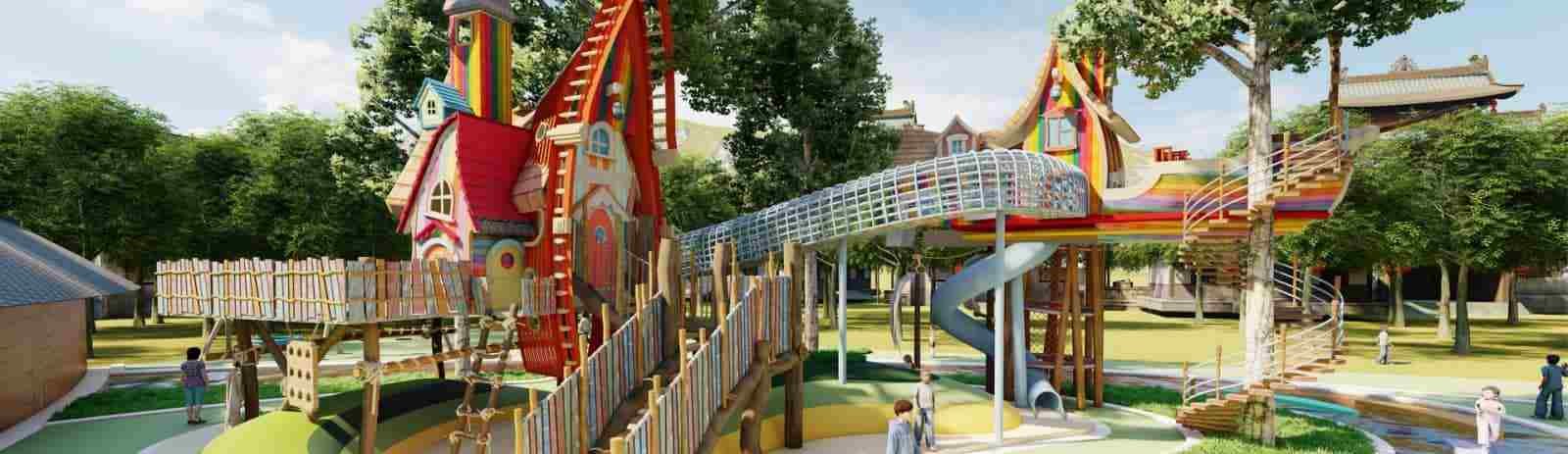
20 Fun Outdoor Playground Activities for Kids: The Ultimate Guide to Screen-Free Play
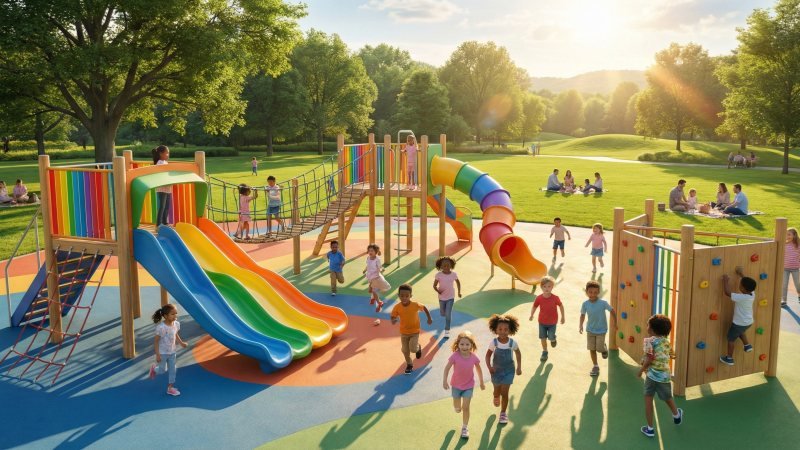
What are the most effective outdoor playground activities to foster child development and reduce screen time?
The most effective outdoor playground activities engage children in physical, sensory, and social play, ranging from equipment-free classics like Tag to structured challenges using slides and climbing frames. By integrating competitive ball games, creative sensory exploration, and age-appropriate tasks, these activities build essential motor skills, teamwork, and cognitive problem-solving abilities in a screen-free environment.
Benefits of Classic Group Games Without Equipment
Think of these as your “plug-and-play” solutions. Organizing classic group games that require no equipment fosters essential social skills, improves cardiovascular health, and enhances cognitive flexibility through strict rule adherence. Best of all? These activities allow immediate participation in any open space, eliminating setup time and ensuring inclusive play for children of varying abilities and backgrounds.

Tag and Its Creative Variations
Tag represents the fundamental structure of playground interactions, relying purely on speed and agility. One player, designated as “It,” chases other players to tag them. Once tagged, that player becomes the new “It.” This continuous cycle keeps heart rates up and encourages spatial awareness. But let’s be honest, standard tag gets stale fast. Introducing structured variations is the key to maintaining engagement.
- Freeze Tag: When tagged, a player must freeze in place with their legs apart. They remain frozen until another player crawls through their legs to “unfreeze” them. This variation encourages teamwork and rescue strategies.
- Shadow Tag: Instead of touching the body, “It” must step on a player’s shadow. This version works best on sunny days and teaches players to observe environmental factors and light angles.
- Amoeba Tag: When “It” tags someone, they join hands. The chain grows longer with each tag. Consequently, the “Amoeba” must coordinate movements to corner remaining players, turning an individual game into a cooperative challenge.
Red Light Green Light
This activity effectively develops impulse control and listening skills. One child acts as the “Traffic Light” and stands at the finish line with their back to the group. The other players line up at a starting distance, typically 20 to 30 feet away. When the leader calls “Green Light,” players run forward. Conversely, when the leader yells “Red Light” and turns around, everyone must freeze immediately.
If the leader spots movement, that player must return to the starting line. Think of this as a playground “braking system” test. It requires them to gauge how fast they can run while retaining the ability to stop instantly.
Hide and Seek
Hide and Seek utilizes the playground’s layout to test problem-solving and spatial reasoning. One “Seeker” covers their eyes and counts to a determined number while others hide. The objective is simple: remain undetected. Establishing clear physical boundaries is critical before play begins to ensure safety.
Want to flip the script? Try the “Sardines” variation. In this version, only one person hides. Subsequently, every seeker who finds the hider joins them in the hiding spot. They pack in like sardines. The game ends when the last person finds the group. This reversal shifts the dynamic from isolation to a social gathering, rewarding the group for paying attention to where others are disappearing.
Simon Says
Simon Says serves as an excellent tool for teachers and monitors to calm a group down. It tests auditory processing and focus. One leader, “Simon,” issues physical commands. Players must only obey commands preceded by the phrase “Simon says.” For example, “Simon says touch your toes” requires action.
Here’s the catch: if the leader simply says “Touch your toes,” players must remain still. Those who move are eliminated. This game requires no running, making it ideal for cooling down after high-energy activities. It forces children to actively filter information rather than reacting automatically to every sound.
Duck Duck Goose
This game introduces young children to the concept of competitive sprinting in a controlled circle. Players sit cross-legged in a wide circle. The designated “Picker” walks around the outside, tapping heads while saying “Duck.” Eventually, the Picker taps a player and shouts “Goose.”
The “Goose” must chase the Picker around the circle. The goal for the Picker is to sit in the Goose’s empty spot before being tagged. If the Picker succeeds, the Goose becomes the new Picker. This structure ensures that every child is involved. Plus, it sharpens reaction time, as seated players must be ready to spring from a static position into action instantly.
Repurposing Structures for Skill Building
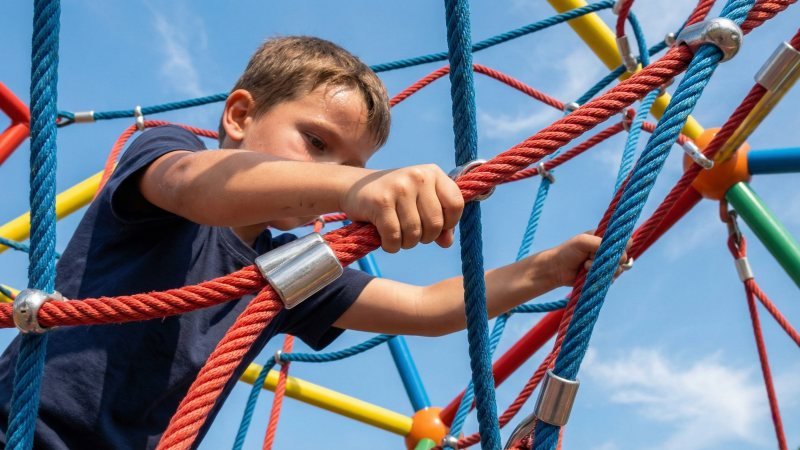
Your equipment isn’t just static hardware; it’s the infrastructure for structured development. Playground equipment serves as the foundation for activities that enhance gross motor skills, proprioception, and spatial awareness. By transforming passive apparatus use into goal-oriented challenges such as relay races, endurance tests, and obstacle courses, children engage in effective high-intensity interval play while significantly improving grip strength, balance, and coordination.
Slide Races and Relay Challenges
We usually view slides as one-way exits, but they function excellently as the critical “return loop” in a relay race circuit. In a standard relay, two teams line up at the bottom of the playground structure. The objective requires the first player to sprint up the access stairs, cross the platform, and slide down to tag the next teammate.
This continuous loop keeps the activity flowing and prevents children from standing still. Safety is paramount here; ensure children maintain proper spacing to avoid collisions at the bottom of the slide.
Variation: The Ball Run
Instead of just sliding themselves, children must roll a ball down the slide to a partner waiting at the bottom. The partner must catch the ball before it hits the ground. This drill improves hand-eye coordination, forcing the receiver to anticipate the object’s trajectory based on the slide’s angle and speed. Note that friction plays a role here; plastic slides generate static electricity, while Metal slides can become faster.
Swing Set Competitions
Swings provide a controlled environment for understanding momentum and pendulum motion. While swinging for height is the default, structured competitions add a layer of measurable skill without compromising safety.
The Shoe Kick Challenge
This is a classic physics-based game. Children pump their swings to a moderate height. At the peak of the forward arc, they must kick a loosened shoe off their foot. The winner is the child whose shoe travels the farthest distance. This activity requires precise timing; releasing the shoe too early (during the ascent) or too late (during the descent) drastically reduces distance.
Synchronized Swinging
For a cooperative challenge, two children on adjacent swings attempt to match their rhythm perfectly. They must reach the apex of their swing at the exact same moment. This requires the faster swinger to adjust their center of gravity or drag their feet slightly to slow down, fostering non-verbal communication and rhythm.
Obstacle Courses on Climbing Frames
Modern composite play structures allow for complex routing. Creating an obstacle course transforms a static structure into a sequential logic puzzle. The golden rule here is simple: The Floor is Lava. Players must navigate from one end of the structure to the other without touching the woodchips or rubber surfacing.
You can define specific routes based on skill level. Refer to the table below for route planning:
| Difficulty Level | Route Components | Target Skill |
|---|---|---|
| Novice | Stairs > Bridge > Slide | Basic Balance & Mobility |
| Intermediate | Ladder > Tunnel > Fireman’s Pole | Core Strength & Bravery |
| Advanced | Rock Wall > Monkey Bars > Spiral Slider | Upper Body Strength & Grip |
Designating a “Start” and “Finish” gate is crucial. This structure turns random climbing into a timed event. Consequently, children learn to optimize their movements for efficiency rather than just speed.
Monkey Bar Endurance Challenges
Think of the overhead ladder, or monkey bars, as a static load test. It provides the ultimate test of upper-body isometric strength where the body is the load moving across the structure.
The Dead Hang Timer
This is the simplest form of competition. Children hang from a single bar with both hands. The last person to drop wins. This builds immense grip strength and shoulder stability. Note that bar diameter affects difficulty; thicker bars are naturally harder for small hands to grip fully.
The Rung Skipper
Advanced climbers can attempt to skip every other rung. This requires generating significant momentum, similar to a pendulum swing. The child must swing their body forward to generate enough force to bridge the wider gap. This dynamic movement engages the back muscles more intensely than standard crossing.
Balance Beam Walk-Offs
Balance beams on playgrounds are often low to the ground, minimizing risk while maximizing vestibular system engagement. Call it the “Walk-Off”—a duel of stability.
Two players start at opposite ends of the beam. They walk toward the center until they meet. Once face-to-face, they must navigate past each other without stepping off. This requires distinct strategies:
- The Hug: Players hold onto each other for mutual support to rotate around.
- The Duck: One player crouches low while the other steps over them.
The surface texture of the beam impacts success rates. A rubberized surface offers high traction, whereas painted metal becomes slippery when humid. Always check the beam surface condition before allowing high-stakes balance games to ensure it isn’t slick from morning dew.
Building Coordination Through Ball Games
Ball games are where the real physics lessons happen. They cultivate essential motor skills such as hand-eye coordination, trajectory prediction, and proprioception through dynamic object tracking. Furthermore, these activities enforce social frameworks by requiring clear communication, strategic role delegation, and strict adherence to shared rule sets, effectively simulating the collaborative environment found in organized team sports.
Four Square
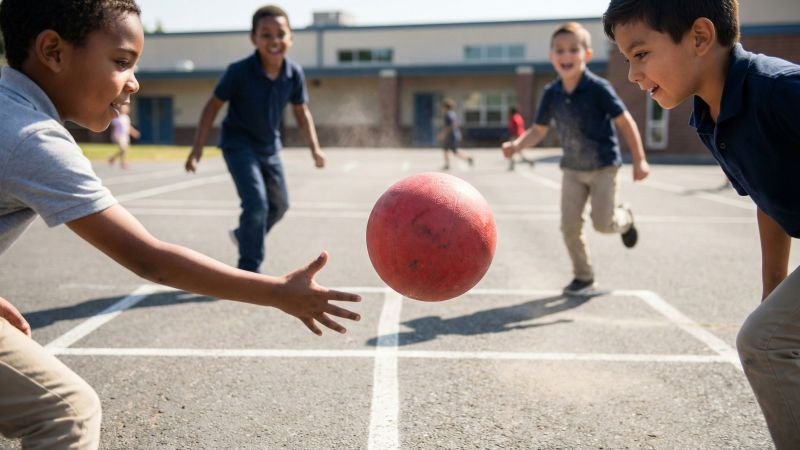
Four Square is a game of territory defense and hierarchy. It requires a hard surface marked with a large square divided into four smaller quadrants. These quadrants are numbered 1 through 4, or labeled Ace, King, Queen, and Jack. The objective is to advance to the highest square (Square 4 or King) and hold that position.
It operates exactly like a corporate promotion ladder. Players enter at the lowest level (Square 1). If a player in a higher square makes an error, they are eliminated and move to the back of the line. Consequently, everyone else shifts up one spot to fill the vacancy.
Core Rules:
- The Service: The player in Square 4 serves the ball by bouncing it into another square.
- The Return: A player must allow the ball to bounce once in their square before hitting it into another player’s square.
- The Fault: Hitting the ball out of bounds or holding the ball counts as a fault.
Note: Use a standard playground ball inflated to a moderate pressure. A ball that is too hard can sting hands, while a soft ball won’t bounce consistently.
Kickball Basics
Kickball mirrors the mechanics of baseball but uses a larger target and a different propulsion method. Why is it a staple? Because kicking a rolling ball is easier than hitting a pitched baseball. The game requires a diamond layout with four bases: First, Second, Third, and Home Plate.
Two teams alternate between offense (kicking) and defense (fielding). The pitcher rolls a rubber playground ball toward the kicker at Home Plate. The kicker must strike the ball with their foot and run toward First Base.
Key Defensive Positions:
| Position | Primary Responsibility | Zone Coverage |
|---|---|---|
| Pitcher | Controls the speed and curve of the rolling ball. | Center Diamond |
| Infielder | Reacts quickly to ground balls for short throws. | Base Paths |
| Outfielder | Tracks high-flying kicks for catch-outs. | Deep Field |
Defenders record an “out” by catching a fly ball, tagging a runner, or throwing the ball to a base before the runner arrives. This structure teaches spatial awareness, as players must calculate the speed of the runner versus the speed of the ball.
Wall Ball
Wall Ball transforms a vertical structure into an active opponent. This is pure reflection physics in action. The angle at which the ball hits the wall (angle of incidence) generally equals the angle at which it returns. Players must intuitively understand this geometry to succeed.
The game begins when a player throws the ball against a wall. Another player must catch or hit the ball before it bounces twice on the ground. If a player drops the ball or fails to reach it, they must sprint to the wall and touch it before another player throws the ball against the wall. This high-stakes mechanic improves reaction time significantly.
Caution: Ensure the wall surface is smooth concrete or brick without protrusions. Irregular surfaces cause unpredictable deflections that can lead to injury.
Dodgeball Variations
Dodgeball focuses on agility and target tracking. The traditional version involves two teams trying to eliminate opponents by hitting them with soft foam balls. However, confined playground spaces often utilize a variation called Gaga Ball.
Gaga Ball takes place in an octagonal pit (the “Gaga Pit”). Players strike the ball with their hands rather than throwing it. The goal is to hit opponents below the knees. This lowers the center of gravity for all players. It forces them to crouch and move laterally, engaging the quadriceps and core muscles.
Here’s the difference: Unlike standard dodgeball, Gaga Ball is a free-for-all where every player fights for themselves. There are no teams. This forces every player to have 360-degree awareness, defending their legs while simultaneously looking for openings to strike.
Spud
Spud combines listening skills with explosive sprinting. It does not require teams. Every player is assigned a specific number. The “It” player stands in the center and throws the ball straight up while shouting a number.
Everyone runs away immediately, except for the player whose number was called. That player must catch the ball and yell “Spud!” At this command, everyone else must freeze instantly. The player with the ball then attempts to hit a frozen player.
The Scoring System:
- If the thrower hits a player, that player receives a letter (S).
- If the thrower misses, the thrower receives a letter.
- Once a player spells S-P-U-D, they are out of the game.
Essentially, this is a lesson in risk assessment. The thrower must judge if they can make the shot or if they should take a “riskier” long throw. The frozen players must control their impulse to flinch or move, developing self-regulation.
The Importance of Creative and Sensory Play
We often focus on cardio, but what about the sensory input? Creative and sensory play ideas utilize textures, colors, and collaborative problem-solving to stimulate neural pathways associated with fine motor control and tactile processing. By engaging with materials like sand, chalk, and natural elements, children enhance their sensory integration skills while developing the ability to visualize and execute complex concepts in a physical space.
Sandbox Treasure Hunts
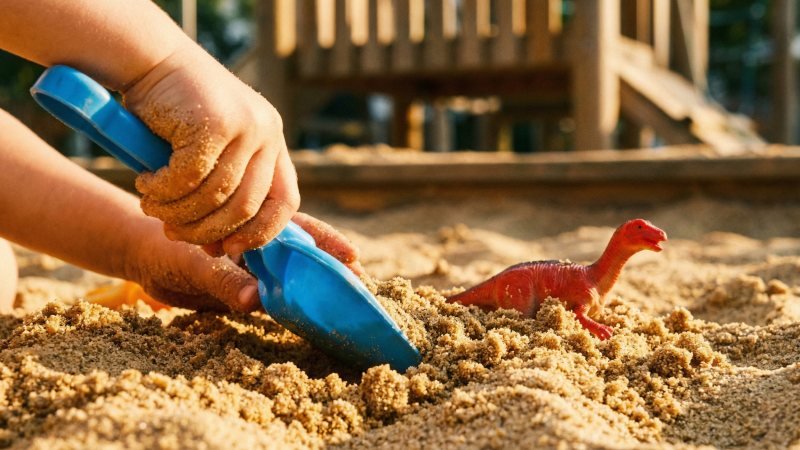
Treat the sandbox like a contained excavation site. It provides an ideal environment for tactile feedback. Children must sift through granular material to locate hidden objects, mimicking an archaeological dig where care and patience are required to uncover the prize.
Setup and Execution:
Parents or supervisors hide small, durable toys (plastic dinosaurs, large coins, or sealed containers) beneath the sand’s surface. Children then use tools like hand rakes, sieves, and brushes to uncover them.
- Tactile desensitization: This activity helps children who are sensitive to textures get used to the gritty feel of sand.
- Object permanence: Younger children learn that objects still exist even when they are not visible.
Note: Always ensure the facility uses “washed play sand.” This specific type of sand is cleaned to remove silica dust and harmful debris, ensuring it is safe for handling.
Sidewalk Chalk Art and Hopscotch
Sidewalk chalk transforms asphalt or concrete into a canvas for blueprints. This activity combines artistic expression with gross motor planning.
Chalk Art:
Children draw boundaries, targets, or imaginary worlds. This requires significant wrist stability and grip strength. It is basically drafting a floor plan on pavement; they must visualize the scale of their drawing to fit the available pavement slab.
Hopscotch Mechanics:
Hopscotch is a structured movement grid.
- Draw a grid of 10 numbered squares.
- The player tosses a marker (stone or beanbag) into a square.
- They must hop through the course on one foot, skipping the square with the marker.
This game acts as a calibration test for balance. The player must land precisely within the lines. Touching a line is a “fault,” requiring them to restart or lose their turn.
Nature Scavenger Hunts
A scavenger hunt changes the playground from a place of exertion to a place of observation. It requires visual discrimination. Children must scan a complex background to identify specific items, slowing down their pace to focus on details they usually ignore while running.
Create a checklist based on the local environment.
| Category | Target Items | Skill Developed |
|---|---|---|
| Textures | Rough bark, smooth stone, prickly leaf | Tactile distinction |
| Colors | Brown twig, green clover, yellow dandelion | Color matching |
| Shapes | Round pebble, oval leaf, straight stick | Geometry recognition |
This activity encourages interaction with the natural elements surrounding the playground equipment, fostering an appreciation for the environment.
Parachute Games
Parachute play creates a visual representation of aerodynamics. A large, circular nylon sheet with handles allows a group to manipulate air pressure. But watch out—if one person is out of sync, the whole system fails.
The Mushroom:
Everyone holds a handle and lifts the parachute waist-high. On the count of three, they lift it high overhead (creating a vacuum) and then pull it down to the ground. This traps a bubble of air inside, forming a massive mushroom shape.
Popcorn:
Place light plastic balls in the center. The group shakes the parachute to pop the balls into the air. The goal is to keep them moving like popcorn in a machine without letting them fly off the edge. This requires constant, coordinated movement from the entire group.
Note: Parachutes typically range from 6 feet to 12 feet in diameter. Choose a size that matches the number of participants to ensure everyone has a handle.
Shadow Tracing
Shadow tracing utilizes natural light to teach perspective and temporal change. It requires a sunny day and a flat surface.
Static Tracing:
One child poses like a statue. Another child uses chalk to trace their shadow outline on the ground. The subject must remain perfectly still, testing their core stability and patience.
Time-Lapse Observation:
Have the child stand in the exact same spot 30 minutes later. Trace the new shadow with a different color. The shadow will have moved and changed length. You’re effectively building a primitive sundial, visually recording the passage of time.
Matching Activities to Developmental Stages
You wouldn’t give a power tool to an apprentice; the same logic applies here. Selecting playground activities based on age requires matching physical challenges with cognitive developmental milestones. Toddlers require stable, low-risk environments to master basic equilibrium, while preschoolers benefit from open-ended structures that facilitate imaginative role-playing. Conversely, school-aged children need rule-based competitive games that test endurance and strategic thinking, aligning with their advanced motor skills and social processing abilities.

Simple Motor Skills Games for Toddlers
Toddlers (ages 1 to 3) operate in a phase of rapid physical acquisition. Their primary goal is stabilizing their center of gravity. Playground activities for this group must focus on “gross motor foundations.” Think of this as laying the concrete foundation before erecting the steel; without a stable base, complex movement is impossible.
Activities should emphasize repetition and cause-and-effect. Simple games involve rolling a large rubber ball back and forth on a flat surface. This teaches tracking and anticipation without requiring complex hand dexterity.
Surface Navigation
Just walking across different playground surfaces is a game for toddlers. Transitioning from a hard rubber surface to wood fiber (mulch) forces the toddler to micro-adjust their ankle muscles. This acts like a calibration test for their balance system.
Industry Standard Note: Ensure toddlers play on equipment specifically rated for the 6-23 month age group. These structures feature lower platforms and specialized barriers to ensure safety.
Imaginative Play for Preschoolers
Preschoolers (ages 3 to 5) shift from purely physical movement to cognitive “prototyping.” They begin to overlay narratives onto physical objects. A simple platform becomes a stage, and a steering wheel becomes a spaceship. At this stage, think of the equipment as the hardware and the kids as the software.
The “Theme” Game
Encourage activities where the equipment dictates a role. If the structure has a window, it becomes a drive-through restaurant. This type of play is “Associative Play,” where children interact with each other loosely around a common activity.
Loose Parts Integration
If the playground permits, introduce safe, movable objects like pinecones or twigs. Preschoolers use these as props—money, food, or tools—to fuel their scenarios. This builds abstract thinking skills. They learn that one object can represent another, a critical step in cognitive processing.
Competitive Challenges for School-Aged Children
School-aged children (ages 6 to 12) have developed the physical strength and mental capacity for “Cooperative Play” and organized competition. They understand rules, hierarchy, and strategy. Now we’re moving into project management territory: they have a goal, constraints, and a timeline.
Time Trials
Use the playground route as a racetrack. One child uses a stopwatch (or counts) while another navigates a specific sequence of equipment. This introduces stress testing to their physical performance. They must decide whether to move fast and risk slipping or move slow and lose time.
Complex Rule Sets
This age group thrives on restriction. Games like “Don’t touch the ground” or “Only use blue bars” force them to problem-solve. They must analyze the structure’s layout and calculate a path that fits the constraints.
| Age Group | Primary Developmental Goal | Activity Focus | Recommended Play Style |
|---|---|---|---|
| Toddlers (1-3) | Balance & Stability | Surface walking, low climbing | Parallel Play (Side-by-side) |
| Preschool (3-5) | Socialization & Imagination | Role-playing, themed scenarios | Associative Play (Sharing materials) |
| School Age (6-12) | Agility & Strategy | Obstacle courses, relay races | Cooperative Play (Team goals) |
Protocols for Safe Outdoor Play
Real supervision isn’t just watching; it’s a three-pronged protocol: pre-play equipment inspection, enforcement of spatial boundaries, and continuous monitoring of physiological stress. Guardians must verify structural integrity and surface temperature before use, establish clear “traffic rules” to prevent collisions, and actively intervene when children display signs of thermal distress or exhaustion. 5 key safety standards are essential knowledge for any playground supervisor.
Checking Equipment Temperature and Stability
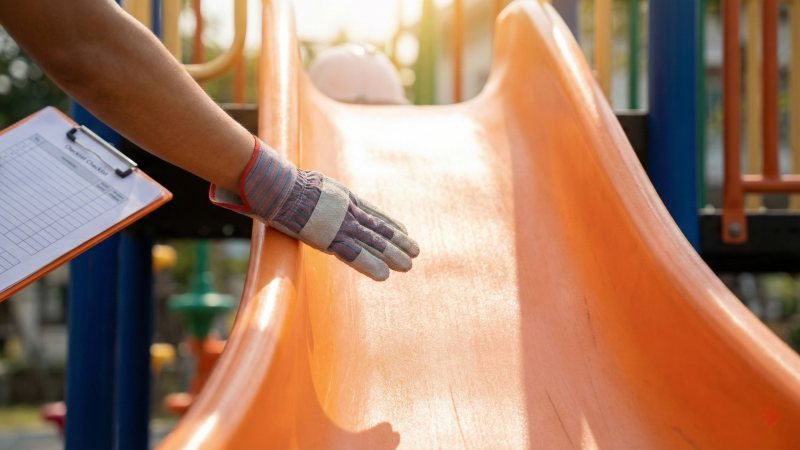
Would you run a machine without checking the bolts? Of course not. Before allowing children to play, an adult must perform a pre-flight inspection. If the hardware is compromised, the play session is unsafe.
Thermal Inspection
Playground equipment absorbs solar radiation. Metal slides and dark plastic surfaces can reach dangerous temperatures quickly.
- Touch Test: Place the back of your hand on the surface for five seconds. If it is too hot for your hand, it is too hot for a child’s skin.
- Material Awareness: Be aware that metal conducts heat rapidly, causing immediate burns, while plastic retains heat longer. Always check slides and seats on sunny days.
Structural Integrity
Inspect load-bearing points briefly. Look for loose “S-hooks” on swings or missing bolts on climbing frames. If a fastener looks loose or a chain looks worn, restrict access to that specific piece of equipment to prevent accidents.
Establishing Clear Boundaries and Rules
Playgrounds require strict zoning to prevent accidents. Just like marking forklift lanes in a warehouse, you need zones to separate fast traffic from pedestrians. Without clear lanes, collisions occur.
Defining the Perimeter
Establish a visual boundary that children cannot cross. Use a fence line, a sidewalk edge, or a tree line. This containment ensures that supervisors can view all children at once.
Zoning Rules
Different pieces of equipment require different behavioral protocols. Refer to the table below for standard zoning rules:
| Zone | Primary Rule | Safety Rationale |
|---|---|---|
| Swing Zone | Do not walk in front or behind moving swings. | Prevents high-impact collisions. |
| Slide Zone | Go down feet first; one person at a time. | Prevents head injuries and pile-ups. |
| Climbing Zone | Three points of contact at all times. | Reduces the risk of falling from height. |
Enforce these rules consistently. If a child violates a safety protocol, stop the activity immediately. This reinforces that safety is non-negotiable.
Recognizing Signs of Overheating or Fatigue
Children often ignore their body’s warning signals during high-intensity play. They operate like an engine running at maximum RPM with no cooling system. If they exceed their limits, they risk heat exhaustion.
Visual Indicators
Supervisors must monitor for specific physiological changes.
- The “Red Face” Warning: Flushed skin indicates the body is trying to cool down.
- Cessation of Sweating: If a child stops sweating while active, this is a critical danger sign. It suggests the thermoregulatory system is failing.
Mandatory Cool-Downs
Implement forced hydration breaks every 15 to 20 minutes. Do not wait for the child to ask for water. Fatigue also reduces coordination. A tired child is more likely to misjudge a step or lose their grip. Therefore, remove a fatigued child from climbing activities immediately to prevent falls.
Conclusion
Creating a comprehensive plan for outdoor playground activities ensures that children receive the physical exercise and cognitive stimulation they need. From classic tag variations to complex obstacle courses, each activity provides a unique opportunity for growth. By selecting age-appropriate games and maintaining rigorous safety inspections, you can transform any playground into a safe, developmental hub.