-
Whatsapp: +86 15516933785
-
Email: hanlin@hanlinplayground.com
-
Address: Shangjie District, Zhengzhou City, Henan Province, China
-
Whatsapp: +86 15516933785
-
Email: hanlin@hanlinplayground.com
-
Address: Shangjie District, Zhengzhou City, Henan Province, China

Choosing the Best Outdoor Playground Equipment for Toddlers: A Guide to Safety, Durability, and Child Development
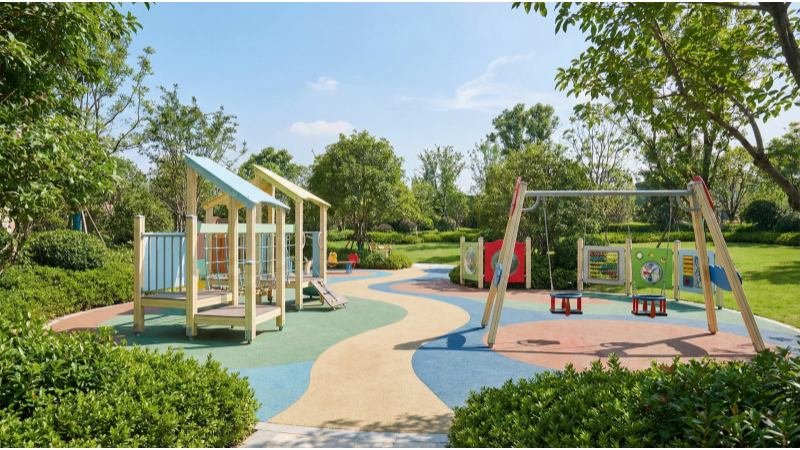
Selecting the optimal equipment requires a strict adherence to safety standards such as ASTM F2373, a focus on age-specific developmental needs like gross motor support and sensory integration, and the use of commercial-grade materials like HDPE and powder-coated steel. A successful installation balances rigorous safety protocols—including critical fall heights and entrapment prevention—with an engaging layout that promotes early social interaction and physical coordination.
The Critical Role of Outdoor Play in Early Childhood Development
Outdoor playground equipment serves as a fundamental infrastructure for toddler development, specifically between the ages of 6 and 23 months. It provides more than just recreation; it offers a calibrated environment for physical exertion, sensory integration, and social practice.
Engaging with these structures directly accelerates the acquisition of gross motor skills, supports vestibular system maturation, and aids the natural transition from solitary observation to parallel play patterns in young children.
Enhancing Gross Motor Skills and Physical Coordination
At the toddler stage, children are essentially testing the structural integrity and capabilities of their own bodies. Playground equipment functions as the primary testing ground for these physical milestones. When a toddler interacts with a structure, they engage large muscle groups in the legs, arms, and torso, which is vital for building core strength.
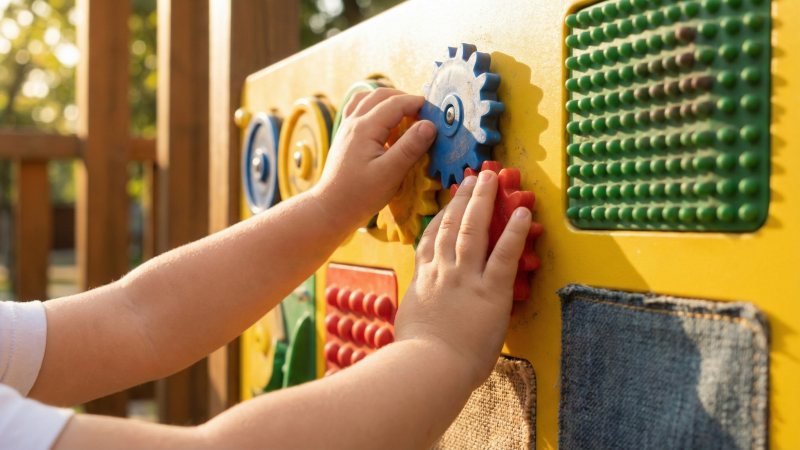
Consider a low-profile climbing ramp. To a toddler, this is a stability challenge that requires the synchronization of different muscle groups, much like how a mechanical transmission requires synchronized gears to function effectively. If one gear slips, the movement halts. Similarly, if a toddler’s balance fails, they learn to adjust their center of gravity to regain traction.
Furthermore, these physical challenges improve coordination. Grip strength is developed when grasping safety handles or rails. This provides a controlled setting for physical “stress tests,” allowing toddlers to push their limits safely. Consequently, they gain confidence in their movements, translating mechanical effort into motor proficiency.
- Balance: Navigating uneven or sloped surfaces.
- Strength: Pulling up onto platforms or holding rails.
- Coordination: Synchronizing hand and foot movements to climb.
Stimulating Sensory Processing with Textures and Colors
Toddlers process the world largely through sensory input rather than abstract thought. Playground equipment is engineered to act as a sensory input device, feeding information to the brain through touch, sight, and movement.
First, consider tactile stimulation. Equipment often features varied materials. A toddler might touch smooth powder-coated steel rails and then transition to a textured High-Density Polyethylene (HDPE) panel. This difference in surface finish is significant. It functions like a quality control sensor detecting surface irregularities. The toddler is calibrating their sense of touch to distinguish between material properties.
Second, the vestibular system is engaged through movement. This system controls balance and spatial orientation. Gentle sliding or swinging motions stimulate the fluid in the inner ear, helping the toddler understand their body’s position in space.
Finally, visual processing is stimulated by high-contrast colors. Manufacturers use primary colors not merely for aesthetics, but to help toddlers distinguish between different functional zones of the play structure, aiding in depth perception.
| Sensory Input | Equipment Element | Developmental Benefit |
|---|---|---|
| Tactile (Touch) | Textured plastic panels vs. smooth metal rails | Helps the brain distinguish between different material properties. |
| Visual (Sight) | High-contrast colors (Red/Blue/Yellow) | Aids in depth perception and identifying boundaries. |
| Vestibular (Balance) | Gentle slides or low-level bridges | Calibrates the inner ear for balance and spatial awareness. |
| Proprioceptive (Body Position) | Climbers or steps | Teaches the brain how much force is needed to move limbs. |
Fostering Early Social Interaction and Cooperative Play
Toddlers typically do not play with each other immediately; they engage in “parallel play.” This means they play adjacent to one another without direct collaboration. Outdoor equipment provides the necessary spatial infrastructure to support this proximity safely.
A play structure acts as a central hub, drawing multiple children to a single location. For example, a wide platform allows two toddlers to stand near each other. They share the same space but focus on their own activities. This proximity is the first step toward social interaction. They observe each other and learn by watching how another child navigates a step or uses a slide.
Moreover, equipment designs often encourage turn-taking through mechanical constraints. A slide creates a natural queue system: one child goes down, and the next follows. This creates a basic, linear flow of interaction, introducing the concept of shared resources.
Eventually, this proximity leads to cooperative play. A toddler might hand a woodchip to another child through a playhouse window. These small interactions are the building blocks of social skills. The equipment removes barriers and creates a shared context for these critical early encounters.
Essential Safety Standards for Toddler-Specific Zones
What are the mandatory safety protocols and compliance standards required for outdoor playground equipment designed for children aged 6 to 23 months?
To ensure the safety of this specific age group, equipment must adhere to strict guidelines such as ASTM F2373 for public use or ASTM F963 for residential structures. These standards mandate that critical fall heights do not exceed the shock-absorbing capacity of the surfacing, openings must prevent head entrapment, and all elevated platforms must feature continuous barriers rather than simple guardrails.

Understanding Age-Appropriate Fall Heights and Critical Fall Height
The concept of Critical Fall Height (CFH) is the most vital metric in playground safety engineering. CFH is not merely the height of the equipment; it is a rating of the surface underneath it. Specifically, it is the maximum height from which a child can fall onto the surface without sustaining a life-threatening head injury.
For toddlers aged 6 to 23 months, their center of gravity is higher than that of older children because their heads are proportionally larger. Consequently, they are more prone to falling head-first. Therefore, the industry standard mandates that the fall height for equipment in this category should be significantly lower than equipment for school-age children.
Under ASTM F2373, play components for this age group are often restricted to very low vertical dimensions. For instance, a slide for a toddler should not have a chute entrance higher than 32 inches.
Think of CFH like the Working Load Limit (WLL) on industrial rigging hardware. You would never lift a 2-ton weight with a strap rated for 1 ton. Similarly, you must never install a climber with a 4-foot fall height over surfacing that is only rated for a 3-foot fall. The rating of the “safety net” (the ground) must always exceed the height of the “hazard” (the equipment).
Industry Note: Please verify specific CFH ratings with your surfacing supplier, as the shock-absorbing performance of materials like poured rubber or engineered wood fiber can vary based on installation depth and sub-base composition.
The Importance of Rounded Edges and Pinch-Point Prevention
Toddlers explore equipment with their hands and often lack the motor skills to withdraw quickly from closing gaps. Therefore, manufacturing standards require meticulous finishing of all hardware components.
Pinch points occur where two moving parts come together, or where a moving part meets a stationary one. If a gap allows a 0.19-inch finger probe to enter but does not allow it to pass through freely, it is a crush hazard. Manufacturers use specific test probes, which act like “go/no-go” gauges used in precision manufacturing, to verify these gaps are safe.
Furthermore, all corners and edges must be rounded. Sharp edges on steel or plastic can cause lacerations. For metal components, this usually involves a specific radius on the edge, ensuring it is smooth to the touch.
- Crush and Shear Points: Mechanisms like suspension bridges or gates must have buffers or spacing that prevents fingers from being caught.
- Protrusion Hazards: Bolts should not extend beyond the nut by more than two threads. This prevents clothing entanglements, which are a major strangulation risk.
- Smooth Finishing: Welds on steel equipment must be ground smooth before powder coating to eliminate burrs.
Selecting Impact-Absorbing Safety Surfacing Materials
The ground surface is the primary safety mechanism in any playground. For the 6-23 month age group, the surface must be firm enough to support early walkers but soft enough to attenuate impact.
Hard surfaces like concrete, asphalt, or packed earth are non-compliant and dangerous. You must choose between Unitary Surfacing and Loose-Fill Surfacing.
Unitary Surfacing includes rubber tiles or Poured-in-Place (PIP) rubber. These are excellent for toddlers because they provide a stable footing for children learning to walk. A loose material can be difficult for a toddler to navigate, similar to how a forklift struggles to gain traction on loose gravel compared to a smooth warehouse floor.
Loose-Fill Surfacing includes Engineered Wood Fiber (EWF) or rubber mulch. While EWF is cost-effective, it requires regular maintenance to ensure the depth remains sufficient to meet CFH requirements.
| Surfacing Type | Stability for Walkers | Maintenance Need | Impact Absorption |
|---|---|---|---|
| Poured-in-Place Rubber | High (Best for Toddlers) | Low | High (Customizable thickness) |
| Rubber Tiles | High | Medium (Seams can separate) | High |
| Engineered Wood Fiber | Low to Medium | High (Requires topping off) | High (If depth is maintained) |
| Sand/Pea Gravel | Very Low (Not recommended) | High | Variable |
Guardrails and Barriers for Elevated Platforms
For older children (ages 5-12), a simple rail is often sufficient to prevent falls. However, for toddlers (6-23 months), the standards are far more rigorous.
In this specific age category, Protective Barriers are required rather than simple guardrails. A barrier is an enclosure that prevents passage beneath or through the protective element. It essentially walls off the elevated platform.
This distinction is crucial. A guardrail might have a horizontal top rail and a lower rail, leaving a gap. A barrier, conversely, is filled in with vertical slats or a solid panel. This design prevents a toddler, who may not have the cognitive ability to recognize the edge, from rolling or crawling off the platform.
The vertical slats on these barriers must be spaced closer than 3.5 inches. This spacing prevents “head entrapment.” If a child can slide their feet and body through a gap, but their head gets stuck, it poses a life-threatening strangulation risk.
- Barriers: Required for platforms over 18 inches high for this age group.
- Guardrails: Generally not sufficient for the 6-23 month demographic on high platforms.
- Climb-Deterrent Design: Barriers should not have horizontal rungs that would allow a toddler to climb up and over the protective wall.
Comparing Material Options for Longevity and Maintenance
Which material composition provides the superior balance of structural longevity and minimal maintenance for outdoor toddler playgrounds?
For optimal durability and reduced upkeep, commercial-grade equipment typically utilizes a hybrid construction of powder-coated steel for structural posts and High-Density Polyethylene (HDPE) for contact surfaces. This combination resists corrosion and UV degradation significantly better than untreated timber, offering a lifespan often exceeding 15 years with minimal maintenance compared to wood’s requirement for annual sealing.
High-Density Polyethylene Plastic for Weather Resistance
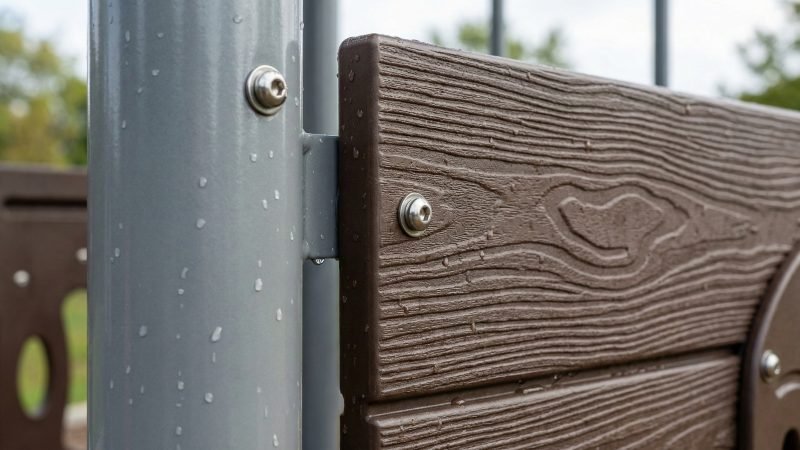
High-Density Polyethylene (HDPE) is the industry standard for panels, slides, and crawl tubes. Unlike cheap, brittle plastics found in indoor toys, HDPE is an industrial-grade thermoplastic. It possesses an extremely high strength-to-density ratio.
Think of HDPE like a solid block of nylon used in a machine shop. The color is not just a surface layer like paint; it is integral throughout the entire thickness of the material. If a toddler scratches the panel with a toy, the scratch remains the same color as the surface. This characteristic eliminates the need for repainting.
Furthermore, professional-grade HDPE includes UV inhibitors (stabilizers) blended into the resin during manufacturing. Without these inhibitors, plastic becomes brittle and fades in the sun, much like untreated PVC piping left exposed to the elements. With them, the material resists cracking and chalking for years.
The material is also impervious to water. It does not absorb moisture, which prevents the growth of mold or mildew. This makes cleaning simple. A pressure washer or a mild detergent is usually all that is required.
Powder-Coated Steel for Structural Integrity
While plastic is excellent for panels, steel provides the necessary skeletal framework. The upright posts and support beams are typically made from galvanized steel tubing. However, raw steel rusts. To prevent this, manufacturers use a process called powder coating.
Powder coating is far superior to standard wet paint. In this process, a dry powder is applied electrostatically to the steel. The steel is then cured in an oven, causing the powder to melt and form a “skin.”
Consider the difference between spray-painting a metal bracket in a garage versus the factory finish on a high-end tool cabinet. The spray paint might chip easily. The tool cabinet finish is hard, bonded, and resistant to impact. That is the effect of powder coating. It creates a barrier against moisture and oxygen.
For outdoor environments, especially near coasts, the steel should also be galvanized (coated in zinc) before powder coating. This provides a double layer of protection against rust.
- 11-Gauge to 13-Gauge Steel: Common thicknesses for commercial posts.
- Electrostatic Bond: Ensures the coating wraps around corners and welds evenly.
- Salt Spray Testing: Look for compliance with ASTM B117 standards.
Rot-Resistant Wood Options and Treatment Requirements
Wood offers a natural aesthetic that blends well with landscapes. However, it requires a strict maintenance schedule. Not all wood is suitable for ground contact.
Cedar and Redwood are naturally resistant to rot and insect damage due to the natural oils in their heartwood. However, they are softwoods. They can dent easily compared to steel or plastic.
Alternatively, Pressure-Treated (PT) lumber is infused with preservatives. While durable, chemicals used in older processes (like CCA) are now restricted. Modern alternatives like ACQ (Alkaline Copper Quaternary) are safer but can corrode standard metal fasteners.
A critical phenomenon in wood is “checking.” As wood dries, it shrinks, causing cracks to open along the grain. This is structurally normal, similar to how concrete develops hairline fractures as it cures. However, for a toddler area, these cracks can trap moisture or create splinters.
To maintain wood, you must apply a water-repellent sealer or stain annually. Without this, the wood will turn gray and eventually decay. For those preferring natural aesthetics, high-quality Rot-Resistant Wood Options must be selected carefully.
| Feature | Cedar/Redwood | Pressure-Treated Pine | Powder-Coated Steel |
|---|---|---|---|
| Rot Resistance | High (Natural) | High (Chemical) | N/A (Rust risk if scratched) |
| Maintenance | High (Annual sealing) | High (Annual sealing) | Low (Wash only) |
| Structural Strength | Medium | High | Very High |
| Splinter Risk | Yes (Requires sanding) | Yes | None |
Eco-Friendly and Recycled Material Considerations
Sustainability is a growing priority in playground design. Recycled Structural Plastic (RSP) is a popular alternative to wood and virgin steel. RSP is often made from post-consumer waste, such as recycled milk jugs (HDPE) and detergent bottles.
RSP mimics the look of wood but behaves like plastic. It does not rot, splinter, or require painting. It is solid and heavy, providing stability.
However, recycled plastic has different structural properties than steel. It has a lower modulus of elasticity, meaning it is more flexible. A long beam of recycled plastic might sag under heavy load if not reinforced with steel inserts. This is similar to using composite decking boards in construction; they often require tighter joist spacing than solid timber to prevent sagging.
When choosing eco-friendly options, ensure the hardware (bolts and screws) is still stainless steel. A recycled plastic post will last for decades, but if the steel bolts rust out in five years, the structure fails.
- Post-Consumer Content: The percentage of material coming from recycled waste (e.g., 95% recycled content).
- Reinforcement: Steel cores are often inserted into recycled plastic posts to prevent warping.
Top Equipment Categories Suited for Ages 6 to 23 Months
Selecting the right apparatus for this demographic requires a departure from standard playground configurations. Equipment must be engineered with specific geometric proportions to accommodate limited balance and fine motor control, ensuring safety without stifling exploration.
The primary equipment categories for this age group include low-profile climbers with graduated steps, ground-level sensory panels, fully enclosed bucket swings, short slides with deep sidewalls, and open-plan playhouses. These components are designed with restricted platform heights and specific stability features.
Low-Profile Climbers and Crawl Tubes
Climbers for this demographic differ significantly from the complex jungle gyms used by school-age children. They function more like a training platform than a challenge course. The design priority is stability over height.
These structures often feature wide, flat steps rather than rungs. A rung requires grip strength and foot arch balance, which toddlers lack. A flat step acts like a loading dock ramp; it provides a solid surface for the entire foot. This design allows toddlers to practice stepping up without the risk of slipping through gaps.
Crawl tubes are another essential component. They provide a safe, enclosed environment for exploration. Unlike open bridges, tubes eliminate the risk of falling off the side. Structurally, these tubes are often made of rotomolded plastic with reinforced ribs. This is similar to the corrugated design of a civil engineering drainage culvert, which increases strength without adding excessive weight.
- Step Depth: Steps must be deep enough (often 7 inches or more) to support a crawling child’s knee.
- Handholds: Integrated handles allow toddlers to pull themselves up, mimicking the grab bars on heavy machinery access points.
- Tunnel Diameter: Tunnels are sized to allow a caregiver to reach in if necessary.
Technical Note: Platform heights for this age group are strictly regulated. Always confirm that the max deck height aligns with ASTM F2373 standards, which typically caps platform heights at 32 inches for the 6-23 month range.
Ground-Level Sensory Walls and Activity Panels
Not all play requires climbing. Sensory walls are critical for inclusive play, allowing children of all physical abilities to engage. These panels are mounted at ground level, accessible to children who are standing, sitting, or using mobility aids.
These panels function like the control interface of a complex machine. They feature gears, chimes, or steering wheels. When a toddler turns a gear, they see a direct mechanical reaction. This teaches cause-and-effect relationships.
The mechanism behind these panels must be robust. A “gear panel” usually consists of HDPE gears mounted on stainless steel shafts. They must spin freely but cannot be removed. It is similar to a sealed bearing assembly; the internal parts move, but the casing prevents tampering.
| Panel Type | Mechanical Action | Cognitive Benefit |
|---|---|---|
| Gear Panel | Interlocking rotation | Teaches cause-and-effect and mechanical linkage. |
| Music/Chime Panel | Percussive impact | Explores auditory feedback and rhythm. |
| Maze/Track Panel | Linear tracking | Improves fine motor skills and hand-eye coordination. |
| Tactile Panel | Static texture variety | Stimulates touch receptors with varied surface finishes. |
Bucket Swings and Gliders with Back Support
Standard belt swings are unsafe for toddlers who lack sufficient core strength to remain upright. Therefore, “Full Bucket” seats are the industry requirement for this age category.
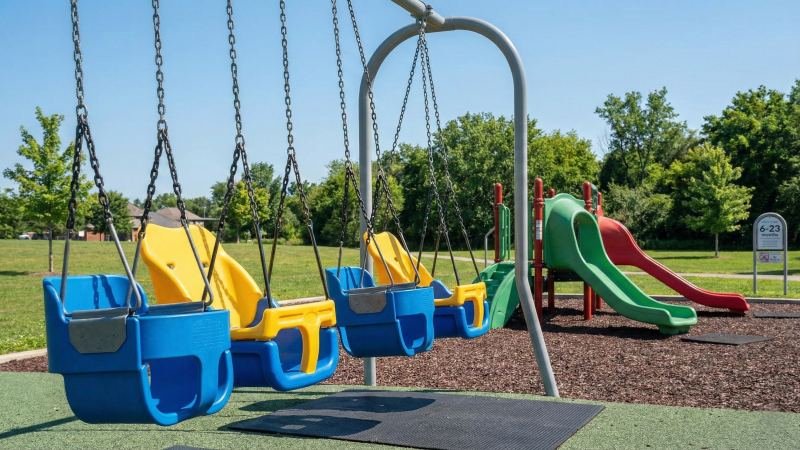
A full bucket swing provides 360-degree support. It features a high back and a solid front guard. This design acts like the safety cage on a forklift operator’s cab. It prevents the occupant from falling out, regardless of the motion.
Gliders are an alternative to swings. They allow for a multi-child rocking motion. For toddlers, these must have high-backed seats and footrests. The motion is controlled and linear, unlike the unpredictable arc of a standard swing.
The suspension chains for these seats are often coated in plastisol (a liquid PVC dip). This coating serves two purposes. First, it prevents small fingers from getting pinched in the chain links. Second, it insulates the metal, preventing burns on hot days.
Small Slides with Gentle Slopes and Deep Sides
Slides for the 6-23 month age group are distinct in their geometry. They are not simply smaller versions of big slides; they have different angles and containment features.
The slope of a toddler slide is gentle, typically averaging around 24 to 30 degrees. This prevents the child from gaining excessive speed. It functions like a gravity conveyor chute designed for fragile goods; the descent is controlled and predictable.
Crucially, these slides feature deep sidewalls. The sides of the slide chute extend vertically, often 4 inches or higher. This containment keeps the toddler centered. Without these deep sides, a child with poor balance could tip over the edge during descent.
The “run-out” section at the bottom is also vital. This is the flat part at the end of the slide. It must be long enough to slow the child to a stop before they exit onto the surfacing. It acts as a braking zone. To ensure longevity, many commercial operators opt for durable Stainless Steel Slides or rotomolded plastic options.
Themed Playhouses for Imaginative Role-Play
Playhouses provide a semi-enclosed space that fosters a sense of security. For public and commercial use, these structures follow an “open-plan” design.
Unlike a residential playhouse with a closing door, commercial toddler playhouses have open doorways and large window cutouts. This ensures clear sightlines for supervision. It is similar to the design of a supervisor’s office on a factory floor; walls define the space, but glass (or in this case, open gaps) ensures visibility is never blocked.
These structures often feature molded-in details like counters, benches, or faux fireplaces. These static elements encourage role-play. Because they are molded into the structure, there are no loose parts to lose or break. Many facilities choose Outdoor Theme Playgrounds to spark imagination while maintaining these safety features.
The roof provides shade but is often vaulted or vented. This prevents heat buildup inside the structure. The material is typically double-walled plastic, which adds rigidity and prevents the walls from warping under their own weight.
Designing a Functional and Inclusive Toddler Play Area
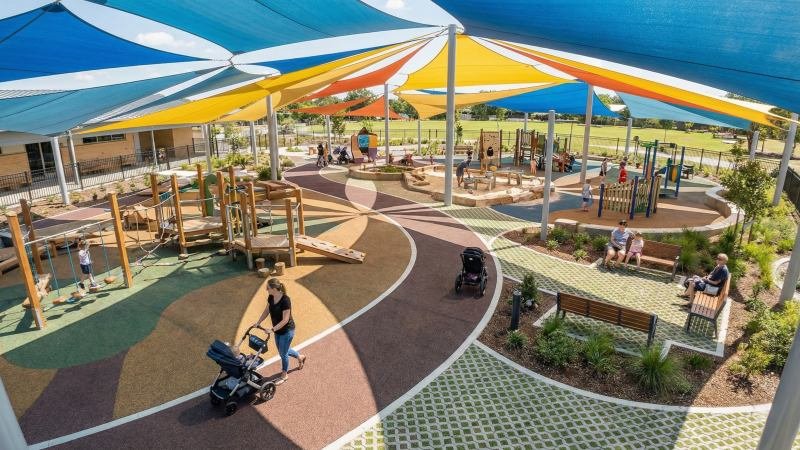
Effective site planning is the differentiator between a chaotic space and a safe developmental zone. A functional toddler playground layout requires unobstructed sightlines for continuous adult supervision, distinct separation between active motion zones and quiet sensory areas, and ADA-compliant pathways.
The design must integrate shade structures to manage thermal comfort and utilize wide, navigable surfacing to accommodate mobility devices, ensuring the space functions as a cohesive system rather than a collection of isolated equipment.
Creating Clear Sightlines for Supervision
The primary defense against playground injuries is active supervision. Therefore, the layout must eliminate all “blind spots.” A supervisor standing at the perimeter should have a complete view of every child. This is similar to the layout of a factory floor control room. The operator needs a direct line of sight to all critical machinery to intervene immediately if a fault occurs.
How should a site planner configure these elements? Designers achieve this by placing taller structures, like playhouses or slide towers, at the outer edges of the play area. Lower equipment, such as ground-level sensory panels or crawl tubes, should occupy the center. This “stadium seating” arrangement ensures that large objects do not block the view of smaller ones.
Furthermore, individual equipment components should feature “visual permeability.” This means walls should have windows, and tunnels should be short or have viewing holes. If a child is inside a structure, they must still be visible.
- Perimeter Placement: Locate bulkier items against the fenceline.
- Transparent Design: Choose panels with cutouts rather than solid walls.
- Angle of View: Ensure corners do not create hidden pockets.
Zoning Active Play Areas from Quiet Observation Spots
Toddler play involves different energy levels. “Active play” includes running, sliding, and swinging. “Passive play” involves sitting, touching sensory panels, or observing. Mixing these zones indiscriminately causes collisions. It creates a safety hazard, much like mixing forklift traffic with pedestrian walkways in a logistics center without marked lanes.
To prevent this, you must establish distinct zones. The “Active Zone” houses slides and climbers. It requires larger “use zones” (the clear space needed around equipment) to accommodate movement. The “Quiet Zone” houses sand tables, benches, or musical instruments.
Between these areas, you should implement “buffer zones.” These can be physical spaces or visual markers like colored surfacing patterns. This separation allows energetic children to run freely without knocking over a child who is sitting quietly.
| Zone Type | Typical Equipment | Traffic Pattern | Safety Priority |
|---|---|---|---|
| Active Zone | Slides, Climbers, Swings | High speed, erratic movement | Impact attenuation (soft ground) |
| Passive Zone | Sensory panels, Playhouses | Stationary, fine motor focus | Protection from runners |
| Buffer Zone | Pathways, Landscaping | Transition space | Traffic flow control |
Incorporating Shade Structures for Sun Protection
Toddlers have sensitive skin and regulate body temperature less efficiently than adults. Direct sunlight also heats equipment to dangerous levels. Plastic slides and coated steel decks can reach temperatures capable of causing contact burns.
Integrating shade is not an accessory; it is a functional requirement. You can achieve this through natural shade (trees) or artificial structures like cantilever shades or hip roofs.
Think of shade structures as a thermal management system for the playground equipment. Just as industrial machinery requires cooling to prevent overheating, a playground needs shade to maintain safe operational temperatures for both the users and the materials.
Ideally, shade should cover the “high-retention” areas. These are spots where children stay for extended periods, such as sandboxes or swing sets.
Ensuring Accessibility for Children with Mobility Aids
An inclusive playground allows children of all abilities to play side-by-side. For toddlers, this often involves accommodating walkers, gait trainers, or wheelchairs.
Compliance with the Americans with Disabilities Act (ADA) requires an “accessible route.” This is a continuous, unobstructed path connecting all play components. It must be at least 60 inches wide to allow two wheelchairs to pass.
The surfacing is the most critical factor here. Loose-fill materials like sand or pea gravel are barriers. They act like deep mud for a wheelchair. Unitary surfacing, like Poured-in-Place rubber, is firm and stable. It functions like a paved concrete ramp, allowing wheels to roll with minimal resistance.
Additionally, elevated structures must have a means of access. For toddlers, “transfer platforms” are used. These are low platforms with handles that allow a child to lift themselves out of a mobility device and onto the structure.
- Ramp Slope: Ramps must not exceed a 1:12 slope ratio (1 inch of rise for every 12 inches of run).
- Ground-Level Play: Ensure at least 50% of play components are accessible from the ground.
- Clear Width: Pathways must accommodate the turning radius of mobility devices.
Installation and Long-Term Maintenance Best Practices
The longevity and safety of a playground are determined during the initial groundwork. Proper installation requires precise site excavation for drainage and securing concrete footings below the local frost line to prevent ground heaving.
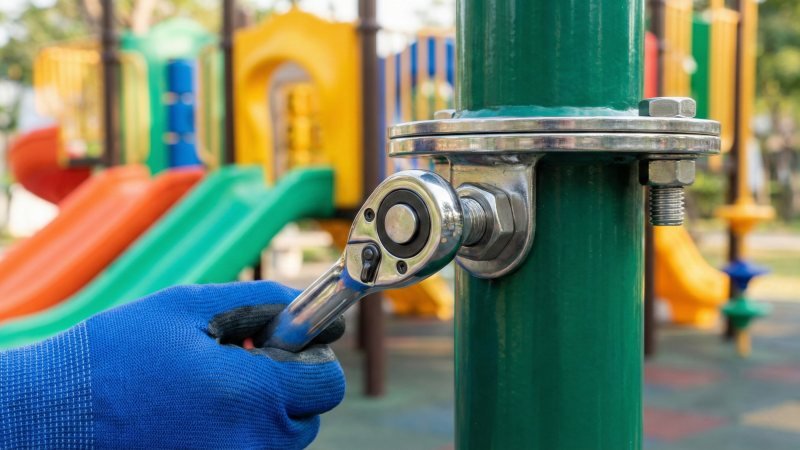
Long-term durability is contingent upon a strict “High-Frequency/Low-Frequency” inspection protocol that identifies loose hardware, surface wear, and structural fatigue before they evolve into critical safety failures.
Site Preparation and Drainage Requirements
A playground is only as stable as the ground beneath it. Before any equipment is assembled, the site must be prepared to handle water. Poor drainage is the leading cause of premature equipment failure. If water pools around the vertical posts, it accelerates corrosion in steel and rot in wood.
Think of the playground site like the foundation of a building. You would not pour a concrete slab on top of a swamp. Similarly, you cannot install equipment directly on top of soft, organic topsoil. The organic soil retains water like a sponge.
The standard process involves excavating the topsoil to a depth of several inches. This soil is replaced with a sub-base of compacted crushed stone. This stone layer acts like a civil engineering French drain. It allows water to flow away from the equipment and into the ground.
Furthermore, the sub-base should have a slight slope, typically 1% to 2%. This guides water away from the play area. If the site is naturally flat, you must engineer this slope during excavation to prevent “ponding.”
Note: Soil conditions vary rapidly by region. Sandy soil drains naturally, while clay soil traps water. Verify your local soil composition with a geotechnical engineer to determine if additional drainage pipes are required.
Anchoring Systems for Stability on Different Terrains
Toddlers may be light, but playground equipment is subjected to significant static loads (its own weight) and environmental loads (wind). Therefore, the equipment must be anchored securely to the earth.
There are two primary mounting methods: In-Ground Mounting and Surface Mounting.
In-Ground Mounting is used when installing on grass or dirt. It involves digging holes for the vertical posts. These posts are then set in concrete. The critical factor here is the “Frost Line.” In colder climates, the ground freezes to a certain depth. If the concrete footing is shallow and sits above this line, the freezing ground will expand and push the concrete up. This is called “frost heave.”
Frost heave is powerful enough to lift a heavy steel structure, twisting the frame and loosening bolts. It is similar to a fence post that leans over after a harsh winter. To prevent this, the concrete footing must extend below the frost line.
Surface Mounting is used when installing onto an existing concrete pad. Here, the equipment has a steel plate welded to the bottom of the post. You drill into the concrete and secure the plate with expansion bolts. This is similar to bolting a heavy lathe machine to a factory floor. The concrete pad itself must be reinforced and thick enough (usually 4 inches minimum) to hold the bolt tension.
| Mounting Type | Ideal Terrain | Key Requirement | Common Failure Mode |
|---|---|---|---|
| In-Ground | Grass, Dirt, Loose-fill | Footing depth > Frost Line | Frost heave lifting posts |
| Surface Mount | Concrete Slab | 2500+ PSI Concrete Pad | Bolts pulling out of thin concrete |
Routine Inspection Checklists for Wear and Tear
Once installed, the equipment requires a systematic audit trail. Maintenance is not just about fixing broken things; it is about preventative detection.
Industry standards suggest dividing inspections into High-Frequency and Low-Frequency intervals.
High-Frequency Inspections happen daily or weekly. These are quick visual checks. You are looking for obvious hazards. Is there broken glass in the play area? Has vandalism occurred? Are there loose “S-hooks” on the bucket swings? For a toddler area, checking for small debris is vital because toddlers put everything in their mouths.
Low-Frequency Inspections happen monthly or quarterly. These are deep mechanical audits. You must physically test the hardware. Use a torque wrench to ensure bolts are tight. Check the bearings on swing hangers. Look for rust on the steel posts where the powder coating might be chipped.
For plastic components, look for “crazing.” These are fine hairline cracks that appear on the surface of HDPE plastic after years of sun exposure. While minor crazing is cosmetic, deep cracks indicate structural brittleness.
- Hardware: Tighten all nuts and bolts; cover exposed threads with caps.
- Welds: Inspect for cracks, especially at joints.
- Plastic: Check for cracks or rough sections that could scrape skin.
- Swing Chains: Check links for wear; replace if thickness is reduced by more than 10%.
Conclusion
Creating a safe and engaging environment for toddlers requires careful consideration of developmental needs, safety standards, and material durability. By selecting equipment designed specifically for ages 6-23 months—such as low-profile climbers and sensory panels—and ensuring proper installation with appropriate surfacing, you foster physical and cognitive growth in a secure setting. Prioritizing high-quality materials like HDPE and powder-coated steel not only ensures longevity but also minimizes long-term maintenance costs.
For professional assistance in designing a compliant and stimulating toddler play area, Contact Us today.