-
Whatsapp: +86 15516933785
-
Email: hanlin@hanlinplayground.com
-
Address: Shangjie District, Zhengzhou City, Henan Province, China
-
Whatsapp: +86 15516933785
-
Email: hanlin@hanlinplayground.com
-
Address: Shangjie District, Zhengzhou City, Henan Province, China

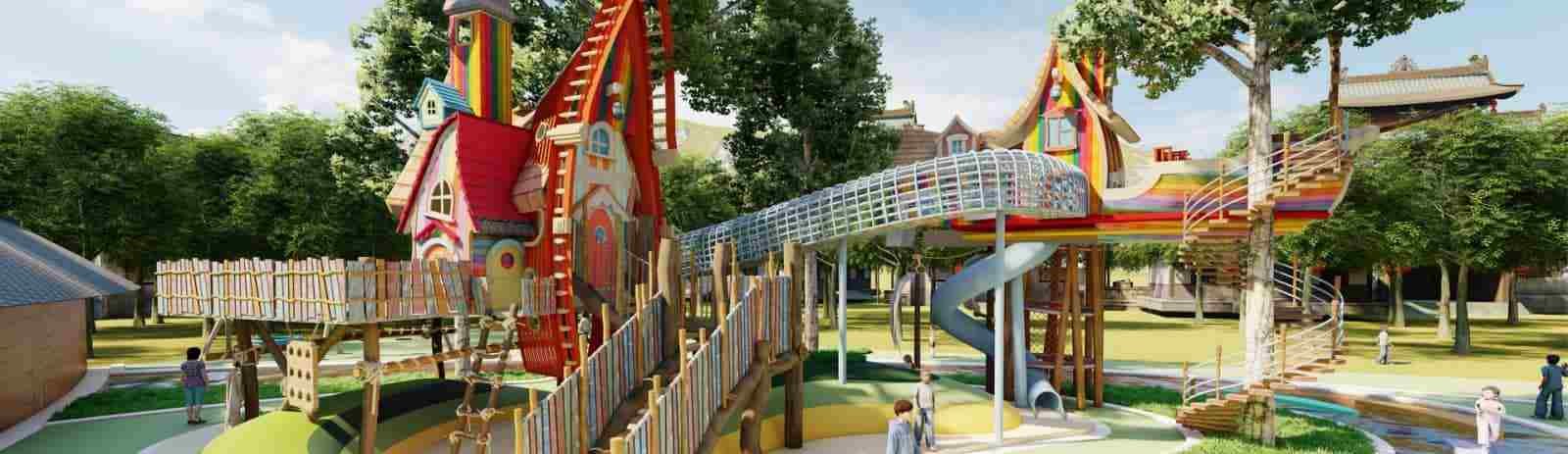
Commercial Wooden Playground Equipment: A Comprehensive Buyer’s Guide
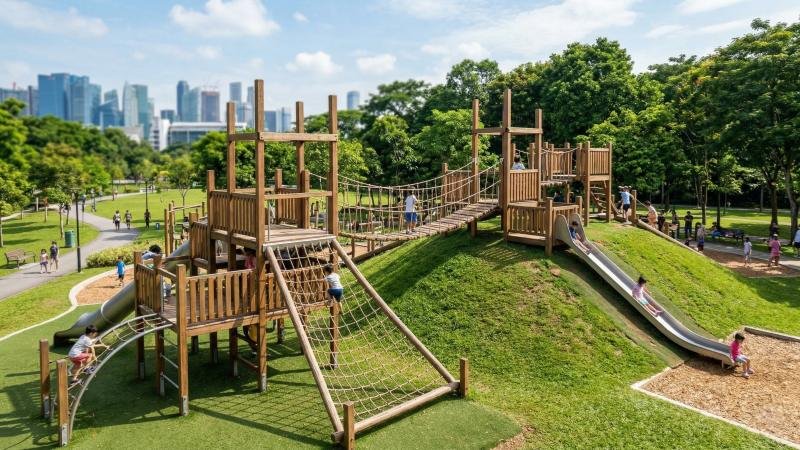
What are the most crucial factors to consider when investing in commercial wooden playground equipment for public use?
The most crucial factors include selecting highly durable timber species, ensuring strict compliance with commercial safety standards like ASTM or EN, implementing inclusive space planning, and calculating the total cost of ownership over a 15- to 20-year lifespan to guarantee long-term safety and structural integrity.
Evaluating Timber Types for Maximum Durability
What is the most critical factor in ensuring your commercial wooden playground equipment withstands decades of heavy public use?
The most critical factor is selecting the appropriate timber species and structural treatment for your specific climate and traffic volume. Commercial play spaces demand materials with inherent high density, such as Robinia or White Oak, combined with industrial-grade preservatives. This combination prevents fungal decay, insect infestation, and mechanical wear over a long lifespan.
Hardwoods vs Softwoods in High-Traffic Areas
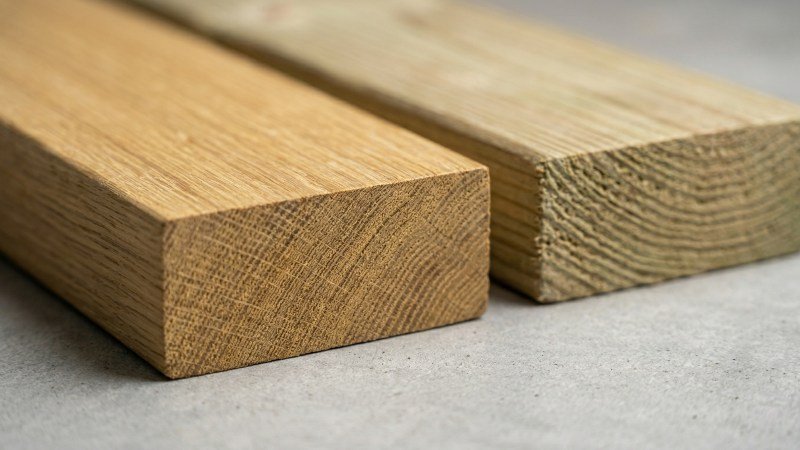
When building a playground for a school or park, the wood must handle constant friction and impact. Will the timber resist splintering when hundreds of children climb on it daily? This depends heavily on whether you choose a hardwood or a softwood.
Hardwoods, such as Robinia (Black Locust) or European Oak, grow slowly. Because of this, they have a very dense cellular structure. Softwoods, like Southern Yellow Pine or Cedar, grow much faster and have a looser grain. Look at it this way: compare a heavy-duty commercial balance beam to a lightweight residential sandbox frame. The commercial beam uses incredibly dense wood to survive constant foot traffic without breaking down. Similarly, high-traffic play areas need dense wood to survive daily abuse.
For example, Robinia has a Janka hardness rating of around 1,700 lbf (pounds-force). As a result, it easily shrugs off vandalism, scratching, and natural wear. In contrast, common Pine sits around 380 to 400 lbf.
| Feature | Hardwoods (e.g., Robinia, Oak) | Softwoods (e.g., Pine, Cedar) |
|---|---|---|
| Durability | Extremely high; resists splintering and dents. | Moderate; more prone to scratching and wear. |
| Initial Cost | Higher upfront investment. | Lower initial purchase price. |
| Lifespan | 20+ years, often with minimal treatment. | 10-15 years, requires strict maintenance. |
| Best For | High-traffic public parks and schools. | Controlled environments or lower-budget projects. |
At the end of the day, hardwoods offer a better long-term investment for public spaces. However, softwoods can work well if they are properly treated and meticulously maintained.
Pressure-Treated Wood and Rot Resistance Solutions
If you choose softwoods, or if your playground is in a damp climate, the wood must be completely protected from moisture. How does the commercial landscaping industry stop wood from rotting in the damp ground? The answer is industrial pressure treatment. Why risk structural failure when modern treatments practically eliminate rot?
The process is straightforward: wood goes inside a giant, sealed cylinder. A vacuum sucks the air from deep inside the wood cells. Then, liquid chemical preservatives get blasted into the empty wood fibers under massive pressure. This process permanently protects the timber from soil fungi, trapped moisture, and wood-boring insects.
Back in the day, the industry relied on CCA (Chromated Copper Arsenate). However, safety regulations have largely banned CCA for children’s play areas. Now, safer alternatives are the standard.
- ACQ (Alkaline Copper Quaternary): A water-based preservative that is highly effective and completely safe for skin contact.
- MCA (Micronized Copper Azole): Uses microscopic copper particles. It causes much less corrosion to structural metal screws and bolts.
The effectiveness of these treatments hinges on their “retention level.” This is the actual amount of chemical preservative retained inside the wood. Ground-contact posts require much higher retention levels than above-ground handrails. Since these specific chemical retention levels shift heavily depending on your geographic moisture zone and individual suppliers, you should always verify the exact treatment specifications and grading with your supplier before cutting a purchase order.
Sustainable Sourcing and Industry Certifications
Commercial playground projects often require strict environmental compliance. Municipalities and school boards want to know exactly where their materials come from. That makes sustainable sourcing a non-negotiable requirement for public bids, not just a nice-to-have bonus.
To guarantee sustainability, you must look for recognized industry certifications. The two absolute heavyweights globally are the FSC (Forest Stewardship Council) and the PEFC (Programme for the Endorsement of Forest Certification).
These organizations track the wood strictly from the forest floor to the final playground structure. This tracking is called the “chain of custody.” Think about how a municipality demands a clear chain of custody for protective rubber surfacing to guarantee chemical safety. In the exact same way, commercial playgrounds require certified timber to guarantee environmental compliance and material integrity.
When wood is FSC or PEFC certified, it proves the forest is managed responsibly. Trees are legally harvested and immediately replanted. On top of that, using certified timber means your public project sails through strict government green procurement rules.
Navigating Safety Standards and Compliance
To guarantee a public commercial wooden playground is legally compliant and safe, you must rely on strict adherence to internationally recognized commercial playground safety standards, like ASTM F1487 in North America or EN 1176 in Europe. These comprehensive guidelines dictate specific structural requirements, covering acceptable hardware protrusion limits, precise head entrapment dimensions, and mandatory load-bearing capacities for timber elements.
Critical Safety Requirements for Play Areas
Let’s start with the structural design rules. Public playgrounds must follow strict measurements to prevent entrapment hazards. What exactly is an entrapment hazard? It occurs when a child’s body can pass through an opening, but their head cannot. Because of this, standards like ASTM F1487 mandate that any completely bounded opening must be smaller than 3.5 inches or larger than 9 inches. This prevents a child’s head from getting stuck between wooden rungs or barrier slats.
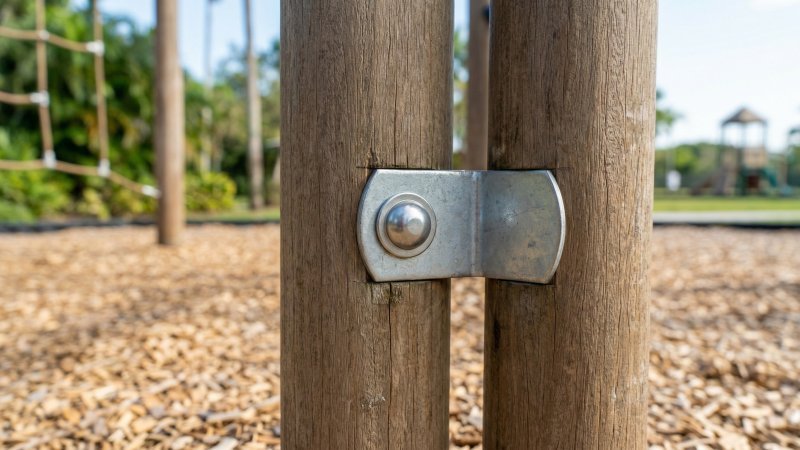
Moving onto hardware, commercial installations can’t cut corners with standard residential screws. Instead, they require industrial-grade, tamper-proof fasteners. These bolts must not protrude dangerously. A protruding bolt can easily catch a child’s clothing. Treat it like the smooth, flush rivets on a commercial aluminum slide tube. Every connection point must remain completely flat to prevent friction burns or snagging.
Don’t forget the guardrails. Handrails require precise heights based on the target age group. Strict adherence to these rail height regulations during the initial design phase is absolutely mandatory to prevent accidental falls from elevated wooden platforms.
Safe Fall Zones and Protective Surfacing Integration
No matter how safe the wooden structure is, children will inevitably fall. How do you prevent serious injuries when a fall occurs from a high commercial play deck? You must install impact-attenuating protective surfacing beneath and around the entire structure. Are you really going to trust a high-traffic fall zone to cheap residential landscaping mulch?
This area is officially called the “use zone.” Typically, the use zone must extend a minimum of 6 feet in all directions from the edge of the stationary equipment. However, moving equipment like wooden swing sets requires a much larger fall zone. Specifically, the swing zone must be twice the height of the suspending pivot point.
Beyond the footprint, the type of surfacing directly hinges on the equipment’s Critical Fall Height (CFH). The CFH is the maximum height from which a child could realistically fall. For instance, a wooden climbing tower with a 6-foot deck requires surfacing rated for a 6-foot fall impact.
You can choose between unitary surfaces or loose-fill materials.
| Surfacing Material | Type | Maintenance Level | Best Application |
|---|---|---|---|
| Poured-in-Place (PIP) Rubber | Unitary | Very Low | High-traffic urban parks; extreme accessibility. |
| Engineered Wood Fiber (EWF) | Loose-Fill | High (requires raking) | Natural wooden playgrounds; budget-conscious schools. |
| Rubber Tiles | Unitary | Low | Geometric play areas; rooftop installations. |
For example, Engineered Wood Fiber (EWF) visually complements wooden playgrounds perfectly. Unlike standard landscaping mulch, EWF is mechanically ground to knit together. This specific knitting action creates a wheelchair-accessible surface that absorbs heavy impacts. Much like how a thick structural rubber mat absorbs heavy dropped weights in an outdoor park gym, certified safety surfacing compresses to eat that kinetic energy.
Always remember that the required thickness of loose-fill materials like EWF will fluctuate depending on the CFH. Because these impact attenuation ratings vary based on the specific material brand, always verify the exact required depth with your surfacing supplier.
Customization and Space Planning Strategy
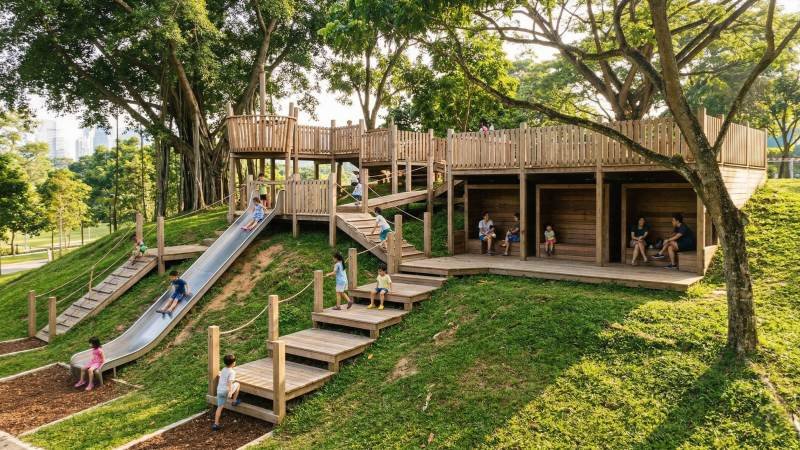
Transforming an empty park lot into a highly efficient commercial wooden play space requires a strategic layout. You must execute a plan that accurately calculates user capacity, integrates age-appropriate zoning, and incorporates accessible pathways. This ensures the playground maximizes play value while seamlessly adapting to the site’s natural topography and strict commercial design requirements.
Assessing Capacity Limits and Target Age Groups
Right out of the gate, you need to map out who will use the playground and what the peak load looks like. Mixing older kids with toddlers on the same wooden structure creates severe collision risks. That’s a recipe for disaster. You need distinct, isolated design zones.
Commercial play areas are typically divided into two main age groups: ages 2 to 5 (early childhood) and ages 5 to 12 (school-age). You must plan the footprint accordingly. For example, equipment for toddlers features lower deck heights and shorter steps. Conversely, school-age structures use taller wooden posts and wider monkey bars. Approach this like designing a public water park. A high-energy wave pool requires a very different layout, depth, and capacity limit than a shallow toddler splash pad. Similarly, dry playgrounds need distinct zones for different developmental stages.
Once the zones are set, calculate the total “play capacity.” This number tells you how many children can safely use the equipment simultaneously. Generally, a well-designed commercial space allocates about 75 to 100 square feet per child within the active play perimeter. However, specific square footage formulas often vary based on local codes and unique equipment footprints. Because of this, always verify these precise capacity calculations directly with your supplier.
Incorporating Inclusive and Accessible Design Features
A modern public park must welcome children of all physical and cognitive abilities. That means your wooden playground needs to push past basic design and embrace full inclusivity.
Accessibility primarily focuses on physical movement. Commercial wooden structures excel here because timber is easily customized into wide, gently sloping wheelchair ramps. Don’t overlook transfer stations, either. These are specially designed wooden platforms equipped with handholds, allowing children to move safely from a mobility device onto the play structure. It’s exactly why a modern park uses paved pathways to connect picnic areas rather than forcing wheelchairs across rough grass—public playgrounds need those same accessible ramps baked straight into the structural frame.
Inclusivity, however, goes beyond wheelchairs. It involves sensory play and cognitive engagement.
| Feature Type | Primary Function | Wooden Playground Examples |
|---|---|---|
| Accessible Mobility | Allows easy physical access to the structure. | Custom wooden ramps; flush transition decks; transfer steps. |
| Tactile & Sensory | Engages multiple senses for cognitive development. | Carved wooden texture walls; integrated musical chimes; sand tables. |
| Quiet Zones | Provides a calm space for easily overstimulated children. | Enclosed wooden playhouses; shaded seating nooks underneath main decks. |
By combining these elements, you ensure the wooden structure serves the entire community effectively.
Adapting Structural Layouts for Irregular Terrains
Let’s talk about the site itself. We all know most public parks and schoolyards aren’t perfectly flat. You might face steep slopes, existing trees, or rocky ground. Fortunately, wooden playground equipment is incredibly adaptable.
You don’t always need to blow thousands of dollars on heavy excavation to flatten a hill. The smarter move is customizing the wooden posts to step down the slope naturally. Similar to how custom landscape retaining walls are terraced to match a hillside’s natural grade, modular wooden play decks can be built at varying heights to follow the existing land.
In fact, slopes actually open up unique design opportunities. For instance, you can install wide embankment slides directly into a hill. This completely eliminates the need for tall, complex wooden staircases. You can also design wooden rope bridges that span safely over uneven ground. Because timber can be easily cut and modified on-site during installation, it is far more flexible than rigid, pre-welded commercial steel structures. This flexibility saves public budgets while creating a more interesting, landscape-integrated playground.
Total Cost of Ownership and Long-Term Maintenance
How can facility managers accurately project the true financial impact of installing a commercial wooden play structure over its entire operational lifetime?
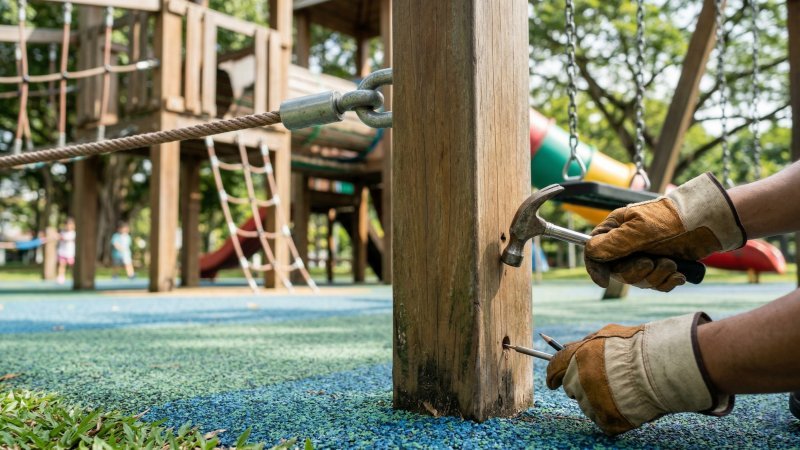
To accurately project the true financial impact, facility managers must calculate the Total Cost of Ownership (TCO). This comprehensive metric combines the initial purchasing price with all projected ongoing expenses. Specifically, these ongoing costs include scheduled structural inspections, periodic wood staining, and the eventual replacement of high-wear components like swing chains.
Balancing Upfront Costs with Expected Lifespan Value
When purchasing equipment for a public park, the initial sticker price is only the beginning. Why do some municipal buyers choose a more expensive wooden structure over a cheaper alternative? Does saving ten percent upfront really matter if you’re doubling your maintenance budget by year three? Veteran managers deeply understand the concept of expected lifespan value. A heavily discounted structure virtually guarantees constant, expensive repairs down the line.
It’s the exact same logic as installing heavy-duty galvanized steel swing chains instead of standard residential chains. The residential chains cost much less initially, but they will wear through quickly under heavy daily use, requiring frequent, costly replacements. Similarly, premium commercial timber requires a higher initial investment but dramatically slashes future labor and repair costs.
| Cost Category | High-Quality Premium Timber | Lower-Tier Budget Wood |
|---|---|---|
| Initial Purchase Price | High | Low |
| Annual Repair Costs | Very Low | High (frequent hardware replacement) |
| Expected Lifespan | 15 to 20+ Years | 7 to 10 Years |
| Overall TCO | Highly Efficient | Poor Long-Term Value |
The takeaway? Always weigh that expected lifespan directly against the initial sticker price. Specific commercial warranty periods can vary significantly between different timber suppliers. Always verify the exact warranty terms and lifespan estimates with your chosen manufacturer.
Routine Structural Inspection Checklists
Regular maintenance isn’t just about keeping the wood looking attractive; it is strictly about structural safety. Public playgrounds experience constant heavy vibration and friction. Because of this, structural hardware is guaranteed to loosen over time. How do maintenance crews catch these hidden mechanical hazards before an injury occurs? They run a strict, routine structural inspection checklist.
Run it exactly how a commercial zipline course runs daily hardware checks before opening. Public play structures demand the same level of rigorous visual and physical checks. Wood naturally swells during heavy rain and shrinks under the hot sun. This constant movement forces bolts to back out slightly.
A standard commercial checklist must cover these critical areas:
- Fastener Tension: Checking and tightening all main structural bolts and screws.
- Ground-Level Posts: Inspecting timber where it meets the soil for early signs of decay.
- Surface Integrity: Identifying and sanding down any dangerous splinters caused by heavy foot traffic.
- Moving Parts: Lubricating metal swing pivots and checking chains for excessive wear.
Staying ahead of inspections flat-out saves money. Catching a loose bolt early prevents a massive wooden beam from snapping under pressure later.
Seasonal Weatherproofing and Treatment Strategies
Wood is a natural, highly porous material. As a result, it fights a constant battle with environmental changes. Unprotected timber will turn gray, crack, and eventually warp under harsh weather. How do you prevent ultraviolet (UV) rays and freezing rain from destroying the equipment? You must implement a proactive seasonal weatherproofing strategy.
Water is the biggest natural enemy of commercial timber. When water freezes deep inside the wood grain, it expands rapidly. This expansion causes deep structural cracks. To stop this damage dead in its tracks, maintenance teams must apply commercial-grade water repellents and UV-blocking stains regularly.
Treat this process just like applying specialized UV-resistant powder coatings to metal playground climbers. The coating acts as a sacrificial barrier against the harsh elements. A proper treatment strategy involves cleaning the wood with a low-pressure wash to remove algae. Next, workers apply a deeply penetrating semi-transparent stain.
Recommended stain formulas and recoating schedules can vary based on the specific factory treatment. Because of this, always run your planned maintenance products and cleaning procedures past the equipment supplier first. Applying the wrong chemical can instantly void a commercial warranty.
Conclusion
Investing in commercial wooden playground equipment requires careful consideration of timber quality, strict adherence to safety standards, and thoughtful space planning. When you understand the differences in wood durability and get ahead of long-term maintenance, your team can build inclusive, safe, and engaging play environments that actually stand the test of time. A clear evaluation of the total cost of ownership ensures your community enjoys a high-quality installation for decades to come.
If you are ready to design your next commercial playground project or need expert guidance on material selection, please contact us.