-
Whatsapp: +86 15516933785
-
Email: hanlin@hanlinplayground.com
-
Address: Shangjie District, Zhengzhou City, Henan Province, China
-
Whatsapp: +86 15516933785
-
Email: hanlin@hanlinplayground.com
-
Address: Shangjie District, Zhengzhou City, Henan Province, China


Complete Guide to Importing Indoor Playground Equipment from China: Sourcing, Manufacturing, and Logistics

How do you navigate the complex process of sourcing safe, high-quality indoor playground equipment from China while avoiding common scams and logistical pitfalls?
Successfully importing indoor playground equipment requires a systematic approach: verifying manufacturers in key industrial clusters like Wenzhou or Zhengzhou, enforcing ASTM/EN safety standards for materials like galvanized steel and fire-retardant vinyl, and managing logistics through FOB terms and correct HS code classification (9506.99). By strictly validating supplier credibility and controlling the design-to-installation workflow, businesses can secure high-return assets at competitive manufacturing costs.
Understanding the Chinese Playground Manufacturing Landscape
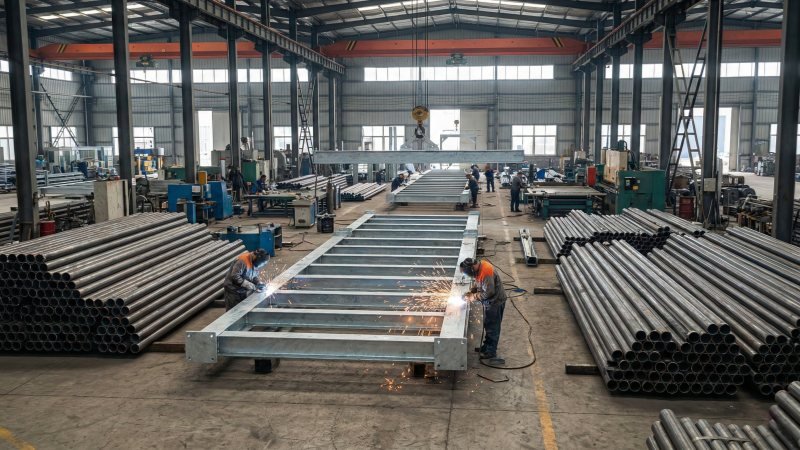
China’s indoor playground industry is primarily divided into two main clusters: the Southern region (Wenzhou and Guangzhou), known for plastic components and soft play, and the Central region (Zhengzhou), known for heavy-duty structural engineering and custom integration. Identifying the right region ensures you match your specific project needs with the supplier’s core manufacturing strengths.
Distinguishing Between Industrial Clusters in Southern and Central China
When you start sourcing, you’ll quickly notice that industrial production in China isn’t random—it’s highly clustered. For indoor playground equipment, knowing the difference between the Southern and Central clusters can save you from buying the wrong grade of equipment.
The Southern Cluster (Wenzhou & Guangzhou)
This region, particularly Qiaoxia town, is famous for rotational molding (plastic parts).
- The Strength: They are excellent for standard, “off-the-shelf” soft play items, small plastic slides, and toddler toys.
- The Vibe: If you need thousands of plastic ball pit balls or a standard modular maze for a small daycare with a limited budget, this supply chain is unbeatable for volume and speed.
The Central Cluster (Zhengzhou)
Zhengzhou sits in China’s heavy industry heartland. While historically famous for mechanical rides, manufacturers here have applied that structural engineering expertise to non-powered playgrounds.
- The Strength: Factories here specialize in heavy-duty steel fabrication. They are the go-to choice for large-scale indoor adventure parks, ninja warrior courses, and high-altitude climbing structures that require superior load-bearing capacity.
- The Vibe: Unlike the “plastic-heavy” style of the south, Zhengzhou manufacturers often treat indoor playgrounds like construction projects, prioritizing thicker steel frames and custom welded integration over simple modular assembly.
| Feature | Southern Cluster (Wenzhou/Guangzhou) | Central Cluster (Zhengzhou) |
|---|---|---|
| Core Material | Plastic (Rotomolding), Light Steel | Heavy Steel, Custom Metal Fabrication |
| Product Strength | Standard Soft Play, Toddler Toys | Adventure Parks, Custom Structures, Ninja Courses |
| Engineering Style | Modular, Fast Assembly | Structural Durability, High Load-Bearing |
| Best For | Daycares, Small Play Areas | Commercial FECs, Sports Parks, High-Traffic Centers |
Spotting the Difference: Direct Manufacturers vs. Trading Agents
Once you identify the region, you have to figure out who you are actually talking to: a Direct Manufacturer or a Trading Agent.
A Trading Agent acts as a middleman. They do not own machines or a factory floor. Instead, they procure from a factory and sell to you at a markup. Their primary advantage is the ability to consolidate products from multiple disparate factories into one container—for example, combining playground equipment with arcade machines and waiting room furniture.
But here is the reality: for the core playground infrastructure, a Direct Manufacturer is typically the superior choice.
Cost Efficiency
Purchasing directly from the factory eliminates the agent’s commission, potentially saving you 10% to 30% on the total project cost.
Technical Communication
Direct communication is critical for custom engineering. Working with an agent can introduce errors similar to using a non-technical translator for an engineering schematic. You might specify a requirement for a specific load-bearing steel bracket, but if the agent lacks engineering knowledge, they may convey a simplified request to the factory, resulting in a standard, insufficient part. Direct access to the manufacturer’s engineers ensures your technical specifications are implemented exactly as requested.
Utilizing B2B Platforms and Factory Websites for Initial Supplier Screening
Your search will likely begin on the internet. B2B platforms like Alibaba and Made-in-China are powerful tools, but they require careful navigation to distinguish factories from traders.
Decoding B2B Platforms
To ascertain a supplier’s true nature, look closely at their product categories. A genuine factory usually focuses on a specific niche. If a supplier lists “Indoor Playgrounds” alongside unrelated items like “Mobile Phone Cases” or “Garden Hoses,” they are almost certainly a trading company. A specialized factory’s catalog will be consistent with their production capabilities.
Analyzing Factory Websites
When reviewing their official digital presence, check for consistency in facility documentation.
- The Background Check: Analyze the background of their product photos. Do the floor colors, crane structures, and factory walls match across different pictures? Inconsistent backgrounds often suggest photos aggregated from different sources.
- The Machine Check: A real manufacturer will proudly showcase their production equipment, such as CNC cutting machines or automatic welding robots.
While you’re at it, run the address through a map service. If the satellite view shows a downtown office building rather than an industrial complex, you’re looking at a trading office, not a factory. These screening methods allow you to build a shortlist of genuine partners efficiently.
Verifying Chinese Supplier Credibility and Production Capabilities
To verify a Chinese supplier, cross-reference their business license on the National Enterprise Credit Information Publicity System to confirm their “Business Scope” includes manufacturing and processing. Supplement this by conducting a live video audit to inspect operating machinery and inventory, and strictly validate their capabilities by contacting previous clients in your specific region.
Checking Business Licenses and Registration via Chinese Government Databases
Don’t let a slick digital storefront fool you; a trading company with three employees can present a website that rivals a factory with 300 workers. The most reliable way to uncover the truth is by examining the official Business License (Ying Ye Zhi Zhao).
Every legitimate Chinese company must hold this document. Request a copy immediately and examine the “Business Scope” section. This section defines exactly what the company is legally allowed to do.
Keywords to Watch For
- Manufacturer: Look for terms like “Manufacture”, “Production”, or “Processing”. These terms indicate they possess the legal rights and facilities to fabricate equipment.
- Trader: Look for terms like “Wholesale”, “Retail”, or “Sales”. If the scope lists these words without manufacturing terms, they are a trading entity.
You can verify the document provided by the supplier against the official Chinese government database, the National Enterprise Credit Information Publicity System (GSXT), to ensure the document has not been altered.
| Indicator | Genuine Manufacturer | Trading Company |
|---|---|---|
| Business Scope | Includes “Production,” “Manufacturing,” “Processing” | Includes “Sales,” “Import & Export,” “Wholesale” |
| Registered Capital | Usually higher (often >5 Million RMB) to cover assets | Often lower (can be <1 Million RMB) |
| Establishment Date | Older dates often suggest stability in manufacturing | Can be very new, as traders open and close quickly |
Conducting Remote Factory Audits using WeChat or WhatsApp Video Calls
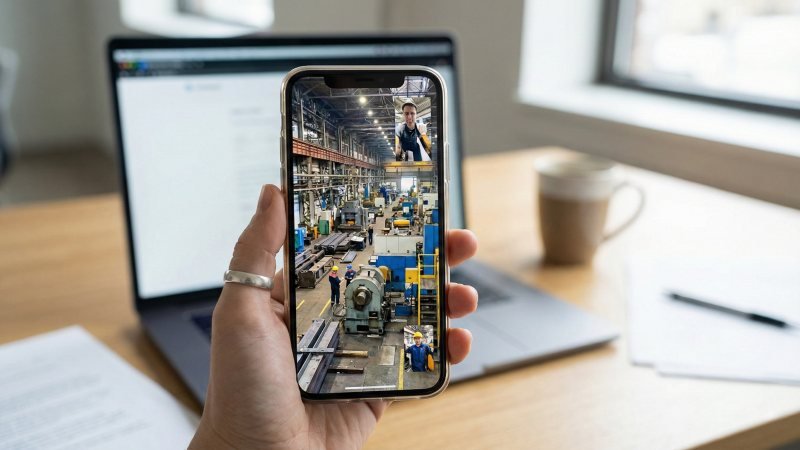
Photos can be manipulated, and pre-recorded videos can be outdated or staged. Would you buy a used car without looking under the hood? Then don’t buy a playground without seeing the factory floor. To confirm the facility’s authenticity, insist on a live video call using WeChat or WhatsApp.
The “Live” Test
During the call, bypass the showroom, which is easily fabricated. Request to see the active production floor and raw material storage.
- Steel Inventory: Look for substantial bundles of galvanized steel pipes.
- Rotational Molds: Ask to see the aluminum molds used to make plastic slides. These are large, expensive assets that trading companies will not possess.
The “Specific Action” Verification
To ensure the video is live and they are at their own facility, give the salesperson a specific, unplanned task. For example, ask them to walk to a specific CNC pipe cutter or laser cutting machine and place a piece of paper with today’s date and your name on it. If they deflect or claim the factory is “too far away,” take that as a massive red flag.
Industry Analogy: This is comparable to a site inspector visiting a construction zone. The inspector does not rely on the architectural model in the sales office; they walk the site to verify the foundation pouring and steel framing in real-time.
Reviewing Project Portfolios of Past Installations in Your Target Market
A supplier might claim “global experience,” but installing a playground in Southeast Asia presents different regulatory challenges than installing one in Europe or North America.
Distinguishing Renders from Reality
Do not accept 3D design renderings as proof of experience. You need to see photos of completed projects. Authentic site photos contain real-world details: fire exit signs, safety netting that shows tension, and actual usage wear. If a photo looks pristine and lacks these imperfections, it is likely a computer graphic.
The Bill of Lading Test
If the supplier cannot provide client contacts due to privacy, ask for a redacted Bill of Lading (B/L). This shipping document proves they actually shipped a container of playground equipment to your country. A trading company might hesitate to show this because the B/L often lists the actual factory as the shipper.
Note: While suppliers may redact the sensitive “Consignee” (buyer) information, the “Description of Goods” and “Port of Discharge” should remain visible to prove the shipment occurred.
Evaluating Product Quality Standards Specific to Chinese Exports
Top-tier Chinese manufacturers adhere to strict export standards, utilizing 48mm diameter hot-dip galvanized steel pipes with a wall thickness of at least 2.0mm to match international structural requirements. Furthermore, reputable suppliers strictly implement ASTM F1918 and EN 1176 safety protocols, using 0.55mm fire-retardant PVC vinyl and high-density sponge foam to prevent flammability and ensure long-term durability in high-traffic commercial environments.
Comparing National Standard GB Steel Pipes against International Specifications
The structural skeleton of an indoor playground relies entirely on its steel framework. In China, steel pipes are categorized under the “GB” (Guobiao) national standards. But here’s the kicker: the domestic standard for light commercial use often differs from the rigorous heavy-duty requirements of North American or European markets.
The Diameter and Thickness Criticality
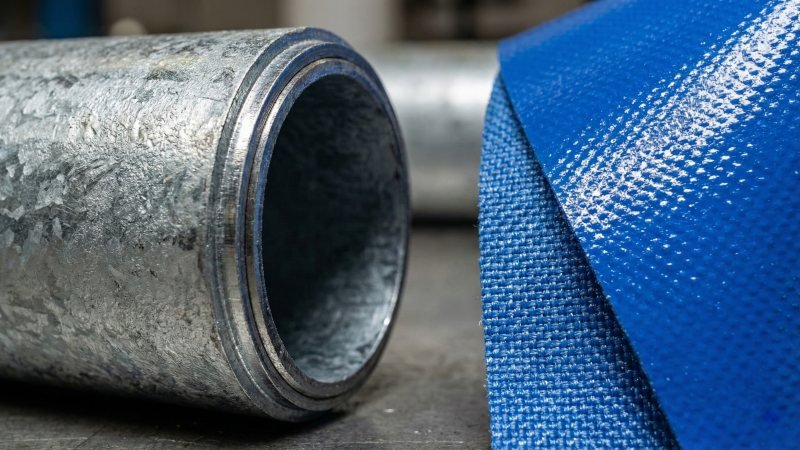
Globally, the industry standard for playground scaffolding is a 48mm outer diameter pipe. While almost all Chinese factories use 48mm pipes, the structural difference lies in the wall thickness.
- Export Standard: A quality pipe should have a wall thickness of 2.0mm to 2.2mm. This thickness provides the rigidity needed to support multi-level structures without swaying or deformation.
- Domestic/Budget Standard: Lower-cost options often utilize 1.5mm or 1.8mm pipes. While visually identical from the exterior, they lack the necessary tensile strength for heavy commercial use. Ensure your contract explicitly specifies 2.0mm thickness, as factories may default to 1.8mm unless instructed otherwise.
Galvanization Quality
You must also verify the type of galvanization. High-quality pipes undergo hot-dip galvanization. This process submerges the steel in molten zinc, coating both the interior and exterior surfaces. This prevents rust from corroding the pipe from the inside out. On the flip side, “cold galvanized” pipes are merely sprayed on the outside; they are aesthetically shiny but offer poor rust protection in humid climates.
Industry Analogy: Consider the steel pipes as the rebar in a concrete column. If the rebar is too thin, the column may look solid on the outside but will fail under structural load.
| Specification | High-Quality Export Standard | Low-Cost Domestic Standard |
|---|---|---|
| Outer Diameter | 48mm | 48mm |
| Wall Thickness | 2.0mm – 2.2mm | 1.5mm – 1.8mm |
| Galvanization | Hot-dip (Inside & Outside) | Cold/Pre-galvanized (Outside only) |
| Structural Integrity | Rigid for 3+ Levels | Suitable for 1-2 Levels only |
Assessing the Thickness and Fire Resistance of PVC Coverings
The “soft” in “soft play” comes from the foam padding wrapped in PVC vinyl. This material endures the most wear and tear from friction and impact.
Vinyl Thickness and Weave
The PVC vinyl fabric used in playgrounds is a composite material with a mesh fabric layer sandwiched between two PVC layers.
- High-End Vinyl: Uses 0.55mm thickness (often marketed as 1000D). It offers high tensile strength and resists tearing even if scraped by zippers or buckles.
- Low-End Vinyl: Uses 0.35mm to 0.45mm thickness. This material is prone to puncture, exposing the foam inside to damage and hygiene issues within months of operation.
Fire Resistance is Non-Negotiable
In a crowded indoor center, fire safety is paramount. Top Chinese exporters use vinyl certified to meet M2 (European) or NFPA 701 (American) fire standards. This ensures that if the material is exposed to a flame, it will self-extinguish once the source is removed. Inferior vinyl acts as a fuel source, melting and dripping, which can rapidly spread fire.
Ensuring Compliance with ASTM and CE Safety Certifications for Export
A certificate on a website is insufficient proof of safety. You must ensure the physical product complies with the specific safety codes of your region, such as ASTM F1918 (USA/Canada) or EN 1176 (Europe).
The “Probe” Test
Compliance is heavily focused on gap spacing to prevent entrapment. Safety inspectors use standardized “probes” (test tools simulating body parts) to audit the equipment.
- Head Entrapment: Gaps must be either too small for a small child’s body to enter, or large enough for a large child’s head to pass through freely. A gap between 9cm and 23cm is typically a “kill zone” where a head can become trapped.
- Finger Entrapment: Holes in slides or netting must not catch a child’s finger or clothing toggles.
Soft Fall Surfacing
Safety standards also dictate the impact attenuation of the flooring. Manufacturers typically supply EVA foam mats. The density and thickness of the mat must correlate with the “Fall Height” of the equipment. For high jumps or climbing walls, standard 2.5cm mats may fail a safety audit, necessitating thicker foam pits or specialized impact-absorbing surfaces.
Industry Analogy: Purchasing compliant equipment is like obtaining a Building Occupancy Permit. The structure might be physically sound, but without passing the Fire Marshal’s specific inspection (ASTM/EN compliance), it cannot legally open to the public.
Navigating the Customization and Design Process with Chinese Teams
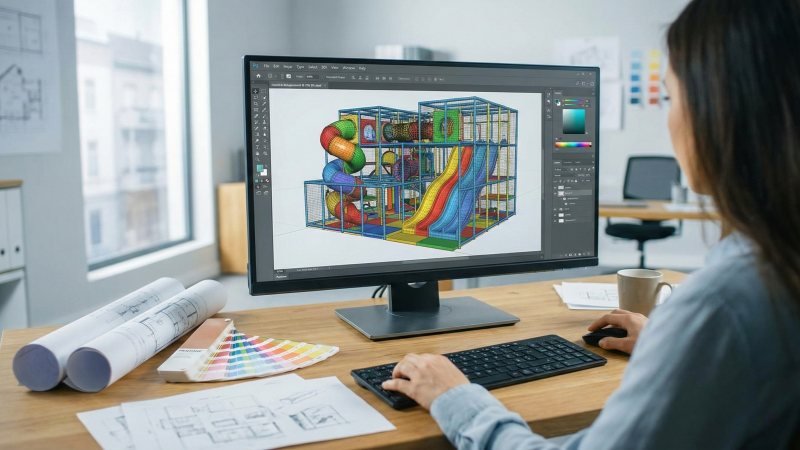
To ensure design accuracy, submit a DWG format CAD file containing exact building dimensions, column locations, and ceiling obstructions like HVAC ducts. Supplement this with a detailed design brief specifying age groups, preferred themes, and functional zones, and actively participate in iterative 3D rendering reviews to verify spatial flow and component placement before manufacturing begins.
Communicating Floor Plans and Theme Requirements to Design Engineers
The success of your indoor playground relies entirely on the accuracy of the initial floor plan. Providing a rough hand-drawn sketch often leads to “installation collision,” where equipment arrives but conflicts with structural elements not shown on the drawing.
Why You Need DWG Files
Chinese design engineers primarily use AutoCAD and 3ds Max. You should provide a DWG file. Unlike a PDF or image, a DWG file contains precise mathematical data about lines and curves.
- Scale Accuracy: A DWG file maintains a 1:1 scale, whereas PDFs can distort dimensions.
- Layer Efficiency: Engineers can isolate relevant layers (e.g., floor footprint) while hiding irrelevant electrical or plumbing diagrams.
Identifying Hidden Obstructions
Your floor plan must explicitly mark “invisible” obstacles.
- Vertical Obstructions: Mark all concrete columns. If a slide path intersects a column, the layout must be fundamentally altered.
- Overhead Obstructions: Note the height of fire sprinklers, HVAC ducts, and hanging lights. If your ceiling is 5 meters high, but a vent hangs down to 4 meters, your equipment height is restricted to the lower clearance.
Industry Analogy: Providing a floor plan is like programming a CNC machine. If the input coordinates (the DWG file) are incorrect, the machine will cut the wrong shape, regardless of the operator’s skill.
| File Type | Suitability | Risk Level | Why? |
|---|---|---|---|
| DWG (AutoCAD) | Best | Low | Contains precise, editable vector data. |
| PDF (Vector) | Acceptable | Medium | Designers must manually trace it, risking errors. |
| Hand Sketch/JPEG | Poor | High | Lines are not straight; dimensions are estimates. |
Understanding the Revision Cycles for 3D Renderings and Layouts
The design process is an iterative cycle, usually requiring three to five rounds of revisions. Do not expect the initial draft to be production-ready.
The “Over-Crowding” Tendency
Designers may aim to maximize the equipment count to increase the perceived “play value” and total price. But here is the problem: this often compromises the operational flow.
- Review for Flow: Ensure clear walkways for parents and clear paths to fire exits.
- Line of Sight: Confirm that supervision points (like a café area) have unobstructed views of critical play zones.
Be specific with your feedback. Instead of requesting to “make it more fun,” provide actionable instructions such as “remove the spiral slide in the corner and replace it with a spider tower.”
Confirming Technical Specifications and Component Lists before Production
The most critical document in this process is not the 3D rendering, but the Component List (Bill of Materials or BOM) attached to the Proforma Invoice.
The Render vs. Reality Gap
A 3D render is a conceptual visualization and may include decorative elements (like fiberglass trees or LED lighting) to enhance the aesthetic. However, if those items are not listed line-by-line in the Excel quotation, they will not be manufactured or shipped.
- Verify the Count: If the render displays 10 soft play shooters, but the BOM lists 6, you will receive 6.
- Check Motor Specs: For electric items, confirm the voltage compatibility. A motor wired for China’s 220V/50Hz will fail or burn out in a region using 110V/60Hz.
Industry Analogy: This is comparable to reviewing a Construction Bill of Quantities (BOQ). Even if the architectural concept art shows marble flooring, if the BOQ specifies laminate, the builder is contractually obligated to install laminate. The contract is the list, not the image.
Managing Payment Terms, Shipping, and Import Logistics
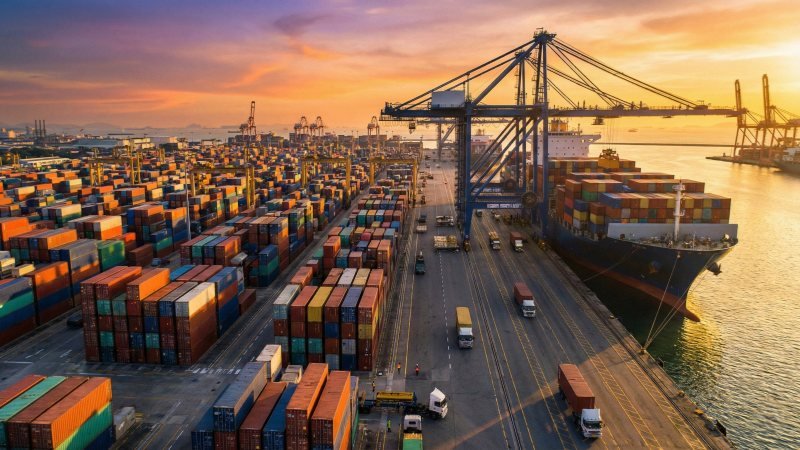
To ensure financial security and logistical control, the industry standard dictates a payment structure of a 30% T/T deposit to start production and a 70% balance payment upon completion but before shipment. Importers should generally prioritize FOB (Free on Board) shipping terms to retain control over freight rates and must classify their cargo under HS Code 9506.99 to accurately determine import duties.
Negotiating Standard Payment Structures and Trade Assurance Contracts
International B2B transactions follow specific financial protocols to mitigate risk for both parties.
The 30/70 Rule
The standard payment method is T/T (Telegraphic Transfer).
- The Deposit: You pay 30% of the total invoice value. This provides the factory with capital to purchase raw materials like steel and PVC vinyl. Production commences only upon receipt of this deposit.
- The Balance: You pay the remaining 70% only after production is complete. You must verify the goods via photos or a video audit before releasing this payment. Once the factory receives the balance, they release the cargo to the port.
Alibaba Trade Assurance
If sourcing through Alibaba, Trade Assurance acts as an escrow service. If the supplier ships late or the quality deviates from the contract, the platform can hold or refund the funds, adding a layer of protection.
Industry Analogy: This payment structure mirrors a commercial construction contract. You pay a mobilization fee to allow the contractor to begin work (the 30% deposit), but you do not release the final retention payment until the work passes inspection (the 70% balance).
Selecting the Right Incoterms like FOB or CIF for Sea Freight
Incoterms (International Commercial Terms) define the transfer of cost and risk. Choosing the wrong term can significantly inflate your landed cost.
FOB (Free On Board) – Recommended
FOB is the most balanced term for importers. The Chinese factory is responsible for getting the container to the Chinese port and clearing Chinese customs. You take responsibility from that point onward, allowing you to choose your own freight forwarder and control the ocean freight rate. Why hand over control of your shipment just to save a few bucks upfront?
EXW (Ex Works) – For Experienced Buyers
You pay for everything from the factory door. You must arrange the truck to pick up the goods in China. While this offers the lowest product price, it requires managing complex inland logistics in China.
CIF (Cost, Insurance, Freight) – The Potential Trap
CIF appears convenient as the supplier handles shipping to your local port. However, suppliers often use the cheapest shipping lines to save money. Upon arrival, the destination port agent may charge you inflated “Terminal Handling Charges” that can be significantly higher than standard rates.
| Incoterm | Who Pays Sea Freight? | Who Controls the Schedule? | Risk of Hidden Destination Fees |
|---|---|---|---|
| EXW | Buyer | Buyer | Low |
| FOB | Buyer | Buyer | Low (Best Value) |
| CIF | Seller | Seller | High (Risky) |
Handling Customs Clearance and HS Codes for Playground Components
When your container arrives, it requires a “passport” to enter the country: the HS Code (Harmonized System Code).
The Correct HS Code
For indoor playground equipment, the standard HS Code is 9506.99.
- 9506: Articles and equipment for general physical exercise.
- 9506.99: Other equipment (Swings, chutes, climbing frames).
Using an incorrect code can be costly. Mislabeing equipment as “Plastic Toys” (Chapter 39) or “Furniture” (Chapter 94) can lead to incorrect duty rates or unnecessary inspections for wood pests. You can verify classifications via the World Customs Organization or your local customs broker.
Essential Documents for Clearance
To clear customs, your freight forwarder needs three key documents from the supplier:
- Commercial Invoice: Lists the declared value of the goods.
- Packing List: Details the contents of the container.
- Bill of Lading (B/L): The title of ownership. You need the original B/L (or a Telex Release) to claim your cargo.
Industry Analogy: The Bill of Lading is the Title Deed for the cargo. Even if you possess the “keys” (the container seal number), you cannot legally take possession of the goods until you present the signed title.
Conclusion
Let’s be honest: importing indoor playground equipment from China is a high-stakes investment that rewards preparation over optimism. By moving beyond the attractive 3D renderings and rigorously auditing the “invisible” elements—business licenses, steel thickness, safety probes, and shipping terms—you transform a risky transaction into a calculated business expansion.
Do not settle for “standard” promises. Verify the raw materials in Wenzhou or Zhengzhou, negotiate FOB terms to control your logistics, and inspect every line item in your Bill of Materials. The difference between a profitable family entertainment center and a compliance nightmare often lies in the quality of the questions you ask before the container ever leaves the port. Your journey to a successful launch begins not with a credit card payment, but with a request for a business license and a live video call.