-
Whatsapp: +86 15516933785
-
Email: hanlin@hanlinplayground.com
-
Address: Shangjie District, Zhengzhou City, Henan Province, China
-
Whatsapp: +86 15516933785
-
Email: hanlin@hanlinplayground.com
-
Address: Shangjie District, Zhengzhou City, Henan Province, China


Designing Safe Toddler Zones: Essential Equipment for Daycares & Preschools

What are the critical design elements and equipment required to create a safe, compliant toddler environment in daycare facilities?
Designing a safe toddler zone requires a holistic approach that integrates visibility-optimized layouts, CPSC-compliant furniture, and strategic zoning. Essential equipment includes ergonomic changing stations with retractable steps to prevent staff injury, evacuation-grade cribs for emergency safety, and impact-absorbing flooring in active play areas. Success depends on balancing strict regulatory compliance with developmentally appropriate spaces that foster independence.
Designing Layouts for Supervision and Traffic Flow
How should a daycare facility arrange a toddler classroom to ensure maximum safety and compliance with supervision regulations?
An effective toddler zone layout prioritizes “Active Supervision” by eliminating visual blind spots through the strategic placement of low-profile dividers and centralizing high-traffic areas. The design must establish clear, unobstructed sightlines from every vantage point while maintaining distinct pathways that prevent congestion and allow for rapid evacuation during emergencies.
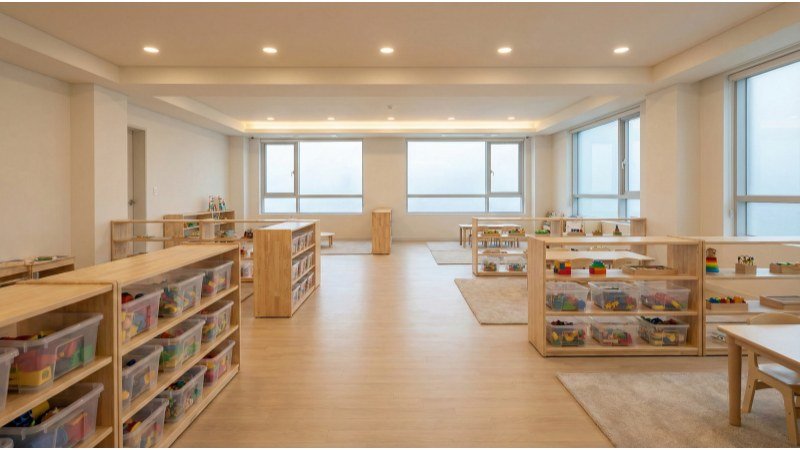
Creating Clear Sightlines for Constant Monitoring
The most fundamental rule in toddler room design is visibility. Teachers must be able to see every child at all times, regardless of where they are standing in the room. This concept, often called “Active Supervision” in regulatory guidelines, dictates where equipment is placed. If a teacher is changing a diaper, they still need a direct line of sight to the play area. Consequently, tall furniture pushed against the center of the room creates dangerous blind spots.
To achieve this, you should utilize the “perimeter view” strategy. Place taller storage units against the walls. In the center of the room, use only low shelving units or see-through dividers. For toddler zones, dividers should generally not exceed 30 inches in height. This height contains the children safely while allowing an adult to see over the top without standing on tiptoes.
Industry Note: Ensure that any structural columns or pillars in the room do not create “shadow zones” where a child can hide. You may need to install convex mirrors in corners to reveal these hidden areas.
Key Layout Checks for Visibility:
- The Diapering Angle: Position the changing table so the caregiver faces the classroom, not the wall.
- The Door Test: Ensure the entrance is visible from all main activity zones to prevent unauthorized exit or entry.
- Glare Management: Position active play areas away from blinding window glare that might hinder a teacher’s ability to scan the room quickly.
Separating High Energy Play from Quiet Rest Areas
Toddlers have fluctuating energy levels, and safety risks increase when high-energy activities clash with low-energy activities. For instance, a toddler running with a block should not be able to trip over a child looking at a book. Therefore, your layout must physically separate “loud/active” zones from “quiet/rest” zones.
You can achieve this separation by using furniture as boundaries. Use sturdy, low shelving units to create physical barriers between the block center (active) and the library or nap area (quiet). This prevents the “drift” of toys and children between incompatible zones. Additionally, separate these zones with distance. Place the active zone near the entrance or outdoor access, and the quiet zone in a secluded corner.
Zone Characteristics Comparison
The following table illustrates how to distinctively characterize these two zones to prevent cross-zone accidents:
| Feature | Active Zone (Blocks, Gross Motor) | Quiet Zone (Reading, Naps) |
|---|---|---|
| Placement | Near high-traffic entryways or exits. | In low-traffic corners, away from doors. |
| Lighting | Bright, natural light to stimulate activity. | Dimmable or softer lighting to induce calm. |
| Boundaries | Open space for movement. | Enclosed on three sides for a “cozy” feel. |
| Acoustics | Near sound-absorbent panels if possible. | Away from noisy areas like bathrooms/sinks. |
Defining Clear Pathways to Prevent Congestion and Collisions
Traffic flow refers to how people move through the space. In a toddler room, poor traffic flow leads to collisions, tripping, and frustration. A common mistake is creating long, straight empty spaces. In the industry, we call these “runways.” If toddlers see a long, straight path, their instinct is to run. This significantly increases the risk of falls and head injuries.
To prevent this, design meandering pathways. Use furniture to break up long straight lines. The path from the entrance to the play area should curve slightly or be interrupted by a “traffic calming” element, like a round table. However, you must balance this with evacuation safety.
Pathway Requirements:
- Width: Pathways must be wide enough for two toddlers to pass without touching, or for an adult to walk comfortably while carrying a child.
- Clearance: Keep all exits completely clear of clutter. Do not place mats or toys directly in front of emergency doors.
- Transition Zones: Create a small “landing pad” at the entrance. This is where parents drop off and pick up. If this area is too small, it creates a bottleneck during busy times, which is a safety hazard.
Note: Specific aisle width requirements for fire safety egress can vary by state and local jurisdiction (often ranging from 36 to 44 inches). Always verify the exact dimensions required by your local fire marshal or licensing agency.
Choosing Compliant Flooring and Protective Surfaces
Compliant daycare flooring requires a strategic combination of impact-absorbing materials in active play zones and impermeable, easy-to-clean surfaces in “wet” areas. Facilities must adhere to ASTM F1292 standards for critical fall heights while ensuring all transitions are flush to eliminate tripping hazards and maintain accessibility.
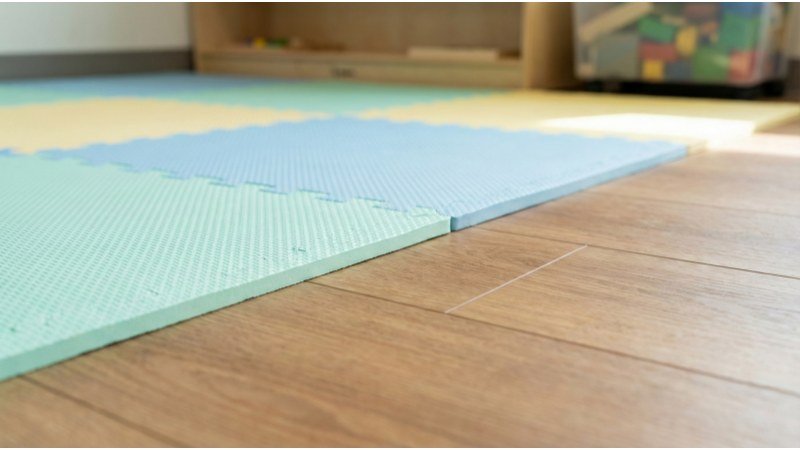
Installing Impact Absorbing Materials in Fall Zones
Toddlers are still mastering balance, making falls frequent and inevitable. Therefore, the flooring under climbing structures or gross motor equipment cannot be standard commercial carpet. You must install “resilient surfacing” that is rated for impact absorption. This is similar to the safety requirements for outdoor playground surfacing, but adapted for indoor use.
The industry standard to watch is the “Critical Fall Height.” This rating indicates the maximum height from which a child can fall onto the surface without sustaining a life-threatening head injury. For example, if you have a climbing loft that is 2 feet high, your flooring must be rated to protect a fall from at least 2 feet.
Types of Resilient Indoor Surfacing
Daycares typically choose between two main categories of protective flooring.
| Material Type | Best Application | Maintenance Note |
|---|---|---|
| Bonded Foam Mats | General play areas, block centers. | Must be cleaned daily; check for gaps between interlocking teeth. |
| Poured-in-Place Rubber | High-risk climbing zones (indoor gyms). | Seamless and highly durable; easier to sanitize than mats. |
| Carpet with Pad | Quiet corners, reading nooks. | Requires a dense, moisture-barrier pad underneath to add cushion. |
Note: The specific thickness required to achieve a certain Critical Fall Height rating varies significantly by material density and manufacturer. Always verify the test data provided by your specific flooring supplier before purchasing.
Selecting Impermeable Flooring for Sanitation Areas
In “wet zones” like art stations, dining areas, and diaper changing corners, the priority shifts from cushioning to containment. The flooring here must be non-porous. This means it prevents fluids—whether spilled milk, paint, or bodily fluids—from seeping into the subfloor where bacteria and mold can breed.
Luxury Vinyl Tile (LVT) has largely replaced traditional Vinyl Composition Tile (VCT) in modern preschool designs. Unlike VCT, which requires frequent stripping and waxing (a chemical-heavy process), LVT is naturally resistant to scuffs and moisture. It creates a sealed surface that allows staff to wipe up spills completely.
However, “impermeable” must not mean “slippery.” You must look for flooring with a proper Coefficient of Friction (COF). This ensures that even when the floor is slightly damp from mopping, it provides enough grip for a toddler’s shoes. A surface that is too smooth increases accident risks significantly for unsteady walkers wearing socks.
Avoiding Tripping Hazards with Seamless Transitions
The most common location for trips and stumbles in a classroom is the line where two different floor types meet. If you transition from a thick carpet in the play area to thin vinyl in the dining area, you create a “lip” or elevated edge. For a toddler who barely lifts their feet when walking, a half-inch height difference is a major obstacle.
To solve this, you must use proper transition strips. In commercial construction, we use “reducers” or “threshold ramps” that slope gently between heights rather than creating a step. Ideally, the subfloor should be prepared so that the finished floor heights are level (flush).
If using area rugs over hard flooring, you must secure the edges. Curling rug corners are a top violation cited during safety inspections. Use heavy-duty, double-sided carpet tape or choose rugs with weighted, rubberized edges that sit flat against the floor. This mirrors the safety protocols used for entry mats in commercial buildings, ensuring the path remains perfectly flat.
Equipment for Diapering and Personal Hygiene
Safe daycare hygiene zones must integrate ergonomic changing tables with retractable stairs to minimize caregiver lifting strain and child-sized sinks that meet ADA height standards for autonomous handwashing. Additionally, these zones require lockable, wall-mounted cabinetry to secure sanitation chemicals out of reach while maintaining immediate accessibility for staff during diapering procedures.
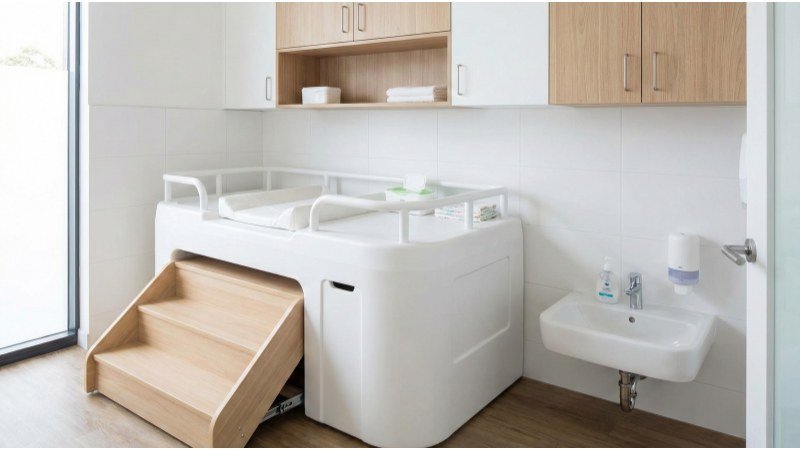
Ergonomic Changing Tables with Safety Steps
The physical demand of lifting toddlers is a leading cause of staff turnover and workers’ compensation claims in the early childhood industry. A typical toddler weighs between 22 to 30 pounds. If a teacher changes ten diapers a day, they are cumulatively lifting hundreds of pounds. Over time, this repetitive motion causes significant back strain.
To mitigate this, you must invest in changing tables equipped with retractable stairs. These specialized tables allow the toddler to walk up the steps to the changing surface with teacher supervision. This design transforms a lifting task into a guiding task. It drastically reduces the physical load on the educator while fostering a sense of autonomy in the child.
Furthermore, the changing surface itself requires specific safety contours. Unlike a flat residential dresser, a commercial changing table must have a deep, molded top. These raised edges, often around 6 inches high, act as a physical barrier to prevent a child from rolling off during the process.
Safety Mechanism Note: The stairs on these units must feature a locking mechanism. When not in use, the stairs should retract into the cabinet and lock in place to prevent unsupervised climbing by other children.
Child Accessible Sinks for Handwashing Training
Handwashing is the single most effective way to control the spread of illness in a group care setting. However, if the sink is too high or the faucets are too hard to turn, toddlers cannot wash their hands effectively. You need “child-accessible” plumbing fixtures that align with the physical stature of a 2-year-old.
Industry standards typically suggest a rim height of roughly 21 to 22 inches for toddlers. At this height, a child can lean over the basin without needing a step stool. Step stools in wet areas introduce unnecessary tripping hazards and should be avoided in permanent facility designs.
Faucet Technology and Safety
The mechanism for turning on the water is just as important as the height.
| Faucet Type | Pros | Cons |
|---|---|---|
| Touchless (Sensor) | Maximizes hygiene; reduces cross-contamination points. | Requires batteries or power source; sensors can be finicky. |
| Metered (Push Button) | Saves water by shutting off automatically after a set time. | Toddlers may struggle to push the button with enough force. |
| Wrist Blade Handles | Easy to operate with elbows/wrists (ADA compliant). | Children may forget to turn them off, causing floods. |
Regardless of the faucet type, you must install an anti-scald mixing valve on the supply line. This device limits the maximum water temperature (usually to 110°F or 120°F) to prevent burns, preventing injuries even if a child accidentally pushes the handle to the hottest setting.
Secure Storage for Hazardous Cleaning Supplies
State licensing regulations are incredibly strict regarding “poisons and hazardous materials.” In a diapering zone, you need immediate access to sanitizing sprays (like bleach water or approved chemical cleaners) to disinfect the mat between every child. However, these chemicals must never be accessible to the children.
This creates a logistical challenge: the cleaner must be within the teacher’s reach but out of the child’s sight and grasp. The solution lies in wall-mounted cabinetry installed directly above the changing station. These cabinets should be positioned at least 48 inches above the floor.
Standard household latches are often insufficient for a commercial environment. Experienced facility managers prefer magnetic locking systems (often called “Tot-Loks”). These invisible locks require a magnetic “key” to open. They are far superior to traditional key locks because they do not have a keyhole that can be jammed, and they lock automatically when the door closes. This ensures that even if a teacher is rushing, the cabinet secures itself, eliminating the risk of human error.
Furniture Standards for Safe Sleep Environments
A compliant sleep environment relies on CPSC-certified evacuation cribs equipped with reinforced steel frames and heavy-duty casters for rapid emergency egress. Administrators must enforce strict spacing protocols, typically requiring 24 to 36 inches between sleeping units, and select soft furnishings upholstered with certified fire-retardant materials to satisfy commercial fire safety codes.
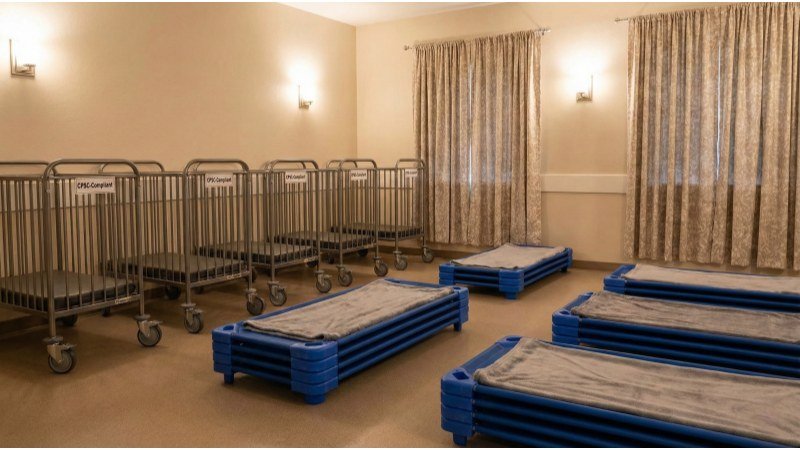
Heavy Duty Evacuation Cribs for Emergencies
In a residential home, a crib is a stationary piece of furniture. However, in a daycare center, a crib serves a dual purpose: it is a sleeping vessel and a life-saving escape vehicle. During a fire drill or real emergency, caregivers cannot carry four infants at once. Instead, they must place multiple infants into a single “evacuation crib” and wheel them to safety.
Therefore, the construction of these cribs differs significantly from standard models. You must look for cribs built with a solid steel frame welded to the wheel brackets. Standard plastic wheels found on home furniture will buckle under the weight of four babies and the stress of rolling over door thresholds or uneven pavement.
You specifically need 4-inch, heavy-duty, locking casters. Think of these casters like the wheels on a hospital supply cart—designed to carry heavy loads smoothly over bumps without jamming. If the wheels are too small, the crib may tip or get stuck on a carpet edge during an evacuation, blocking the exit.
Regulatory Note: Always verify that the crib bears a label certifying compliance with CPSC 16 CFR 1220, the federal standard for non-full-size cribs.
Spacing Guidelines for Cots and Sleep Mats
The arrangement of sleeping furniture is strictly regulated to prevent the spread of airborne illness and to ensure teachers can walk between children during nap time. Simply cramming as many cots as possible into a room is a major violation.
Most state licensing boards mandate a specific clearance around each cot or mat. While this varies, the industry “rule of thumb” is a minimum of 18 to 36 inches on all sides (except where touching a wall). This aisle space ensures that if a child requires medical attention, a staff member can reach them instantly without stepping over other sleeping children.
Head-to-Toe Arrangement
Beyond distance, you must adopt the “Head-to-Toe” configuration. This means if Child A has their head at the top of the cot, Child B (placed parallel) must have their feet at that end. This arrangement ensures that if two children cough or sneeze, they are not breathing directly into each other’s faces, significantly reducing viral transmission.
| Feature | Stackable Plastic Cots | Folding Vinyl Mats |
|---|---|---|
| Hygiene | Mesh fabric allows airflow; easier to clean. | Vinyl surface can trap heat/sweat; needs frequent wiping. |
| Storage | Stack neatly on dollies; prevents floor contact. | Fold up; often stored in cabinets or on shelves. |
| Durability | Rigid frames last for years. | Vinyl seams may crack over time with heavy use. |
Fire Retardant Materials for Rest Area Soft Furnishings
Creating a “cozy” atmosphere in the sleep area often involves adding rocking chairs for bottle feeding or soft rugs for quiet play. However, you cannot simply buy these items from a home furniture store. Commercial daycares are subject to much stricter fire codes than private residences.
The foam and fabric inside a nursing chair or a reading beanbag act as fuel during a fire. Therefore, regulations often require these items to meet California Technical Bulletin 117-2013 (CAL 117) or similar flammability standards. This ensures the material resists ignition, preventing a small spark from becoming a fully developed fire in the moments before evacuation.
When purchasing soft seating, you must check the underside of the furniture for the manufacturer’s tag. This tag explicitly states that the materials comply with flammability laws. If a fire marshal inspects your facility and finds a rocking chair without this certification, they can force you to remove it immediately.
Selecting Developmentally Appropriate Play Furniture
Developmentally appropriate furniture prioritizes injury prevention through stabilized, low-profile storage units that resist tipping and soft, vinyl-encased foam climbers for safe motor skill practice. Additionally, all rigid furniture must feature fully rounded edges and weighted bases to support unsteady walkers during group activities.
Stabilized Low Shelving to Prevent Tipping
Furniture tip-overs are one of the most critical safety hazards in early childhood environments. Toddlers are naturally curious and often attempt to climb shelves to reach a toy on top. If a storage unit is top-heavy or unstable, it can easily fall onto the child. Therefore, you must select shelving specifically engineered with a wide base and a low center of gravity.
In the industry, we look for units that meet ASTM F2057 stability standards. Unlike standard bookcases, daycare shelving often features a trapezoidal shape—wider at the bottom than the top—which acts like a pyramid to prevent tipping. Alternatively, use units with substantial counterweights in the base.
If you must use taller units against a wall, they must be anchored to the studs using heavy-duty brackets. However, for room dividers in the center of the space, you are limited to freestanding units. In this case, restrict the height to approximately 24 to 30 inches. This ensures the unit is low enough that a toddler is less likely to try climbing it, and if they do hang on the edge, the leverage isn’t sufficient to pull it over.
Industry Insight: Avoid units with doors or drawers for toddler zones. Open shelving prevents pinched fingers and allows teachers to spot checking inventory instantly.
Soft Climbers for Gross Motor Development
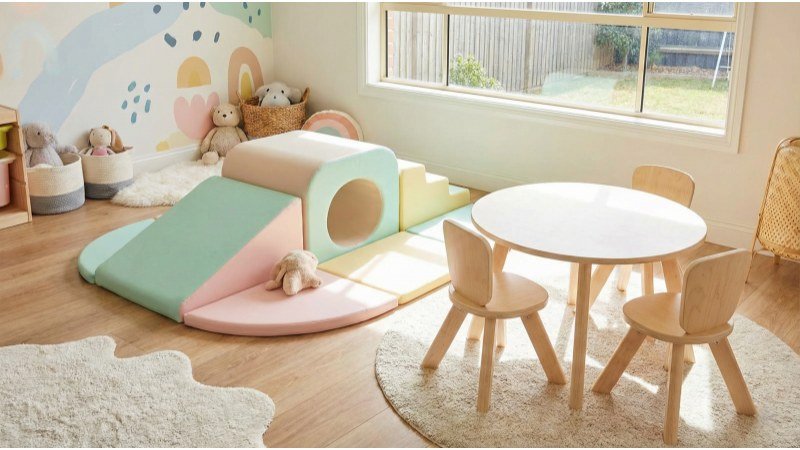
Toddlers have a biological drive to climb and explore heights. If you do not provide safe equipment for this need, they will inevitably try to climb unsafe furniture like tables or shelves. The solution is to introduce “soft play” equipment. These are climbing structures made from high-density foam cores covered in durable, phthalate-free vinyl.
The density of the foam is the critical technical specification here. It must be firm enough to support a child’s weight without collapsing (which causes ankle rolls) but soft enough to absorb impact during a tumble. Think of it like the difference between a soft pillow and a gym mat; you need the firmness of the gym mat for stability.
Soft Climber Components Checklist:
- Ramps and Slides: Encourage crawling and sliding, building core strength.
- Tunnels: Develop spatial awareness and object permanence.
- Steps: Practice balance and coordination in a forgiving environment.
The solution is to introduce soft play equipment.
Note: Vinyl thickness is measured in ounces. A higher ounce rating (e.g., 14 oz vs. 10 oz) generally indicates a thicker, more puncture-resistant cover that withstands daily cleaning.
Rounded Tables and Seating for Group Interaction
When toddlers lose their balance, they often fall forward. If they hit the sharp corner of a standard square table, it can cause a severe laceration requiring stitches. To eliminate this risk, every piece of rigid furniture in a toddler room must feature “radiused” edges. This means corners are mechanically rounded off, and edges are smoothed with T-mold banding to create a soft bumper.
Furthermore, seating requires specific stability features. Toddlers often rock back and forth or sit down aggressively. Standard lightweight plastic chairs can slide out from under them. You should select chairs with “splayed legs” (legs that angle outward). This design creates a wider footprint, making the chair significantly harder to tip over backward.
Sizing Guide for Ergonomics
Proper sizing reduces fidgeting and falls. The distance between the seat height and table height is crucial for comfort.
| Equipment Type | Recommended Height Range (Toddlers 18-36 mos) | Ergonomic Goal |
|---|---|---|
| Chair Seat | 10″ – 12″ | Feet should be flat on the floor for stability. |
| Table Top | 18″ – 20″ | Elbows should rest comfortably on the surface. |
| Clearance | 7″ – 8″ gap between chair and table | Allows distinct leg movement without trapping knees. |
Conclusion
Designing safe toddler zones is not merely about purchasing attractive furniture; it is about constructing a complex ecosystem that protects children while encouraging their development. From ensuring clear sightlines for active supervision to selecting furniture that withstands daily wear and emergency evacuations, every decision impacts the safety and well-being of the children in your care.
By adhering to strict standards for fall zones, hygiene accessibility, and sleep safety, you create a foundation where toddlers can explore confidently and staff can work efficiently. If you need assistance selecting the right compliant equipment for your specific facility layout, please contact us for expert guidance.