-
Whatsapp: +86 15516933785
-
Email: hanlin@hanlinplayground.com
-
Address: Shangjie District, Zhengzhou City, Henan Province, China
-
Whatsapp: +86 15516933785
-
Email: hanlin@hanlinplayground.com
-
Address: Shangjie District, Zhengzhou City, Henan Province, China

How Much Does a Stainless Steel Playground Slide Cost? Core Pricing Factors Explained
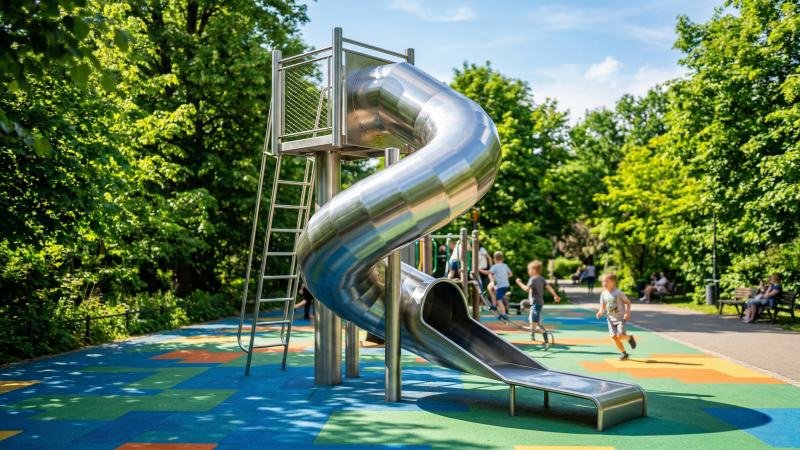
Are you trying to calculate the exact budget required for a commercial stainless steel playground slide?
The total cost of a stainless steel playground slide is primarily determined by three core factors: the diameter of the sliding tube, the structural complexity of the design, and the overall platform height. Variations in these specifications directly dictate the volume of raw materials needed, the hours of skilled welding required, and the engineering complexity necessary to ensure structural safety.
The Impact of Tube Diameter on Material Expenses
How exactly does the width of a slide tube change the total price of the equipment?
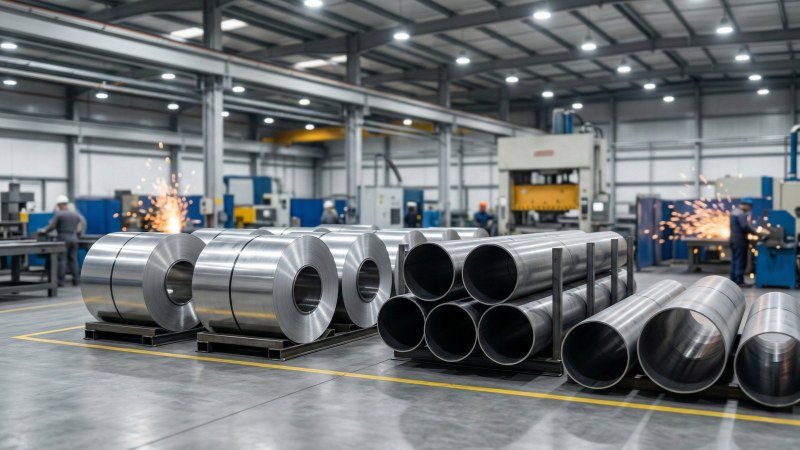
The tube diameter directly dictates the total surface area of stainless steel required for manufacturing. As the diameter increases, the factory must use wider and heavier steel sheets. This significantly raises base material costs, welding time, and overall shipping weight.
Standard 60cm for Compact Spaces
The 60cm diameter is the baseline size for many basic slide projects. This size requires the least amount of raw metal. Because the tube is narrower, the steel sheets do not need to be as thick to stay rigid. That keeps your base material cost very low.
Forming a 60cm tube is standard practice in playground manufacturing, similar to rolling the metal for standard playground crawl tunnels. The narrower diameter requires less force to bend and shape on standard factory rollers.
- Uses less total square footage of stainless steel.
- Requires less welding wire and labor time.
- Weighs less, which reduces transportation costs.
Keep in mind that exact plate thickness and material weight can vary based on the manufacturer’s specific tooling capabilities. Always verify the final dimensional specifications and metal gauge with your supplier.
Mid-Range 72cm and 76cm for General Commercial Use
When you move to a 72cm or 76cm diameter, the cost jumps noticeably. Why step up to these larger sizes? They offer better clearance for older children and thicker winter clothing.
This size range is the standard for city parks and schools. To make a wider tube, manufacturers must cut larger steel blanks. On top of that, as the circle gets wider, the metal can flex more easily. To prevent this, factories must upgrade to a thicker sheet of steel.
The table below shows how the required material increases as the diameter grows.
| Tube Diameter | Approximate Circumference (Material Width) | Relative Material Cost Impact |
|---|---|---|
| 60cm | 188.4 cm | Baseline Cost |
| 72cm | 226.1 cm | +20% Material Volume |
| 76cm | 238.6 cm | +26% Material Volume |
This jump in material volume directly increases your purchase price.
Premium 80cm for High-Traffic and Adult Accessibility
The 80cm diameter is the premium option. It is specifically designed to accommodate adults or parents riding with toddlers. Naturally, this size carries the highest material price tag.
Just as load-bearing playground swing frames require thicker steel columns to support heavy dynamic loads, a wider 80cm tube requires a much thicker metal wall to prevent buckling under pressure. An 80cm slide usually demands 2.5mm or 3.0mm thick stainless steel, rather than the standard 2.0mm used for smaller tubes.
This extra thickness drastically increases the total weight of the slide. It also forces the factory to use heavy-duty hydraulic press brakes to bend the thick metal. The combination of thicker steel, heavier weight, and specialized machine labor makes the 80cm option the most expensive choice in terms of raw material expenses.
Slide Configurations and Structural Complexity
The physical shape and structural design of a stainless steel slide heavily influence the final manufacturing price.
The structural configuration of a slide dictates the price by altering the required welding hours, engineering complexity, and material volume. A basic straight design requires standard linear welding, whereas complex curves, full-tube enclosures, and custom transparent sections demand advanced 3D modeling, specialized rolling equipment, and highly skilled manual fabrication, directly increasing the total cost.
Straight vs S-Spiral Geometry
Straight slides are the most budget-friendly option. Factories easily cut metal sheets and form them into simple straight lines. That means the required labor time drops significantly.
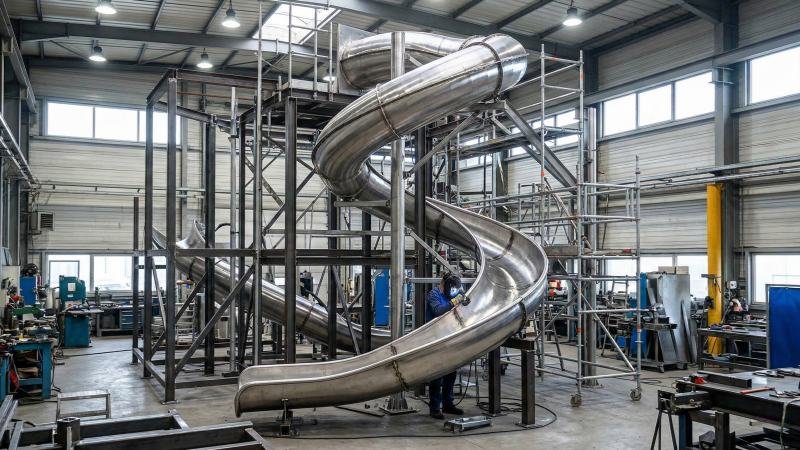
But throw an S-spiral into the mix, and the whole equation changes. Creating a twisted, descending curve requires advanced engineering. Workers cannot simply bend the metal in one single direction. Unlike a straight sliding track, workers must carefully roll the steel on multiple axes to maintain a consistent sliding slope and rider safety through the curve.
Beyond the rolling process itself, welding a spiral is notoriously difficult. Ever tried maintaining a perfect, continuous bead on a compound curve? This precise manual work takes significantly more time. In the real world, complex spiral geometry can increase fabrication labor costs by 30% to 50% compared to straight designs. Since minimum bending radius capabilities vary between factories, always verify the exact turning limits for your specific custom design.
Full Tube vs Half Tube Material Requirements
Why do fully enclosed slides cost so much more? The answer comes down to basic math and factory labor.
A half-tube slide is an open-top design. It uses a single formed sheet of metal for the bottom sliding track. Right off the bat, it requires less raw stainless steel.
Switch to a full-tube slide, and you need two separate halves. Workers must weld a top cover securely to the bottom track. This design choice immediately doubles your raw material requirements. Crucially, it also creates two long, continuous welding seams along the entire length of the equipment.
- Requires twice the amount of stainless steel sheet metal.
- Doubles the amount of welding wire and shielding gas consumed.
- Demands extensive interior polishing to make the seams safe.
Workers must grind and polish the inside joints perfectly smooth. This prevents children from snagging their clothes. This internal finishing work is highly labor-intensive and directly drives up the final price.
Cost Implications of Transparent and Semi-Transparent Sections
Adding clear windows to a stainless steel slide makes it look modern and fun. But the second you mix materials, production costs spike.
Factories usually use thick, impact-resistant polycarbonate for these transparent sections. The plastic itself is not the main expense. Instead, the high cost comes from joining the plastic securely to the metal. You cannot weld plastic to steel. Because of this, we have to engineer custom metal flanges.
Similar to integrating heavy-duty polycarbonate viewing bubbles into a multi-level playground deck, the factory must cut precise holes in the steel. Then, they must install waterproof gaskets, metal frames, and industrial fasteners to ensure a seamless, child-safe transition between the plastic and the metal.
| Design Configuration | Material Joining Method | Relative Fabrication Cost |
|---|---|---|
| Solid Stainless Full Tube | Continuous Argon Arc Welding | Baseline Enclosed Cost |
| Tube with Transparent Top | Flanges, Bolts, and Rubber Seals | High (+30% to +40%) |
This mechanical fastening process takes hours of extra manual labor. Factor in the need to secure those joints to withstand weather and heavy vibration, and you add significant structural complexity to the build.
Platform Height and Its Compounding Effect
How exactly does the starting height of your playground structure multiply the total cost of your stainless steel slide project?
The platform height dictates the total linear length of the slide, which directly multiplies material and fabrication costs. Furthermore, taller elevations require exponential increases in heavy-gauge load-bearing columns, custom mounting brackets, and specialized installation equipment to maintain structural integrity and rider safety.
Base Pricing for Single-Level Drops
When dealing with a standard single-level drop, the pricing formula remains relatively predictable. Factories typically calculate this base cost using a fixed price per linear meter.
A standard playground deck usually sits at 1.2 meters, 1.5 meters, or 2.0 meters high. Because these heights are standard, the required slide length is easy to calculate. Most manufacturers use a standard 30-degree to 40-degree descent angle for safety. So, a 2-meter high platform generally requires about 4 to 5 meters of actual slide length.
Think of this process like ordering standard modular playground posts and decks. The factory cuts standard materials, applies basic welds, and ships the product with minimal custom engineering.
- Uses standard support poles that bolt directly into a concrete pad.
- Requires no heavy crane equipment for installation.
- Involves simple, pre-engineered mounting brackets.
Because standard deck heights and descent angles can vary slightly between different playground equipment manufacturers, always verify the exact required slide length and connection specifications before finalizing your budget.
Why Multi-Story and Custom Elevations Increase Costs Exponentially
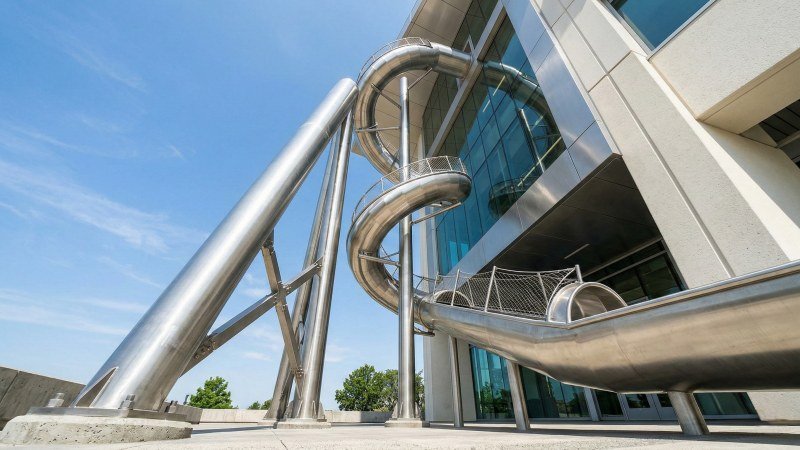
What happens when you design a slide exiting from a second-story mall floor or a three-story outdoor tower? The costs do not simply double. Instead, they increase exponentially.
A multi-story slide faces immense gravitational and dynamic forces. When a person slides down from a great height, they generate significant kinetic energy. This energy causes the metal tube to vibrate and sway. Think a standard deck flange can handle the sway of a 3-story drop? Not a chance. To prevent structural failure, engineers must design heavy-duty support systems.
This is similar to the engineering required for large-scale amusement park water slides or giant tower structures. A towering slide requires heavy steel supports, thicker foundations, and complex cross-bracing to resist wind and dynamic user movement.
| Cost Factor | Single-Level Drop (Under 2m) | Multi-Story Elevation (Over 3m) |
|---|---|---|
| Support Columns | Standard 114mm steel pipes | Heavy-duty, thick-walled truss supports |
| Mounting Hardware | Basic deck flanges | Custom wall-anchors and floor plates |
| Installation Method | Manual lifting by workers | Requires heavy machinery and cranes |
| Engineering Fees | Included in base price | Requires custom structural safety analysis |
And let’s not forget the site itself—custom elevations often mean the slide must navigate around existing building architecture. Workers must fabricate custom support arms to anchor the slide safely to concrete walls or structural pillars. Throw in the cost of renting heavy machinery, like scissor lifts and cranes, to install these massive steel sections securely at high elevations, and you’ll add thousands of dollars to your final project invoice.
Conclusion
Understanding the pricing factors of stainless steel slides allows you to make informed decisions for your next commercial project. By carefully selecting the appropriate tube diameter, slide configuration, and platform height, you can balance structural safety with your project’s budget. Upgrading to thicker materials, spiral designs, or multi-story elevations will naturally increase the final cost due to added engineering and fabrication labor. If you need help calculating the exact costs for your specific design requirements or navigating these technical specifications, please feel free to contact us today for professional assistance and a detailed quote.