-
Whatsapp: +86 15516933785
-
Email: hanlin@hanlinplayground.com
-
Address: Shangjie District, Zhengzhou City, Henan Province, China
-
Whatsapp: +86 15516933785
-
Email: hanlin@hanlinplayground.com
-
Address: Shangjie District, Zhengzhou City, Henan Province, China

How to Create a Commercial Outdoor Montessori Playground: A Complete Design & Equipment Guide

What constitutes the gold standard for designing and equipping a nature-based educational play space?
Creating a commercial outdoor Montessori playground requires a strategic integration of durable natural materials, open-ended design principles, and rigorous safety engineering. Unlike traditional playgrounds, these spaces are meticulously zoned to foster independence and sensory exploration, utilizing commercial-grade wooden structures and impact-absorbing surfacing that comply with ASTM and EN public use standards to ensure a secure environment for self-directed learning.
Key Characteristics of a Montessori-Inspired Outdoor Space
What distinguishes a commercial Montessori playground from a standard recreational area?
A Montessori-inspired outdoor space is defined by its use of natural materials, an emphasis on open-ended exploration, and design elements that foster independence through self-directed play. Unlike traditional playgrounds that dictate how children should play with fixed plastic structures, these environments utilize wood, stone, and topography to create a sensory-rich setting. The design prioritizes “calculated risk,” allowing children to assess their own physical limits within a safe, controlled environment, thereby promoting confidence and cognitive development.
Prioritizing Natural Materials Over Plastic
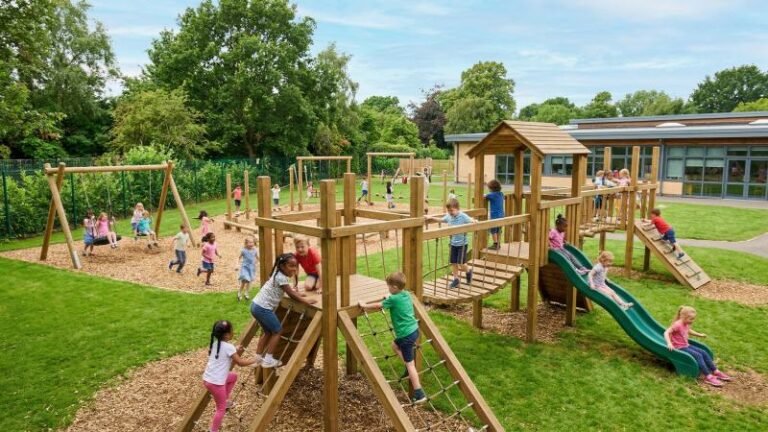
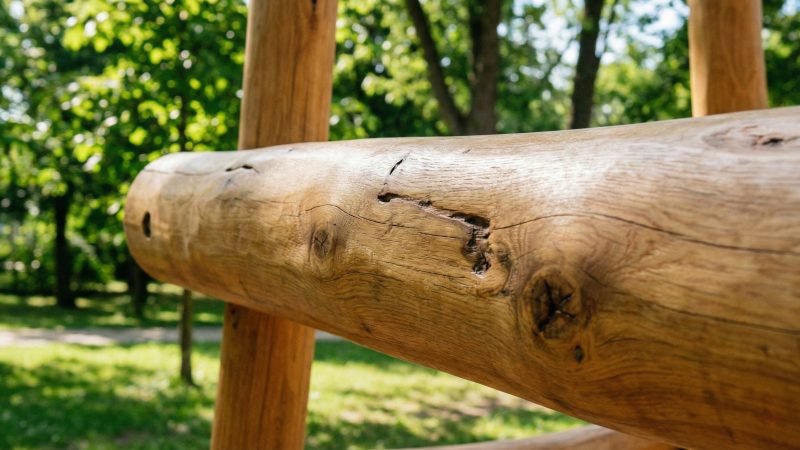
The most immediate visual difference in a Montessori playground is the absence of bright, primary-colored plastic. Instead, the design relies heavily on organic materials. For a commercial facility, this means sourcing high-quality hardwoods like Robinia, Cedar, or pressure-treated pine.
Using natural materials provides a superior sensory experience. Plastic tends to feel the same regardless of the shape—uniformly smooth and often thermally conductive (too hot or too cold). In contrast, wood offers texture, temperature moderation, and visual grain patterns. When a child grips a wooden beam, they feel the friction and warmth of the material. This tactile feedback is crucial for developing fine motor skills and sensory processing.
Then there is the visual factor. Standard playgrounds often create visual overstimulation. A nature-based design blends with the landscape, making the playground feel like an extension of the environment rather than an intrusion.
Comparison: Natural vs. Synthetic Commercial Materials
| Feature | Natural Materials (Wood/Stone) | Synthetic Materials (Plastic/Steel) |
|---|---|---|
| Tactile Feedback | High (Varied textures, warmth) | Low (Uniformly smooth, cold/hot) |
| Visual Impact | Calming, blends with landscape | High contrast, stimulating |
| Weight/Stability | Heavy, grounded feel | Lighter, often requires deep footing |
| Aging Process | Weathers naturally (silver/grey) | Fades or cracks over time |
Note: The specific weathering properties and lifespan of wood species can vary based on the supplier and local climate conditions. We recommend selecting timber grades specifically rated for ground contact in your region.
Focusing on Open-Ended Play Opportunities
In the playground industry, equipment is often categorized as either “prescriptive” or “open-ended.” Prescriptive equipment has a single, defined purpose. For example, a spring rider shaped like a horse creates a singular narrative: the child is riding a horse.
Montessori design rejects this limitation. It favors open-ended structures that function as “blank canvases” for the child’s imagination. A simple wooden platform system is not just a platform. To one child, it is a stage; to another, it is a mountain summit; and to a third, it is a house.
Here is where the ROI kicks in. If a piece of equipment only does one thing, children may get bored after a few uses. However, if the equipment adapts to the child’s changing play ideas, engagement remains high over time. This fosters creativity and social negotiation among children as they decide the rules of their game.
Encouraging Calculated Risk and Physical Challenge
Safety is paramount in any commercial setting, but Montessori philosophy distinguishes between “hazard” and “risk.” A hazard is a hidden danger the child cannot see, such as a loose bolt or a rotting plank—these must be eliminated. A risk is a visible challenge the child chooses to undertake, such as walking across a narrow beam.
A well-designed Montessori playground encourages calculated risk. This means the environment offers challenges that require focus and effort, building physical competence and self-esteem.
Elements of Beneficial Risk
- Variable Heights: Structures should offer different levels of elevation. This allows toddlers to stay low while older children climb higher, self-regulating based on their comfort level.
- Balance Challenges: Unlike rigid steel walkways with high guardrails, a log balance beam requires the child to use their core muscles and focus to stay upright.
- Graduated Difficulty: The design should allow a child to master a skill in steps. For instance, a low stepping stone leads to a higher one, creating a clear path of progression.
By providing these opportunities, you allow children to learn their body’s limits. This internal risk assessment is a critical life skill that standard, overly-protected playgrounds often fail to teach.
Essential Gross Motor Equipment for Active Play
The core of a commercial Montessori gross motor zone relies on modular wooden climbing structures, varied balance trails, and overhead upper-body apparatus. Unlike standard playgrounds that often center around a single slide tower, a Montessori zone focuses on functional movement patterns. Equipment is selected to develop specific skills: geometric climbers for coordination, stepping clusters for vestibular development, and brachiation bars for upper-body strength.
Modular Climbing Structures and Arches for Different Ages
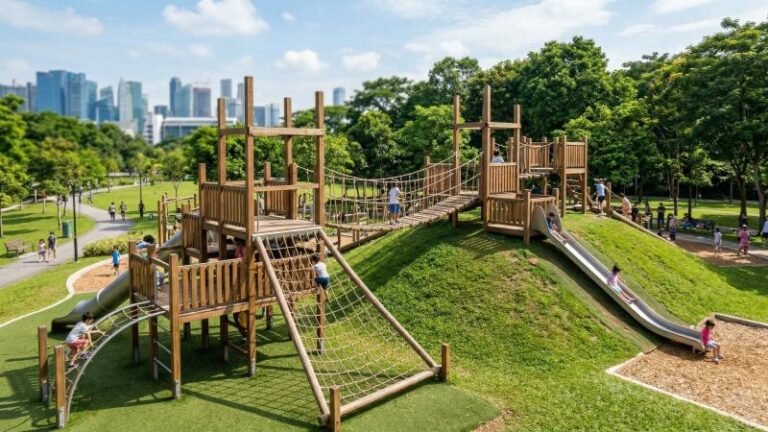
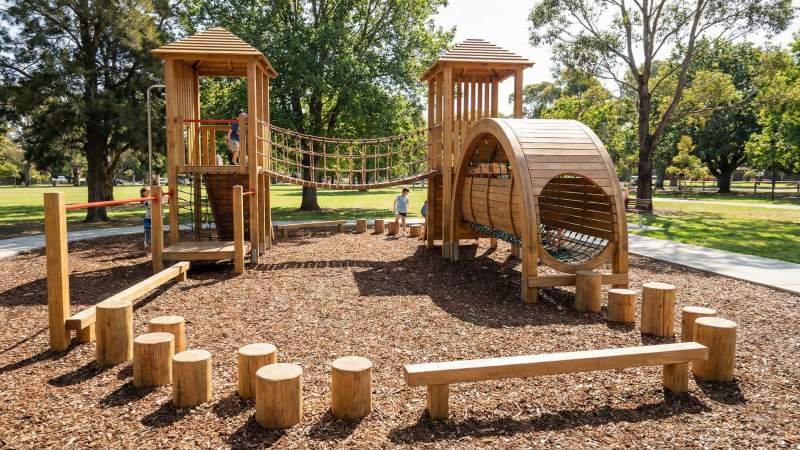
In a commercial setting, climbing structures serve as the central hub for physical activity. The Montessori approach utilizes geometric shapes, such as triangles, domes, and arches, rather than thematic structures like pirate ships. These shapes are stable, inviting, and functionally versatile.
Scalability and Modularity
Commercial climbing systems function similarly to industrial scaffolding. You can start with a central unit and add connecting bridges or ramps later. This modularity is vital for business owners as it allows you to expand your playground’s capacity as your visitor numbers grow, without the capital expense of replacing the entire system.
The Benefit of Non-Directional Play
A slide has one direction: up the stairs, down the chute. A geometric climbing dome is non-directional. Children can approach it from any side. This increases the “throughput” of the equipment—more children can play on a dome simultaneously than on a slide, maximizing the utility of your floor space.
Safety Note: The diameter of climbing rungs is a critical technical specification. Toddler rungs must be small enough for a secure grip, while school-age rungs must be thicker to support weight. Always ensure your equipment meets ASTM F1487 or EN 1176 standards for the specific age group served.
Wooden Balance Beams and Stepping Log Clusters
Balance is a fundamental gross motor skill that connects directly to reading and writing readiness. To develop this, Montessori playgrounds utilize “balance trails” rather than isolated pieces of equipment.
Creating Continuous Circuits
Think of a balance trail like an electrical circuit. If the wire is broken, the energy stops. Similarly, balance equipment should be arranged in a flow. A child should be able to step from a log to a beam, then to a boulder, without touching the ground. This encourages the “floor is lava” style of play, which requires intense concentration and core stability.
Types of Balance Equipment
| Equipment Type | Physical Challenge | Commercial Application |
|---|---|---|
| Fixed Balance Beams | Linear movement, heel-to-toe walking. | Install in zig-zag patterns to save space and increase difficulty. |
| Stepping Log Clusters | Vertical jumping and landing stability. | Group varying heights (e.g., 6″ to 18″) to create “mountain” peaks. |
| Wobble Boards | Dynamic balance (reaction to movement). | Best for older zones; requires pivot hardware maintenance. |
Surface Texture and Grip
Commercial Wooden Balance Beams are often treated with a non-slip grit or have a natural rough-sawn texture. Smooth, polished wood becomes dangerous when wet. When selecting logs or beams, ensure the top surface provides adequate friction for rubber-soled shoes.
Monkey Bars and Trapeze Rings for Upper Body Strength
Upper body strength is frequently underdeveloped in modern children due to sedentary lifestyles. Brachiation (swinging from arm to arm) is the antidote, engaging the shoulder girdle and hand grip.
The Mechanics of Brachiation
This equipment functions like a conveyor system for the body. The child must support their entire weight and generate momentum to move forward. This is significantly more physically demanding than simply climbing a ladder, where the legs do the work.
Equipment Variations
- Monkey Bars: The classic horizontal ladder. Rigidity is key here. If the bars flex or bounce too much under weight, it breaks the child’s rhythm.
- Trapeze Rings: These hang from chains or ropes. They add an element of instability. The child must stabilize the ring before grasping it, which engages the stabilizer muscles in the shoulder and core.
Critical Reminder: The “Critical Fall Height” of the surfacing underneath (mulch, sand, or rubber) must match the maximum height of the equipment. Verify this rating with your surfacing supplier to ensure compliance.
Integrating Sensory and Practical Life Stations
Commercial sensory and practical life stations are engineered fixtures designed to withstand heavy daily use while facilitating fine motor development through “real work” simulations. Unlike residential toys, these stations utilize industrial materials like stainless steel, high-density polyethylene (HDPE), and rot-resistant hardwoods. They feature integrated drainage systems and permanent anchoring, transforming messy play into a structured educational activity.
Setting Up Durable Mud Kitchens for High-Traffic Use
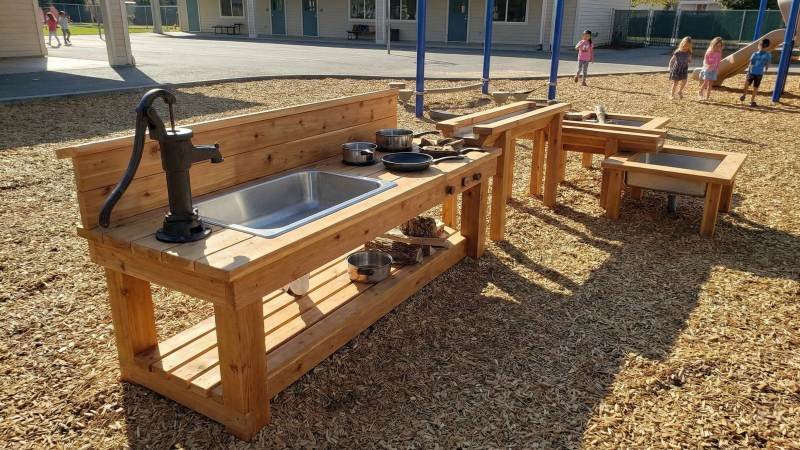
In a commercial Montessori setting, a mud kitchen is not a toy; it is a workstation. It mimics a professional kitchen prep area. The design must prioritize hygiene and durability over aesthetics.
Material Selection for Counters and Sinks
Standard pine lumber used in DIY projects will rot quickly when exposed to constant mud and moisture. For high-traffic facilities, the countertop surface must be non-porous. High-Density Polyethylene (HDPE) or naturally rot-resistant hardwoods like Black Locust are industry standards.
The sink basins should be stainless steel rather than plastic. Stainless steel resists cracking during freeze-thaw cycles and is easier to sanitize. Think of these basins like the sinks in a school cafeteria; they need to endure constant scrubbing and impact.
Plumbing and Water Access
Let’s talk about the plumbing reality. A functional mud kitchen requires a water source, but running pressurized lines is expensive. A common industry solution is the manual hand pump system. This draws water from a reservoir or connection, adding a physical “work” element—children must exert mechanical effort to get the water, reinforcing the cause-and-effect relationship.
Water Tables and Sandboxes for Tactile Exploration
Tactile exploration stations like water tables and sandboxes are essential for sensory processing. In a public or school environment, the primary design challenge is containment and maintenance.
Sandboxes: Hygiene and Drainage
A commercial sandbox is engineered similarly to the foundation of the playground itself. It requires proper drainage to prevent it from becoming a mud pit. This typically involves a layer of gravel and landscape fabric beneath the play sand, functioning like a French drain system. A breathable, weighted cover is mandatory equipment to prevent animal contamination when the facility is closed.
Water Tables: Flow and Physics
Water tables should demonstrate fluid dynamics. Instead of a stagnant pool, effective commercial designs use cascading levels. Water flows from a top basin to lower basins through sluice gates. This mimics a lock-and-dam system used in civil engineering. Children learn about gravity and volume as they manipulate the gates.
Planter Boxes for Nature Observation and Gardening
Gardening aligns perfectly with the Montessori “Care of Environment” curriculum. However, planting in the ground is often impractical in high-traffic zones due to soil compaction from foot traffic.
Raised Beds for Protection and Ergonomics
Raised planter boxes function like guardrails for plants, physically separating the growing medium from the walking surface. From an ergonomic standpoint, a standard height of 18 to 24 inches allows children to interact with the soil without kneeling in mud and ensures ADA (Americans with Disabilities Act) compliance for wheelchair users.
Volume and Material Considerations
The structural walls of the planter must withstand the outward pressure of wet soil, similar to a retaining wall. Commercial planters often use 4×4 inch timbers or thick composite lumber to prevent bowing.
Warning: Ensure the wood used for planters is untreated or treated with non-toxic preservatives. Standard pressure-treated lumber (often green-tinted) may leach chemicals into the soil, which is unsafe for edible gardens.
Smart Layout Strategies for Playground Flow
A smart layout utilizes distinct zoning to manage energy levels, placing high-traffic active areas away from quiet, contemplative spaces to prevent collisions. This strategic “zoning” directs foot traffic much like traffic lanes in civil engineering, while decentralized storage and impact-absorbing natural surfacing ensure that the environment remains orderly, accessible, and compliant with safety regulations.
Separating High-Energy Zones from Quiet Observation Areas
In commercial playground design, controlling the flow of traffic is essential for safety. You cannot have children running full speed toward a climbing tower while cutting through a quiet reading nook.
The Concept of Buffer Zones
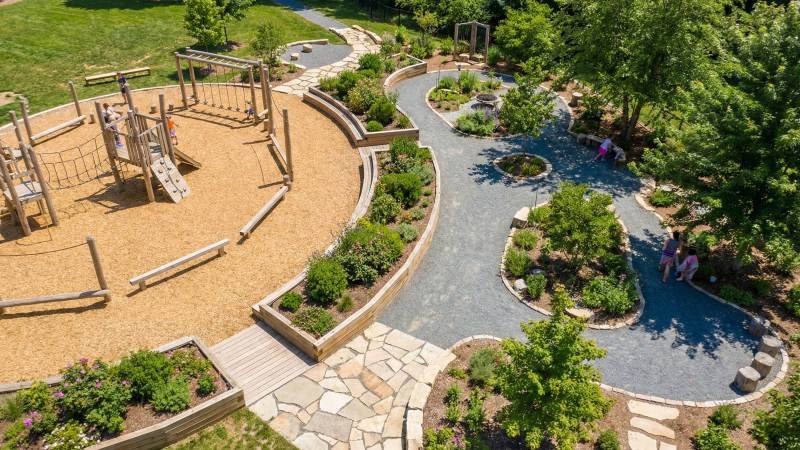
To solve this, designers use “buffer zones,” similar to how urban planning separates a highway from a residential neighborhood. In a playground, a buffer zone might be a sensory garden or a wide pathway. It physically separates the “High-Energy Zone” (climbing, swinging) from the “Quiet Zone” (art, nature observation).
Visual and Physical Barriers
Children naturally follow the path of least resistance. Low fencing, planter boxes, or changes in ground texture act as guide rails. For example, changing the ground surface from wood chips (active zone) to flagstone pavers (quiet zone) creates a visual and tactile cue. This subconsciously tells the child to slow down, much like a “rumble strip” alerts a driver on a road.
Accessible Storage Solutions for Loose Parts
“Loose parts” are small, movable objects like blocks, stones, or fabrics. In a commercial facility, centralized storage often leads to clutter.
Point-of-Use Storage
Commercial storage follows the logic of a well-organized manufacturing floor. Items should be stored exactly where they are used—known as Point-of-Use (POU) storage. If you have a sand area, the buckets and shovels need a dedicated shelf right next to the sand.
Open Shelving vs. Closed Bins
Montessori emphasizes independence. Open shelving acts like a retail display, allowing children to see what is available and return it easily. Crucially, outdoor shelves must be self-draining (slatted wood or wire mesh) to prevent them from collecting rainwater and becoming birdbaths.
Choosing Safe and Natural Ground Surfacing
The ground surface is the largest safety feature in your playground. In a Montessori setting, we reject bright rubber tiles in favor of natural-looking materials that still meet safety codes.
Engineered Wood Fiber (EWF)
This is not standard garden mulch. Engineered Wood Fiber (EWF) is a manufactured wood product designed to knit together to form a stable surface. It looks like a forest floor but functions like an impact-absorbing safety mat. It is the industry standard for natural playgrounds.
Play Sand vs. Structural Sand
Sand is excellent for sensory play, but it creates accessibility issues for wheelchairs. Therefore, sand is often restricted to the “sand pit” zone, while EWF covers the general circulation areas.
Comparison of Natural Surfacing Options
| Surface Material | Impact Absorption | Accessibility (Wheelchairs) | Montessori Aesthetic |
|---|---|---|---|
| Engineered Wood Fiber (EWF) | High (Rated for falls) | Moderate (Firm if compacted) | Excellent (Wood look) |
| Play Sand | High (If deep enough) | Low (Wheels sink) | Good (Natural texture) |
| Rubber Mulch | Very High | Moderate | Low (Synthetic look) |
| Turf/Grass | Low (Wear patterns form) | High | High (Greenery) |
Maintaining the Environment and Safety Standards
What are the specific maintenance obligations required to ensure a commercial natural playground remains safe and compliant over time?
Maintaining a commercial Montessori playground requires a rigorous schedule of structural inspections, surface replenishment, and wood preservation treatments. Facility managers must conduct frequent audits to identify natural wear patterns, such as timber checking or hardware loosening caused by thermal expansion, ensuring the site continuously meets ASTM F1487 or EN 1176 safety specifications to mitigate liability and prolong equipment life.

Regular Inspection Routines for Commercial Wooden Equipment
Wood is a hygroscopic material that absorbs and releases moisture, causing natural expansion and contraction.
Hardware Tightening Schedules
Because the wood moves, the steel bolts connecting the timbers can loosen over time. Think of this like the maintenance required for industrial machinery with moving parts. If you neglect the torque settings, stability is compromised. A protocol to retighten hardware should be established on a monthly or seasonal basis.
Distinguishing “Checks” from Cracks
Inspectors often confuse natural wood “checks” with structural cracks. A check is a separation of the wood grain that occurs as the log dries. It usually runs lengthwise and stops at the center of the log. This is normal and cosmetic. A structural crack is different; it often goes all the way through the timber or breaks across the grain, requiring immediate attention.
Inspection Frequency Table
| Component | Frequency | What to Look For |
|---|---|---|
| Moving Parts | Daily | Swings, bearings, and hinges for squeaking or excessive wear. |
| Surfacing | Weekly | Displaced mulch/sand, foreign objects, debris. |
| Hardware | Monthly | Loose bolts, protruding caps, missing vandalism-resistant screws. |
| Timber | Quarterly | Splinters, rot at ground level, structural cracks. |
Weatherproofing and Treating Natural Wood for Longevity
Investing in high-quality wooden equipment requires protecting that investment from UV radiation and moisture. Unprotected wood will turn grey and eventually rot.
The Silvering Process vs. Decay
All exterior wood will eventually turn silver-grey due to UV exposure. This is a cosmetic change called a “patina” and does not necessarily indicate rot. However, if the wood feels soft or spongy to the touch, specifically near the ground (the “splash zone”), this indicates decay.
Penetrating Oils vs. Film Finishes
For commercial playgrounds, avoid varnish or paint. These form a film on top of the wood that will crack and peel when the wood moves. Instead, use penetrating oils. These soak into the wood fibers to repel water. They do not peel, meaning when maintenance is needed, you simply clean the wood and apply a new coat—no heavy sanding required.
Compliance with Safety Standards (ASTM/EN) for Public Use
Compliance is the legal shield for your business. In the United States, commercial playgrounds must adhere to ASTM F1487 (Public Use). In Europe, the standard is EN 1176. These are far stricter than residential standards.
The Head and Neck Entrapment Probe
Certified Playground Safety Inspectors (CPSI) use specific tools called “probes” to test openings. The most critical is the head entrapment probe. It ensures that an opening is either small enough that a body cannot fit through, or large enough that a head can slide out easily. The danger zone is an opening generally between 3.5 inches and 9 inches.
Fall Zone Clearance
Every piece of equipment has a required “use zone” or “safety zone.” This is the empty space needed around the structure. For a climbing structure, this usually extends 6 feet (1.8 meters) in all directions. You cannot place a bench or a tree within this zone. Documenting your adherence to these zones is vital for liability protection.
Conclusion
At the end of the day, building a commercial Montessori playground isn’t just about buying wood and bolts—it is an investment in creating a developmental environment that respects the child’s intelligence and physical capabilities. By prioritizing natural materials, ensuring rigorous safety compliance, and designing for flow and independence, you create a unique space that stands out in the market.
If you are ready to design a playground that meets these high standards, contact us today to discuss your vision.