-
Whatsapp: +86 15516933785
-
Email: hanlin@hanlinplayground.com
-
Address: Shangjie District, Zhengzhou City, Henan Province, China
-
Whatsapp: +86 15516933785
-
Email: hanlin@hanlinplayground.com
-
Address: Shangjie District, Zhengzhou City, Henan Province, China

Indoor Playground Business Plan: The Complete Guide to Costs, Profits, and Execution
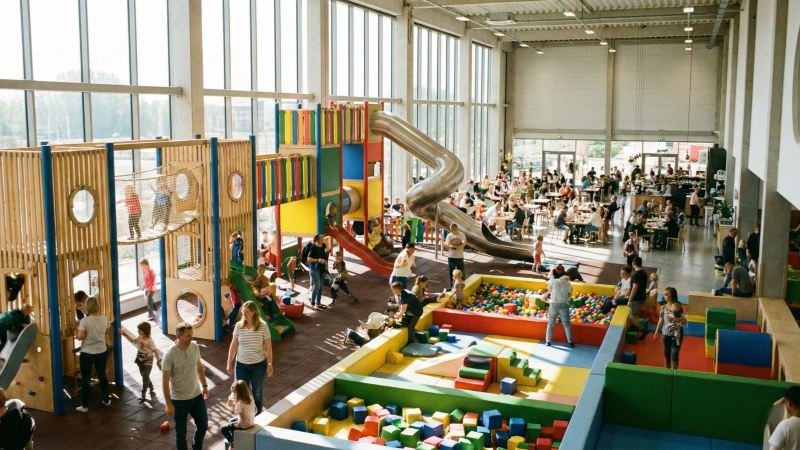
What exactly goes into a professional indoor playground business plan to ensure funding and long-term success?
A comprehensive indoor playground business plan integrates a detailed market analysis of local demographics, a strict safety compliance strategy for equipment, and robust financial projections including a 24-month return on investment (ROI) roadmap. It serves as a critical document for securing bank financing, negotiating leases, and establishing operational protocols that minimize liability while maximizing revenue through admissions and party packages.
Market Analysis and Target Demographics
How do you determine if a local market can actually support a new indoor playground business?
A successful market analysis for an indoor playground primarily involves quantifying the population of families with children aged 0-12 within a specific drive-time radius and analyzing competitors to find service gaps. This process requires gathering demographic data on household income and population density, then cross-referencing this with the current capacity of existing entertainment centers to prove there is unmet demand before signing a lease.

Identifying Your Core Customer Base and Age Groups
Let’s get one thing straight: you are serving two very different masters. First, you have the consumers, who are the children playing on the equipment. Second, you have the customers, who are the parents paying for the tickets. A solid business plan addresses the needs of both.
You cannot simply target “children.” You must segment them by age because a toddler has different physical capabilities than a pre-teen. If you group them incorrectly, you risk safety issues and boredom. Who is actually swiping the credit card? It’s the parent who notices that a facility designed purely for 10-year-olds is too dangerous for their toddler, or that a soft play center is too “babyish” for their energetic 8-year-old.
Primary Age Segments
- Toddlers (0-2 Years): These children require ground-level soft play. They need sensory toys and heavy supervision. The decision-makers here are usually stay-at-home parents looking for weekday activities. When planning, you must focus on designing safe toddler zones that are physically separated from high-energy areas.
- Core Group (3-8 Years): This is the “bread and butter” of the indoor playground industry. These children can navigate multi-level play structures independently. They drive the demand for weekend parties.
- Pre-teens (9-12 Years): This group requires more challenging equipment. They often prefer attractions like ninja courses or climbing walls rather than traditional ball pits.
Parent Demographics
You also need to analyze the parents. Look for households with disposable income. In the indoor playground industry, the ideal demographic is often families with a dual income or stay-at-home parents in suburban areas who value safe, climate-controlled environments for their children.
Analyzing Local Competitors and Finding Market Gaps
Competitor analysis is not just about listing other businesses; it is about hunting for what the current market lacks. You must differentiate between direct competitors and indirect competitors.
Direct Competitors
These are other indoor playgrounds, trampoline parks, or family entertainment centers (FECs) in your area. You must physically visit these locations rather than relying on their websites. Look for operational weaknesses: is their facility dirty? Is the staff rude? Do they focus entirely on trampolines and lack a safe area for toddlers? If a local competitor has a 2-hour wait time on Saturdays, that is a strong indicator of market undersupply.
Indirect Competitors
These are places that compete for a family’s time and money but offer a different experience, such as public parks, zoos, or movie theaters. Public parks are your main indirect competitor because they are free. But here is the catch: they are at the mercy of the weather. Your strategic advantage over a public park is climate control. During hot summers or rainy seasons, your “market gap” is providing a dry, cool, and comfortable place to play.
Identifying the Gap
Use a table to compare features and find your niche.
| Feature | Competitor A (Trampoline Park) | Competitor B (Small Soft Play) | Your Potential Gap |
|---|---|---|---|
| Age Focus | Teens / Adults | 0-5 Years | 3-10 Years (The Void) |
| Food Service | Vending Machines | Snacks only | Full Café / Coffee Bar |
| Cleanliness | Low | Medium | Premium / High Hygiene |
| Party Rooms | Shared space | Small rooms | Private Suites |
By using a matrix like this, you can see where you can win. If everyone else is doing cheap snacks, a high-quality coffee bar for parents becomes your competitive advantage.
Assessing Location Viability and Foot Traffic
The physical location of your playground dictates your revenue potential. In this industry, you generally rely on customers living within a specific drive time. Most parents are unwilling to drive more than 20 minutes for a standard play session. This means your population analysis should focus on a 15-to-20-minute drive radius, not just a generic city-wide census.
Visibility and Accessibility
A warehouse tucked away in an industrial park might have cheap rent, but it requires a massive marketing budget to tell people you exist. On the flip side, a location in a shopping mall or next to a supermarket guarantees “passive” foot traffic. Parents running errands will see your playground and plan a future visit.
Technical Building Requirements
You must assess the building’s physical suitability. The most critical metric is Clear Height. This is the usable height from the floor to the lowest hanging obstruction (like lights or sprinklers), not just the roof height.
If you plan to install a standard three-level play structure, you typically need a clear height of at least 15 to 18 feet (approx. 4.5 to 5.5 meters). If a building only has 10-foot ceilings, you are physically limited to small toddler equipment, which severely restricts your revenue potential. Since specific height requirements vary depending on the structure design, always verify the exact vertical clearance needs with your equipment supplier before signing a lease.
Parking Ratios
Never underestimate parking. Indoor playgrounds have high occupancy during peak times (weekends). If your capacity is 100 children, you might need 50 to 80 parking spaces, assuming many families drive separate cars for birthday parties. A lack of parking causes frustration and will stop customers from returning, regardless of how good your facility is.
Playground Design and Equipment Selection
How do you design an indoor playground layout that maximizes both customer capacity and safety?
A high-performance indoor playground design utilizes a “circular flow” layout to prevent bottlenecks, segregates active play zones by age group to minimize injury risks, and balances high-capacity attractions with detailed sensory play to extend dwell time. This approach ensures parents have clear sightlines for supervision while maximizing the number of paying customers the facility can safely accommodate per hour.
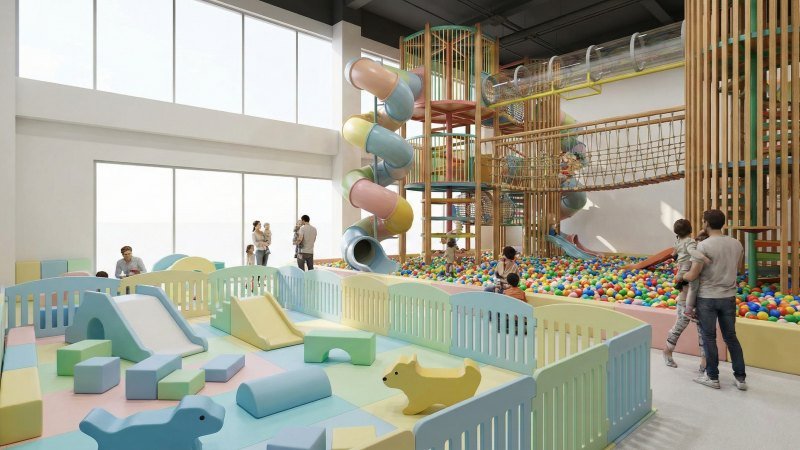
Optimizing Floor Plans for Flow and Capacity
Your floor plan is the blueprint for your revenue. If the layout is poor, customers will feel crowded even when you are not at full capacity. The goal is to move people efficiently from the entrance to the play zones and then to the café.
The “Goldfish Bowl” Concept
Successful operators often use a design concept known as the “Goldfish Bowl.” In this layout, the seating area is central or elevated, and the play structures wrap around it. This allows parents to sit in one spot and visually track their children across different zones. If a parent cannot see their child, they get anxious and leave early. If they are comfortable and have a clear view, they stay longer and buy more coffee.
Zoning for Safety and Throughput
You must physically separate high-energy zones from low-energy zones. Think of it like a theme park: you separate roller coasters from kiddie rides to prevent collisions. Your floor plan needs distinct boundaries.
- The Decompression Zone: The entrance should not lead immediately into the play structure. You need a wide lobby for taking off shoes and signing waivers. A cramped entrance creates a bottleneck that slows down ticket sales.
- The Toddler Buffer: Place the toddler zone away from the main structure’s exit. You do not want excited 10-year-olds running out of a slide and crashing into a 2-year-old.
Selecting Equipment Mix for Maximum Replay Value
“Replay value” means the equipment is fun enough that a child wants to come back next week. If you only buy static equipment (like simple tunnels), children get bored after one visit. You need a mix of active, interactive, and challenging elements.
Balancing Throughput vs. Dwell Time
Different equipment serves different purposes in your business model.
- High Throughput (Slides): A slide is fast. A child goes up and comes down in seconds. This handles large crowds well but provides short engagement.
- High Dwell Time (Ball Pits/Building Blocks): These areas keep a child occupied for 20 minutes. They absorb crowds but can feel full quickly.
The 80/20 Rule of Attractions
A solid plan allocates 80% of the budget to “Active Play” (running, climbing, sliding) and 20% to “Interactive Play” (projection games, ball blasters). Interactive elements are expensive but they create the “wow” factor that drives birthday party bookings.
Equipment Capacity Planning
You need to know how many kids fit in your structure to calculate your potential revenue. A generic rule of thumb in the industry is that a multi-level play structure can accommodate approximately one child for every 20-25 cubic feet of play space. But here is the reality check: capacity calculations vary significantly based on the specific layout density and local fire codes; therefore, you must confirm the rated capacity with your manufacturer and local fire marshal.
| Equipment Type | Function | Best For | Footprint vs. Capacity |
|---|---|---|---|
| Donut Slide | High Thrill | Viral Marketing (Photos) | Large footprint / Medium capacity |
| Spider Tower | Climbing Challenge | Older Kids (5-10) | Small footprint / High vertical capacity |
| Ball Blaster Arena | Interactive | Party Groups | Medium footprint / High capacity |
| Sand/Rice Pit | Sensory Play | Toddlers (0-3) | Small footprint / Low capacity |
Adhering to International Safety Standards and Certifications
Safety is not just about avoiding accidents; it is about liability protection. If you are in the United States, you must comply with ASTM F1918. In Europe, the standard is EN 1176. These are not optional guidelines; they are the benchmarks insurance companies use to decide if they will cover you.
Critical Safety Metrics
- Head Entrapment: Manufacturers use test probes to ensure there are no openings between 3.5 inches and 9 inches. If a child enters feet first, their head must not get stuck.
- Fall Height and Attenuation: Any equipment where a child is elevated requires specific flooring. If a child can fall from 4 feet, the floor underneath must be rated to absorb the impact of a fall from that height. Concrete or thin carpet is unacceptable.
The “Pinch Point” Inspection
Before opening, you must inspect for pinch points. This is similar to checking a door hinge to ensure fingers can’t get caught. If two parts of the playground move (like a swing or a spinner), there must be enough clearance so a child’s finger cannot be crushed between them.
Documentation and Certificates
Do not just take a supplier’s word for it. Demand the TUV or SGS certificate for the specific batch of equipment you are buying. A certificate from three years ago is not valid for a slide manufactured today. To ensure you are buying compliant gear, consult a guide on how to identify quality and safety standards.
Detailed Financial Projections and Startup Costs
What is the actual cost to open an indoor playground, and how long does it take to become profitable?
The total startup cost for an indoor playground typically ranges from $50,000 to over $500,000, heavily dependent on facility size and equipment complexity. A robust financial model requires balancing high initial capital expenditures (CapEx) for equipment and renovation against ongoing operating expenses (OpEx) like rent and insurance, with the goal of achieving a break-even point typically within 18 to 24 months through a mix of high-margin birthday parties and steady open play revenue.

Estimating Initial Capital Expenditure and Hardware Costs
Your Capital Expenditure (CapEx) represents the one-time money you spend to open the doors. In this industry, the play equipment itself is your biggest asset. It is the engine of your business. If you buy a cheap engine, your business will break down.
The “Playground-to-Space” Ratio
Do not assume you need to fill every inch of your building with equipment. A common mistake is overspending on hardware. Experienced operators typically allocate about 40% to 50% of the total floor area for the actual play structure. The rest is needed for parents, café seating, and party rooms.
Cost Breakdown by Category
You should categorize your budget to avoid surprises.
- Equipment Costs: This includes the main jungle gym, soft play mats, and interactive games. Costs usually average between $80 and $150 per square meter of play space, though this varies significantly based on design intricacy.
- Shipping and Installation: This is where rookie owners get burned. Equipment often ships from overseas. You must budget for freight, customs duties, and a professional installation crew. Installation alone can cost 10% to 15% of the equipment price.
- Leasehold Improvements: This is the cost to make the building ready. It includes HVAC upgrades, lighting, and building bathrooms. Construction materials and labor rates fluctuate locally, so always get three quotes from contractors before finalizing your renovation budget.
| Cost Category | Estimated Allocation | Notes |
|---|---|---|
| Play Equipment | 35% – 45% | The core attraction (slides, frames, mats). |
| Renovation/Fit-out | 20% – 30% | Flooring, painting, electrical, plumbing. |
| Deposits & Legal | 10% – 15% | Lease deposits, permits, business formation. |
| Pre-opening Marketing | 5% – 10% | Website, launch ads, signage. |
| Working Capital | 10% – 15% | Cash reserve for the first 3 months of operations. |
Calculating Monthly Operating Expenses and Overhead
Once you open, you have monthly bills to pay regardless of how many customers show up. These are your Operating Expenses (OpEx). Controlling these costs is the only way to survive the slow seasons.
Rent and Occupancy Costs
Rent is usually your largest fixed cost. In the family entertainment industry, your rent should ideally stay below 15% of your projected gross revenue. If your rent pushes towards 20% or higher, it becomes very difficult to maintain a healthy profit margin. You must also account for “Common Area Maintenance” (CAM) fees, which landlords charge for building upkeep.
Insurance Premiums
Insurance is unique in this industry. Unlike a retail store, you have higher liability risks. You need General Liability Insurance specifically rated for “Amusement Centers.” Premiums have risen in recent years. Understanding indoor playground insurance costs is crucial, as you might pay anywhere from $2,000 to $10,000+ per year depending on your attractions. For example, having a trampoline zone often doubles your insurance rate compared to just having a soft play structure.
Labor Efficiency
Staffing is a variable cost. You need more staff on Saturday than on Tuesday.
- The “Floater” Role: Efficient playgrounds use staff who can switch roles. A “Party Host” should also be able to clean tables or work the front desk. This reduces the total headcount needed.
- Ratio Management: Aim for a payroll cost that is roughly 20% to 25% of your revenue.
Forecasting Revenue from Admissions, Memberships, and Parties
You cannot rely on just one income stream. Successful indoor playgrounds rely on a “Three-Legged Stool” model for revenue. If one leg breaks, the business falls.
Leg 1: Open Play (The Traffic Driver)
This is the daily ticket sales. It brings people in, but the profit margins are lower because it is unpredictable. You make money here on volume.
- Weekdays vs. Weekends: Expect 70% to 80% of your open play revenue to come from Friday through Sunday. Weekdays are often very slow unless you have specific toddler programs.
Leg 2: Birthday Parties (The Profit Maker)
This is where the real money is. A birthday party package sells “time and space” at a premium.
- Pre-booking: Parties are booked weeks in advance. This gives you guaranteed cash flow.
- Upselling: A $300 party package can easily become a $500 sale with add-ons like extra pizza, themed decorations, or goody bags. The margin on a party package is often over 50%.
Leg 3: Memberships (The Stabilizer)
Memberships provide recurring revenue. Even if it rains for a month and nobody comes out, the monthly membership fees still hit your bank account. This covers your basic bills like electricity and internet.
Determining ROI and Breakeven Timeline
Your Return on Investment (ROI) measures how efficiently your business generates profit from the initial cash you spent. Banks need to see this number.
Calculating the Breakeven Point
This is the moment when your total revenue equals your total costs.
Formula: Total Fixed Costs ÷ (Average Ticket Price – Variable Cost per Customer) = Number of Customers Needed.
For example, if your rent and staff cost $10,000 a month, and you make $10 profit per child, you need 1,000 children per month just to break even. Any child after number 1,000 is pure profit.
Realistic Timelines
In the indoor playground industry, a realistic timeline to recover your initial investment (Payback Period) is 18 to 24 months.
- Months 1-6: You are building a customer base. You might lose money or just break even.
- Months 6-12: Operations stabilize. Word of mouth spreads. You start seeing consistent monthly profits.
- Year 2: You use profits to pay back the initial loan or investor capital.
If your calculations show a payback period of 6 months, you are likely being too optimistic. If it shows 5 years, the risk is too high. Adjust your ticket prices or reduce your rent expectations to find a healthy middle ground.
Operational Logistics and Risk Management
How do you manage the daily risks and operations of an indoor playground to ensure safety and minimize liability?
Effective operational management relies on a strict ratio of trained floor monitors to children, comprehensive general liability insurance tailored for amusement centers, and a documented sanitation schedule using hospital-grade disinfectants. Minimizing risk requires a proactive maintenance log that tracks equipment wear and tear daily to prevent accidents before they occur.

Staffing Requirements and Training Protocols
Staffing an indoor playground involves more than just hiring teenagers to stand around. You need a structured team focused on safety. Think of your “Court Monitors” like lifeguards at a swimming pool. Their primary job is not customer service; it is accident prevention. They must actively scan the play zones to stop unsafe behavior, such as running up slides or roughhousing, before an injury happens.
Staff-to-Child Ratios
You must maintain a safe ratio of staff to children. A common industry standard is one monitor for every 20 to 30 children in active play areas. However, high-risk areas like trampolines or climbing walls often require a stricter 1:10 ratio. If you are understaffed, you increase the risk of collisions and injuries. Be sure to confirm the required staffing ratios with your insurance provider and local authorities, as these can vary by region.
Essential Roles
- Court Monitors: They enforce rules inside the structure. They need training in conflict resolution to handle unruly children firmly but gently.
- Front Desk/Check-in: These staff members are the gatekeepers. They ensure every child has a signed waiver and wears the correct grip socks.
- Party Hosts: They manage the timeline of birthday parties. They are responsible for serving food and keeping the party schedule on track so the room is ready for the next group.
Emergency Training
Your training protocol must cover specific emergency scenarios. Every staff member needs to know the Code Adam procedure for a missing child. Beyond that, basic First Aid and CPR training isn’t optional—it’s mandatory. If a child breaks a specialized rule, staff should know exactly how to intervene without escalating the situation.
Essential Insurance Policies and Liability Coverage
Insurance for an indoor playground is specialized. A standard business policy is insufficient because your primary “product” is physical activity. If a child breaks an arm, you need a policy that specifically covers “Participant Liability.”
General Liability vs. Participant Liability
Most businesses have General Liability insurance for slips and trips (like a customer slipping on a wet floor). However, you also need Participant Liability. Why does this distinction matter? Because this covers injuries that happen while the customer is using the equipment. Without this, a lawsuit from an injured child could bankrupt your business.
Waivers and Release of Liability
The waiver is your first line of defense. Every customer must sign one before entering. A digital waiver system is superior to paper because it is searchable and easier to store. The waiver acknowledges the inherent risks of play. While a waiver does not stop someone from suing you, it significantly strengthens your legal defense.
Cyber Liability
Since you collect data on children (names, birthdates) and credit card information for bookings, you are a target for hackers. Cyber liability insurance protects you if your customer database is breached.
| Insurance Type | Purpose | Critical For |
|---|---|---|
| General Liability | Covers spectators and premises accidents. | Slips, trips, falls in the café. |
| Participant Liability | Covers active players on equipment. | Broken bones, sprains on slides. |
| Workers’ Compensation | Covers staff injuries. | Employees lifting heavy mats. |
| Property Insurance | Covers physical assets. | Fire, flood, or equipment theft. |
Daily Maintenance Schedules and Hygiene Protocols
Cleanliness is the number one thing parents look for. If your facility smells like dirty socks or the ball pit looks grimy, parents will not return. Hygiene is a marketing tool as much as a safety requirement.
The “Ball Pit” Challenge
Ball pits are notorious germ traps. You cannot just spray the top layer. You need a clear protocol. Most successful operators use a ball washing machine. This device sucks the balls out of the pit, scrubs them with sanitizer, and shoots them back in. You should aim to deep clean the ball pit at least once a week, or more frequently during flu season.
Daily Inspection Log
Before the doors open, a manager must walk through the entire structure. This is your “pre-flight check.”
- Check Zip Ties: The soft foam padding on steel pipes is often held on by heavy-duty zip ties. These can snap or rotate, exposing sharp plastic edges.
- Inspect Netting: Look for holes in the safety netting. A small hole can quickly become a trap for a child’s finger or head.
- Tighten Bolts: Vibration from hundreds of running kids loosens bolts over time. Check floor anchors and slide connections daily.
Sanitization Schedule
Use a “clean-as-you-go” approach for high-touch surfaces. Staff should wipe down café tables immediately after a family leaves. For the play structure, use an electrostatic sprayer at the end of every night. This device charges the disinfectant mist so it clings to the underside of tubes and netting, ensuring 100% coverage. For a detailed breakdown of these procedures, refer to our complete safety sanitation guide.
Documentation is Key
You must log every cleaning and inspection. If a parent claims their child got an infection at your facility, a completed cleaning log is your proof that you exercised “duty of care.” Without this log, you have no evidence to defend your hygiene standards.
Marketing Strategy and Revenue Maximization
How do you ensure your indoor playground attracts customers immediately and generates consistent profit year-round?
A successful marketing strategy requires building an email list of local parents months before opening to guarantee a strong launch, utilizing a “good-better-best” tiered pricing model to increase the average transaction value, and implementing a recurring membership program to stabilize cash flow during slow seasons. This approach shifts the focus from selling single tickets to building long-term customer lifetime value.

Pre-Launch Marketing and Grand Opening Strategies
You cannot wait until you unlock the front doors to start marketing. If you do, you will open to an empty room. You must build anticipation. Think of this like a movie trailer; you need to get the audience excited before the premiere.
The “Construction Phase” Campaign
As soon as you sign the lease, put a large banner on the building. It should say “Coming Soon” and include a QR code. This code should lead to a landing page where parents can enter their email address to win a “Free Annual Pass.” This is your “Lead Magnet.” Your goal is to collect at least 1,000 email addresses of local parents before you open. These are your first customers.
The Soft Opening Strategy
Do not open to the general public on day one. Instead, host a “Soft Opening” for influencers, local “mom bloggers,” and community leaders. Let them play for free in exchange for posting photos on social media. This creates “Social Proof.” When other parents see real children having fun at your facility on Instagram or Facebook, they will trust your business more than if they just saw an ad.
Digital Advertising Focus
Traditional radio or newspaper ads are often ineffective for this industry. Your core customers are young parents who spend time on social media. Run targeted ads on platforms like Facebook and Instagram. You can specifically target users who are parents of children aged 0-10 and live within a 15-mile radius of your location. This ensures you are not wasting money showing ads to people who live too far away.
Structuring Ticket Pricing and Party Packages
Your pricing strategy dictates your profit margin. If you price too low, you cannot cover rent. If you price too high, families will go to the park for free.
The Psychology of Tiered Pricing
When selling birthday parties, never offer just one option. Use the “Good-Better-Best” model. Most customers will avoid the cheapest option (fearing it is “cheap”) and the most expensive option. They will naturally choose the middle option. This allows you to steer customers toward the package with the best profit margin for you.
- Tier 1 (Basic): 10 kids, 1 hour play, paper plates. (Low margin, price anchor).
- Tier 2 (Premium): 15 kids, 2 hours play, pizza included, themed napkins. (Target seller).
- Tier 3 (VIP): 20 kids, private room, dedicated host, goody bags, coffee for parents. (High margin, luxury).
Time-Limited vs. Unlimited Play
Deciding between charging by the hour or offering “all-day play” is critical.
- Weekdays: Offer “All-Day Play.” The facility is not full, so you want guests to stay longer and buy lunch at your café.
- Weekends: Consider “2-Hour Time Limits.” On busy Saturdays, you need turnover. If a child stays for 5 hours on a single \$15 ticket, they are occupying a spot that could be sold to a new customer. Always analyze local competitor pricing before finalizing your rates to ensure you are competitive yet profitable.
Building Loyalty Through Memberships and Events
Recurring revenue is the holy grail of the indoor playground business. Rain or shine, subscriptions keep your bank account positive.
The Gym Membership Model
Create a monthly membership program that automatically charges the parent’s credit card, similar to how a gym operates. Price this at roughly 2.5 times the cost of a single visit.
- The Math: If a single ticket is \$15, set the membership at \$35/month.
- The Psychology: The parent thinks, “If I go three times, I save money.”
- The Reality: Many members will only visit once or twice a month, but they will keep paying the subscription for the convenience. This “breakage” is pure profit.
Filling the “Dead Zones”
Indoor playgrounds are often empty on Tuesday mornings or Wednesday afternoons. You still pay rent for these hours, so you need to fill them. Create specific weekly events to draw crowds during these slow times.
| Event Name | Target Audience | Timing | Goal |
|---|---|---|---|
| Toddler Tuesdays | Stay-at-home parents (Kids 0-4) | Tuesday 10 AM – 12 PM | Fill quiet mornings. |
| Sensory Friendly Hour | Special needs families | Sunday 9 AM – 10 AM | Community service & brand loyalty. |
| Parents’ Night Out | Parents wanting a date night | Friday 6 PM – 9 PM | High ticket drop-off service. |
| Homeschool Hop | Homeschool groups | Wednesday 1 PM – 3 PM | Capture non-school crowds. |
By programming your calendar this way, you maximize the utilization of your facility, ensuring your expensive equipment is earning money every hour you are open.
Finalizing Your Plan for Stakeholders
How do you present your indoor playground business plan to effectively secure funding from banks and approval from landlords?
A successful presentation packages your data into a professional format that prioritizes financial stability over creative concepts, specifically highlighting key ratios like Debt Service Coverage Ratio (DSCR) and clear liquidity reserves. You must demonstrate to stakeholders that your business is a low-risk investment with a proven ability to repay loans and rent, rather than just a fun idea for children.

Writing a Compelling Executive Summary
Make no mistake: the executive summary is the make-or-break section. Investors and loan officers are busy people. They often read the first two pages and skip the rest. If this section does not grab their attention, they will not look at your detailed financial spreadsheets.
The “Hook” and the Solution
Start by clearly stating the problem in your local market. For example, “City X has 50,000 families but no indoor climate-controlled play areas.” Then, present your business as the unavoidable solution. You are not just opening a playground; you are filling a service gap.
Summarize, Don’t Copy
Do not simply copy and paste paragraphs from the rest of your plan. This section must be a distilled version of your entire vision. It functions like the “attract mode” on an arcade machine. It flashes the most exciting features—profitability, location, and experience—to convince the user to insert a coin (invest).
Key Elements to Include:
- Mission Statement: A one-sentence definition of your business values.
- Company Overview: Who owns it and what is your legal structure (LLC, Corp)?
- Financial Highlights: Total startup cost, projected annual revenue, and break-even month.
- Location Strategy: Why this specific building ensures success.
Key Metrics Banks and Landlords Need to See
Banks do not care how fun your slides are. They care about your ability to repay debt. Landlords do not care about your color scheme. They care if you can pay rent for the next 10 years. You must speak their language using specific financial ratios.
Debt Service Coverage Ratio (DSCR)
This is the number one metric for lenders. It measures your available cash flow versus your debt obligations.
- The Formula: Net Operating Income ÷ Total Debt Service.
- The Benchmark: Most commercial banks require a DSCR of at least 1.25x. This means for every $1.00 of debt payment, you have $1.25 in income. If your plan shows a 1.0x ratio, it is too risky for them. Lending requirements vary by region and economic climate, so it is wise to check current interest rates and DSCR requirements with your local bank officer.
Rent-to-Revenue Ratio
Landlords use this to judge if you can afford their space. In the Family Entertainment Center (FEC) industry, a healthy ratio is typically between 10% and 15%. If your projections show rent consuming 30% of your income, a savvy landlord will reject you because they know you will eventually default.
| Metric | Definition | Target Range | Why They Care |
|---|---|---|---|
| DSCR | Cash flow vs. Loan payments | 1.25x or higher | Ensures you can pay the bank back. |
| Liquidity Ratio | Cash on hand vs. Short-term bills | 2:1 | Shows you can survive a slow month. |
| Occupancy Rate | Actual customers vs. Total capacity | 25% – 40% (Average) | Proves your revenue goals are realistic. |
Common Mistakes to Avoid in Your Presentation
Many aspiring owners sabotage their own application by making rookie errors. These mistakes signal to investors that you are inexperienced and risky.
The “Blue Sky” Fallacy
This occurs when you assume best-case scenarios for everything. Do not project 100% capacity on weekends all year round. Experienced operators know that summer months might be slow because kids play outside. A bank wants to see a conservative plan. They prefer a plan that works at 40% capacity over one that only works at 90%.
Underestimating Working Capital
A major red flag is asking for just enough money to open the doors. You must request Working Capital. This is cash in the bank to pay staff and electricity for the first 3 to 6 months while you build your customer base. If you do not include this in your request, you look unprepared for the reality of business ramp-up.
Ignoring the Competition
Never say “we have no competition.” Even if there is no other indoor playground, you compete with public parks, movie theaters, and tablets. Acknowledging these competitors shows you have a realistic view of the market landscape.
Neglecting the Exit Strategy
Investors want to know how they get their money out eventually. Are you planning to run this for 20 years? Do you plan to sell it to a franchise chain in 5 years? Including a clear exit strategy shows you are thinking like a business owner, not just a playground enthusiast.
Conclusion
The bottom line? Starting an indoor playground is a complex venture that requires balancing the excitement of creating a fun environment with the cold realities of business management. By meticulously planning your market entry, designing a safe and engaging facility, and maintaining strict financial discipline, you can build a thriving business. Remember that your business plan is a living document; it should evolve as your business grows, ensuring you remain profitable and relevant in the ever-changing entertainment landscape.