-
Whatsapp: +86 15516933785
-
Email: hanlin@hanlinplayground.com
-
Address: Shangjie District, Zhengzhou City, Henan Province, China
-
Whatsapp: +86 15516933785
-
Email: hanlin@hanlinplayground.com
-
Address: Shangjie District, Zhengzhou City, Henan Province, China

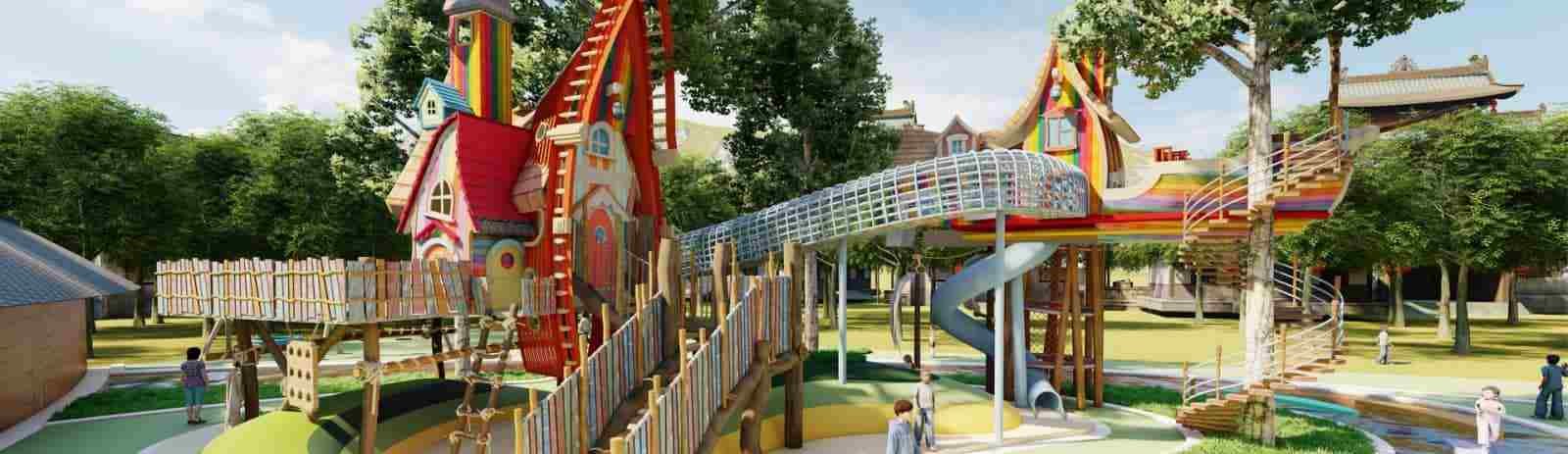
Indoor Playground Design Fees: When Is It Free and When Do You Pay?
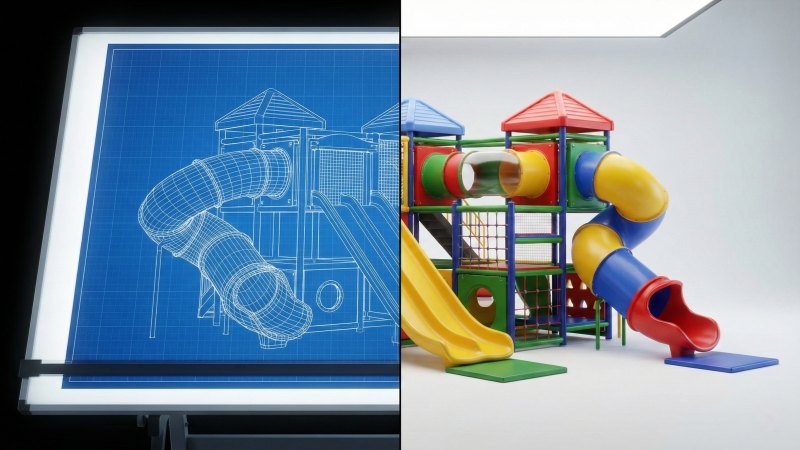
Do you need to pay a separate fee for the design of your indoor playground project, or is it included in the equipment cost?
In principle, indoor playground design is free for most standard projects, as manufacturers view it as a necessary part of the sales proposal. However, for highly complex facilities or projects requiring custom Research and Development (R&D), a design fee or deposit is standard practice, which is typically deducted from the final equipment purchase price upon contract signing.
The Industry Standard: Complimentary Design Services for General Projects
Is it standard practice to pay a separate fee just to see a preliminary layout for your indoor playground investment?
In the majority of cases involving standard indoor playground projects, professional design services are provided free of charge by the manufacturer. This complimentary service typically includes adapting existing catalog products to fit your specific floor plan and generating basic 3D renderings to visualize the equipment placement before purchase.

Adapting Standard Catalog Products to Your Venue
Most indoor playground structures use a modular system. This works very much like industrial scaffolding or warehouse racking systems. The steel pipes, clamps, and deck boards are manufactured in standard sizes. We do not need to reinvent the wheel for every project. Instead, we select pre-engineered components from our library to fill your space.
Designers use specific grid dimensions to plan these layouts. A common industry standard is a 4ft x 4ft (approx. 1.22m x 1.22m) grid for the main frame structure. Because these components already exist in our digital database, placing them into your floor plan is efficient and does not require new engineering calculations. Note that grid sizes can vary between manufacturers (e.g., metric vs. imperial standards), so it is important to verify the exact frame specifications with your chosen supplier to ensure they fit your site constraints.
The process is strictly about arrangement. We take a spiral slide, a ball pit, and a trampoline area from our catalog and arrange them to fit around your building’s columns and specific dimensions. Since no new parts are being invented, the operational cost to the manufacturer is low, allowing us to pass these savings on to you by offering the layout work for free.
Basic Layouts and 3D Renderings for Small to Medium Sites
For small to medium-sized venues (typically under 500 square meters or 5,000 square feet), the design process is straightforward. The goal is to show you exactly what fits within your architectural boundaries. You provide your floor plan, and the design team provides a visualization.
This service usually includes two key outputs:
- 2D Floor Plan: This is a top-down view showing the flow of the playground, marking entry/exit points, and ensuring the equipment does not block fire exits or walkways.
- 3D Effect Drawing: This is a visual representation allowing you to see the color scheme and the height of the equipment relative to your ceiling.
Typical Turnaround Time for Standard Designs
| Project Size | Estimated Design Time | Output Included |
|---|---|---|
| Small (<150 sqm) | 1 – 2 Business Days | 2D Plan, 1-2 3D Perspectives |
| Medium (150-500 sqm) | 2 – 4 Business Days | 2D Plan, 3-4 3D Perspectives |
These renderings are sufficient for making a buying decision. They confirm that the slide fits the ceiling height and that the structure fits the width of the room. They are practical tools rather than artistic masterpieces, which allows manufacturers to offer them without a fee.
Why Manufacturers Offer Free Design for Standard Orders
Why would a business give away hours of skilled labor? The answer lies in accuracy and sales efficiency. In the playground industry, the design is the quote. You cannot accurately price a playground until you know exactly how many pipes, platforms, and slides are required.
If you were ordering a conveyor belt system for a factory, the supplier would sketch out how it fits your production line to provide a price and prove the equipment works. The same logic applies here.
Key Reasons for the Free Model:
- Risk Reduction: If the manufacturer designs the layout, they take responsibility for the fit. They ensure the equipment matches the building dimensions, preventing costly errors during installation.
- Speed to Quote: Generating a standard design allows the sales team to calculate an exact price quickly, moving the project from a concept to a contract efficiently.
- Visual Confirmation: Most investors are not engineers. A 3D image bridges the gap between a technical list of parts and the final product.
By offering this for free, the manufacturer removes a barrier to entry, allowing you to explore the feasibility of your project without an upfront financial commitment.
Two Specific Scenarios Where Design Fees Apply
So, if standard layouts are free, when does a manufacturer actually charge for design work?
Manufacturers charge design fees when a project requires significant custom research and development (R&D) or involves complex, large-scale facility planning. In these cases, the work shifts from simple equipment arrangement to engineering new products or integrating multiple business systems, requiring hundreds of hours from senior architects and structural engineers.
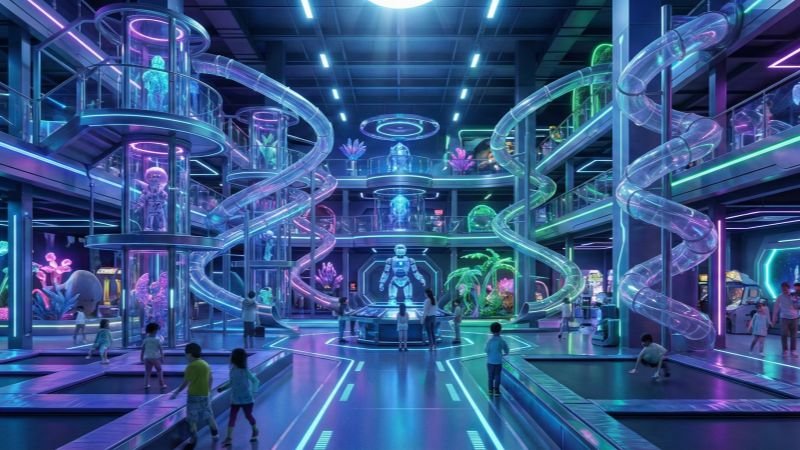
Custom R&D for New Modules and Unique Theming
Standard design is like assembling a model kit where all the pieces are pre-cut. Custom design, however, is like carving the pieces yourself before assembly. When an investor requests a play element that does not exist in the current catalog, the manufacturer cannot simply “draw” it; they must engineer it.
This process involves Research and Development (R&D). For example, if you require a playground themed entirely around a specific, non-standard shape—like a multi-level structure inside a giant custom-molded fiberglass whale—the engineering team faces new challenges. They must calculate the load-bearing capacity of the fiberglass shell and determine how the steel frame connects to this new material without cracking it.
The Engineering Workflow for Custom Items
- Structural Calculation: Engineers calculate weight loads to ensure the custom structure supports adults and children safely.
- Mold Creation: Factory workers must create new molds for plastic or fiberglass components, which consumes raw materials and labor.
- Safety Testing: The new module must undergo virtual or physical stress testing to meet ASTM or EN1176 safety standards.
Because this work involves creating a new product rather than just placing an existing one, it incurs a cost. The fee covers the time of industrial engineers and the resources used for prototyping.
| Standard Catalog Design | Custom R&D Design |
|---|---|
| Uses existing CAD blocks | Creates new CAD models from scratch |
| Verified safety data exists | Requires new safety calculations |
| Completed in days | Can take weeks or months |
| Cost: Free | Cost: Billable Fee |
Complex Planning for Large-Scale Family Entertainment Centers
Then there is the issue of scale. We are not just talking about a play corner; we are referring to comprehensive Family Entertainment Centers (FECs). These projects typically exceed 1,000 square meters (approx. 10,700 square feet).
Designing an FEC is similar to urban planning. It is not just about where to put the slide; it is about how the entire facility functions as a business. For these massive projects, manufacturers assign their most senior designers or hire external interior architects.
Why Large-Scale Projects Require Paid Design:
- Utility Integration: The playground design must align with the building’s mechanical systems. Designers must route equipment around HVAC ducts, sprinkler systems, and complex electrical wiring. A standard designer does not handle these architectural conflicts.
- Traffic Flow Management: In a center with 500+ visitors, bad design leads to overcrowding. Paid planning analyzes visitor flow to prevent bottlenecks at the entrance or ticket counters.
- Multi-Zone Integration: Large centers often combine trampolines, soft play, climbing walls, and arcade machines. These different zones have different floor height requirements and safety clearances. Merging them into a seamless map requires advanced technical skills.
In this context, you are paying for consulting expertise. The manufacturer provides a complete venue solution, including fire exit planning and spectator area layout, rather than just a list of equipment.
The Design Deposit Model: Costs Deducted from Your Final Order
If manufacturers claim design is often free, why do they sometimes ask for an upfront payment before drawing a single line?
The design deposit model functions as a good-faith payment rather than an additional expense. In this system, the client pays a preliminary fee to initiate the custom design process, which is later fully deducted from the final equipment purchase price. This ensures the design service remains effectively free for serious buyers while compensating the engineering team for their initial labor if the project does not proceed.

How the Refundable Design Fee Works
This financial structure is straightforward. It operates exactly like a retainer or an advance on a future purchase. You are not buying a drawing; you are reserving a production slot and engineering time.
When a manufacturer requests a design fee—typically ranging from $300 to $1,000 for standard large projects—they generate a separate invoice for this service. Once you pay this deposit, the design team begins their work. They create the layout, the 3D renderings, and the revision iterations.
Crucially, this money does not disappear. When you decide to move forward and sign the purchase contract for the playground equipment, the manufacturer applies a credit to your final bill.
Financial Breakdown of the Deposit Model
| Transaction Step | Action | Financial Impact |
|---|---|---|
| 1. Initial Inquiry | You request a custom design for a large space. | Balance: $0 |
| 2. Deposit Payment | You pay the design fee (e.g., $500). | You: -$500 Manufacturer: +$500 |
| 3. Design Process | Team delivers layouts and revisions. | No extra cost. |
| 4. Final Order | Equipment total is $50,000. Manufacturer deducts the $500. | New Invoice Total: $49,500 |
| 5. Result | You pay the remaining balance. | Total Design Cost: $0 |
In this scenario, the design is technically free because the money you paid upfront went directly toward the steel, plastic, and soft padding of your future playground. However, if you take the design and decide not to build the project, or if you take the design to a different competitor, the manufacturer keeps the deposit. This covers their labor costs for the hours spent on your proposal.
Why This Policy Protects Both the Investor and Manufacturer
Think of this policy as a filter. It separates serious investors from casual inquiries. In the manufacturing industry, engineering resources are finite. A senior designer can only work on a limited number of complex layouts per week.
Protection for the Manufacturer
Without a deposit, design teams often face a flood of requests from individuals who are just “brainstorming” or researching without a secured venue or budget. This is similar to a factory running a prototype mold for a client who hasn’t committed to a production run. It wastes valuable machine time and material. By requiring a deposit, the manufacturer ensures their high-level staff works only on viable projects, preventing the exploitation of their technical expertise by competitors who might try to copy a layout without understanding the structural engineering behind it.
Protection for the Investor
So, does this actually benefit you? Surprisingly, yes.
- Priority Access: When you pay a deposit, you become a contracted client, not just a lead. Your project moves to the top of the queue.
- Access to Senior Talent: Manufacturers often assign junior draftsmen to free, speculative sketches. However, paid deposit projects usually go to Senior Designers or Technical Directors. You get experienced professionals who understand flow dynamics and safety codes.
- Accountability: Since money has changed hands, the manufacturer is legally and ethically bound to deliver a high-quality proposal that meets your specific requirements.
“Think of the design deposit as ‘Earnest Money.’ It proves you are ready to build, and it commits the factory to deliver their best engineering work for your facility.”
This mutual commitment creates a professional partnership, moving the relationship from a tentative sales conversation to a concrete engineering project. Consequently, the resulting design is sharper, safer, and more tailored to your specific business goals.
The Hidden Value of Professional Design Services
Beyond the fee, what are you actually buying? Why is professional design critical for the long-term success of your indoor playground business?
Professional design services extend far beyond simple aesthetics; they are essential for optimizing operational efficiency, maximizing visitor throughput, and ensuring strict compliance with global safety standards like ASTM and EN. A professionally planned layout prevents costly structural errors, minimizes liability risks, and creates a unique competitive advantage that drives repeat customer visits.
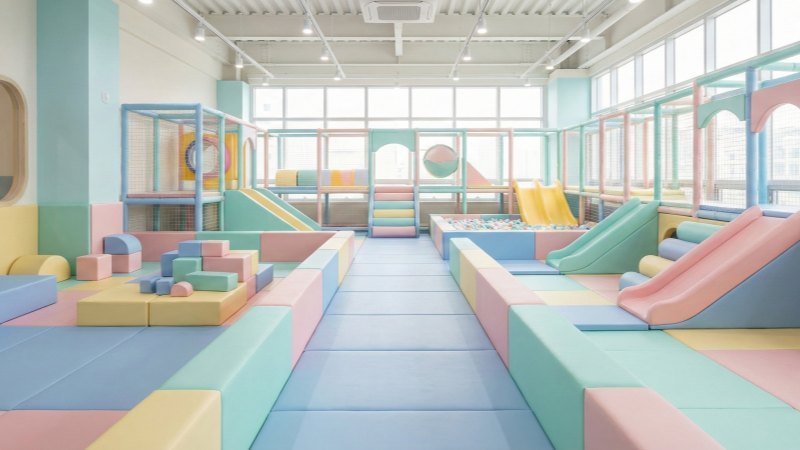
Optimizing Visitor Flow and Playability
A playground is a high-traffic environment. Just like a theme park queue requires specific widths to manage crowds, a playground needs clear paths for running children. Professional designers analyze throughput capacity, measuring how many children can play safely at one time.
If a layout is poor, you get “traffic jams.” For example, placing a slow-moving activity, like a single-lane rope bridge, right at the main entrance causes a bottleneck. Kids wait in line, parents get frustrated, and your capacity drops.
Key Flow Strategies Used by Pros:
- Circulation Paths: Designers ensure main walkways are wide enough for two-way traffic. Note that specific width requirements often depend on local fire codes; always check with your local authority.
- Zoning: Active zones (trampolines) are separated from quiet zones (sensory play) to prevent collisions.
- Visibility: The layout is planned so parents can see their children from the seating area. This reduces anxiety and lets adults relax longer.
Think of this like a factory assembly line. If one machine is too slow, the whole line stops. In a playground, if one slide exit is blocked by a ball pit, the fun stops. Professional design removes these blockages before you build.
Ensuring Safety Standards and Structural Logic
What happens if you skip this step? You don’t just risk bad aesthetics; you risk liability.
Safety is not just about soft padding; it is about geometry and physics. Professional designers understand Structural Logic. They know that a three-story steel frame requires specific bracing to handle the dynamic load of jumping children.
They also calculate Fall Zones (or Use Zones). This is the empty space required around equipment. For instance, a slide exit needs a specific amount of clear space so a child does not slide into a wall.
“A professional design doesn’t just show you where the equipment goes; it proves where the equipment cannot go.”
Common Safety Considerations in Design:
- Head Impact Criteria: Ensuring steel pipes are high enough that kids don’t bump their heads.
- Entrapment Avoidance: Designing gaps that are either too small for a finger or large enough for a body, but never in between.
- Egress Routes: Planning emergency exits that are accessible even when the park is full.
Differentiating Your Park from Competitors
The market is crowded. Many indoor playgrounds buy generic “cookie-cutter” designs. These look identical to every other park in the city. Professional design helps you stand out.
A custom design integrates your specific brand colors and themes into the equipment itself. Instead of a generic square maze, a designer can create a castle, a spaceship, or a jungle that fits your building’s unique shape. This is crucial for Return on Investment (ROI). Parents are more likely to post photos of a unique, beautiful park on social media, creating free advertising for you.
Comparison: Generic vs. Professional Design
| Feature | Generic Template Design | Professional Custom Design |
|---|---|---|
| Theme | Standard primary colors (Red, Blue, Yellow). | Custom themes (Space, Ocean, Candy). |
| Space Use | Often leaves “dead space” in corners. | Utilizes every square inch, including columns. |
| Replay Value | Basic loops that kids bore of quickly. | Complex routes that encourage exploration. |
| Identity | Looks like a fast-food play area. | Looks like a destination attraction. |
By investing in professional design, you are not just buying plastic and steel. You are buying a business asset that competes better in your local market.
Getting Started with Your Custom Proposal
So, you’re ready to build. What do you need to send the manufacturer to get the ball rolling?
To start the custom design process, you must submit a precise floor plan, preferably in CAD (DWG) format, detailing the room’s length, width, and clear ceiling height. Simultaneously, providing a defined budget range and a specific target age group ensures the design team selects the most suitable play elements for your business model.
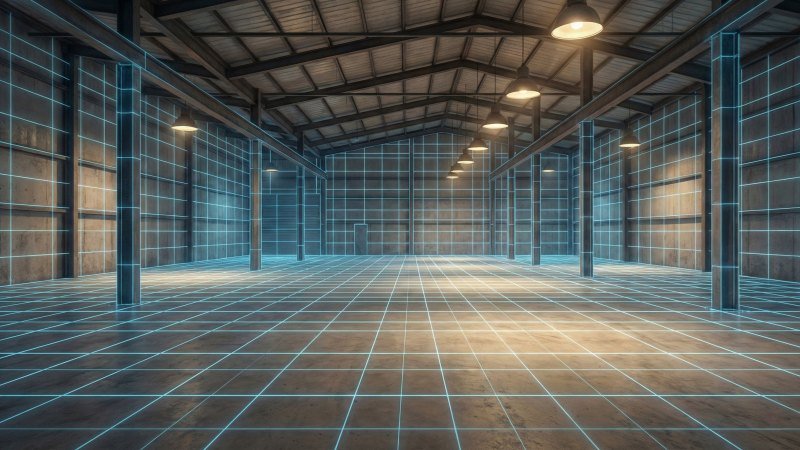
Essential Documents: CAD Drawings and Site Dimensions
The foundation of any accurate design is the floor plan. Manufacturers cannot build a safe structure based on a rough sketch. Think of this like programming a CNC machine. You cannot input “roughly 10 inches” into the machine; you must input exact coordinates. If the data is wrong, the final part will not fit.
Similarly, indoor playgrounds are built on a strict steel grid system. If your measurements are off by even a few inches, the steel frame might hit a column during installation. This leads to expensive on-site cutting and welding modifications.
What Your Floor Plan Must Include:
- The DWG File: This is the standard file format for AutoCAD. It allows designers to import your building’s geometry directly into their 3D software.
- Clear Ceiling Height: You must measure the distance from the floor to the lowest obstruction. This includes hanging lights, HVAC ducts, or sprinkler pipes.
- Entry and Exit Points: Clearly mark where the main doors and fire exits are located. The design cannot block these areas.
- Column Locations: If your building has support pillars, mark their exact size and location. The designer will often build the playground structure around these to save space.
“Accuracy at this stage saves you thousands of dollars in installation labor later.”
Defining Your Budget and Target Audience
Many investors hesitate to share their budget. They fear the manufacturer will simply max out the price. However, hiding your budget is like asking an architect to design a house without telling them if you want a cozy cottage or a luxury mansion. The budget defines the scope and density of the project.
- Low Budget: Focuses on the main frame, slide, and open play areas.
- High Budget: Includes electronic interactive games, fiberglass decorations, and complex mechanical modules.
Target Audience Segmentation
You must also define who will use the equipment. A playground designed for toddlers fails if teenagers use it, and vice versa. The equipment must match the physical size and energy level of the user.
Equipment Selection by Age Group
| Age Group | Typical Equipment Features | Design Focus |
|---|---|---|
| Toddlers (1-4 Years) | Soft foam blocks, low ramps, sensory wall panels. | Safety & Supervision: Parents must easily reach the child. |
| Juniors (5-12 Years) | Spiral slides, ball blasters, multi-level mazes. | Activity & Exploration: High energy burn and physical challenges. |
| Teens/Adults (13+ Years) | Trampoline parks, Ninja warrior courses, high ropes. | Competition & Skill: Strength-based obstacles and extreme sports. |
By clarifying these two factors—budget and audience—you guide the designer to create a proposal that is not only beautiful but also profitable for your specific market.
Conclusion
Understanding the fee structure for indoor playground design is crucial for planning your initial investment. While manufacturers generally offer complimentary layouts for standard projects to facilitate the sales process, complex customization and large-scale planning understandably incur fees to cover engineering resources. Remember, in most legitimate partnerships, these fees are refundable deposits that eventually contribute to the cost of your equipment. By providing accurate CAD drawings and a clear budget from the start, you ensure that you receive a professional, safe, and profitable design, regardless of whether a deposit is required.