-
Whatsapp: +86 15516933785
-
Email: hanlin@hanlinplayground.com
-
Address: Shangjie District, Zhengzhou City, Henan Province, China
-
Whatsapp: +86 15516933785
-
Email: hanlin@hanlinplayground.com
-
Address: Shangjie District, Zhengzhou City, Henan Province, China


The Ultimate Buyer’s Guide to Sourcing Cargo Net Playground Equipment
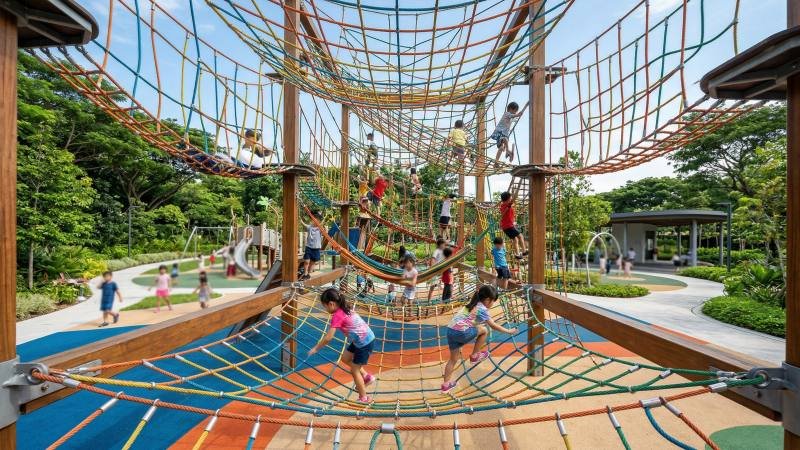
What are the essential factors to consider when purchasing commercial cargo nets for playgrounds?
When sourcing commercial cargo net playground equipment, buyers must evaluate the durability of rope materials like steel-core combination ropes, specify the correct mesh size and rope diameter for the target age group, ensure strict compliance with ASTM F1487 or EN 1176 safety standards, and select appropriate heavy-duty installation hardware. A comprehensive approach guarantees long-term structural integrity and user safety in high-traffic environments.
Selecting the Most Durable Rope Materials
Determining the optimal material for a commercial playground cargo net requires evaluating both the anticipated traffic volume and the site’s environmental exposure. Commercial sourcing typically prioritizes steel-core combination ropes for superior structural strength and vandalism resistance. Meanwhile, buyers select high-grade, UV-treated synthetics like polypropylene or polyethylene for the outer coating to ensure maximum abrasion resistance and user comfort.
Polypropylene vs Polyethylene Ropes
When sourcing pure synthetic nets, you’re usually looking at polypropylene (PP) versus polyethylene (PE). Both are thermoplastic polymers, but let’s be clear—they perform very differently in the field. Polypropylene is the go-to for texture. It offers a slightly rougher surface, providing children with a much better, safer grip during climbing. Plus, PP holds color pigments exceptionally well during the extrusion process.
On the flip side, polyethylene is significantly smoother. It packs superior abrasion resistance compared to PP, which is why PE is heavily deployed in high-friction zones. Is one strictly better than the other? Not necessarily. It depends entirely on your specific playground design.
Think of this like specifying playground plastics. Just as you’d spec high-density polyethylene (HDPE) for a slick playground slide, but pivot to textured rotational-molded plastics for a climbing wall, you need to match your rope fiber to the required grip profile.
| Feature | Polypropylene (PP) Ropes | Polyethylene (PE) Ropes |
|---|---|---|
| Surface Texture | Slightly rough, excellent grip | Very smooth, lower friction |
| Abrasion Resistance | Moderate to High | Excellent |
| Weight | Lightweight (floats on water) | Slightly heavier |
| Best Application | Vertical climbing nets | High-traffic horizontal crawling nets |
Steel-Core Combination Ropes for Commercial Use
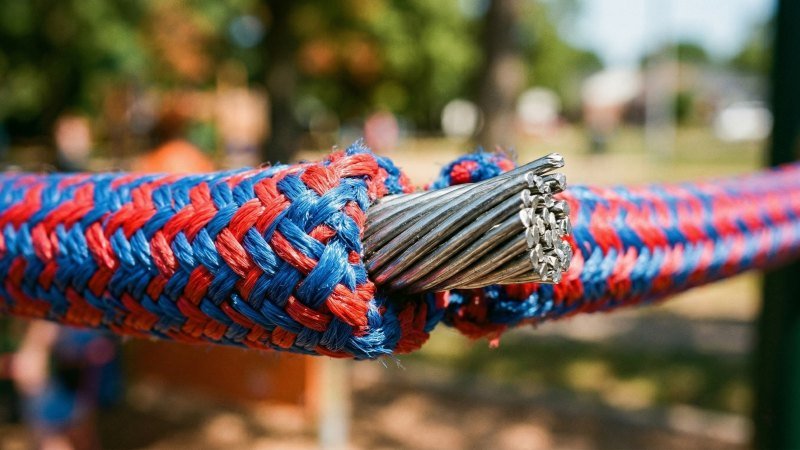
Let’s face it: for heavy-duty municipal parks and schoolyards, pure synthetic ropes just don’t cut it. That’s why the industry standard relies heavily on steel-core combination ropes. A combination rope consists of galvanized steel wire strands tightly wrapped inside a braided synthetic fiber jacket.
This design solves a massive headache: vandalism. Standard ropes are easily defeated by ordinary pocket knives. The internal steel cable, however, makes combination ropes nearly impossible to sever on a whim. More importantly, the steel core kills the stretch factor. Ever seen a cheap synthetic net sag dangerously after just one busy summer? Steel-core ropes maintain their rigid structural shape under heavy dynamic loads.
Typically, we spec 16mm (approx. 5/8 inch) combination ropes for standard cargo nets. However, since wire counts and exact load-bearing capacities fluctuate based on the manufacturing process, always verify the exact tensile strength and technical specifications with your chosen supplier.
“Using steel-core combination rope is the single most effective way to extend the lifespan of a public playground net from two years to ten years.”
UV Resistance and Weatherproofing Treatments
Playground cargo nets bake in direct sunlight all day. Over time, UV radiation breaks down the molecular bonds in plastics, causing synthetic ropes to become brittle, fade out, and eventually snap.
To combat this, top-tier manufacturers utilize UV stabilizers. They mix these chemical additives directly into the liquid plastic resin before extruding the rope fibers. That means the protection is baked right into the fiber’s DNA.
Word to the wise: avoid ropes relying on a cheap topical UV spray. Surface sprays wear off rapidly from the friction of children’s shoes. In brutal sun environments like Arizona or Florida, an improperly treated synthetic rope can lose up to 50% of its tensile strength in a single season. Always demand certification confirming the rope yarns are internally UV stabilized.
Essential Customization and Technical Specifications
When ordering a custom cargo net, buyers must precisely specify the mesh size, rope diameter, and edge finishing. These technical specifications directly determine the net’s structural integrity, age appropriateness, and compatibility with the existing playground framework.
Calculating the Ideal Mesh Size
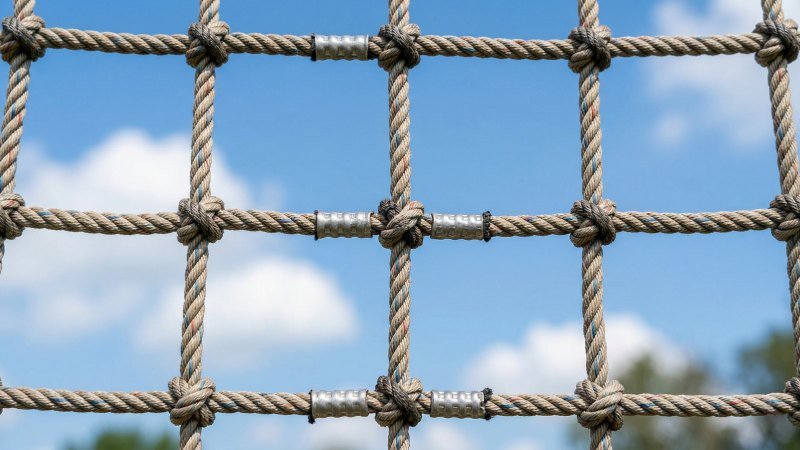
The mesh size is the open space between the intersecting ropes. Nailing this dimension is critical for both playability and structural design. Are you engineering a fast vertical climbing wall or a slow, challenging bridge? The mesh size dictates the function.
As a baseline, we usually spec a mesh size between 250mm (about 10 inches) and 300mm (about 12 inches) for standard commercial climbing nets. Toddler zones require a tighter mesh to accommodate shorter reaches. Conversely, teen-focused structures demand a wider mesh to provide a legitimate physical challenge.
When submitting custom dimensions, you absolutely must clarify how the factory measures the mesh. Some facilities measure from the center of one rope to the center of the next. Others measure the “clear opening”—the empty space strictly between the inside edges. Because tolerances vary based on the manufacturing equipment, lock down the exact measurement methodology with your supplier before finalizing the PO.
Think of mesh size like the rung spacing on a vertical playground ladder. Space them too far, and the user is stranded. Group them too tightly, and the structure becomes a cluttered waste of material.
Choosing the Correct Rope Diameter
Selecting the rope diameter is an exercise in pure ergonomics. A child’s hand has to wrap securely around the profile. If the rope is too thick, smaller children lose their grip. Too thin, and you induce hand fatigue while sacrificing the tensile strength needed for heavy public use.
In our industry, the gold standard is 16mm (approximately 5/8 inch). It hits the sweet spot: robust enough to handle extreme live loads, yet slim enough for a 5-year-old to confidently grasp.
Of course, specialized builds require specialized specs. Here is how it usually breaks down:
| Rope Diameter | Target User Group | Common Application Scenarios |
|---|---|---|
| 14mm | Toddlers (Ages 2-5) | Low-level crawling tunnels, indoor soft play areas |
| 16mm | Standard (Ages 5-12) | Main vertical climbing walls, suspension bridges |
| 18mm – 20mm | Teens / Heavy Duty | Giant spatial climbing towers, high-tension spans |
Keep in mind that thicker rope drastically increases the shipping weight and the dead load pulling on your structural posts. Your engineering team needs to account for this mass when designing the support frame.
Edge Finishing and Border Customizations
The middle of the net looks great, but the edges are where the real engineering happens. Edge finishing dictates exactly how the perimeter ties into your playground structure.
A commercial net never just ends with frayed ropes. Factories have to bind or loop those edges securely. One heavy-duty approach is a thickened border rope—weaving a 16mm inner net into a massive 20mm outer frame. This distributes the tension evenly across the entire grid.
Another bulletproof finish is the “looped end” or “thimble edge.” The manufacturer permanently splices a reinforced loop at the end of every extending rope. Installers simply slide a galvanized bar through the loops to anchor the net to the frame.
“Proper edge finishing prevents the outermost ropes from unraveling under high tension, which is the leading cause of premature net failure in commercial parks.”
Match your edge finishing to your attachment method. A net engineered for round steel pipes demands entirely different border hardware than one bolting into square timber posts.
Critical Safety Standards and Compliance
To ensure public safety and minimize liability, buyers must source cargo nets that strictly comply with international playground standards. In North America, equipment must meet ASTM F1487 guidelines, while European markets require EN 1176 certification. These standards dictate critical safety thresholds, including load-bearing capacities, fall heights, and precise gap dimensions to prevent severe entrapment hazards.
Understanding ASTM F1487 Requirements
If you are sourcing for a public park or school in the US, ASTM F1487 is your absolute rulebook. For cargo nets, it zeros in on structural integrity and use zones.
ASTM F1487 demands that climbing nets withstand specific dynamic loads without collapsing under multiple users. Beyond that, it dictates the required fall surfacing footprint. The height of your net directly dictates the volume of rubber or wood mulch required beneath it.
Similar to how a playground main deck must support a maximum user load without deflecting, a cargo net must hold its shape under heavy tension. Always demand the lab testing reports proving the net’s weight capacity.
EN 1176 Standards for European Markets
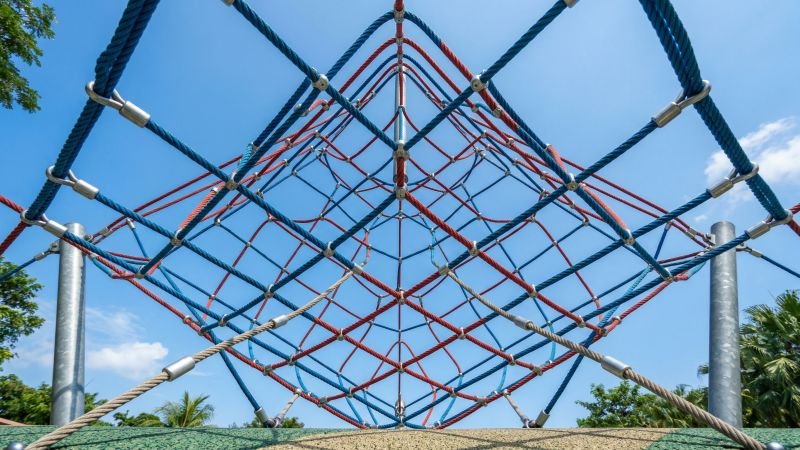
Projects following European safety models must adhere to the EN 1176 standard. While it runs parallel to ASTM, EN 1176 utilizes distinct testing methods, placing heavy scrutiny on 3D spatial networks (those massive pyramid-shaped climbing rigs).
EN 1176 evaluates intersecting ropes and unified structural behavior, alongside strict guidelines on maximum free fall heights within the net itself. Because of this, a net perfectly engineered for ASTM might actually fail EN 1176 testing due to minor interior fall zone miscalculations.
| Standard Focus | ASTM F1487 (North America) | EN 1176 (Europe & Others) |
|---|---|---|
| Primary Goal | General commercial playground safety | Comprehensive equipment & surfacing safety |
| Testing Approach | Focuses heavily on use zones and impact | Strict focus on structural spatial networks |
| Compliance Proof | IPEMA Certification often utilized | TUV Certification commonly required |
Designing to Prevent Head and Neck Entrapment
The most severe hazard on any climbing structure is head and neck entrapment—when an opening allows a child’s body to slip through, but catches their head.
To eliminate this, inspectors use specialized metal testing probes mimicking the size of a child’s torso and head. The rule is non-negotiable: if the small torso probe passes through a gap, the larger head probe must also pass through completely.
Do you really want to risk a failed site audit—or worse—over a quarter-inch measurement error? According to general industry safety guidelines, fully bounded openings usually must be smaller than 3.5 inches or larger than 9 inches. Anything in between is a massive liability.
“Failing an entrapment probe test is the number one reason custom playground nets are rejected by safety inspectors during final site audits.”
Make sure your manufacturer accounts for rope stretch. Top-tier factories design their mesh sizes so that even after years of heavy tension, the gaps never stretch into that dangerous entrapment zone.
Installation Hardware and Connector Types
To lock the ropes securely, buyers must specify the correct installation hardware and connector types based on the net’s structural design. High-traffic commercial networks typically require heavy-duty aluminum cross connectors to lock intersecting ropes. In contrast, low-impact zones can utilize durable plastic connectors, while the outer perimeter always demands secure end fittings and robust anchoring systems to attach the net to the main playground frame.
Heavy-Duty Aluminum Cross Connectors
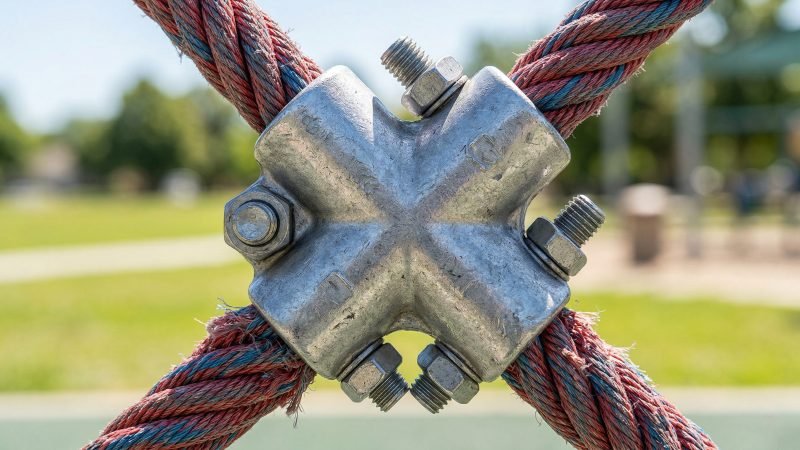
Where ropes intersect, they must be locked down. In the commercial sector, we rely on heavy-duty aluminum cross connectors. Factories use massive hydraulic presses to crush these metal joints directly onto the ropes.
These function exactly like the heavy-duty pipe clamps securing main platforms to playground posts. Just as that clamp prevents the deck from sliding, an aluminum connector grips the ropes so violently that the grid cannot shift.
Aluminum is the only metal for the job here. It naturally resists rust and, as a bonus, it’s significantly lighter than solid steel, keeping your net’s dead weight manageable.
“Using hydraulically pressed aluminum connectors is the industry standard for preventing rope slippage on tall, vertical climbing nets.”
Plastic Connectors for Low-Impact Zones
Not every build needs a hydraulic press. For indoor soft-play centers or toddler crawling tunnels, injection-molded nylon or industrial plastic connectors do the trick perfectly.
Installers simply screw the two interlocking halves over the crossing ropes. In these specific zones, the dynamic drop weight is minimal, meaning the extreme clamping force of aluminum is overkill.
On top of that, plastic connectors offer smooth, rounded edges with no exposed metal, which is a major safety advantage for smaller kids. Just keep them out of high-abuse outdoor parks.
| Feature | Aluminum Connectors | Plastic Connectors |
|---|---|---|
| Durability | Extreme (resists heavy vandalism) | Moderate (can crack under heavy abuse) |
| Best Application | Public parks, high vertical towers | Toddler areas, indoor playgrounds |
| Weather Resistance | Excellent | Good, but can become brittle in deep freezes |
| Cost | Higher | Lower |
Secure End Fittings and Anchoring Systems
Internal connectors hold the grid together; end fittings anchor the beast to your playground.
Typically, border ropes terminate in metal thimbles. A thimble is a teardrop-shaped metal ring spliced directly into the rope loop, taking the friction of the attachment bolts so the rope fibers don’t wear through.
To marry these thimbled loops to the steel posts, you rely on two main components:
- D-Shackles: Heavy metal links that connect the loops to the frame brackets.
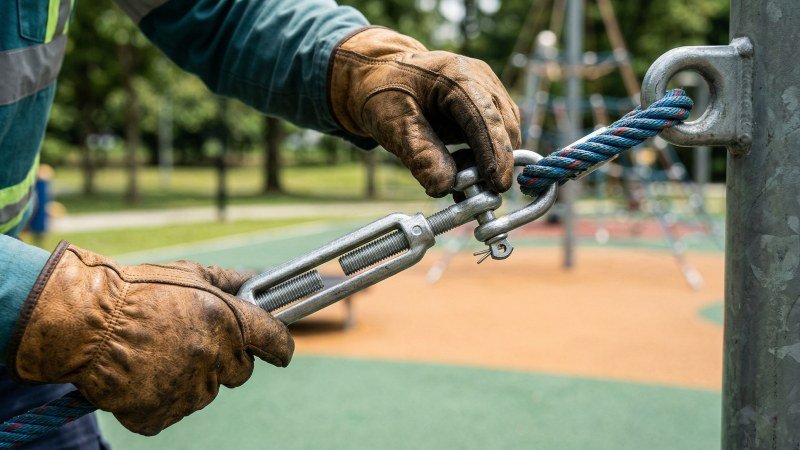
- Turnbuckles: This is your primary tensioning tool. Installers twist the turnbuckle to pull a newly hung, sagging net perfectly tight. As the ropes naturally stretch over the years, maintenance crews just crank the turnbuckles a few more rotations to restore the necessary tension.
Long-Term Maintenance and Inspection
Facility managers must implement a rigorous, long-term maintenance protocol to maximize the lifespan of commercial cargo nets. This process requires establishing a routine inspection schedule based on usage volume, actively identifying signs of critical wear and tear such as frayed steel cores, and making data-driven decisions between localized repairs and complete structural replacements.
Creating a Routine Inspection Schedule
A cargo net is never a “set it and forget it” installation. High-tension networks demand consistent oversight.
Start with a quick visual sweep daily or weekly to catch obvious vandalism like sliced ropes or missing D-shackles. Next, mandate a thorough tactile inspection every month where staff physically pull on the anchor points and inspect the hardware.
Top it off with a comprehensive annual audit by a certified playground safety inspector. Treat it exactly like poured-in-place rubber surfacing: sweep it daily, but test the impact attenuation annually. Why wait for a snapped wire to tell you it’s time for a major repair?
Identifying Critical Wear and Tear
You need to train your team to distinguish between normal field wear and catastrophic structural failure. Sun fading is purely cosmetic. An exposed internal steel core is a liability.
Expect the outer synthetic jacket to fuzz up over time from shoe friction—that’s standard. But if that synthetic jacket tears completely open to expose the internal galvanized steel wires, pull it from service immediately. Exposed steel rusts quickly, and broken strands create razor-sharp burrs that will slice a user’s hand.
Also, keep a close eye on the tensioning hardware. Dynamic play vibrates turnbuckles loose over time, causing the net to sag out of compliance.
| Type of Wear | Visual Indicator | Severity Level | Required Action |
|---|---|---|---|
| Cosmetic Wear | Faded colors, slight surface fuzzing | Low | Continue monitoring |
| Hardware Loosening | Sagging net, loose turnbuckle threads | Medium | Re-tighten immediately |
| Jacket Failure | Deep cuts exposing the steel core | High | Take out of service |
| Strand Breakage | Snapped metal wires poking through | Critical | Replace section immediately |
“Catching a loose anchor point early prevents the uneven weight distribution that ultimately destroys the intersecting rope connectors.”
Repair vs Replacement Decision Making
When the damage happens, you have a call to make: patch the sector or scrap the net?
If a vandal slices a single rope on a one-year-old net, repair it. Modern commercial nets are often modular. Your crew can unbolt the damaged segment and splice in a replacement, saving thousands.
However, if you’re looking at a ten-year-old net with heavy UV rot and multiple rusted core wires, patching is a waste of money. The overall tensile strength of the network is compromised, making a full replacement the only safe, professional move.
Conclusion
Let’s wrap this up. Successfully sourcing and maintaining a commercial playground cargo net requires serious attention to the engineering details. From specifying galvanized steel-core ropes and locking down safe mesh clearances, to verifying ASTM or EN 1176 compliance, every call you make impacts the lifespan and safety of the rig. By locking in the right hardware and enforcing a strict maintenance schedule, you guarantee your climbing structures stay safe, compliant, and rock-solid for the long haul.
If you need further assistance with customized specifications, safety compliance, or material selection for your next commercial project, please feel free to contact us.