-
Whatsapp: +86 15516933785
-
Email: hanlin@hanlinplayground.com
-
Address: Shangjie District, Zhengzhou City, Henan Province, China
-
Whatsapp: +86 15516933785
-
Email: hanlin@hanlinplayground.com
-
Address: Shangjie District, Zhengzhou City, Henan Province, China

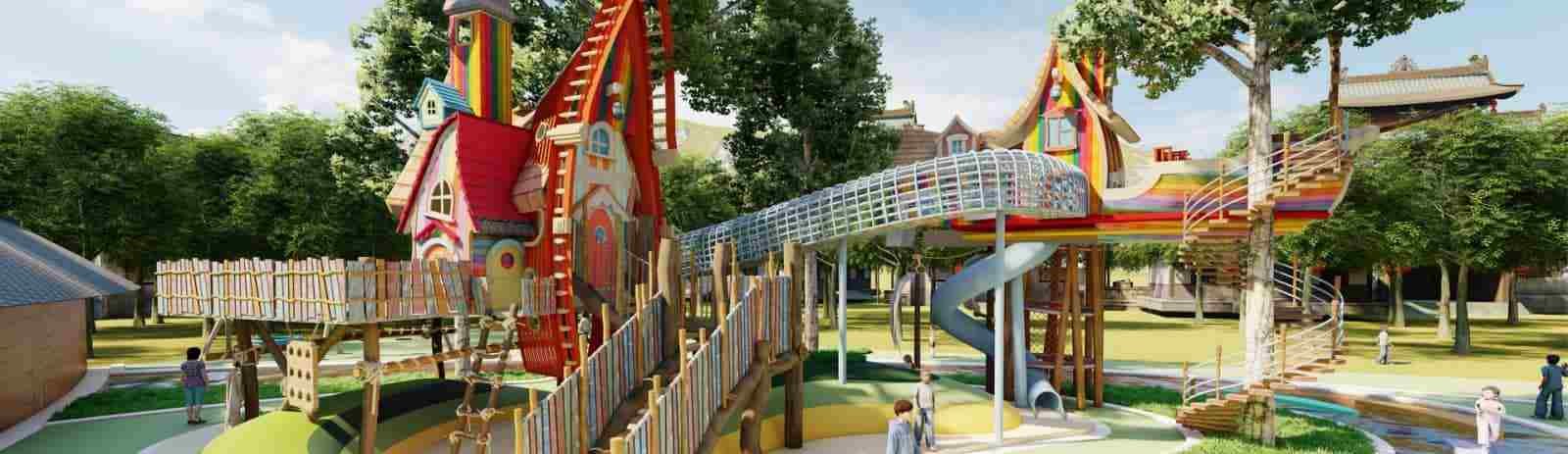
The Ultimate Guide to Planning and Buying a Large Outdoor Playground
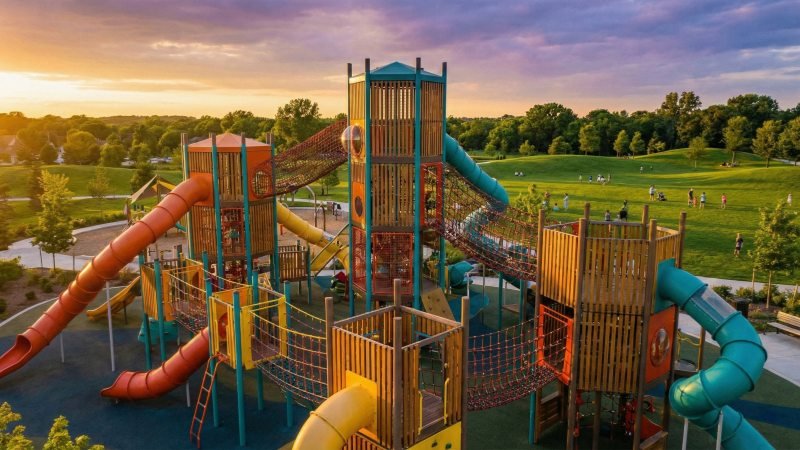
What are the essential steps and critical considerations required to successfully plan, budget, and purchase a large commercial outdoor playground?
To successfully develop a commercial playground, you must first calculate usable site space and child capacity, followed by establishing a comprehensive budget that includes equipment, freight, and professional installation. Subsequently, you must select compliant safety surfacing, verify that the structural equipment meets mandatory ASTM or TUV standards, and choose highly durable materials like galvanized steel and HDPE plastics to guarantee a safe, long-lasting, and inclusive play environment.
Assessing Your Site Space and Capacity Requirements
How do you accurately determine the right size and capacity for a new commercial playground?
To accurately determine playground size, calculate the total usable footprint minus mandatory safety use zones. Then, allocate specific play events per child based on their age group. This spatial planning ensures the play area remains safe, functional, and structurally uncrowded.
Calculating Usable Footprint and Safety Zones
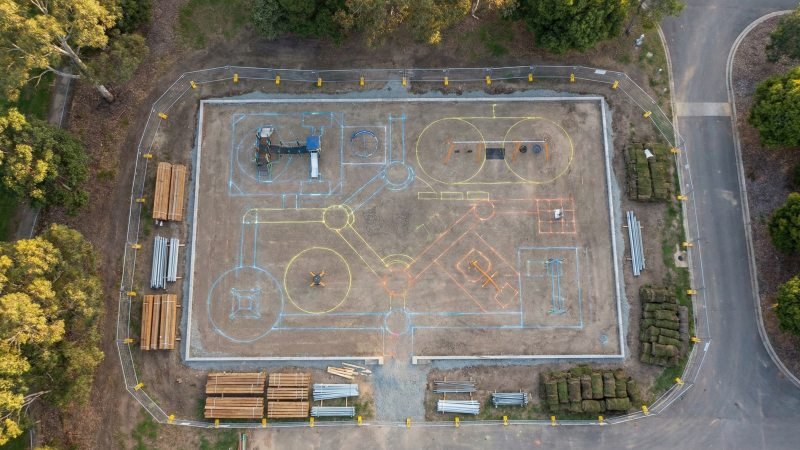
Start by identifying the total raw acreage of your site. Next, subtract areas needed for sidewalks, benches, and fencing. What you have left is your true usable footprint.
But here’s the catch: the equipment cannot fill this entire footprint. Every commercial play structure requires a designated safety zone. A safety zone, often called a use zone, is the clear space around the equipment. This space prevents collisions if a child falls.
Just as a sports court requires out-of-bounds space for players to safely run, playground equipment requires a spatial setback from fences, walkways, and other structures.
As an industry standard, you must extend the safety zone at least 6 feet in all directions from the stationary equipment’s edge. Dynamic equipment takes this a step further. For example, a swing set requires a use zone equal to twice the height of the suspending pivot point. You must measure this distance from both the front and back of the swing.
Because of this, space requirements naturally vary based on equipment height and movement type. Always verify the exact safety zone dimensions and technical specifications with your chosen equipment manufacturer before finalizing your layout.
General Safety Zone Expansions
| Equipment Type | Required Use Zone Extension |
|---|---|
| Stationary Climbers | 6 feet in all directions |
| Standard Slides | 6 feet plus the height of the slide platform |
| Swings | Twice the pivot height (front and back) |
| Spring Riders | 6 feet minimum clearance |
Determining Maximum Child Capacity by Age Group
After mapping the footprint, you must determine how many children can safely use the space. Overcrowding leads to accelerated equipment wear and increases collision risks. For that reason alone, capacity planning is critical.
Playground capacity is not simply about total square footage. Instead, industry professionals calculate capacity using play events. A play event is any distinct interactive component. This includes a single slide, a steering wheel panel, or a climbing ladder.
Generally, one active play event can support one to two children simultaneously. That means a large composite structure featuring 20 play events can safely accommodate roughly 30 to 40 children.
Let’s not forget, spatial needs change drastically based on user age. Toddlers interact differently than older children. They require closer supervision and more open deck space for cautious movement. Older children, on the other hand, need more vertical climbing space and dynamic movement areas.
Capacity Planning Metrics by Age
| Age Group | Typical Space Requirement | Primary Focus |
|---|---|---|
| 2 to 5 Years | 75 sq. ft. per child | Ground-level events, wide decks |
| 5 to 12 Years | 100 sq. ft. per child | Vertical climbers, overhead rings |
Designing separate zones for these two age groups prevents older, faster children from colliding with younger toddlers. Separate zones also ensure the capacity limits remain accurate for each specific play area.
Budgeting for Commercial Play Equipment and Installation
How much does it actually cost to build a complete commercial playground from start to finish?
A complete commercial playground typically costs between $1,000 and $2,000 per child capacity. Importantly, the physical equipment accounts for roughly half of the total budget. The remaining funds must cover essential installation labor, specialized site preparation, and freight shipping. Therefore, a comprehensive budget requires factoring in both visible structural costs and hidden logistical expenses.
Average Cost Breakdown for Play Structures
A common rookie mistake is assuming the play structure itself is the only major expense. In reality, the physical equipment is just one piece of the puzzle. You need to allocate your budget across several distinct categories. The core play structure usually consumes about 50% to 60% of your total budget. Professional installation typically requires 25% to 30%. Don’t ignore freight shipping, which often accounts for 5% to 15%. Finally, basic site preparation makes up the remaining 10% to 15%.
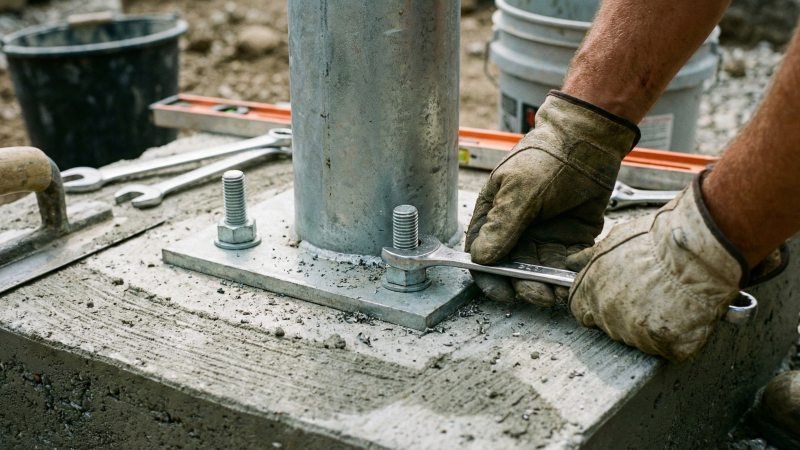
Why is installation a significant expense? Because commercial playgrounds are heavy, complex systems that require certified installers. You are not simply bolting light backyard parts together. Instead, you are anchoring heavy steel posts into deep concrete footings, which requires specialized machinery and strict leveling. Professional labor is absolutely non-negotiable for structural integrity. Because installation rates and equipment pricing fluctuate regionally, request a detailed, line-item breakdown directly from your supplier.
Typical Project Cost Allocation
| Budget Category | Average Percentage Allocation | Estimated Cost for a $50,000 Project |
|---|---|---|
| Play Equipment | 50% – 60% | $25,000 – $30,000 |
| Professional Installation | 25% – 30% | $12,500 – $15,000 |
| Freight Logistics | 5% – 15% | $2,500 – $7,500 |
| Site Preparation | 10% – 15% | $5,000 – $7,500 |
Hidden Expenses in Site Preparation and Freight
Beyond the standard invoice, what else is lurking in the budget? Site prep and freight logistics are notorious for surprising new buyers.
What exactly goes into site preparation? For starters, the land must be perfectly level. If your designated area has a slope, you must pay for professional earth grading. Make no mistake: if the ground is uneven, the structural support posts will not align correctly, compromising the entire structural grid of the playground. You might also need to excavate rocks or remove old equipment. Contractors often install underground drainage systems as well. Poor drainage will severely flood your play area after heavy rain, destroying surfacing materials. These earthmoving tasks aren’t DIY; they require heavy machinery and specialized contractors.
Freight shipping presents another massive logistical expense. Commercial play equipment is incredibly bulky and exceptionally heavy. Manufacturers ship these large parts on dedicated flatbed trucks. A standard composite structure, for instance, can weigh several thousand pounds.
You must also strictly consider site offloading fees. Standard freight delivery does not include unloading the truck. If you lack a forklift on-site, you must pay extra for a liftgate service. Those hidden logistical fees add up fast.
Selecting the Right Playground Surfacing Materials
What is the most effective way to choose the safest and most durable ground cover for a commercial play area?
To select the right playground surfacing, evaluate the material’s impact attenuation, accessibility, and long-term maintenance costs. Unitary surfaces like poured-in-place rubber offer superior wheelchair access and low maintenance, while loose-fill options like engineered wood fiber provide excellent shock absorption at a lower initial price point. Ultimately, the best material balances your specific budget constraints with mandatory ADA compliance and safety requirements.
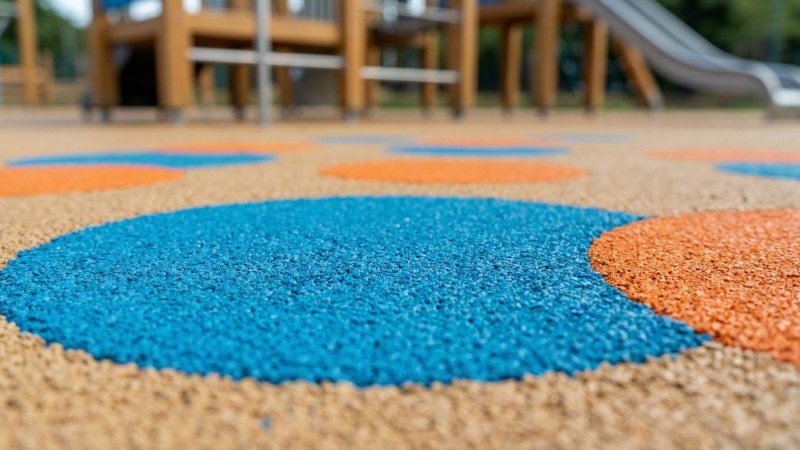
Poured-in-Place Rubber vs Rubber Mulch
Let’s break down two popular rubberized options. Poured-in-Place (PIP) rubber and rubber mulch both offer excellent shock absorption. Put them in practice, though, and they function very differently.
Poured-in-Place rubber is applied much like a seamless athletic track. Installers mix rubber granules with a polyurethane binder directly on-site, then trowel it perfectly smooth. The result? PIP creates a solid, unified surface. It is incredibly durable and requires almost zero daily maintenance.
On the flip side, rubber mulch is a loose-fill material. Manufacturers create it from shredded, recycled tires. It provides outstanding fall protection. Yet, children easily kick it out of high-traffic zones, like under swings or slide exits. Maintenance staff must constantly rake it back into place to keep the ground safe.
More importantly, the required depth of these materials directly dictates their safety rating. The critical fall height of your highest play structure dictates exactly how thick the surfacing must be to comply with impact attenuation standards.
Comparison of Rubber Surfacing Options
| Feature | Poured-in-Place (PIP) Rubber | Rubber Mulch |
|---|---|---|
| Surface Type | Unitary (Solid, seamless) | Loose-fill (Individual pieces) |
| Initial Cost | Very High | Moderate |
| Maintenance | Very Low | High (Requires frequent raking) |
| Durability | 10 to 15 years | 10+ years (Needs occasional top-offs) |
Engineered Wood Fiber and ADA Accessibility
What if you need an affordable option that still meets strict accessibility rules? Engineered Wood Fiber (EWF) is often the best solution. Listen, EWF is not your standard landscaping bark. Manufacturers mechanically shred wood to specific industry dimensions. This precision process ensures the wood fibers knit together tightly.
When properly compacted, EWF creates a firm, slip-resistant surface. Think of it like a professionally maintained park trail. When heavily compacted, the interlocking EWF allows wheelchairs and walkers to roll across the playground smoothly. This specific compaction makes it fully compliant with the Americans with Disabilities Act (ADA).
There is a tradeoff, though: achieving this accessibility requires strict, ongoing maintenance. Over time, EWF naturally decays and compresses under heavy foot traffic. Heavy rain can also wash the fibers away. When that happens, the surface loses its necessary firmness and its protective depth.
To counter this, owners must frequently top off the wood fiber and re-compact it. Neglect this maintenance, and the playground quickly becomes inaccessible. Wheelchairs will easily sink into the loose fibers. While EWF saves money upfront, you must budget for continuous labor and replacement material over the lifespan of the park.
Navigating Safety Standards and Certifications
How do you ensure your commercial playground equipment meets all necessary legal and safety requirements before purchasing?
To ensure safety compliance, you must verify that all commercial playground equipment adheres strictly to ASTM International standards and CPSC guidelines. Furthermore, if you are sourcing equipment internationally, you must look for recognized certifications like the TUV mark and CE declarations. These mandatory technical benchmarks guarantee that the structures prevent entrapment hazards, withstand heavy dynamic loads, and minimize your overall liability risks.
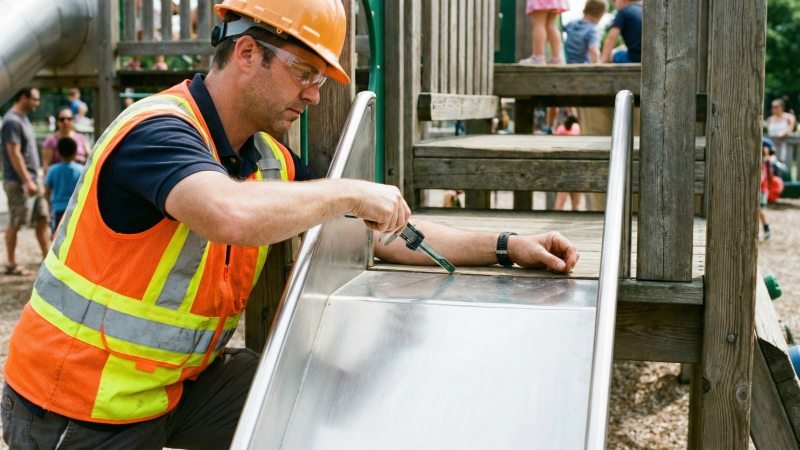
Key ASTM and CPSC Guidelines You Must Meet
In the United States, commercial playground safety relies on two primary organizations. The Consumer Product Safety Commission (CPSC) provides general safety recommendations. ASTM International sets the strict, detailed technical standards.
Think of the CPSC guidelines as the overarching safety blueprint for your park layout. ASTM standards, on the other hand, serve as the strict engineering codes that dictate exactly how thick a steel support beam must be to prevent a structural failure.
For commercial outdoor playgrounds, the most critical standard is ASTM F1487. This specific document outlines the exact performance requirements for public use play equipment. For example, it strictly defines head and neck entrapment hazards. According to ASTM rules, any opening on a play structure must be smaller than 3.5 inches or larger than 9 inches. This precise measurement prevents a child’s body from slipping through while their head gets trapped.
ASTM F1487 also strictly mandates rigorous structural integrity testing. The equipment must successfully support multiple users simultaneously without bending or breaking. Always verify the exact compliance certificates and testing reports directly with your supplier before purchase.
Comparison of Domestic Safety Frameworks
| Organization | Primary Focus | Industry Role | Key Standard/Document |
|---|---|---|---|
| CPSC | Injury prevention and public awareness | Government safety recommendations | Public Playground Safety Handbook |
| ASTM | Engineering specifications and testing | Mandatory technical compliance | ASTM F1487 |
Important TUV and CE Marks for International Equipment
Today, many buyers source large outdoor playground structures from international manufacturers. If you look overseas for equipment, you must understand global safety certifications. The two most common international indicators are the CE mark and the TUV certification.
The CE mark is a fundamental requirement for products sold within the European Economic Area. Essentially, it is a manufacturer’s declaration stating that the equipment meets baseline European health, safety, and environmental protection standards. The catch is that the CE mark is often self-certified by the factory.
Are you really going to stake your liability on a factory’s self-declaration? That is where TUV Rheinland becomes essential. TUV is an independent, globally recognized testing agency. A TUV mark proves a specific playground structure has passed rigorous third-party physical testing.
TUV zeroes in on testing playground equipment against the EN 1176 standard. This is the European equivalent to the American ASTM F1487 standard.
Why Third-Party Testing Matters
- Objective Verification: TUV engineers physically stress-test the equipment connections, load capacities, and moving parts.
- Liability Protection: Holding a third-party certificate proves you performed due diligence during the purchasing process.
- Global Trust: A TUV mark signifies that the manufacturer invested heavily in independent safety verification.
Balancing domestic guidelines with international certifications ensures your playground is structurally sound and legally compliant.
Choosing Durable and Low-Maintenance Materials
What are the most resilient materials you should select to build a long-lasting commercial play structure?
To maximize longevity, you must construct commercial playgrounds using heavily galvanized steel or structural-grade aluminum for the primary load-bearing posts. Furthermore, you should utilize High-Density Polyethylene (HDPE) plastics for all interactive panels and sliding components. Ultimately, choosing these weather-resistant materials drastically reduces long-term maintenance costs and prevents structural failure in harsh outdoor environments.
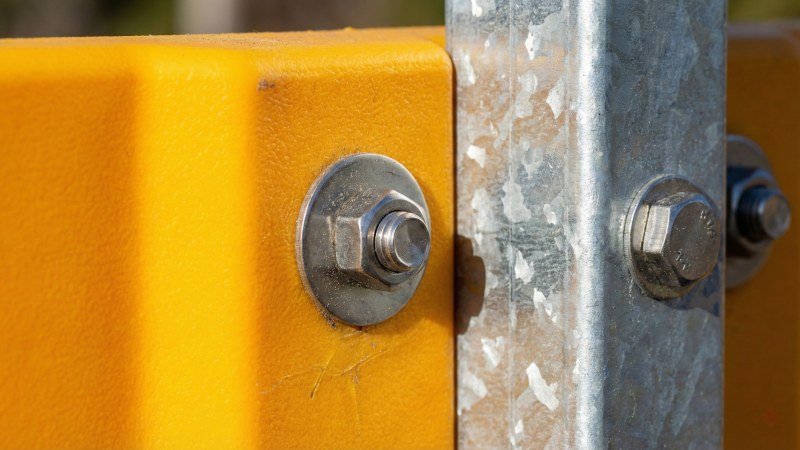
Commercial-Grade Steel vs Aluminum Components
Look at the structural backbone of your play area. Manufacturers build upright support posts using either commercial-grade steel or aluminum. Both metals provide incredible strength. But put them in specific climates, and they perform very differently.
Think of the main support posts as the load-bearing columns of a park pavilion; they must bear immense dynamic weight from heavy composite platforms and constantly moving children without buckling.
Commercial playgrounds utilize 5-inch or 3.5-inch outside diameter (OD) galvanized steel pipes. Steel is exceptionally strong and highly cost-effective. Raw steel naturally rusts over time, meaning factories have to treat it aggressively. They hot-dip the steel in zinc and apply a baked-on powder coating. This dual-layer process prevents dangerous structural corrosion. Be sure to review the structural specifications for your specific environmental needs.
Aluminum takes a different approach: it is naturally rust-resistant. It does not contain any iron, so it simply cannot oxidize like standard steel. If you are building a playground near a saltwater coast, aluminum is always the superior choice. Saltwater air aggressively destroys standard steel components.
Comparison of Structural Metals
| Material | Key Advantage | Best Application Environment | Typical Post Diameter |
|---|---|---|---|
| Galvanized Steel | Maximum structural strength | Standard municipal parks | 3.5″ to 5″ OD |
| Aluminum | Absolute rust resistance | Coastal areas, high humidity | 3.5″ to 5″ OD |
High-Density Polyethylene Plastics for Longevity
Move up from the posts, and you have to evaluate the materials used for slides, roofs, and activity panels. Today, industry leaders overwhelmingly use High-Density Polyethylene (HDPE). Why is this specific plastic the gold standard?
Unlike older brittle fiberglass slides, solid HDPE is an incredibly dense, impact-resistant thermoplastic that will never shatter or splinter. It successfully retains its structural integrity through freezing winters and scorching summers. Commercial play panels utilize 3/4-inch thick solid HDPE boards for maximum rigidity.
Manufacturers also inject pigment directly into the plastic during the molding process, alongside adding powerful UV stabilizers to the raw mixture. This ensures the color permeates the entire material completely. If a child heavily scratches the panel, the color underneath remains identical. Always review the colorfast warranty to ensure long-lasting vibrancy. The bottom line? Utilizing solid HDPE eliminates constant sanding, repainting, and costly seasonal repairs.
Inclusive and Thematic Design Strategies
How do you design a commercial playground that engages all children while simultaneously standing out visually?
To design an engaging and inclusive playground, you must physically integrate wheelchair-accessible ramps and ground-level sensory panels alongside a cohesive visual theme. By combining mandatory ADA-compliant structural access with custom architectural aesthetics, you create a universal environment that accommodates all physical abilities while elevating the entire landscape design.
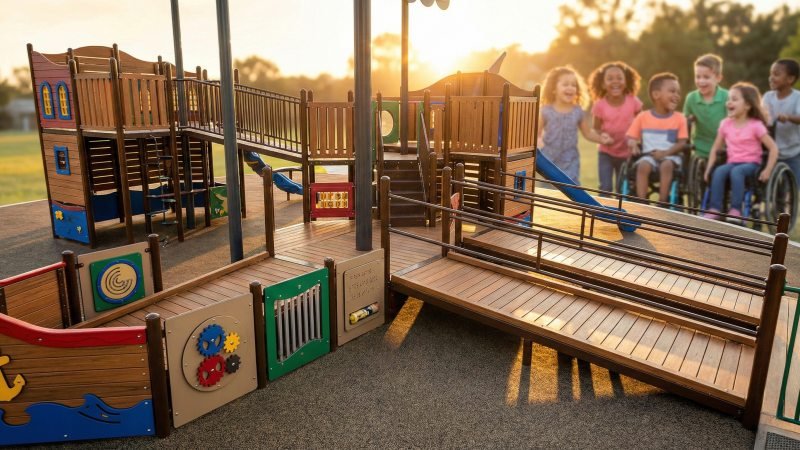
Incorporating Sensory Play and Wheelchair Access
True inclusivity means moving past basic safety codes to create genuine accessibility. Designing an inclusive playground requires more than just installing a single ramp. Just as an inclusive classroom provides various learning tools for different cognitive needs, your playground must offer multiple ways for children to interact regardless of physical or cognitive limitations.
For physical accessibility, you must incorporate wide structural ramps. These ramps allow wheelchairs to reach elevated decks. This allows children with mobility devices to play right alongside their peers. You also need to install transfer stations. These specialized platforms allow children to safely move from a wheelchair directly onto a slide or climbing deck. Ensure your playground designer adheres to the exact ADA dimensional specifications for proper ramp gradients and deck clearances.
But does inclusivity stop at a wheelchair ramp? Not at all. You must strongly consider cognitive and sensory accessibility. Many children require specific tactile or auditory stimulation to stay engaged. That means installing sensory play events primarily at the ground level where everyone can reach them.
Key Elements of an Inclusive Play Area
| Equipment Category | Purpose | Example Components |
|---|---|---|
| Mobility Access | Enables wheelchair navigation | Double-wide ramps, flush-mount spinners |
| Tactile Stimulation | Provides hands-on engagement | Gear panels, textured climbing grips |
| Auditory Play | Encourages sound exploration | Outdoor chimes, stationary bongo drums |
Popular Themes for Parks and Schools
Switching gears, let’s talk about the visual identity of your equipment. Thematic design transforms standard metal and plastic into an immersive storytelling environment, much like a themed amusement park attraction.
For municipal parks, nature-inspired themes are incredibly popular. Manufacturers utilize specialized molds to create plastics that mimic natural wood grain or large stones. The finished product blends seamlessly into the surrounding forest or natural landscape. This specific design approach often features treehouse-style roofs and realistic faux-log climbers.
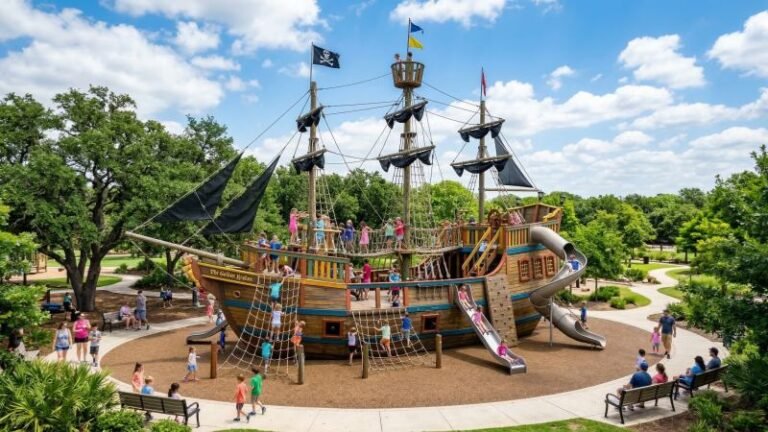
Elementary schools, meanwhile, frequently lean toward highly imaginative and bright themes. A nautical or pirate ship theme utilizes custom-routed panels shaped like ship bows, anchors, and steering wheels. Alternatively, space exploration themes feature rocket-shaped towers and control center activity boards.
Behind the scenes, manufacturers pull off these complex themes using precision computer numerical control (CNC) routing. This industrial machinery precisely cuts thick plastic sheets into any imaginable shape. You can easily customize the equipment to match a school mascot or a town’s historical heritage without compromising the structural integrity of the core playground.
Conclusion
Building a large outdoor playground requires careful navigation of spatial planning, budget allocation, material selection, and strict safety compliances. By calculating the correct footprint, anticipating hidden installation costs, and selecting durable materials like galvanized steel and PIP rubber, you ensure the longevity of your investment. Above all, integrating inclusive designs and ADA-compliant accessibility ensures that every child can safely engage in the space. Nail these structured steps, and you can confidently transition from initial planning to a fully realized, world-class recreational environment.
Ready to design an accessible, visually stunning, and highly durable play area for your community? Please contact us today to explore custom options, discuss your site plans, and receive a comprehensive quote!