-
Whatsapp: +86 15516933785
-
Email: hanlin@hanlinplayground.com
-
Address: Shangjie District, Zhengzhou City, Henan Province, China
-
Whatsapp: +86 15516933785
-
Email: hanlin@hanlinplayground.com
-
Address: Shangjie District, Zhengzhou City, Henan Province, China

Top 5 Benefits of Climbing Net Playgrounds for Children’s Physical and Cognitive Development
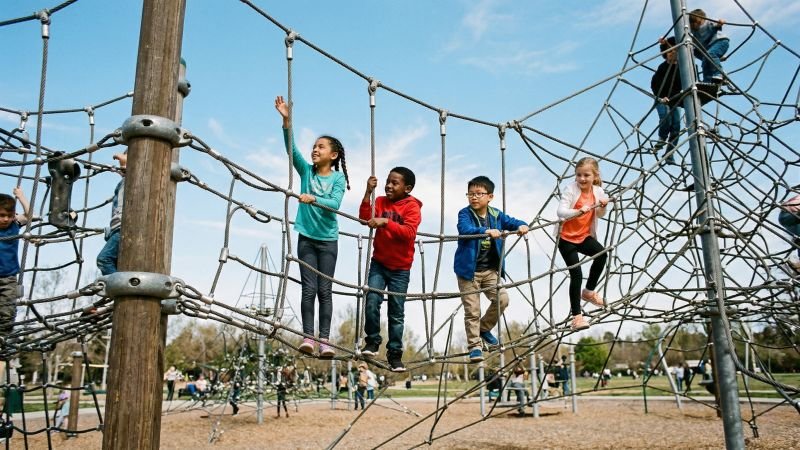
Ever wonder why modern playground specs increasingly favor complex climbing net playgrounds over traditional rigid structures?
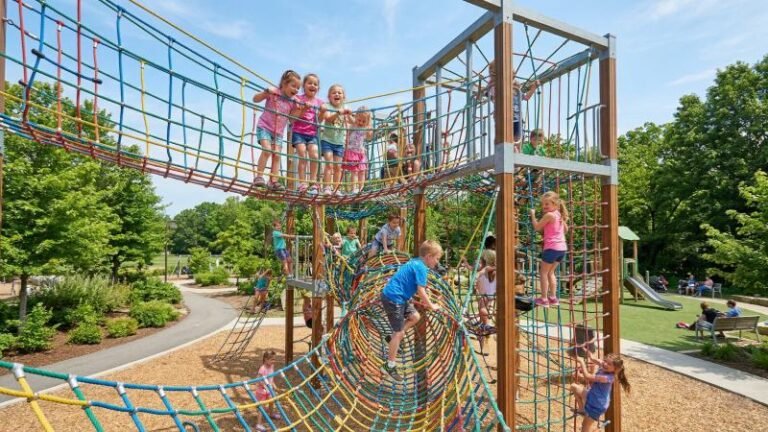
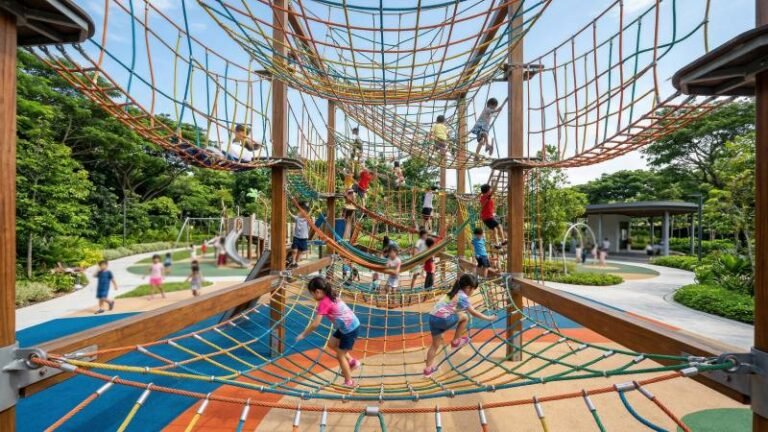
Climbing net playgrounds provide a dynamic, multi-sensory environment that simultaneously challenges a child’s body and brain. They accelerate physical development by building core strength, full-body agility, and fine motor grip mechanics, while concurrently advancing cognitive growth through complex route planning, spatial awareness, and independent risk assessment. This dual engagement creates a comprehensive developmental tool disguised as play.
Benefit 1: Strengthening Gross and Fine Motor Skills
How exactly do climbing net playgrounds improve a child’s gross and fine motor skills simultaneously?
Climbing net playgrounds require continuous, synchronized movements that activate major muscle groups for gross motor development. Simultaneously, they demand precise grasping and pinching of ropes to enhance fine motor mechanics. This dual-action environment forces children to constantly adjust their physical output. Consequently, this leads to measurable improvements in overall muscular coordination and dexterity.
Building Core Strength and Full-Body Agility
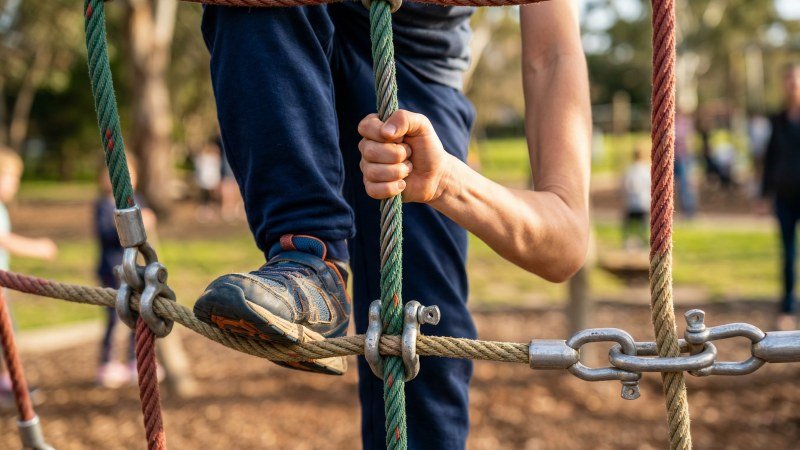
Let’s look at the biomechanics. When children engage with a climbing net playground, they interact with a dynamic surface. Every step alters the tension of the ropes, forcing the child to immediately engage their core muscles to remain stable.
This translates to raw physical development. Reaching for a higher rope requires shoulder strength, while pushing up demands serious leg power. The result? Unmatched full-body agility. This process directly builds gross motor skills.
Look at it like designing a central-mast space net structure. The heavy-duty steel central mast provides core stability, while the radiating ropes distribute the changing play loads. A child’s body operates on the exact same principle. Their core is the central mast, and their limbs act as the tensioned cables, continually adjusting to the shifting weight to maintain an upright posture.
| Action | Primary Muscle Group | Gross Motor Benefit |
|---|---|---|
| Reaching upward | Deltoids and Latissimus Dorsi | Upper body extension and reach |
| Stabilizing posture | Abdominals and Obliques | Core strength and torso control |
| Stepping upward | Quadriceps and Glutes | Lower body power and thrust |
Many commercial playground nets utilize 16mm or 20mm steel-core ropes designed with specific deflection limits. Since flexibility and tension ratings can vary based on the specific materials used, you should always verify the exact load capacities and structural specifications with your equipment supplier.
Refining Hand-Eye Coordination and Grip Mechanics
But this isn’t just about gross motor force. Climbing net playgrounds are equally effective at refining fine motor skills. As a child navigates the structure, they must constantly look at a specific target and place their hands precisely, driving continuous visual-motor integration.
Gripping those ropes develops critical hand mechanics. Children must use both palmar grasps (using the whole hand) and pincer grasps (using the thumb and fingers). The specific diameter of the ropes forces a tight wrap, which directly strengthens the flexor tendons in the forearms and fingers.
“Consistent engagement with dynamic rope structures builds the hand strength necessary for daily fine motor tasks, such as holding a pencil correctly or fastening clothing.”
It’s similar to how a heavy-duty, tamper-proof shackle securely bolts onto a rigging ring in commercial playground installations. The connecting pin must align perfectly and lock with sufficient torque to hold the structural weight safely. A child’s hand works the exact same way: visually align with the rope, then apply the correct grip tension to secure their own body weight. If the grip is too loose, the connection fails. They learn to adjust their grip mechanics rapidly based on that direct, unforgiving sensory feedback.
Benefit 2: Enhancing Proprioception and Spatial Awareness
Developing an understanding of one’s body in physical space is a complex neurological process. Climbing nets act as an accelerator for this crucial skill.
Climbing net playgrounds enhance proprioception and spatial awareness by forcing children to navigate complex, three-dimensional geometric structures. As the ropes shift under their weight, sensory receptors in their joints constantly send positional feedback to the brain. Consequently, this continuous sensory loop improves a child’s ability to coordinate movements without relying solely on visual cues.
Developing 3D Body Positioning
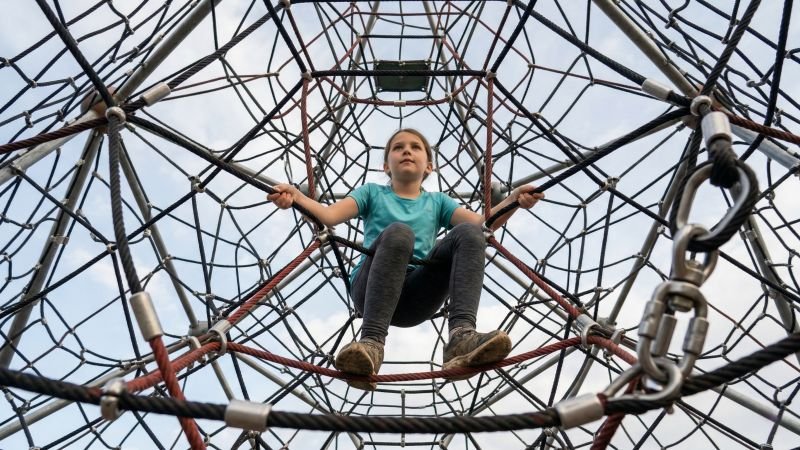
Unlike flat, static playground surfaces, climbing nets force a child to map their body across a true X, Y, and Z axis. This continuous, multi-planar navigation drastically sharpens their spatial awareness.
They quickly learn exactly where their limbs are, even if they aren’t looking directly at them. This internal sense of body positioning—proprioception—is a vital developmental milestone.
Standard commercial climbing nets often feature a specific mesh spacing—typically between 250mm and 300mm—designed explicitly to comply with head entrapment safety standards. Maneuvering through these specifically measured grid openings forces children to accurately judge distances and adjust their physical footprint to fit.
Mastering Balance on Dynamic Surfaces
What makes a net so much harder to navigate than a solid platform? It’s the active load distribution. Every time a child shifts their weight, the entire structure reacts. Add other children playing on the same net, and the surface becomes highly unpredictable.
This constant kinetic feedback forces instant micro-adjustments, lighting up the child’s vestibular system. They learn to maintain equilibrium despite a constantly moving foundation.
Engineers use turnbuckle tensioning systems at the foundation to keep large net structures plumb when wind or kinetic weight applies force. A child’s vestibular system acts as their own internal turnbuckle. It instantly recalibrates their center of gravity to keep them upright on a swaying rope.
| Equipment Type | Surface Reaction | Proprioceptive Feedback Level |
|---|---|---|
| Traditional Platform | Static and unyielding | Low |
| Fixed Climbing Wall | Stable with rigid holds | Moderate |
| Climbing Net Structure | Highly dynamic and responsive | High |
“Dynamic rope structures provide the essential, unpredictable sensory input required to fully develop a child’s equilibrium and spatial mapping capabilities.”
Through repeated exposure to these dynamic shifts, children develop a superior baseline of balance, translating directly into fewer falls and better physical coordination in everyday life.
Benefit 3: Cultivating Advanced Problem-Solving Abilities
How do complex rope structures transform a standard playground visit into a dynamic cognitive puzzle?
Climbing net playgrounds cultivate advanced problem-solving abilities by presenting children with continuously shifting physical challenges. To navigate the structure successfully, children must analyze multiple pathways, anticipate structural bottlenecks, and execute sequential decisions. Consequently, this active cognitive processing directly enhances their analytical thinking and logical deduction skills.
Planning Efficient Routes and Overcoming Obstacles
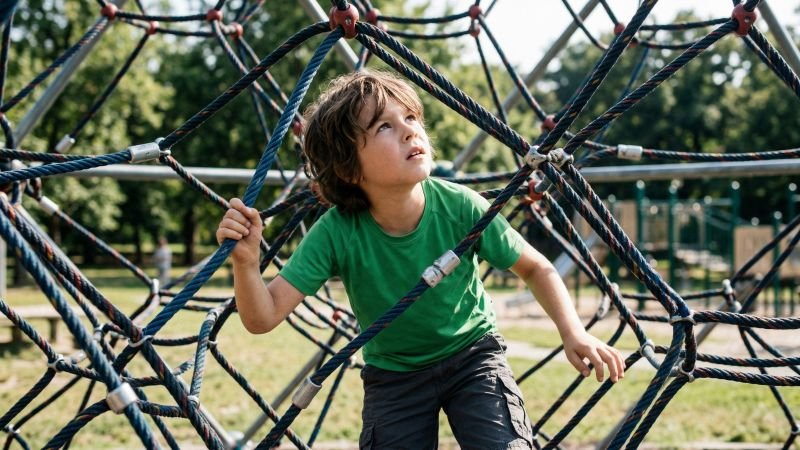
Kids don’t just climb these structures; they calculate them. Before grabbing that first rope, they actively map out their intended path, looking up at the complex grid to determine the most efficient route. This requires intense forward-thinking and visual analysis.
It’s the same logic a site engineer uses when assembling a multi-directional forged aluminum connector matrix. You have to understand how the angles and spacing of those connectors dictate the entire geometry of the structure. A child mentally analyzes this geometry before making a move, evaluating which rope junctions lead to dead ends and breaking down a massive physical obstacle into smaller, executable steps.
Adapting Strategies Through Trial and Error
But what happens when a planned route fails because a rope sags under a sudden load transfer from another user? They hit a physical dead end. This real-time trial and error is where the real cognitive development happens.
In a continuous space net, tension is never static—it travels through the ropes based on user movement. When a child encounters a suddenly unstable path due to this shifting tension, they don’t quit. They recalculate the route and pivot, learning how to adjust their strategy quickly when faced with unexpected physical variables.
| Cognitive Skill | Action on the Climbing Net | Real-World Application |
|---|---|---|
| Analytical Thinking | Identifying dead ends before moving | Breaking down complex academic tasks |
| Strategic Adjustment | Changing direction when a rope sags | Pivoting effectively during project failures |
| Logical Deduction | Choosing a taut rope over a loose one | Making evidence-based, rational choices |
“Navigating complex net structures requires continuous cognitive recalibration. This transforms physical play into an active exercise in applied logic.”
By testing different routes, children realize that physical failure is just new data. They immediately apply this data to make a smarter, more calculated decision on the next attempt.
Benefit 4: Boosting Working Memory and Concentration
While the physical exertion is obvious, the intense mental workout provided by a climbing net is equally critical for a child’s working memory and attention span.
Climbing net playgrounds boost cognitive focus by requiring children to actively recall specific physical sequences and structural layouts. To navigate efficiently, they must hold mental blueprints of the rope grid in their short-term memory while maintaining sustained attention to their immediate movements. Consequently, this intense mental engagement directly strengthens working memory capacity and improves overall concentration levels.
Memorizing Complex Climbing Sequences
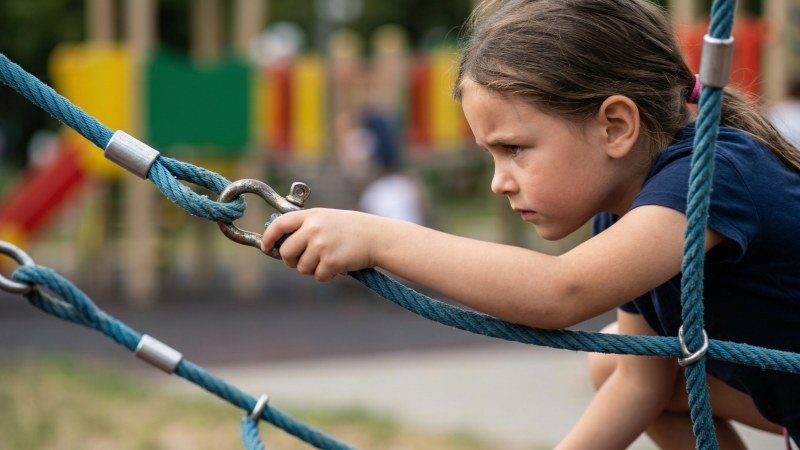
Watch a kid navigate a massive spider web structure. They aren’t staring at their feet. They’re looking three moves ahead and memorizing the necessary steps, leaning heavily on their working memory.
They have to remember which ropes are tightly tensioned, which are loose, and recall the exact sequence of handholds from a previous successful climb. This goes beyond physical repetition; it is active cognitive recall.
Much like a professional installation crew meticulously following a sequential assembly manual to match specific rope lengths to designated structural nodes, the child is building a temporary mental blueprint. They map the environment and store that sequence in their brain to safely guide their limbs.
Translating Active Focus into Academic Preparedness
How does this translate to the classroom? You can’t zone out while suspended in a 3D matrix. You have to stay locked in.
This deep level of concentration actively strengthens neural pathways, training the brain to block out external distractions. This unbroken concentration is no different than a QA inspector checking hundreds of aluminum cross-connectors for snag hazards—a single lapse in focus means failure. The child practices this exact type of unbroken concentration to ensure their own safe passage.
| Cognitive Action on Playground | Direct Academic Translation |
|---|---|
| Recalling a 5-step climbing route | Remembering multi-step mathematical formulas |
| Ignoring playground noise while climbing | Focusing on a reading assignment in a busy classroom |
| Sustaining attention until reaching the top | Completing a lengthy school project without giving up |
“Sustained engagement on complex playground structures trains the brain to manage cognitive load effectively. This directly enhances a child’s ability to maintain focus during structured academic tasks.”
The discipline required to manage that cognitive load doesn’t stay on the playground. It builds the exact mental stamina needed for a student sitting at a desk.
Benefit 5: Fostering Risk Assessment and Self-Confidence
How do complex climbing net structures actually teach a child to manage fear and build unshakeable self-confidence?
Climbing net playgrounds foster risk assessment by providing a highly calculated environment where children can safely test their personal boundaries. As they encounter perceived heights and unstable surfaces, they must independently evaluate their own capabilities before making a move. Consequently, successfully navigating these controlled risks directly translates into lasting emotional resilience and profound self-confidence.
Evaluating Personal Limits in a Safe Environment
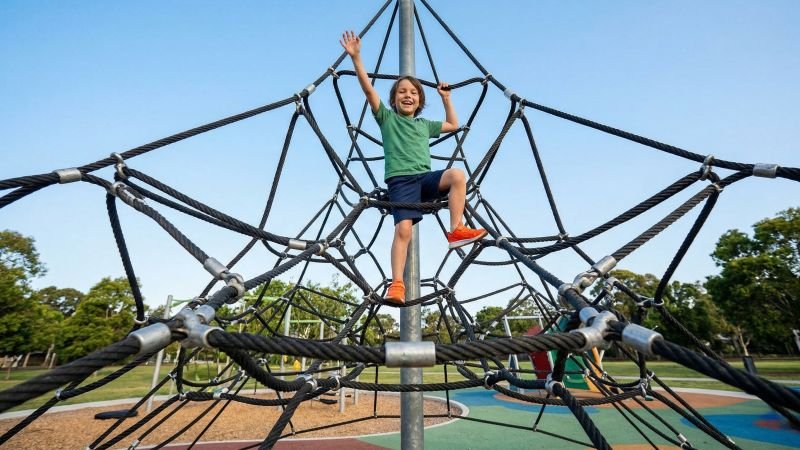
Yes, a high rope structure looks intimidating. But that perceived risk is exactly the point. Children need to experience manageable fear to learn how to overcome it. In the industry, we call this “calculated risk.”
Children constantly ask themselves internal questions on the ropes: Is that gap too wide? Can my grip handle this angle? By answering these questions, they evaluate their physical limits. They learn the critical difference between a hazard (a hidden danger) and a risk (a challenge they can accept).
As engineers, we rely on Head Injury Criterion (HIC) data to dictate the exact thickness of rubber surfacing required to manage a fall zone safely. We don’t eliminate the height; we engineer the safety net. Climbing nets operate on the same philosophy. The intricate layers of rope are designed to break up long fall trajectories.
Commercial climbing structures are typically designed to comply with specific safety standards, such as EN 1176 or ASTM F1487, which mandate maximum Free Height of Fall (FHF) limits. Since maximum fall heights and required safety zones vary based on regional regulations, always verify the exact structural safety specifications with your equipment supplier.
Building Resilience Through Independent Play
Here is the reality of independent play: large net structures aren’t built for adults to helicopter over their kids. Once a child is on the grid, they are on their own.
If they feel stuck or frightened halfway up, they have to manage their own adrenaline, assess the surroundings, and map their own way down. This independent struggle is vital for building deep emotional resilience.
We run severe tensile strength tests on steel-core cables in the factory to ensure they handle stress without yielding. Independent climbing runs a similar test on a child’s emotional tensile strength. They process the fear, manage the stress, and bounce back stronger.
| Play Environment | Adult Involvement | Emotional Development Outcome |
|---|---|---|
| Ground-level sandbox | High (parents often direct play) | Low independent resilience |
| Traditional slide | Moderate (parents can lift children) | Moderate confidence building |
| 3D climbing net | Low (child must navigate alone) | High resilience and self-reliance |
“Mastering a challenging physical structure without direct adult intervention is a fundamental catalyst for building lasting self-esteem.”
When a child reaches the top of that net on their own, the achievement is tangible. They didn’t just scale a structure; they conquered their own hesitation, forging enduring self-confidence.
Conclusion
Climbing net playgrounds are far more than aesthetic site features. They are high-performance training environments that nurture both the physical and mental architecture of a child. By challenging balance, memory, problem-solving skills, and gross motor strength simultaneously, dynamic nets ensure that playtime delivers measurable developmental ROI. Investing in this caliber of play equipment is a direct investment in the resilience, coordination, and confidence of the next generation.