-
Whatsapp: +86 15516933785
-
Email: hanlin@hanlinplayground.com
-
Address: Shangjie District, Zhengzhou City, Henan Province, China
-
Whatsapp: +86 15516933785
-
Email: hanlin@hanlinplayground.com
-
Address: Shangjie District, Zhengzhou City, Henan Province, China

Choosing Wooden Playground Equipment for Schools: A Complete Buyer’s Guide
How can school administrators confidently select and maintain the safest, most engaging wooden playground equipment for their students?
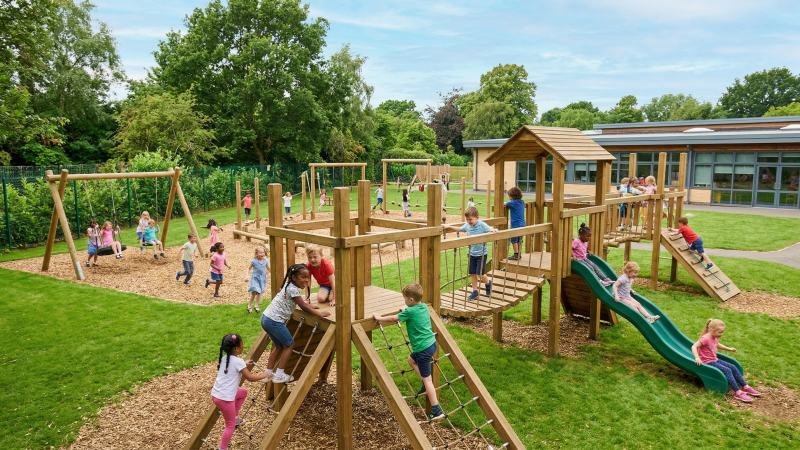
School administrators select optimal wooden playground equipment by prioritizing sustainably sourced timber with splinter-free finishes and galvanized metal ground fixings. On top of that, they maximize educational value by choosing age-appropriate structures and ensure long-term compliance with safety standards by implementing strict, documented routine maintenance schedules.
Evaluating the Unique Advantages of Timber for Students
Why should schools choose timber over plastics or metals when investing in new play structures?
Timber provides unparalleled sensory benefits and aligns directly with school sustainability targets. Unlike metal or plastic, wood offers a tactile, temperature-neutral surface that stimulates child development. Beyond that, sustainably sourced timber actively sequesters carbon, helping educational institutions meet strict environmental regulations and achieve green campus certifications.
Providing Tactile and Sensory Stimulation Through Natural Materials
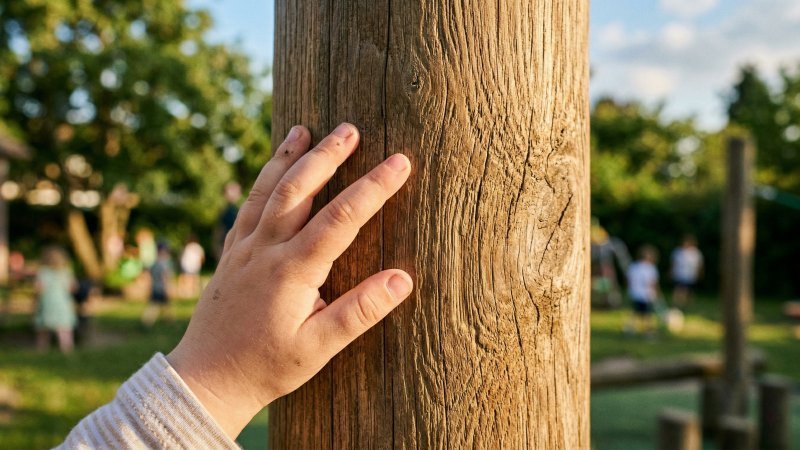
Let’s face it, children interact with the world through touch. Wood offers a rich, textured surface that synthetic materials simply cannot replicate. Have you noticed how metal playground equipment feels in the summer? It absorbs heat quickly. The result? It can become dangerously hot for children to use. Timber, on the other hand, has very low thermal conductivity. That means wooden play structures remain temperature-neutral and comfortable throughout the entire school year.
This natural texture provides essential sensory feedback. When students grip a wooden climbing pole, they feel the natural grain. This tactile engagement actively supports fine motor skill development. We can compare this directly to school landscaping choices. For example, replacing synthetic rubber wet-pour surfacing with natural timber bark mulch immediately changes how children engage with the ground. Both the bark mulch and the wooden climbing frames offer irregular, organic textures that stimulate neural pathways differently than uniform plastics.
Let’s not overlook the visual aesthetics. The organic look of wood blends seamlessly into outdoor school environments. It creates a calming, biophilic atmosphere, which helps reduce playground anxiety and sensory overload for neurodivergent students.
Playground Material Sensory Comparison
| Material Type | Thermal Conductivity | Surface Texture | Visual Impact |
|---|---|---|---|
| Natural Timber | Low (Remains temperature neutral) | Organic, varied grain | Calming, blends with natural surroundings |
| Powder-Coated Steel | High (Gets extremely hot/cold) | Smooth, highly uniform | Industrial, highly reflective |
| HDPE Plastic | Medium (Can retain heat) | Smooth or artificially molded | Synthetic, high contrast colors |
Meeting School Sustainability and Green Campus Goals
Modern schools face increasing pressure to adopt environmentally friendly practices. Installing wooden playground equipment directly supports these green campus initiatives. Timber is a naturally renewable resource. Because of this, it boasts a significantly lower embodied carbon footprint than steel fabrication or plastic manufacturing.
When trees grow, they absorb carbon dioxide from the atmosphere. This biological process is called carbon sequestration. As a result, using timber in school playgrounds physically locks this carbon away for decades. According to timber industry lifecycle analyses, utilizing sustainably harvested wood acts as a net carbon sink for the school grounds.
Sourcing Certified Sustainable Timber
But let’s be realistic—not all wood is equally sustainable. Schools must look for specific industry certifications. The most recognized global standards are the Forest Stewardship Council (FSC) and the Programme for the Endorsement of Forest Certification (PEFC). These labels guarantee that the timber comes from responsibly managed forests rather than illegal logging operations.
Choosing FSC-certified timber ensures that for every tree harvested for your playground project, another is planted or allowed to regenerate naturally.
Because carbon footprint metrics and exact sourcing origins can vary widely based on the timber species and regional availability, you should verify these exact sustainability parameters with your playground supplier before finalizing procurement. At the end of the day, a wooden playground serves as a tangible environmental lesson, physically demonstrating the school’s commitment to sustainability to both the students and the wider community.
Addressing Wooden Equipment Safety in High-Traffic Playgrounds
How do schools guarantee the physical safety of hundreds of children when installing wooden playground equipment in busy daily play areas?
Schools ensure playground safety by utilizing processed timber with splinter-free finishes and rounded edges to prevent direct impact injuries. Administrators also prevent long-term structural failures by specifying metal ground fixings to stop sub-surface wood rot. Factor in specialized anti-slip grooves on all stepping surfaces, and you drastically reduce fall hazards during wet conditions.
Specifying Splinter-Free Finishes and Rounded Timber Edges
Untreated wood naturally splinters over time. That’s exactly why manufacturers must process playground timber extensively before installation. High-traffic school environments demand perfectly smooth surfaces. To achieve this, raw timber undergoes industrial planing and heavy machine sanding. This multi-step process removes all rough fibers effectively.
Are sharp corners dangerous? Absolutely. They pose significant risks during accidental collisions. To engineer around this, manufacturers use a process called chamfering. Similar to how plastic slide chutes are molded with soft curves, timber requires industrial chamfering to eliminate sharp 90-degree angles and create safer, impact-friendly profiles.
The European playground safety standard, EN 1176, specifically mandates edge profiling. It requires a minimum 3mm radius on all accessible structural edges.
Ensuring strict compliance with EN 1176 significantly reduces the severity of impact injuries during active school play.
Keep in mind, the exact chamfer radius and finishing grades can vary based on the specific timber species used. Because these parameters differ between manufacturers, always verify the exact edge specifications and safety certifications directly with your playground supplier.
Preventing Sub-Surface Wood Rot with Metal Ground Fixings
Ever seen a beautiful new playground start leaning after just five years? That’s what happens when moisture gets the upper hand. Moisture is the biggest enemy of outdoor wooden structures. When timber sits directly in the soil, it absorbs groundwater through capillary action. Before you know it, the wood rots from the inside out. This hidden decay drastically weakens the structural integrity. And we all know the worst-case scenario: rotting support posts can cause heavy climbing frames to collapse entirely.
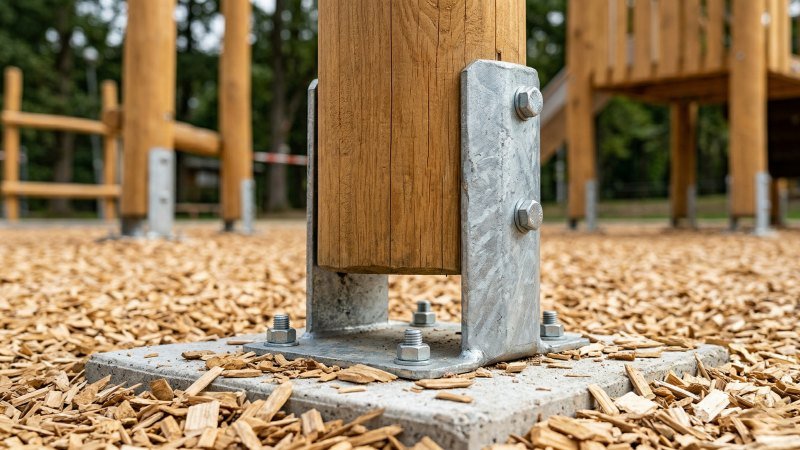
How do we solve this dangerous problem? We must isolate the wood from the wet earth. Professional installers use heavy-duty galvanized steel ground fixings. These metal shoes act as a protective physical barrier. They secure the wooden posts firmly into concrete foundations while keeping the timber above the soil line.
Just as heavy-duty swing set A-frames utilize metal ground boots to prevent base corrosion, timber posts require galvanized steel shoes to prevent wood rot. Playground metal ground anchors serve this exact protective purpose, extending the equipment’s lifespan by decades.
Timber Post Installation Method Comparison
| Installation Method | Moisture Exposure | Estimated Structural Lifespan | Collapse Risk |
|---|---|---|---|
| Direct Soil Burial | High (Constant soil contact) | 3 to 7 Years | Very High |
| Galvanized Steel Fixings | Low (Isolated from soil) | 15 to 20+ Years | Low |
Applying Anti-Slip Grooves and Treatments for Safe Stepping
Rain and morning dew make smooth timber incredibly slippery. Because of this, high-traffic school playgrounds require heavily modified stepping surfaces. Slipping on elevated wooden platforms causes severe injuries. That means safety features must be integrated directly into the wood.
Manufacturers tackle this problem using two primary physical methods. First, they machine deep anti-slip grooves directly into the timber boards. These physical channels provide immediate traction for rubber shoe soles and allow rainwater to drain away quickly. Second, they apply resin-bonded aggregate inserts. Installers inject a mixture of strong epoxy and abrasive grit into pre-cut slots on the wood.
This surface modification is similar to the textured rubber steps found on commercial splash pad equipment—both intentionally interrupt the smooth surface to maintain a strong grip when wet.
- Machine-Routed Grooves: Excellent for flat decking and natural water drainage.
- Resin-Bonded Aggregates: Essential for inclined ramps and high-angle climbing walls.
These anti-slip treatments ensure children can play safely year-round, preventing weather-related closures and keeping the outdoor curriculum running smoothly.
Selecting Age-Appropriate Timber Structures for Different Key Stages
How do school administrators accurately match wooden play structures to the rapid developmental phases of their students?
Selecting age-appropriate timber structures requires aligning the physical complexity of the equipment with specific educational Key Stages. Schools achieve this by installing low-level tactile units for Early Years, modular balancing trails for primary-aged students, and tall, multi-tier climbing towers to provide calculated risks for older children.
Sensory Mud Kitchens and Sandpits for Early Years Foundation
Early Years Foundation Stage (EYFS) students require ground-level engagement. So, towering climbing structures are entirely unsuitable. Instead, schools must prioritize sensory and tactile development. Mud kitchens and wooden sandpits serve this exact purpose perfectly.
These low-level installations encourage cooperative role-play and fast-track essential fine motor skills. When toddlers mix sand, water, and soil on a wooden workbench, they practice early problem-solving. Just as early years educators use tactile sensory bins indoors to build foundational cognitive skills, outdoor mud kitchens provide the same developmental groundwork on a larger scale.
Is fall height a major concern here? Generally, no. Equipment designed for EYFS typically features a Free Fall Height (FFH) of less than 600mm. As a result, these specific units often do not require expensive rubberized safety surfacing beneath them. However, exact platform heights and timber bowl dimensions differ between manufacturers, so you should always verify the exact dimensions and required safety zones with your playground supplier before finalizing your site layout.
Progressive Trim Trails and Balance Beams for Primary Students
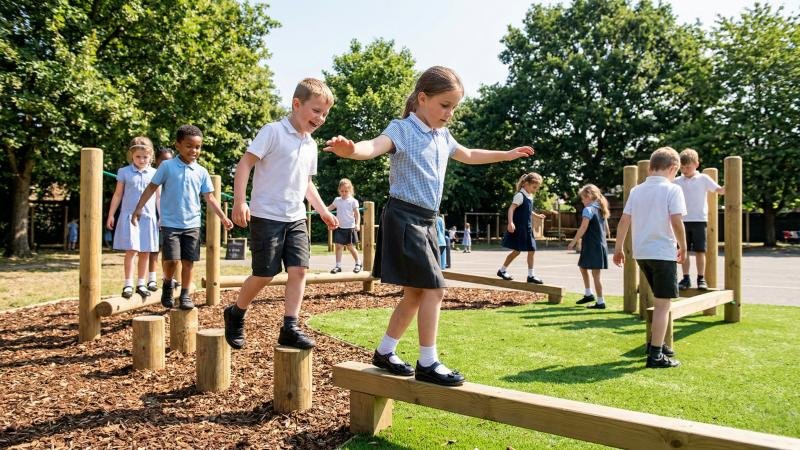
As students transition into primary education, their physical capabilities expand dramatically. They need equipment that actively tests their agility, balance, and core strength. Progressive trim trails are the most effective solution for this specific age group.
A trim trail is a linear arrangement of individual wooden obstacles. Typical components include stepping logs, wobble bridges, and parallel balance beams. Think of a trim trail like a physical obstacle course; each modular wooden station links together to create a continuous, flowing challenge.
This modularity handles high playground traffic incredibly well. During a busy school recess, a single elongated trim trail can safely accommodate over 30 students simultaneously. Children naturally form a line and navigate the course one by one. This specific layout minimizes dangerous playground collisions and encourages children to set personal physical goals over time.
Equipment Suitability by Key Stage
| Educational Stage | Target Age Range | Primary Equipment Focus | Typical Free Fall Height |
|---|---|---|---|
| Early Years (EYFS) | 3 to 5 Years | Sensory play, tactile engagement | Under 600mm |
| Primary (KS1 & KS2) | 5 to 11 Years | Balance, agility, continuous flow | 600mm to 1500mm |
| Older Children (KS3) | 11+ Years | Upper body strength, calculated risk | 1500mm to 3000mm |
Challenging Wooden Climbing Towers for Older Children
Older children quickly lose interest in basic, ground-level play equipment. To keep them physically active, schools must introduce the concept of “calculated risk.” That’s exactly where multi-tier wooden climbing towers become an essential campus addition.
These complex structures feature vertical climbing walls, heavy-duty rope nets, and high-level platforms. They specifically target upper-body strength and spatial awareness. If the equipment is too easy, students simply will not engage with it. For that reason, climbing towers must provide genuine, intimidating physical challenges to remain effective.
Managing Structural Loads and Safety Zones
Designing these tall towers requires careful engineering. As the structure grows taller, the dynamic forces exerted by playing children multiply significantly. Just as a commercial zip wire requires heavy-duty anchor poles to manage extreme kinetic force, a tall climbing tower requires thick, reinforced wooden uprights to safely manage the dynamic energy of multiple playing children.
Of course, taller structures introduce greater fall risks. Climbing towers frequently feature platform heights reaching up to 3 meters. Because maximum fall heights heavily dictate the thickness and cost of the required impact-absorbing surfacing, careful planning and adherence to strict safety compliance are critical for any school project.
Integrating Timber Installations into the Outdoor Curriculum
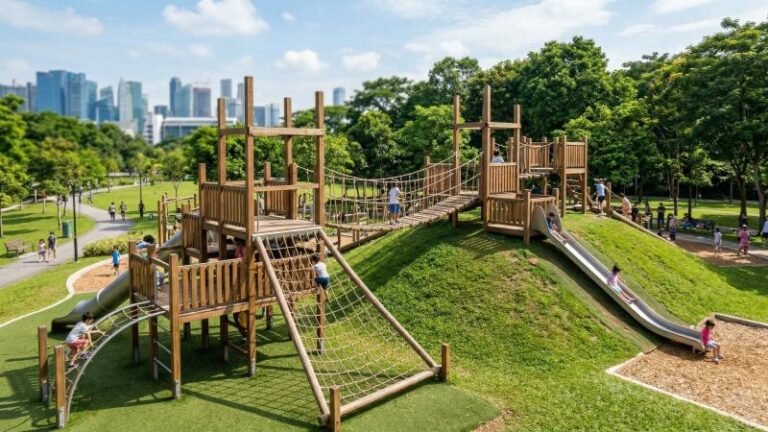
Educators can seamlessly transform traditional wooden playground equipment into active extensions of their daily academic lesson plans. Schools successfully integrate timber installations by utilizing them as dedicated outdoor teaching spaces, installing structured wooden seating areas for group lectures, and using thematic play structures to facilitate interactive lessons outside the traditional classroom.
Creating Nature-Based Outdoor Classrooms and Seating Areas
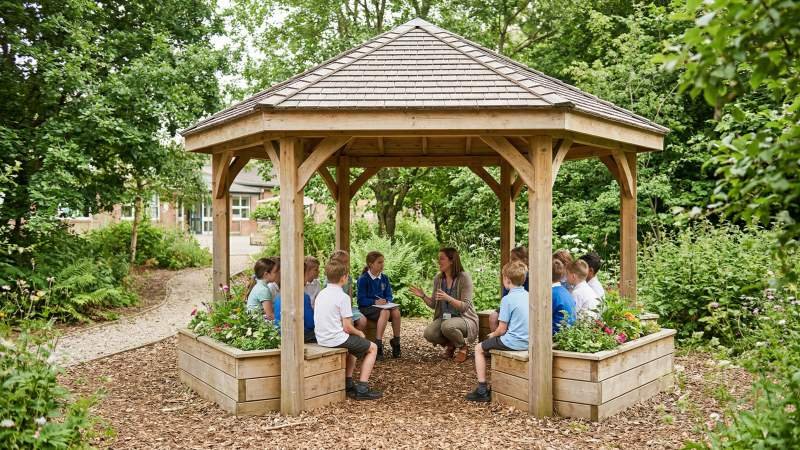
Why let all that outdoor space go to waste when it can do double duty as a managed classroom? Modern education frequently moves beyond four interior walls. That’s why schools increasingly use timber structures to build dedicated outdoor classrooms. These specific areas provide structured, managed environments for formal lessons. A simple circle of wooden planter benches encourages open group discussions. Take it a step further, and larger timber gazebos offer complete weather protection for year-round learning.
Just as indoor classrooms use acoustic panels to manage sound, large wooden gazebos create focused acoustic zones outdoors. The solid timber roof physically traps the teacher’s voice. The payoff is immediate: students can hear instructions clearly over the ambient playground noise.
These dedicated zones require specific physical features to function well. Many schools install outdoor chalkboards directly onto the wooden support posts. You’ll also see schools incorporating heavy-duty timber tables for writing and science experiments.
Common Outdoor Classroom Configurations
| Structure Type | Typical Student Capacity | Primary Educational Use |
|---|---|---|
| Timber Amphitheatre | 30 to 60+ Students | Large school assemblies, drama performances |
| Hexagonal Gazebo | 15 to 30 Students | Focused group lessons, wet-weather shelter |
| Storytelling Circle | 10 to 15 Students | Reading sessions, small group discussions |
Fostering Imagination with Wooden Pirate Ships and Castles
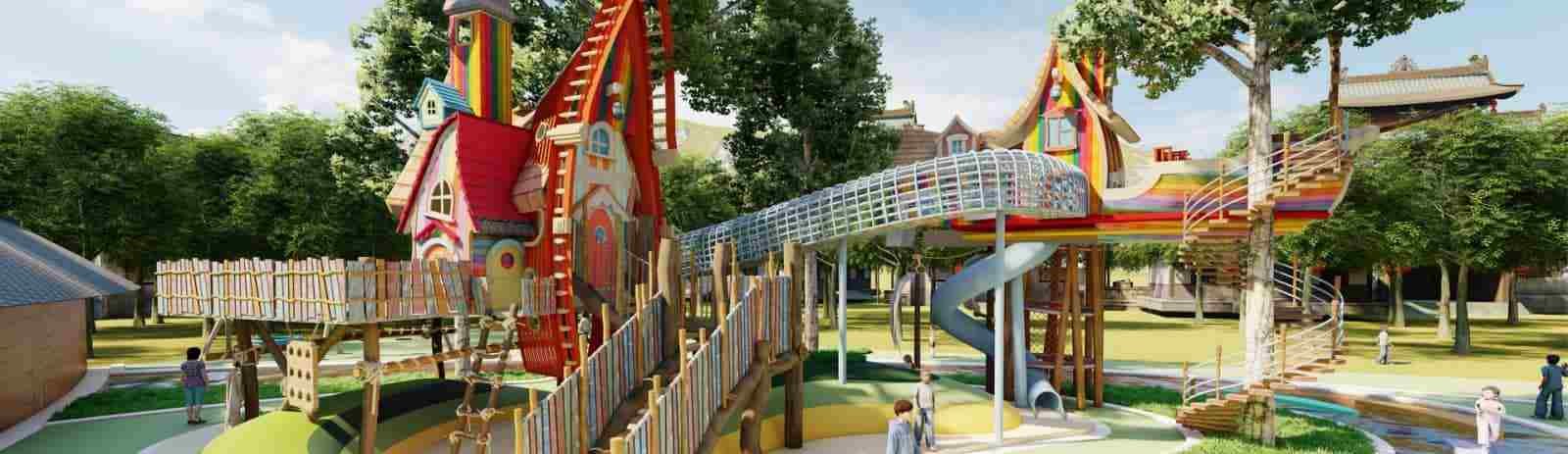
Thematic timber structures actively support the academic curriculum. Installations like wooden pirate ships, trains, and medieval castles are incredibly popular. They serve as highly interactive tools for history, geography, and literature lessons.
Just as a sandbox provides a blank canvas for tactile play, a wooden castle provides the physical boundaries and inspiration for student role-play. Teachers actively use these physical structures to bring historical events to life.
For example, a large wooden pirate ship greatly aids primary geography lessons. Students can practically learn about navigation, weather patterns, and global trade routes. Or look at how a wooden castle directly supports history modules regarding medieval defenses as students physically engage with wooden battlements, towers, and drawbridges.
Thematic play structures transform abstract academic concepts into tangible, physical experiences for young students.
Beyond the core subjects, these installations drastically improve language and communication skills. When children play on a wooden ship, they naturally negotiate roles and create complex narratives. This unstructured dramatic play heavily supports the English curriculum. The bottom line is that these thematic installations turn recess into a direct extension of the classroom. Suddenly, the playground becomes a highly valuable, multi-purpose educational asset.
Planning for Long-Term Maintenance on School Grounds
How can school facility managers effectively maintain wooden playground structures to maximize their lifespan and ensure continuous student safety?
Schools maximize the lifespan of wooden playground equipment by implementing proactive, documented maintenance schedules. Facility managers achieve this by conducting routine visual inspections to monitor natural timber splitting and by adhering to strict timelines for applying specialized wood treatments and UV-protective stains.
Scheduling Routine Inspections for Natural Timber Splitting
Wood is a natural, hygroscopic material. This means it constantly absorbs and releases moisture depending on the weather. This constant expansion and contraction causes natural cracks to appear along the grain. In the timber industry, we call these cracks “shakes.”
Parents and teachers often worry when they see large splits in playground posts. However, these cracks are rarely structural failures. Similar to how wooden park benches develop surface checks over time without losing structural integrity, playground posts develop radial splits as they weather while retaining their full load-bearing capacity.
Nevertheless, schools must monitor these splits closely to prevent finger entrapment hazards. The European safety standard EN 1176 outlines specific inspection frequencies to ensure ongoing compliance.
Playground Inspection Frequency
| Inspection Type | Frequency | Primary Focus for Timber Components |
|---|---|---|
| Routine Visual | Weekly | Check for severe splintering or obvious vandalism. |
| Operational | Quarterly | Measure timber splits, check ground fixing stability. |
| Annual Main | Yearly | Comprehensive structural audit by a certified inspector. |
During operational inspections, maintenance staff should measure the width of any timber splits. Generally, cracks wider than 8mm can become finger traps for young children. If a split grows too large, staff must sand the edges or fill the gap with outdoor-grade wood filler. Because acceptable gap tolerances and warranty conditions regarding timber splits differ among manufacturers, always verify the exact acceptable crack widths with your playground supplier.
Implementing Wood Treatment and Re-Staining Timelines
Think a quick coat of cheap varnish is going to cut it against heavy foot traffic? Not a chance. While initial pressure treatments protect the timber’s core from rot, the surface still needs defense against the elements. Ultraviolet (UV) light from the sun degrades wood fibers over time. Leave it untreated, and playground equipment quickly fades to a silvery-grey color. Worse still, unprotected surfaces absorb rainwater, which accelerates surface decay.
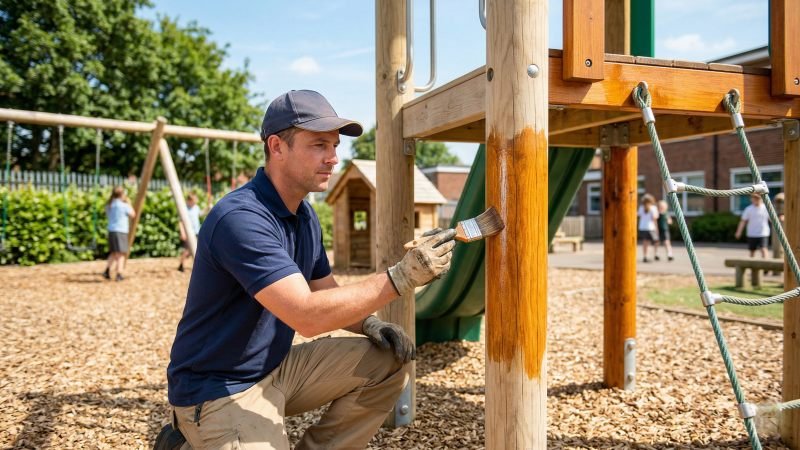
To get ahead of this, schools must implement a strict re-staining schedule. Just as wooden playground fencing requires periodic treating to prevent rot at the soil line, elevated playground timber needs regular topical treatments to repel rainwater and block UV rays.
Applying a high-quality, microporous wood stain extends the aesthetic and functional life of the playground significantly.
Facility managers should avoid cheap, film-forming varnishes. These hard coatings will inevitably peel and flake under heavy student foot traffic. Instead, schools should use penetrating oil-based treatments. These specific stains soak deep into the wood grain. This allows the timber to breathe while actively repelling liquid water.
Typically, new playground equipment requires its first maintenance coat after 12 to 18 months of natural weathering. After that initial treatment, schools should plan to re-stain the equipment every two to three years to prevent costly timber replacements down the road.
Conclusion
Choosing the right wooden playground equipment transforms a simple schoolyard into a dynamic, safe, and engaging learning environment. By understanding the sensory benefits of natural timber, strictly adhering to safety standards like metal ground fixings, and selecting age-appropriate structures, schools can provide immense value to their students. Furthermore, proactively planning for long-term maintenance ensures these valuable outdoor assets serve the educational community for decades to come.
If you are ready to start planning your school’s next outdoor play area or need assistance selecting the safest timber options for your students, please contact us.