-
Whatsapp: +86 15516933785
-
Email: hanlin@hanlinplayground.com
-
Address: Shangjie District, Zhengzhou City, Henan Province, China
-
Whatsapp: +86 15516933785
-
Email: hanlin@hanlinplayground.com
-
Address: Shangjie District, Zhengzhou City, Henan Province, China

Commercial Indoor Wooden Playground: The Ultimate Guide to Design, Safety, and ROI
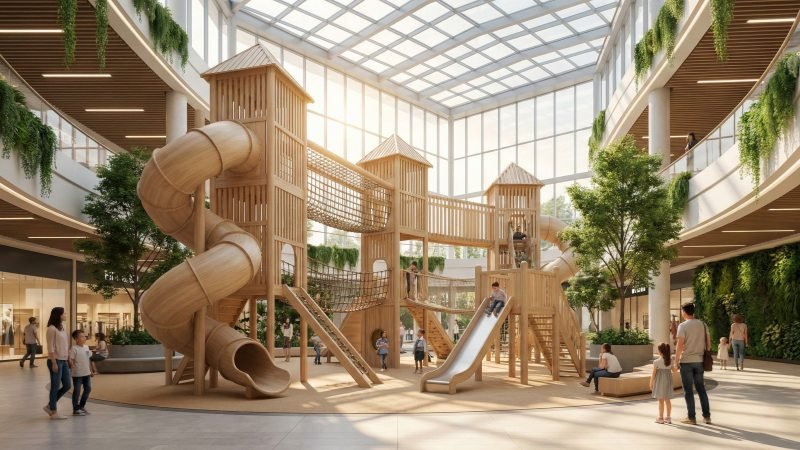
What are the critical factors business owners must consider when planning a commercial indoor wooden playground to ensure safety, durability, and profitability?
A successful commercial indoor wooden playground combines rigorous safety compliance (ASTM/ADA) with strategic spatial design to maximize ROI and durability. By prioritizing premium hardwood materials over plastic, businesses create a safe, sustainable, and aesthetically superior environment that drives customer retention and distinguishes the brand in a competitive market.
Why Choose Wood Over Plastic for Commercial Spaces
Why are commercial venues increasingly selecting wooden playgrounds over traditional plastic structures?
Commercial indoor wooden playgrounds provide a distinct competitive advantage by offering superior structural durability for heavy daily use, creating a sophisticated aesthetic that complements modern interior design, and signaling a commitment to sustainability that appeals to eco-conscious parents.
Creating a Premium Aesthetic and Natural Ambiance
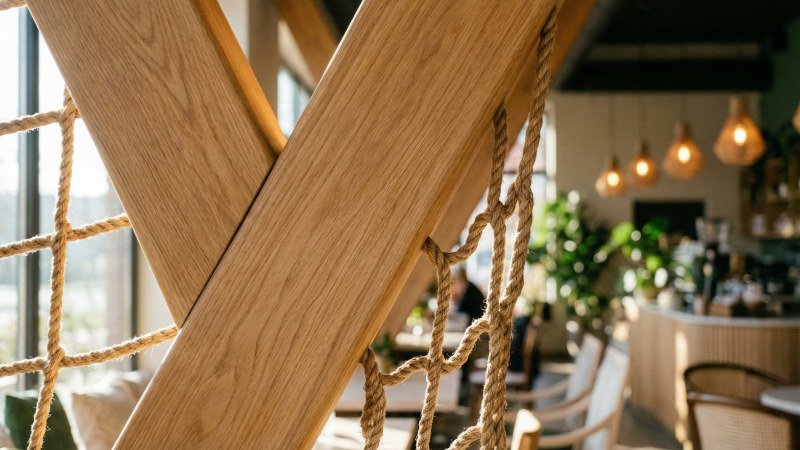
In the commercial play industry, first impressions determine whether a customer returns. Traditional plastic playgrounds often use bright, neon colors like primary red, yellow, and blue. While this captures immediate attention, it often creates “visual noise.” This can make a space feel chaotic or cluttered, especially in high-end venues like family cafes, pediatric waiting rooms, or luxury shopping centers.
Wood flips this script completely. By utilizing natural tones, the structure blends seamlessly with interior decor rather than fighting against it. The texture of grain and the warmth of timber create a calming environment. This concept is often referred to in design as biophilia, which means bringing elements of nature indoors to reduce stress. For a business, this means parents are more relaxed and willing to stay longer, increasing their dwell time.
Think about the atmosphere in a fast-food chain play area compared to a boutique hotel lounge. Plastic structures dictate a loud, high-energy vibe. A wooden structure, however, acts as functional furniture. It allows the playground to serve as a design centerpiece rather than an eyesore that needs to be hidden in a corner.
Visual Impact Comparison
| Feature | Traditional Plastic Playground | Commercial Wooden Playground |
|---|---|---|
| Color Palette | Bright, saturated neon colors | Neutral, warm, earthy tones |
| Texture | Smooth, cold, artificial | Tactile, warm, organic grain |
| Atmosphere | High energy, chaotic, loud | Calming, sophisticated, inviting |
| Target Perception | Mass-market, temporary entertainment | Premium, curated experience |
Durability of Hardwood in High-Traffic Areas
Commercial environments face significantly more wear and tear than residential backyards. A playground in a mall might see hundreds of children per day. Under this stress, materials behave differently. Plastic components, often made from molded polyethylene, are prone to stress fractures and discoloration over time. When a plastic tube or slide cracks, it cannot be repaired; the entire component must be discarded and replaced.
Hardwood structures are engineered to withstand this constant impact. Dense woods used in commercial manufacturing, such as Ash or Oak, possess a high strength-to-weight ratio. This is comparable to the difference between a solid timber support beam and a hollow PVC pipe in construction. The solid timber absorbs shock and supports heavy loads without warping.
Here is the real engineering advantage: repairability. If a wooden post gets scratched or dented from heavy use, it does not lose its structural integrity. Maintenance staff can often sand down the imperfection and refinish the surface to make it look new again. This capability extends the lifespan of the equipment significantly compared to plastic, which shows permanent signs of aging such as white stress marks at bending points.
Note on Materials: The durability and density of wood can vary significantly depending on the specific timber species (e.g., Birch plywood vs. solid Maple) and the manufacturing process. Ensure the material specifications meet your facility’s traffic requirements. You can verify wood hardness ratings via resources like the Janka Hardness Scale.
Enhancing Brand Image with Eco-Friendly Materials
Modern consumers are increasingly “values-driven.” Parents today often prefer businesses that demonstrate social responsibility. Installing a plastic playground relies heavily on petroleum-based manufacturing, which can conflict with the values of eco-conscious customers.
Choosing wood signals that your business prioritizes sustainability. Wood is a renewable resource, especially when sourced from forests certified for responsible management, such as those monitored by the Forest Stewardship Council (FSC). By highlighting this choice in your marketing, you transform a simple play area into a statement about your brand’s ethics.
Beyond the optics, there is the feel. Plastic surfaces can generate static electricity and often feel flimsy. Wood feels solid and grounded. This tangible quality communicates stability and safety to parents watching their children play. When parents perceive the environment as high-quality and safe, their trust in the business increases.
Key Safety Standards and Regulations
What specific safety standards and regulations must a commercial indoor wooden playground meet to ensure it is legally compliant and safe for public use?
Commercial indoor wooden playgrounds must strictly adhere to ASTM F1918 standards for soft contained play equipment and meet ADA guidelines to ensure accessibility for children with disabilities. Furthermore, these structures require the use of CPSC-compliant, non-toxic finishes to prevent chemical exposure, alongside rigorous structural engineering to withstand dynamic loads and prevent tipping in high-traffic commercial environments.
Navigating ASTM and ADA Compliance Requirements
In the United States, the primary standard for indoor play equipment is ASTM F1918. Unlike residential sets, which follow less stringent rules, commercial equipment must pass rigorous tests for public safety. This standard specifically addresses “Soft Contained Play Equipment,” covering everything from the spacing of the slats to the flammability of the materials.
You have to watch out for “entrapment hazards.” This refers to spaces where a child’s body could pass through, but their head could get stuck. Inspectors use specific test probes—templates shaped like a small child’s torso and head—to verify these openings. If the torso probe fits through an opening but the head probe does not, the design fails immediately. This is similar to a “Go/No-Go” gauge used in industrial quality control: there is no margin for error when safety is involved.
Then you have the accessibility factor. ADA (Americans with Disabilities Act) compliance is not optional. A commercial playground cannot exclude children with mobility challenges.
- Accessible Routes: There must be a clear path for a wheelchair to reach the play structure.
- Transfer Stations: These are low platforms that allow a child to lift themselves out of a wheelchair and onto the play equipment.
- Ground-Level Activities: The design must include play panels or sensory features reachable from a seated position.
Note: Specific compliance requirements, such as the exact ratio of ground-level components to elevated components, may vary based on the total size of your playground and local building codes. For a deeper dive into these protocols, refer to our guide on safety standards.
Importance of Non-Toxic Varnishes and Smooth Finishes
Wooden playgrounds require coatings that do more than just look good; they must be chemically safe. Children interact with these structures intimately. They touch the wood, crawl on it, and toddlers often mouth the surfaces. Consequently, the varnishes and paints used must be certified non-toxic and free from harmful chemicals like lead, formaldehyde, and phthalates, often regulated by the CPSC.
The industry standard involves using water-based, low-VOC (Volatile Organic Compound) lacquers. High-VOC solvent-based finishes can “off-gas,” releasing chemical vapors into your indoor air long after installation. In a contained indoor environment with limited ventilation, this can cause respiratory issues as outlined by the EPA.
It’s not just about the chemistry; it’s about the texture. This is known as “finishing.” Every edge must be “eased” or rounded over. A sharp 90-degree corner on a wooden post acts like a dull blade if a child falls against it. Manufacturers typically use a router to create a specific radius (curve) on all edges.
Friction Coefficient
The varnish also dictates how slippery the surface is.
- Too Smooth: A floor panel that is too glossy becomes a slip hazard, especially for children running in socks.
- Too Rough: A surface with too much grip can cause “rug burn” or abrasion injuries on slides.
Structural Stability Requirements for Indoor Installations
Unlike outdoor playgrounds, which are often cemented deep into the ground, indoor playgrounds usually sit on top of a finished concrete slab. This presents unique structural challenges regarding stability and tipping.
The structure must withstand Dynamic Loads. A “static load” is just the weight of the wood itself. A “dynamic load” is the force generated when ten children run, jump, and swing on the frame simultaneously. The momentum of swinging bodies creates lateral (side-to-side) force. If the structure is not engineered correctly, this force can cause the unit to rock or tip over.
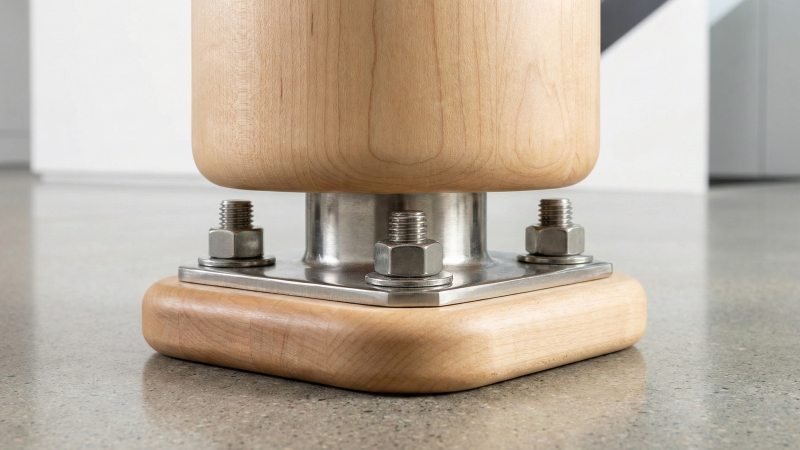
Gravity and momentum are the enemies here. To combat them, commercial installers use heavy-duty steel base plates. These plates are bolted directly into the facility’s concrete subfloor.
Common Anchoring Methods:
| Anchoring Type | Application | Stability Level |
|---|---|---|
| Concrete Wedge Anchors | Used for solid concrete floors; the standard for malls and play centers. | High |
| Wall Bracing | Attaching the structure to the building’s wall studs for extra support. | Very High |
| Free-Standing Bases | Used when drilling into the floor is forbidden (e.g., leased spaces). Requires a wider footprint to prevent tipping. | Medium |
Imagine a tall, narrow bookshelf in a retail store. If it isn’t secured, a slight bump can topple it. To make it safe, you either bolt it to the floor or make the base significantly wider. Indoor playgrounds follow the exact same physics principles to ensure stability.
Customization Strategies for Different Indoor Layouts
How can you fit a profitable commercial playground into an oddly shaped room or a tight floor plan without wasting valuable retail space?
Maximizing indoor play areas requires a strategic “zone-based” design approach that utilizes verticality and corner configurations to reclaim dead space. By implementing modular wooden systems, operators can customize layouts to fit irregular architectural footprints—such as structural columns or low ceilings—ensuring every square foot generates revenue while allowing for scalable expansion as the business grows.
Utilizing Corners and Irregular Shapes Efficiently
In commercial real estate, you pay for every square foot of space. So, dropping a square box in a round room isn’t going to work. It creates “dead zones” around the perimeter that cannot be used for seating or foot traffic.
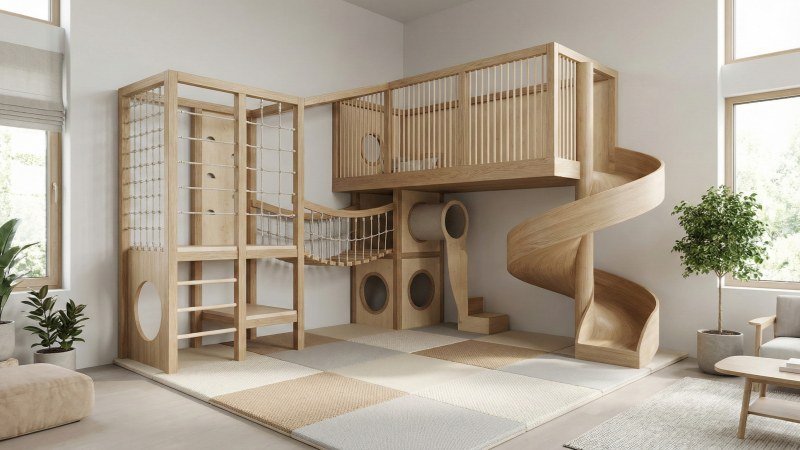
Custom wooden playgrounds excel here because they function like built-in cabinetry rather than prefabricated furniture. Just as a carpenter builds shelving to wrap around a wall obstruction, a playground designer can shape the structure to fit existing architecture. Even if you have an oddly shaped room, customization allows you to utilize every inch.
Common Irregular Layout Solutions:
- The L-Shape: Perfect for corners. This design pushes the play structure against two walls, opening up the center of the room for parent seating or café tables.
- Column Wraps: Many commercial buildings have structural support pillars in inconvenient spots. A custom design can build the playground around the pillar, turning an obstacle into a central climbing feature.
- The Galley Layout: For narrow spaces (like a hallway or a long retail strip), the playground is designed to be long and thin, encouraging “flow” rather than gathering.
By molding the equipment to the room, you maximize “Play Value per Square Foot.” This metric measures how much activity fits into a specific area.
Vertical Expansion Options for Various Ceiling Heights
When floor space is limited, the only way to go is up. Utilizing vertical space allows you to double or triple your capacity without occupying more floor area. This is similar to a warehouse installing a mezzanine floor to store more inventory without buying a bigger building.
Strategies for Different Ceiling Heights:
| Ceiling Height | Design Strategy | Recommended Features |
|---|---|---|
| Low (Under 8 ft) | Horizontal Spread | Ground-level sensory boards, crawl tunnels, low balance beams. Focus on toddler zones. |
| Standard (8-12 ft) | Double Deck | Two-level structure. Upper level for crawling/sliding, lower level for role-play cottages. |
| High (12 ft+) | Vertical Towers | Three-level decks, spiral tube slides, high rope bridges. Creates a “wow” factor. |
But be careful—you can’t just hit the ceiling. Vertical expansion requires careful planning regarding clearance.
Note: Building codes typically mandate a specific clearance distance between the top of the play structure and the ceiling sprinklers or light fixtures (often 18 inches or more). Always verify the exact vertical clearance limitations with your local fire marshal or architect before finalizing a design height.
Modular Systems for Scalability and Future Updates
A major challenge for new businesses is budget. You might not have the capital to build a massive playground on day one. This is where modular wooden systems provide a massive advantage over static manufacturing.
Think of a modular playground like a standardized shelving system in a retail store. You can start with the base unit. Later, when the business becomes profitable, you can bolt on additional sections without tearing down the original structure.
Benefits of a Phased Installation:
- Phase 1 (Launch): Install the main tower and a slide. This gets you open and operating.
- Phase 2 (Growth): Six months later, add a connecting bridge and a second tower.
- Phase 3 (Refresh): A year later, swap out a play panel for a new interactive game to keep repeat customers interested.
This “Plug-and-Play” capability is specific to engineered wooden systems that use universal connection points. It allows the playground to grow alongside your business revenue, reducing the initial financial risk.
Cost Analysis and Return on Investment
Is investing in a premium commercial wooden playground financially viable compared to cheaper alternatives, and what is the realistic timeline for seeing a return on that investment?
A commercial indoor wooden playground typically commands an initial capital expenditure 20% to 40% higher than plastic equivalents, yet it delivers a superior Return on Investment (ROI) through extended equipment lifespans and increased customer spending. By functioning as a high-quality anchor attraction, these structures significantly boost “dwell time,” leading to higher secondary revenue in food, beverage, and retail sales, often offsetting the initial cost difference within the first 18 to 24 months of operation.

Breakdown of Manufacturing and Installation Costs
Understanding where your budget goes is crucial for planning. Unlike buying a pre-made product off a shelf, paying for a commercial wooden playground is more like commissioning a construction project. The total price tag is split into “hard costs” and “soft costs.”
Hard Costs (Materials and Production):
The largest portion of your budget pays for the raw timber and fabrication. High-grade hardwoods like Maple or Ash are commodities. Their price is higher than the petroleum pellets used to make plastic slides. Additionally, wooden components require skilled carpentry to shape, sand, and finish. This is labor-intensive compared to a machine injection-molding thousands of identical plastic tubes.
Soft Costs (Design and Engineering):
You are also paying for safety compliance. A certified engineer must calculate the load-bearing capacity of the beams. This ensures the structure won’t collapse under the weight of thirty children. This engineering fee is usually included in the project quote but represents a significant value.
Installation Labor:
Don’t overlook the install crew. A professional installation crew might spend 3 to 7 days assembling a complex structure. This includes anchoring the unit to the subfloor and testing for stability.
Typical Cost Allocation:
| Cost Category | Approximate % of Budget | Description |
|---|---|---|
| Materials & Fabrication | 50% – 60% | Wood, hardware, varnish, slides. |
| Shipping & Logistics | 10% – 15% | Crating and freight transport. |
| Installation Labor | 20% – 25% | On-site assembly crew and travel. |
| Design & Engineering | 5% – 10% | CAD drawings and safety certification. |
Impact of Wooden Play Structures on Customer Retention
The ROI of a playground is not just about ticket sales; it is about “Dwell Time.” In the family entertainment industry, dwell time is the duration a family stays in your facility. It’s simple math: the longer they stay, the more they spend.
A high-quality wooden playground acts as a comfortable environment rather than just a frenetic activity zone. Because wood absorbs sound better than hollow plastic, the area is quieter. This encourages parents to relax rather than rush to leave.
The “Coffee Index” Effect:
Consider a family cafe. If the play area is loud and chaotic (typical of plastic structures), parents might leave after 45 minutes. If the area is calming and engaging (typical of wooden structures), they might stay for 90 minutes. That extra 45 minutes often results in a second round of coffee or a lunch order.
Over a year, increasing the average transaction value by just $5 per family due to extended stays can generate tens of thousands of dollars in additional revenue. This “secondary revenue” is where the playground truly pays for itself, making it a profitable business investment. It transforms a passive amenity into an active sales driver.
Long-Term Maintenance Costs Compared to Plastic Alternatives
When analyzing costs, let’s talk about the “Total Cost of Ownership” (TCO) over five to ten years, not just the upfront price. Plastic equipment has a hidden flaw: it is generally disposable.
The Plastic Replacement Cycle:
When a plastic tube cracks or becomes brittle from UV exposure (even indoor lighting causes fading), it cannot be fixed. You must order a brand-new component from the factory. If that specific model is discontinued, you might have to replace the entire section of the playground. This is comparable to replacing cheap laminate flooring; if a plank chips, the water gets in, and you often have to rip up the whole section.
The Wood Restoration Cycle:
Why buy a new part when you can restore the one you have? If a child scratches a wooden post with a toy, or if the finish wears down after three years of heavy use, you do not throw it away.
- Sand: A maintenance worker sands down the surface layer.
- Refinish: A fresh coat of non-toxic varnish is applied.
- Result: The piece looks brand new.
This maintenance can often be done in-house. This eliminates the need for expensive shipping of bulky replacement parts. Over a decade, the ability to refinish existing materials rather than buying new ones makes wood the more distinct financial winner.
How to Select the Right Manufacturer
How can business owners distinguish between a reputable commercial playground partner and a generic reseller to ensure their investment is safe and durable?
Selecting the right manufacturer requires verifying their specific experience with commercial-grade installations through past project portfolios, confirming comprehensive warranty coverage that addresses structural timber integrity versus consumable parts, and reviewing a transparent project timeline from initial CAD rendering to final safety inspection. A qualified supplier must provide verifiable case studies, proof of product liability insurance, and a dedicated project manager to navigate compliance standards throughout the build.
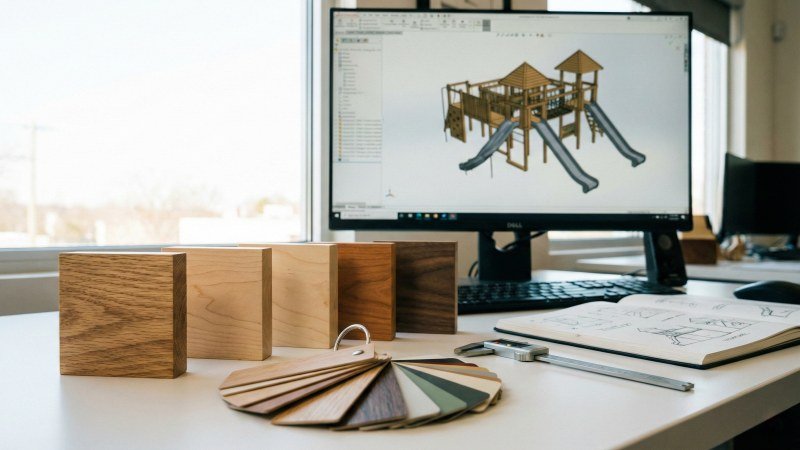
Evaluating Portfolios and Past Commercial Projects
When browsing manufacturer websites, it is easy to be fooled by beautiful images. However, you must distinguish between digital 3D renderings and actual photos of installed projects. A rendering shows what the company hopes to build; a site photo shows what they actually built.
Look for a “Track Record of Execution.” This is similar to hiring a contractor to build a house. You wouldn’t hire a builder who only shows you drawings but no finished houses. Ask the manufacturer for a list of recent installations in venues similar to yours. If you are opening a high-traffic mall play area, a manufacturer who primarily supplies small daycares may not understand the structural durability you need.
Key Portfolio Indicators:
- Scale of Projects: Have they successfully installed large, multi-level structures?
- Variety of Venues: Do they have experience working in diverse environments like museums, airports, or restaurants?
- Client References: Can they provide contact information for past clients? Speaking to a past customer can reveal hidden issues like shipping delays or poor communication.
Note: Suppliers often showcase their “best-case” scenarios. Always ask for photos of projects that are at least three years old. This reveals how their materials hold up to real-world aging and usage.
Understanding Warranty Terms and After-Sales Support
A commercial playground is a long-term asset, and the warranty is your insurance policy. But read the fine print before you sign. You must understand the difference between “Structural Warranty” and “Cosmetic Warranty.”
Think of this like commercial facility flooring: the subfloor (structure) might be guaranteed for decades, but the carpet tiles (soft goods) are expected to wear out and be replaced. In the playground industry, standard warranties follow a similar tiered structure.
Typical Commercial Warranty Tiers:
| Component Category | Typical Coverage Period | What is Covered? |
|---|---|---|
| Structural Timber | 5 – 10 Years | Rot, structural failure, major cracking. |
| Plastic Components | 3 – 5 Years | UV fading, stress cracks, manufacturing defects. |
| Soft Goods (Nets/Pads) | 1 – 2 Years | Stitching failure, foam compression. |
| Hardware | 1 – 3 Years | Rust, bolt shearing, connector failure. |
After-Sales Service:
Beyond the paper warranty, consider the logistics of repair. If a slide cracks, does the manufacturer stock replacements domestically, or will you have to wait six weeks for a shipment from overseas? A reliable partner keeps an inventory of common spare parts to minimize your facility’s downtime.
The Process from 3D Design to Final Installation
A professional manufacturer follows a strict engineering workflow to ensure the final product fits your space perfectly. This is not a simple “add to cart” transaction. It is a consultative construction process.
Step 1: The Site Survey and Consultation
The process begins with accurate measurements. You provide the floor plan, ceiling height, and location of obstacles like pillars or fire exits. The designer analyzes your “traffic flow” to ensure the playground doesn’t block emergency paths.
Step 2: 3D Modeling and Revisions
The manufacturer creates a CAD (Computer-Aided Design) model. This digital twin allows you to see exactly how the playground looks in your room. This is the time to make changes. Moving a slide in the software takes five minutes; moving it during installation costs thousands of dollars.
Step 3: Engineering and Fabrication
Once you approve the design, it goes to engineering. Here, they calculate load paths and safety zones. The factory then cuts the timber to precise specifications. This pre-fabrication ensures that when the parts arrive at your location, they fit together seamlessly like a complex puzzle.
Step 4: Professional Installation
Finally, a certified crew assembles the structure. They don’t just bolt it together; they perform “audit checks” during the build. They measure gap sizes to prevent entrapment hazards and torque bolts to specific settings. The project is not complete until a final walkthrough confirms stability and safety compliance.
Conclusion
Investing in a commercial indoor wooden playground is a strategic decision that balances safety, aesthetics, and long-term financial returns. By choosing durable hardwood materials, navigating safety standards like ASTM and ADA, and partnering with a reputable manufacturer, businesses can create a unique destination that drives customer loyalty.
Whether you are retrofitting a small corner or planning a commercial indoor wooden playground from scratch, the key to success lies in early planning and quality materials. Do not view the playground merely as an expense, but as a high-yield asset that enhances your brand’s value. To ensure your project meets your specific vision and budget, the next logical step is to consult with a design specialist who can transform your floor plan into a safe, engaging reality.