-
Whatsapp: +86 15516933785
-
Email: hanlin@hanlinplayground.com
-
Address: Shangjie District, Zhengzhou City, Henan Province, China
-
Whatsapp: +86 15516933785
-
Email: hanlin@hanlinplayground.com
-
Address: Shangjie District, Zhengzhou City, Henan Province, China


How to Choose Safe and Durable Climbing Net Playground Equipment for Your Project?
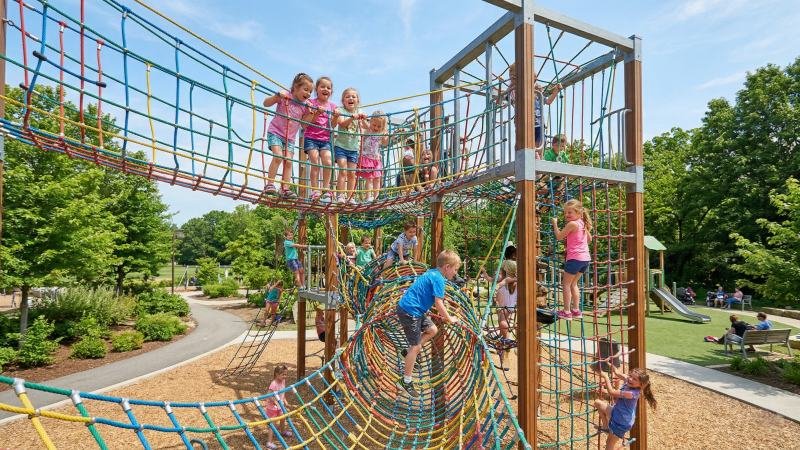
What are the essential factors to consider when choosing safe and durable climbing net playground equipment for your next project?
To select the best climbing net playground equipment, you must prioritize strict compliance with international safety standards like ASTM or EN, utilize ultra-durable materials including steel-core ropes and commercial-grade connectors, optimize site planning for maximum capacity, and implement a modular design to ensure long-term, cost-effective maintenance.
Essential Safety Standards and Compliance Metrics
What are the most critical safety standards and compliance metrics you must evaluate before installing a commercial climbing net?
To ensure ultimate safety, climbing net playgrounds must adhere to strict international standards like ASTM F1487 or EN 1176. These comprehensive metrics dictate acceptable mesh sizes to prevent entrapment, mandate structural load limits, and establish exact formulas for calculating critical fall heights and required safety zones.
Navigating ASTM and EN Guidelines
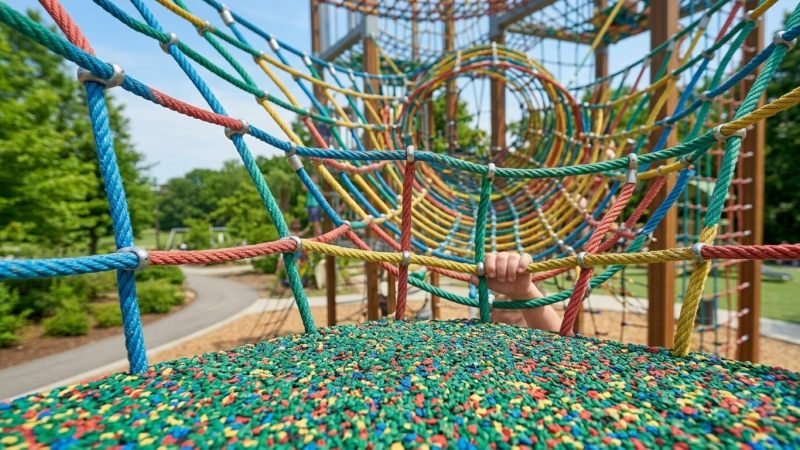
Before you break ground, you need to know the rules of the game. Globally, commercial playground equipment relies on two primary frameworks: ASTM F1487 in the United States and the EN 1176 standards in Europe. Both systems share a vital core goal: to prevent life-threatening hazards on climbing structures.
Head and neck entrapment is a primary hazard. To mitigate this, grid sizes in climbing nets are strictly regulated. For example, openings typically must be smaller than 3.5 inches or larger than 9 inches. This rule ensures a toddler’s body cannot slip through while their head gets stuck.
Look at it this way: it’s no different than the strict spacing rules for playground guardrails or barrier panels. The vertical slats must be spaced closely enough so a child cannot pass their body through and become wedged. Similarly, a playground net must intentionally prevent a child’s limbs from becoming trapped.
But it’s not just about spacing. These standards also dictate structural integrity. The equipment must support multiple children climbing simultaneously, meaning testing involves applying heavy, concentrated loads to the rope joints.
Since testing methods and local requirements can differ slightly, third-party certification is non-negotiable. Certifications might vary based on the specific region or the testing laboratory used. Therefore, always request official, updated test reports directly from your supplier to ensure full compliance.
| Regulatory Standard | Primary Region | Key Focus for Climbing Nets |
|---|---|---|
| ASTM F1487 | North America | Entrapment prevention and structural user load limits. |
| EN 1176 | Europe | Stability testing and comprehensive fall hazard mitigation. |
| AS 4685 | Australia | UV degradation metrics and localized structural integrity. |
Determining Proper Fall Heights and Safety Zones
Once you’re compliant, you need to map out the physical footprint. You’re looking at two critical metrics: the Critical Fall Height (CFH) and the designated Use Zone.
Let’s nail down the Critical Fall Height first. This is the highest designated play surface from which a child could theoretically fall. However, climbing nets are unique structures. Their dense, overlapping geometric layers often act as an internal safety barrier. Because of this, the physical apex of the structure is not always the official CFH. If a child slips near the top of a spatial network, they usually land on a lower web layer.
Since these calculations hinge heavily on the net’s specific internal geometry, fall height data can fluctuate. As a result, it is imperative to verify the exact CFH rating with your equipment manufacturer before purchasing your safety surfacing.
Then there’s the Use Zone. This is the mandatory safety area surrounding the equipment that must be covered with impact-absorbing surfacing. Think of the use zone like the mandatory swing arc clearance required around a commercial swing set. You must keep that specified operational radius entirely clear of hard obstacles to prevent accidental impacts.
As a rule of thumb, the use zone must extend a minimum of 6 feet in all directions from the outermost edge of the climbing net. On top of that, the surfacing material must match or exceed the specific CFH of your structure.
Proper impact attenuation is non-negotiable. If your net has a CFH of 8 feet, your engineered wood fiber or poured-in-place rubber must be explicitly certified to absorb an 8-foot impact.
By strictly aligning your playground design with these precise safety metrics, you protect the users and guarantee long-term operational compliance.
Material Selection for Maximum Longevity
Material choice makes or breaks a high-traffic playground. It is the single most crucial step to guarantee your climbing net survives years of heavy outdoor use.
To maximize longevity, you must select playground equipment built with steel-core multifilament ropes, UV-stabilized synthetic coatings, and commercial-grade metallic connectors. These specific materials resist severe weathering, prevent vandalism, and maintain structural tension far better than standard residential fibers.
The Advantage of Steel-Core Ropes Over Standard Options
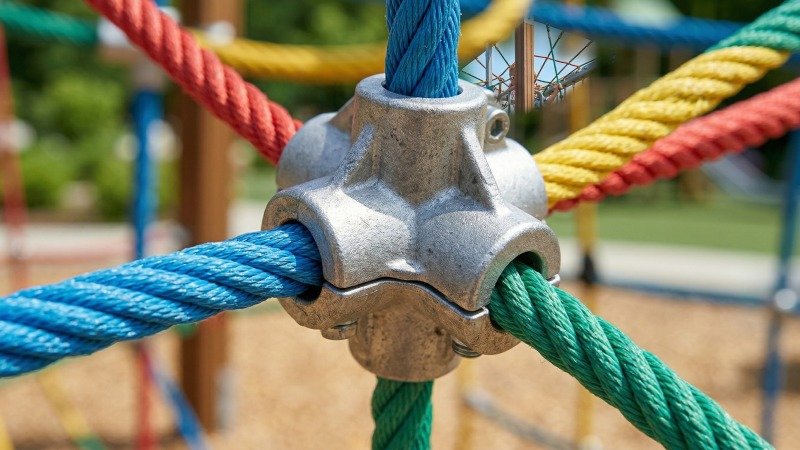
Commercial climbing structures demand exceptional tensile strength. Standard nylon or natural fibers? Don’t even bother. Instead, professional manufacturers use steel-core multifilament ropes. Typically, these ropes feature a diameter of 16mm to 20mm. Inside the synthetic outer layer, multiple strands of braided galvanized steel provide maximum durability.
Think of steel-core ropes like the plastisol-coated steel chains used on heavy-duty commercial swing sets. The outer synthetic yarn provides a smooth, comfortable tactile surface for children’s hands, while the inner steel core delivers the critical load-bearing strength. This design strictly prevents the structure from snapping under heavy, shifting loads.
Standard ropes will eventually stretch, sag, or break under constant tension. On the flip side, steel-core ropes maintain their rigid geometric shape over time. The hidden metal core also acts as a powerful deterrent against vandalism—a standard pocket knife cannot easily sever a reinforced steel-cable net.
| Feature | Standard Nylon Rope | Steel-Core Multifilament Rope |
|---|---|---|
| Vandal Resistance | Low (Easily cut) | High (Difficult to sever) |
| Tensile Strength | Moderate | Exceptional |
| Sagging Over Time | High probability | Very low probability |
UV Protection and Weather Resistance Capabilities
Outdoor gear takes a beating from the elements. Sunlight and moisture are the biggest enemies of synthetic materials. Ever seen a vibrant rope net turn into a brittle, chalky mess after just one summer? That’s what UV radiation does to untreated plastics, making standard ropes faded and dangerous to climb.
The industry fix? Quality climbing nets utilize high-grade polypropylene or polyester yarns deeply infused with advanced UV stabilizers during the manufacturing process.
Much like how industrial powder coating shields steel playground support posts from rust, these UV-stabilizers protect the rope’s chemical bonds from solar degradation. Thanks to this, the rope securely retains its vibrant color and structural flexibility for years.
Beyond sun protection, the outer synthetic fibers must aggressively resist moisture absorption. If playground ropes absorb water, they rot or freeze during winter. Water-repellent synthetic materials are absolutely necessary to ensure year-round weather resistance.
Evaluating Connectors and Hardware Strength
Even the toughest rope is useless if the joints fail. A climbing net is essentially a complex web of tension. What happens when a dozen teenagers hit a climbing net at a full sprint? The intersecting joints take massive, multi-directional shear forces.
That’s why professional rigs never rely on cheap plastic cross-connectors for primary load-bearing joints. Instead, they use heavy-duty pressed aluminum ferrules or cast stainless steel junctions.
Consider the heavy-duty mounting collars used to attach structural platforms to main playground uprights. Those metallic collars are just as critical as the decks they support. Similarly, a playground net’s metallic connectors are the vital nodes that safely distribute kinetic weight across the entire structure.
Beyond the internal joints, you need to evaluate the hardware that anchors the net to the main support posts. High-quality systems utilize tamper-resistant, rust-proof stainless steel bolts. This specialized hardware prevents unauthorized loosening by vandals, ensuring the net remains securely tensioned and safe for daily use.
Strategic Site Planning and Age-Appropriate Design
Optimizing your playground site layout requires balancing spatial efficiency with the specific developmental needs of your target users.
To successfully plan your site, you must leverage vertical climbing networks to maximize user capacity within a small footprint, while carefully customizing the rope grid intervals. Adapting these grid sizes ensures older children encounter engaging physical challenges, while strictly preventing younger toddlers from slipping through oversized gaps.
Maximizing Capacity in Limited Spaces
When you’re dealing with urban parks or tight schoolyards, ground space is at a premium. So how do you pack maximum play value into a tiny footprint? Why waste premium ground space when you can build upward?
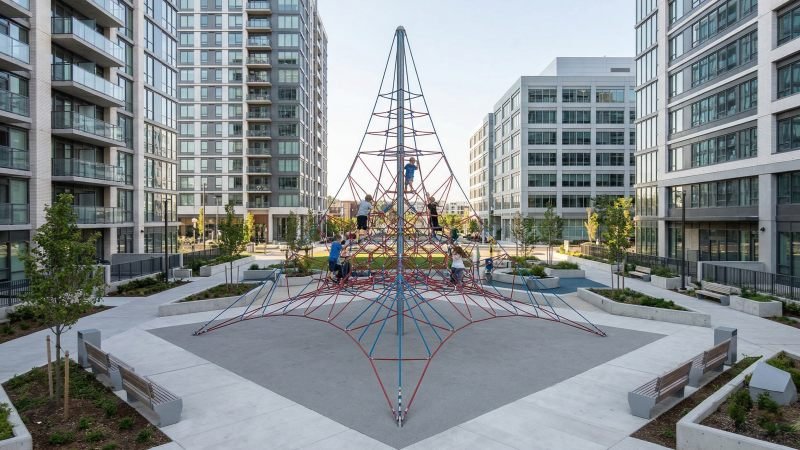
Just as playground designers use multi-level play towers to increase capacity without expanding the footprint, central-mast climbing nets build vertically instead of sprawling outward like traditional horizontal ramp systems.
The result? A single piece of equipment can safely host a massive number of users simultaneously. For example, a standard 20-foot tall pyramid net can easily accommodate 40 to 50 children at once, requiring only a relatively compact 30-foot diameter installation footprint.
This high density of play is incredibly valuable for high-traffic public parks. Compact vertical structures leave more ground area available, freeing up space for mandatory safety surfacing zones or ADA-accessible pathways.
Because the exact user capacity and required footprint depend heavily on the specific geometric design of the structure, verify the maximum safe user load and physical dimensions with your equipment supplier before finalizing your site plan.
Customizing Grid Sizes for Target Age Groups
A structure is only as good as its usability. One size definitely does not fit all. You must match the complexity of the climbing net to the developmental stage of the children using it.
Why would you install a challenging, wide-spaced net designed for teenagers in a preschool zone? You wouldn’t. Doing so is both dangerous and discouraging for small children. The grid size—the physical distance between intersecting ropes—must be dialed in perfectly.
For toddlers and preschoolers (ages 2-5), the design must focus on confidence and accessibility. Tighter spacing allows shorter arms and legs to reach the next rope easily while preventing small bodies from slipping through unexpectedly.
Switch gears to school-aged kids (ages 5-12), and the requirements change. They need greater physical challenges and larger grid openings. These wider gaps force them to stretch, plan their routes, and develop complex motor skills. A net that is too tight will bore older children quickly.
| Target Age Group | Recommended Grid Spacing Focus | Primary Design Objective | Typical Structure Preference |
|---|---|---|---|
| Ages 2 to 5 | Tighter gaps, close reach | Confidence building, easy grip | Low-to-ground webs, gentle slopes |
| Ages 5 to 12 | Wider gaps, extended reach | Motor skill challenge, route planning | Tall pyramids, complex spatial nets |
By clearly defining your target age group first, you select a climbing net that offers the perfect balance of safety and challenge. This strategic choice ensures your playground remains highly utilized for years.
Long-Term Maintenance and Inspection Strategies
What are the most effective long-term maintenance strategies to keep your climbing net playground safe and operational?
To ensure continuous safety and performance, you must implement a rigorous maintenance strategy centered on scheduled visual and tactile inspections for rope fraying and hardware fatigue. Furthermore, prioritizing equipment with modular designs allows facility managers to swiftly replace isolated damaged sections without dismantling the entire structure, thereby minimizing downtime and long-term repair costs.
Routine Checks for Rope and Fastener Wear
Getting the net in the ground is only half the battle. After handover, proactive maintenance is everything. You cannot simply install the equipment and walk away; a strict schedule for routine inspections is required.
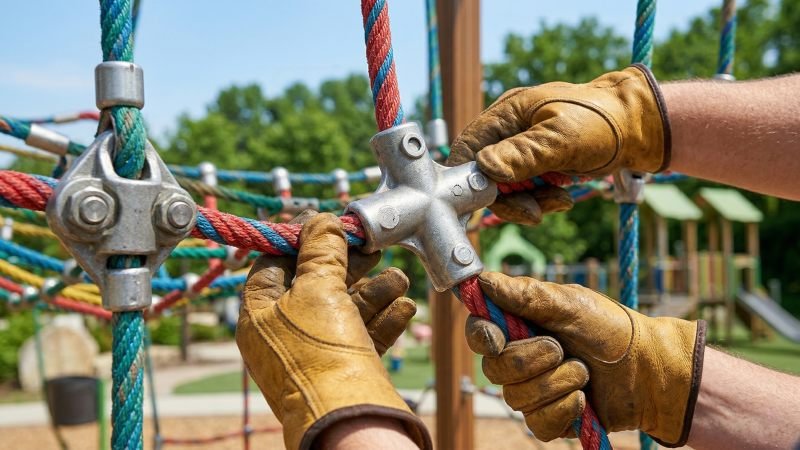
Effective inspections require both visual and tactile checks. Start with a visual sweep of the entire structure for obvious vandalism, looking for cut ropes or missing end caps. Then, get your hands on it. Maintenance staff must physically run their hands over the heavy-use areas feeling for frayed synthetic fibers or any exposure of the inner steel core.
It’s exactly like the mandatory maintenance checks on a commercial zipline system. A zipline operator physically inspects the main cable to feel for micro-abrasions before they become critical failures. Similarly, playground maintenance staff must manually check ropes and connectors to catch hidden wear early.
Don’t forget the tension. Over time, high traffic causes slight shifts in the anchor points. Check the turnbuckles and ground anchors to ensure the net remains completely taut. A loose net compromises the designed fall safety metrics.
Always consult your manufacturer’s specific maintenance manual to establish this inspection schedule, as frequency often depends on local climate conditions such as heavy snow or coastal salt exposure.
“Proactive tactile inspections discover 70% of potential hardware failures before they pose a physical risk to playground users.”
Benefits of Modular Component Replacement
Let’s talk total cost of ownership. Eventually, parts wear out or severe vandalism occurs. How your climbing net handles this damage is a massive financial factor.
Here’s where modular design pays off. Traditional nets are often woven as one massive, continuous web. If a vandal cuts a single rope in the middle, the entire structural integrity fails, meaning you’re replacing the whole expensive net.
By contrast, modular climbing nets use segmented ropes connected by heavy-duty hardware joints. If a specific section is damaged, you only swap out that individual segment.
Consider how playground safety surfacing works. If a single rubber tile is damaged, you pop it out and install a new tile—you don’t repour the entire playground floor. Modular climbing nets apply this exact same cost-saving logic to the vertical play structure.
| Maintenance Factor | Modular Net Design | Continuous Rope Design |
|---|---|---|
| Repair Scope | Replace single damaged segment | Replace entire net structure |
| Playground Downtime | Minimal (Repaired in hours) | Extensive (Closed for weeks) |
| Long-Term Repair Cost | Very Low | Extremely High |
By specifying a modular system, you empower your maintenance team to make quick, targeted repairs. This drastically reduces long-term maintenance budgets and ensures your playground stays open and safe for the community.
Conclusion
Specifying the right climbing net playground equipment goes far beyond visual appeal; it demands a deep understanding of structural integrity and user safety. By holding the line on established safety standards, demanding high-quality steel-core materials, strategically mapping your site layout, and locking in a routine maintenance plan, you build a secure and highly engaging environment. Ultimately, investing in durable, compliant, and modular playground systems protects your budget and maximizes the play value for your community for years to come.
If you need tailored climbing net solutions or expert assistance in planning your next successful playground project, please feel free to contact us.