-
Whatsapp: +86 15516933785
-
Email: hanlin@hanlinplayground.com
-
Address: Shangjie District, Zhengzhou City, Henan Province, China
-
Whatsapp: +86 15516933785
-
Email: hanlin@hanlinplayground.com
-
Address: Shangjie District, Zhengzhou City, Henan Province, China

Indoor Playground Insurance: Costs & How to Avoid Common Pitfalls
What are the typical costs and key requirements for insuring an indoor playground business?
Indoor playground insurance premiums generally range from $1,500 annually for small soft play areas to over $30,000 for large adventure parks with high-risk equipment. To ensure financial safety and avoid common coverage pitfalls, business owners must secure a comprehensive package policy—including General Liability and Commercial Property—and maintain rigorous daily maintenance logs to validate safety compliance.
Breakdown of Indoor Playground Insurance Costs
How much should you realistically budget for your indoor playground insurance premiums this year?
On average, indoor playground owners can expect to pay between $1,500 and $15,000 annually for general liability coverage. Small, toddler-focused soft play centers typically fall on the lower end of this spectrum, while large adventure parks featuring trampolines, ninja courses, or climbing walls often face premiums exceeding $20,000 per year due to increased risk exposure.
Estimated Annual Premium Ranges by Facility Size
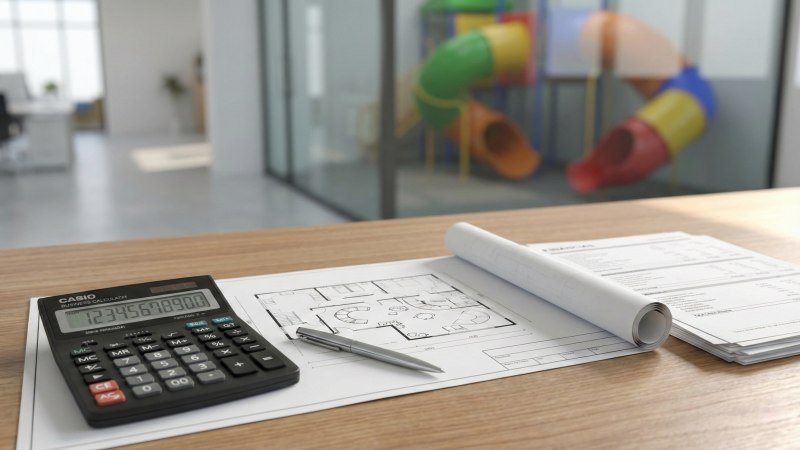
The square footage of your facility is a primary baseline for insurance carriers. Larger spaces naturally accommodate more customers. Consequently, higher foot traffic increases the statistical probability of an accident occurring. Insurers view this “exposure” directly through the lens of your facility’s physical size and capacity.
However, size is not just about floor space. It correlates with the number of attractions you can fit inside. A small storefront implies low-speed and low-impact play. In contrast, a warehouse-sized facility suggests high-energy activities.
Below is a breakdown of estimated costs based on facility scale.
| Facility Scale | Square Footage | Typical Annual Premium Range |
|---|---|---|
| Micro / Mobile | Under 1,500 sq. ft. | $1,200 – $2,500 |
| Small Center | 1,500 – 4,000 sq. ft. | $3,000 – $7,000 |
| Medium Facility | 4,000 – 10,000 sq. ft. | $8,000 – $18,000 |
| Large Adventure Park | Over 10,000 sq. ft. | $20,000 – $50,000+ |
Note: These figures are estimates. Premium rates can vary significantly based on your specific insurance carrier and regional market conditions. Always verify exact quotes with your provider.
High-Risk Equipment That Spikes Your Rates
Not all playground equipment is created equal in the eyes of an underwriter. The specific mix of attractions in your facility dictates your “risk class.” Think of this like the difference between a coin-operated kiddie ride and a mechanical bull. Both are rides, but one carries a much higher chance of throwing a rider off, requiring significantly higher liability coverage.
Standard soft play equipment, such as foam shapes, ball pits, and low-level slides, is generally considered “low hazard.” These structures are static and have low injury rates. Therefore, facilities relying solely on these elements enjoy the lowest rates.
However, introducing “active” or “high-velocity” equipment changes the equation immediately.
The “Multiplier” Effect
Adding a single high-risk attraction does not just add a small fee; it often moves your entire policy into a higher risk category. Common equipment that spikes premiums includes:
- Trampolines: These are the single biggest driver of cost. A trampoline court can double or triple your premium compared to a standard playground due to the risk of collision and orthopedic injuries.
- Inflatables (Bounce Houses): While popular, these require constant supervision to prevent collisions. If they are not permanently anchored, the risk profile increases further.
- Ninja Warrior Courses: These obstacles encourage speed and difficult physical maneuvers. The likelihood of falls is higher here than in a ball pit.
- Climbing Walls: Without auto-belay systems, the risk of operator error is high. Even with safety systems, the height factor increases the potential severity of an injury.
If you are planning your layout, remember that swapping a foam pit for a standard mat area might save you thousands of dollars a year.
The Impact of Location and Revenue on Pricing
Your physical address and your financial success play surprising roles in your insurance costs.
Geographic Location
Insurance rates are heavily influenced by the legal climate of your state or county. Some states are known as “litigious environments.” In these areas, lawsuits are more frequent, and settlement payouts are higher. Consequently, insurers charge more to operate there to protect their bottom line.
For example, a playground in a state with strict consumer protection laws and a history of high jury awards for personal injury claims will pay more than an identical facility in a state with tort reform laws that cap damages.
Gross Revenue as a Risk Metric
It might seem counterintuitive, but the more money your business makes, the more you will pay for insurance. Insurers use your Gross Annual Revenue as a direct proxy for the number of people walking through your doors.
If your revenue doubles, it usually means your visitor count has doubled. Twice as many children playing equals twice the opportunity for a slip, trip, or fall.
The Audit Process:
Most policies begin with a deposit premium based on your projected revenue. At the end of the policy term, the insurer will conduct a premium audit.
- If you earned less than projected: You might get a small refund or credit.
- If you earned more than projected: You will receive a bill for the difference.
Therefore, when budgeting, you must treat your insurance cost as a variable expense that scales with your success, rather than a fixed monthly bill. For a deeper dive into financial planning, you can review our guide on how much it costs to start an indoor playground.
Essential Coverage Types for Full Protection
What specific insurance policies does an indoor playground need to operate legally and safely?
To fully protect an indoor playground business, owners must secure a “package policy” that typically includes General Liability for customer injuries, Commercial Property Insurance for equipment and tenant improvements, and Workers Compensation for staff safety. Additionally, industry experts strongly recommend adding Participant Accident coverage to pay immediate medical bills for injured guests and Cyber Liability insurance to protect sensitive customer data stored in booking systems.

General Liability Insurance as the Foundation
General Liability (GL) is the bedrock of your risk management strategy. For an indoor playground, this is the policy that responds when a parent claims your business caused bodily injury to their child.
Without GL, a single lawsuit could drain your business bank account. It covers the legal fees to defend you in court and the settlement costs if you are found negligent.
What it actually covers:
- Bodily Injury: This is the most common claim. Example: A child fractures a wrist coming down a slide too fast.
- Third-Party Property Damage: If a staff member accidentally spills a drink on a parent’s expensive laptop in the café area.
- Personal and Advertising Injury: This covers claims of libel or slander, such as if you use a photo of a child in an ad without the parent’s permission.
Think of General Liability like the safety netting around a trampoline court. It is there to catch the business when an external force (a lawsuit) tries to knock you out of operation. It does not fix the trampoline if it breaks; it only handles the people who get hurt on it.
Commercial Property Insurance for Equipment and Structure
While General Liability covers the people, Commercial Property Insurance covers your “stuff.” Most indoor playgrounds have thousands of dollars invested in soft play structures, arcade machines, and cafe equipment.
If a fire breaks out or a water pipe bursts above your ball pit, General Liability will not pay a dime to replace your equipment. That is the job of Commercial Property Insurance.
Key Distinction: Building vs. Contents
Most playground owners lease their space. Therefore, you likely do not need to insure the entire building shell (the landlord does that). However, you must insure your “Business Personal Property” and “Tenant Improvements.”
- Business Personal Property: Movable items like tables, loose foam blocks, and cash registers.
- Tenant Improvements: Structural changes you made, such as bolting a jungle gym to the floor or building a cafe counter. Once attached, these are often considered part of the building, but you are responsible for insuring the value you added.
| Asset Category | Examples in Indoor Playgrounds | Coverage Goal |
|---|---|---|
| Play Structure | Steel frames, netting, slide bodies | Repair or full replacement cost after disaster. |
| Electronics | POS systems, sound systems, arcade games | Replacement due to theft, fire, or power surge. |
| Inventory | Cafe food, grip socks, merchandise | Reimbursement for stock lost to spoilage or damage. |
| Betterments | New flooring, party room walls, lighting | Protecting the money you spent upgrading a leased space. |
Note: Definition of “Tenant Improvements” can vary by lease agreement. Always verify with your landlord and insurer who is responsible for specific structural additions.
Workers Compensation and Accident Medical Coverage
This section covers the immediate physical well-being of the humans in your facility. It is important to distinguish between your employees and your customers.
Workers Compensation (For Staff)
If a “court monitor” hurts their back lifting heavy gym mats, or a cafe worker burns their hand on an espresso machine, Workers Compensation pays for their medical bills and lost wages. In almost every state, this is non-negotiable and required by law as soon as you hire your first employee.
Participant Accident Coverage (For Guests)
This is a “secret weapon” policy that many new owners overlook. It is separate from General Liability.
General Liability only pays if you are sued and found negligent. Participant Accident Coverage pays the medical bills for a guest’s injury regardless of fault, up to a certain limit (e.g., $5,000).
Why do you need it?
It acts as a buffer. If a child chips a tooth, the parents are upset and facing a $1,000 dentist bill. If you have this coverage, the insurance pays the dentist directly. This often makes the parent happy and prevents them from filing a much larger lawsuit against your General Liability policy later.
Cyber Liability for Digital Booking Systems
Modern indoor playgrounds are digital-first businesses. You likely use cloud-based platforms (like Roller, Party Center Software, or WaiverKing) to process credit cards and store digital waivers.
These systems hold sensitive data:
- Personally Identifiable Information (PII): Names, addresses, and children’s birthdates.
- Financial Data: Credit card tokens and billing history.
If your point-of-sale system is hacked or “held hostage” by ransomware, Cyber Liability insurance steps in. It covers the cost of notifying customers, paying for credit monitoring, and even paying the ransom to unlock your system so you can open for business on Saturday morning.
Think of it this way: Property insurance protects the physical arcade machines; Cyber insurance protects the credit card data stored inside the booking computer.
Critical Pitfalls That Lead to Denied Claims
Why do insurance companies frequently refuse to pay out claims even when a playground owner has an active policy?
Insurance claims are most frequently denied because facility owners fail to provide documented proof of safety compliance, such as daily maintenance logs, or they rely on legally unenforceable liability waivers. Furthermore, using equipment that is explicitly excluded in the policy’s fine print, or performing unauthorized DIY repairs on play structures, allows the insurer to categorize the incident as “negligence” or “breach of contract,” resulting in an immediate voidance of coverage.
Inconsistent or Missing Maintenance Logs
In the world of insurance, there is a golden rule: “If it is not written down, it did not happen.”
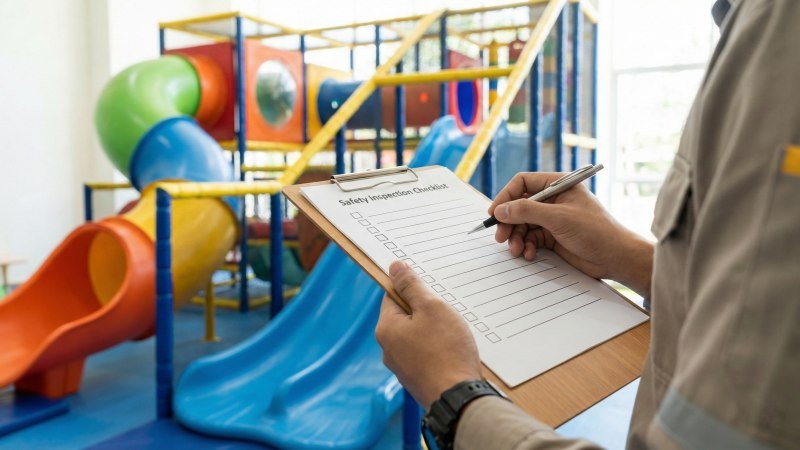
Many playground owners inspect their facility every morning. They check the netting, tighten zip ties, and sanitize the ball pit. However, if they do not record these actions in a logbook, they have no proof.
When an injury occurs, the first thing an insurance adjuster requests is the maintenance log for the weeks leading up to the accident. They look for patterns of negligence.
If a child gets hurt due to a loose floor mat, and your logs show that you checked the mats that morning, the injury is an “accident.” However, if you have no logs, the insurer will argue that you failed to maintain the premises. This shifts the classification from an accident to negligence. For a comprehensive guide on maintaining standards, refer to our article on how to clean and inspect indoor playground equipment.
What a Solid Log Must Include:
- Date and Time: Exactly when the inspection happened.
- Inspector Name: Who performed the check.
- Specific Checkpoints: “Checked vertical netting,” “Inspected slide joints,” not just “Checked room.”
- Corrective Actions: If a zip tie was loose, the log must state, “Replaced loose zip tie on Level 2.”
Relying on Legally Weak Liability Waivers
A waiver is a contract between you and your customer. It states that the customer understands the risks of play. However, many owners simply copy a waiver from a competitor’s website or use a free template.
This is a dangerous trap. Waiver laws vary significantly by state and country. A waiver that protects a gym in Texas might be completely useless for a playground in California.
Common Waiver Failures:
- Poor Phrasing: If the text is confusing or uses ambiguous language, a judge may throw it out.
- Gross Negligence: Most waivers protect against ordinary accidents. They rarely protect you if you were “grossly negligent” (e.g., ignoring a known broken slide).
- Parental Signatures: A minor cannot sign a contract. If a parent does not sign on behalf of the child, the document is void.
| Weak Waiver Strategy | Strong Waiver Strategy |
|---|---|
| Copy/Paste from Google. | Drafted by a local attorney specializing in entertainment law. |
| Paper Only, stored in messy boxes. | Digital Storage (cloud-based) with easy retrieval by name. |
| Vague Language: “We are not responsible for anything.” | Specific Language: Cites specific risks like “trips, falls, and collisions.” |
Note: Laws regarding liability waivers are highly jurisdictional. Always have a qualified attorney review your specific document to ensure it holds up in your local court system.
Overlooking Policy Exclusions for Specific Attractions
Insurance policies contain a section called “Exclusions.” This is a list of things the insurance company will never pay for.
A common pitfall occurs when an owner expands their facility. You might start with a standard soft play structure. Later, you decide to buy a mechanical bull or a high-performance trampoline to increase revenue.
If you do not call your broker to add these specific items, they remain excluded.
The “Silent” Exclusion Risk:
Some policies have broad exclusions for “inflatable amusement devices” or “rebound devices.” If you add a small bounce house for a birthday party, you might accidentally void your coverage for that entire area.
Always check your policy before buying new equipment. If the equipment falls under an exclusion, you must purchase a “rider” or “endorsement” to cover it.
Unauthorized Equipment Modifications and Repairs
Commercial playground equipment must meet strict standards, such as ASTM F1918 (North America) or EN 1176 (Europe). Manufacturers build equipment to meet these safety codes.
A major pitfall arises when owners try to save money on repairs. If a net tears or a foam pad wears out, the owner might fix it using supplies from a local hardware store.
Why this leads to denial:
- Non-Compliant Materials: Hardware store zip ties are often weaker than industrial nylon ties. If you use a weak tie and it snaps, causing an injury, you have altered the safety rating of the structure.
- Voiding the Warranty: Unauthorized repairs usually void the manufacturer’s warranty.
- Alteration of Design: Drilling a new hole to move a slide creates a new stress point.
Insurers view DIY repairs as “unauthorized modifications.” If an accident happens on a modified piece of gear, the insurer will claim the equipment was no longer safe for use. Always use Original Equipment Manufacturer (OEM) parts for repairs.
Confusing General Liability with Product Liability
This is a complex but critical distinction.
- General Liability: Covers you if your actions cause harm (e.g., you didn’t clean a spill).
- Product Liability: Covers injuries caused by a defect in the equipment itself (e.g., a steel weld snaps due to poor manufacturing).
Many owners assume their insurance covers everything. However, if a child is hurt because a brand-new slide collapses due to bad steel, your General Liability carrier might deny the claim. They will say, “We insure your operation, not the manufacturing of the slide.”
The Import Trap:
This is dangerous if you import cheap equipment directly from overseas manufacturers who do not have US-based insurance. If the equipment fails, the parents will sue you. If the manufacturer has no insurance for you to fall back on, you are left paying the bill.
How to avoid this:
Ensure your equipment supplier provides a “Certificate of Insurance” proving they have valid Product Liability coverage in your country. This ensures that if the equipment is defective, their insurance handles the claim, not yours.
Actionable Strategies to Lower Your Premiums
How can indoor playground owners actively reduce their insurance premiums without cutting necessary coverage?
To lower insurance premiums, facility owners should implement documented safety training programs for staff, specifically in CPR and emergency response, to demonstrate reduced operational risk. Additionally, commissioning annual safety audits by certified third-party inspectors provides insurers with validated proof of compliance, often unlocking “best-in-class” pricing. Finally, bundling General Liability and Commercial Property insurance with a single carrier can typically secure multi-line discounts ranging from 5% to 15%.
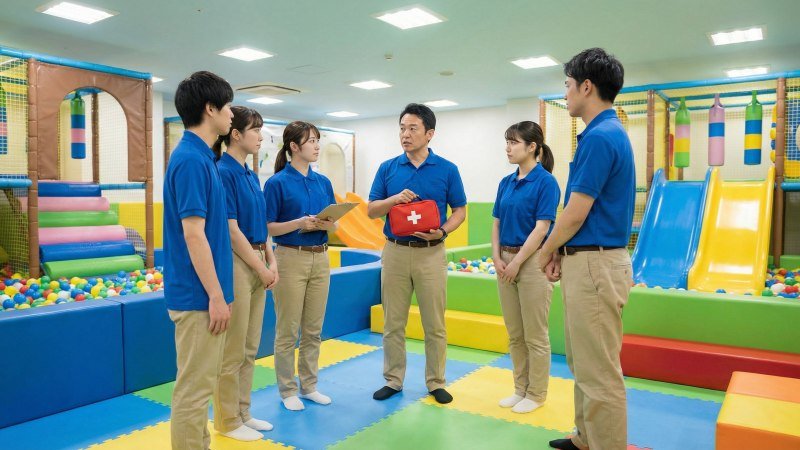
Implementing Certified Safety Training Programs
Insurance carriers base your premium on “risk.” If your staff does not know how to handle an emergency, your risk is high. Conversely, a well-trained team acts as a risk reduction system.
Simply telling employees to “be safe” is not enough. You must provide formal, certified training. When an underwriter sees that every floor monitor holds a valid certification, they view your business as a professional operation rather than a casual play center.
Essential Training Certifications:
- CPR and First Aid: All shift supervisors should be Red Cross or AHA certified. This ensures that if a child is injured, immediate care is available before an ambulance arrives.
- Crowd Control Management: Training staff on how to de-escalate conflicts between parents prevents physical altercations that lead to liability claims.
- Equipment Operation: Just as a lifeguard needs a certification to watch over a pool, your floor monitors need specific training to supervise high-activity zones safely.
Documentation is Key
You must keep a digital copy of every employee’s certification in their personnel file. When you apply for insurance renewal, submit a summary of these credentials. It serves as tangible proof that your human error risk is low.
The Financial Value of Third-Party Safety Audits
Most owners inspect their own facility. However, insurance companies know that owners might overlook problems to save money. This is why a third-party audit is so valuable.
A third-party audit involves hiring an independent, certified inspector to examine your equipment. In the amusement industry, look for inspectors certified by organizations like AIMS International (Amusement Industry Manufacturers and Suppliers) or NAARSO (National Association of Amusement Ride Safety Officials).
How This Lowers Premiums:
- Validation: It proves to the insurer that your equipment meets current safety standards (like ASTM F1918).
- Negotiation Power: You can present a “Clean Health Report” to your broker. Your broker can then use this report to negotiate better rates with underwriters, arguing that your facility is safer than the average competitor.
Please note: The cost of a professional audit varies significantly depending on the size of your facility and the number of attractions. Always confirm current rates with local inspection agencies.
Although an audit might cost between $1,000 and $3,000 upfront, the potential premium savings and the prevention of a costly lawsuit make it a wise investment.
Bundling Policies for Multi-Line Discounts
One of the quickest ways to reduce costs is to stop buying insurance “a la carte.” Many business owners buy General Liability from one company and Workers Compensation from another. This approach often results in paying full price for both.
Insurance carriers want all of your business. To encourage this, they offer “Multi-Line Discounts.” This is similar to a cable company offering a lower rate if you buy internet and TV together.
Common Bundling Combinations:
- BOP (Business Owners Policy): This combines General Liability and Commercial Property into one package.
- Commercial Package Policy: This can include Liability, Property, Auto (if you have company vans), and Umbrella coverage.
Estimated Savings Comparison
The table below illustrates potential savings for a medium-sized facility.
| Policy Type | Purchased Separately | Purchased as a Bundle | Potential Savings |
|---|---|---|---|
| General Liability | $6,000 | (Bundled) | — |
| Property Insurance | $2,500 | (Bundled) | — |
| Total Cost | $8,500 | $7,650 | $850 (approx. 10%) |
Note: Discount percentages are subject to carrier guidelines and your specific claims history. Always ask your broker to quote both separate and bundled options to verify the savings.
By consolidating your policies, you not only save money but also simplify your administrative work with a single renewal date and one point of contact.
Conclusion
Securing the right insurance for your indoor playground is a balancing act between cost and coverage. While the premiums for high-risk equipment and large adventure parks can be significant, the risk of operating without adequate protection is far greater.
By understanding the key cost drivers—from facility size to equipment types—and proactively avoiding common pitfalls like missing logs or weak waivers, you can build a resilient business. Remember, insurance is not just a fixed cost; it is a financial tool. Using strategies like third-party audits and staff training not only keeps your visitors safe but can also actively lower your annual expenses. Prioritize safety, document everything, and consult with a specialized insurance broker to ensure your playground remains a place of fun, not financial liability.