-
Whatsapp: +86 15516933785
-
Email: hanlin@hanlinplayground.com
-
Address: Shangjie District, Zhengzhou City, Henan Province, China
-
Whatsapp: +86 15516933785
-
Email: hanlin@hanlinplayground.com
-
Address: Shangjie District, Zhengzhou City, Henan Province, China

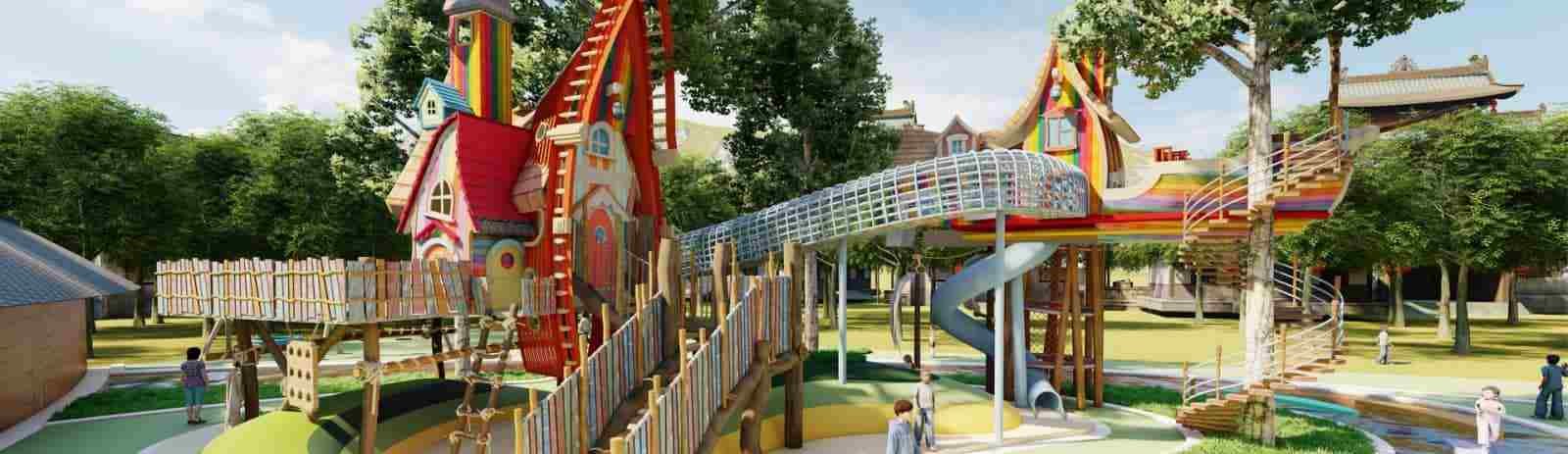
Indoor Playground Manufacturer Services: From Initial Budgeting to Custom Design
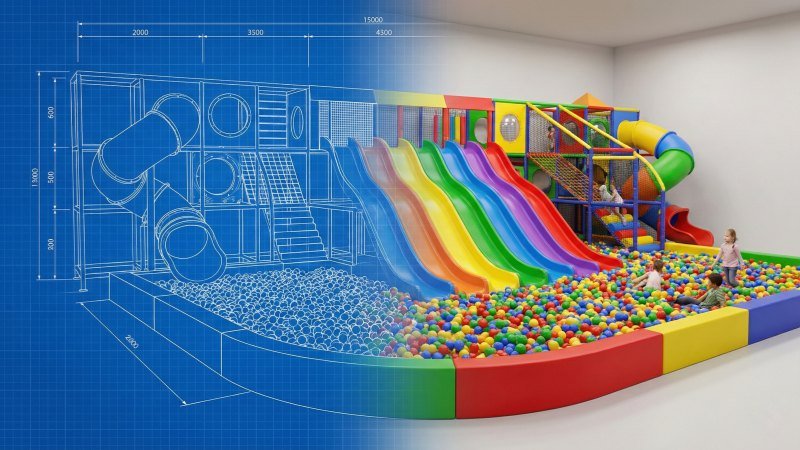
Indoor playground manufacturers provide comprehensive end-to-end services, ranging from initial budget estimation and site selection advice for investors without a venue, to custom CAD-based design, thematic planning, and technical layout optimization for confirmed sites, ensuring operational flow, safety compliance, and maximum return on investment.
Service Phase 1: Planning Assistance Before You Secure a Venue
What exact support can an indoor playground manufacturer provide before you even lease a commercial space?
As a manufacturer, we offer vital early-stage planning assistance by supplying square-meter cost estimates, benchmarking budgets for different equipment tiers, and providing architectural requirements to help you secure a viable, profitable venue.
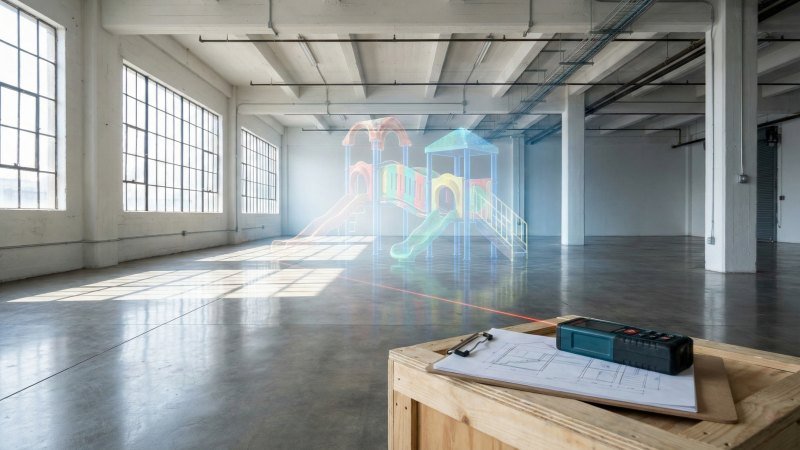
Providing Cost Estimates and Price Ranges per Square Meter
So, how do you calculate costs without a final blueprint? We use the square meter pricing model. This method gives you a baseline financial target before we draw a single line.
Just as a steel mill quotes raw galvanized coils by the ton before rolling them into specific profiles, we quote baseline indoor playground equipment costs by the square meter. This calculation happens before we design the final layout. You simply multiply your target lease area by our industry averages.
Usually, basic indoor playground equipment costs range from $100 to $300 per square meter. However, these figures act only as a starting point. Your final price depends heavily on the internal play density. Do you want tightly packed obstacle courses, or are you looking for open free-play zones?
“A reliable manufacturer provides transparent price ranges early. This prevents investors from signing leases they cannot afford to fill.”
Note: Exact pricing varies based on raw material costs (such as steel and PVC) and specific supplier manufacturing standards. Always verify current price ranges directly with your chosen equipment supplier.
Benchmarking Budgets for Standard vs High-End Configurations
Square footage is only half the equation. The real cost driver is the equipment tier you select. What makes a playground “high-end” versus “standard”? We separate these into distinct budget benchmarks.
A standard configuration uses traditional, passive play structures. These include basic steel frames, standard PVC foam padding, and simple ball pits. Consequently, standard setups require a lower initial investment. They are excellent for smaller communities or secondary markets where ticket prices must remain competitive.
Conversely, a high-end configuration includes interactive, mechanized, or custom-themed elements. These parks feature motorized rides, custom fiberglass decorations, and digital projection games. High-end parks demand a larger budget but allow you to charge premium ticket prices to recoup the investment.
Configuration Comparison Table
| Feature Category | Standard Configuration | High-End Configuration |
|---|---|---|
| Main Materials | Standard PVC, basic foam, netting | Custom fiberglass, interactive screens, thick PVC |
| Equipment Types | Static slides, ball pits, trampolines | Motorized spinners, digital targets, custom obstacles |
| Theming | Basic color blocks, simple prints | Fully immersive 3D themes (e.g., Space, Jungle) |
| Target Market | Budget-conscious, local neighborhoods | Premium malls, large entertainment centers |
By understanding these tiers clearly, you can perfectly align your equipment budget with your target market.
Professional Advice on Selecting Suitable Building Structures
Don’t just sign a lease based on the monthly rent. Not every commercial space can safely house an indoor playground. As a manufacturer, we guide you on strict structural requirements.
Why does building structure matter so much? Just as a heavy-duty gantry crane requires a reinforced concrete footing, a multi-level soft play frame requires specific commercial building dimensions. If you lease the wrong space, you cannot install profitable equipment.
Required Ceiling Heights
First, verify the clear ceiling height. This is the exact distance from the floor to the lowest hanging roof obstacle, like fire sprinkler pipes or HVAC ducts.
- Single Level: Requires at least 2.5 meters of clear height.
- Two Levels: Requires a minimum clear height of 3 meters.
- Three Levels: Needs 4.5 meters or more to ensure safe standing room.
- Trampoline Parks: Require absolute minimums of 5.2 meters to ensure safe jumping clearance.
Floor Load-Bearing Capacity
Next, check the commercial floor load capacity. Indoor play frames carry significant weight. The galvanized steel pipes, heavy plastics, and hundreds of active children add up quickly. Therefore, your concrete floor must safely support this active, shifting load. Usually, a minimum load-bearing capacity of 300 kilograms per square meter is required for standard play structures.
Note: Required load capacities will fluctuate based on the specific equipment weight and structural design. Always confirm these engineering specifications with both your building landlord and your equipment supplier before signing a final lease.
Service Phase 2: Custom Design Solutions for Your Confirmed Site
Once you have secured your venue, how do manufacturers turn a blank floor plan into a fully realized playground design?
We transform your empty venue into a functional attraction by analyzing your CAD architectural drawings to map precise dimensions, applying your chosen visual theme to specific play zones, and engineering a custom equipment list that fits strictly within your financial allocation.
Analyzing Your Floor Plan and CAD Drawings
The design process begins with hard data, not guesswork. We cannot build a safe structure based on a rough sketch. We require a professional CAD (Computer-Aided Design) file, typically in DWG format. This is the industry standard for accuracy.
Just as a CNC machine requires precise digital coordinates to cut metal parts within tolerances, our design software needs exact venue measurements to fit the playground frame. A discrepancy of just 5 centimeters can cause installation failure, requiring costly on-site welding modifications. Therefore, we import your DWG file directly into our 3D modeling software.
We look for specific hard data points on your map. We identify the exact perimeter of the play area. We also locate fixed utility points. This includes HVAC ducts, fire sprinkler systems, and electrical boxes. We map these elements now so we don’t block them later.
“A 2D CAD layout is the skeleton; the 3D rendering is the skin. We must get the skeleton right first.”
If you only have a hand-drawn sketch, we must convert it. We will ask you to measure the length, width, and height of every wall manually. However, providing the original architectural blueprint is always faster and more accurate.
Selecting Themes and Specific Play Equipment
Once the technical specs are locked in, we focus on the visual experience. This is where your market research meets our manufacturing capabilities. You choose a theme that fits your local demographic.
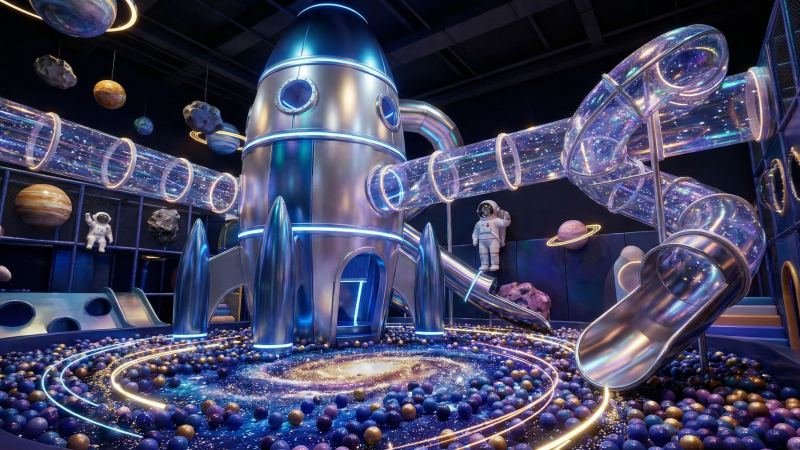
A theme is not just paint; it dictates the materials we use. For example, a “Cyberpunk” or Space theme often requires more fiberglass molding and LED lighting integration. A “Jungle” or Candy theme relies more on soft PVC leather wrapping and colorful netting.
We also select specific equipment modules. We mix “anchor attractions” (large slides, donut slides) with “capacity fillers” (ball pits, sand pools).
Popular Themes and Component Differences
| Theme Category | Visual Style | Typical Material Usage | Common Equipment |
|---|---|---|---|
| Jungle / Forest | Green tones, leaf patterns | Soft PVC wrapping, nylon netting | Tree-house lookouts, vine swings |
| Space / Sci-Fi | Blue/Black tones, metallic finish | Fiberglass shapes, LED strips | Rocket ship towers, tube slides |
| Candy / Pastel | Pink/White tones, rounded shapes | High-gloss PU leather, soft foam | Donut slides, macaroon swings |
| Ocean / Pirate | Blue tones, ship structures | Wood-grain PVC, theming paint | Pirate ship frames, ball fountains |
Tailoring the Proposal to Your Investment Budget
This is where we align the design with your wallet. In Phase 1, we gave you a general estimate. Now, we perform Value Engineering. This means we adjust the design to match your exact budget cap.
If your budget is tight, we prioritize high-impact items. We might place a large, impressive spiral slide at the front for visual appeal. Then, we use simpler, cost-effective soft play obstacles in the back. This maintains the “wow factor” without overspending.
Think of this like configuring a modular production line. If the total cost is too high, we do not scrap the whole line. Instead, we remove a specific processing station or swap a premium component for a standard one.
We can adjust the density of the playground. We might reduce the number of electric soft play items, which are expensive to maintain. We replace them with static frame obstacles, which cost less. We give you options. You can choose a “High Configuration” with all the bells and whistles, or a “Cost-Effective Configuration” that maximizes play area for a lower price.
Technical Coordination and Layout Optimization
How does technical layout optimization affect the safety and profitability of an indoor playground?
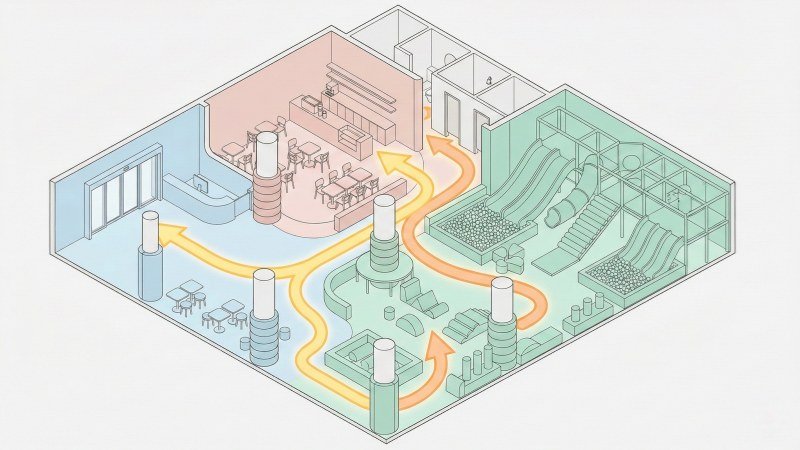
Technical coordination optimizes an indoor playground by strategically placing entrances to drive foot traffic, integrating structural pillars into the play equipment to maximize space, and establishing clear consumer flow lines to increase secondary spending while strictly adhering to fire safety regulations.
Strategic Entrance Positioning for Maximum Foot Traffic
It starts at the front door. The entrance is the most critical technical coordinate on your floor plan. If the entrance is hidden, your ticket sales drop.
Think of the entrance like the loading zone of a manufacturing assembly line. If the raw material (customers) cannot enter smoothly, the entire production (profit) slows down. We position the main gate facing the area with the highest pedestrian density. In a shopping mall, this is usually near the escalators or the food court.
We also design the reception area to handle “peak load.” During weekends, lines form quickly. We calculate the reception desk size to allow for queuing space without blocking the hallway.
Furthermore, we must allocate space for the “transition zone.” This is where children take off shoes and parents pay. If this area is too small, it creates a bottleneck. We typically recommend reserving at least 10% to 15% of the total floor area for the reception, shoe lockers, and waiting zone.
“A well-placed entrance acts as a magnet. It pulls customers in from the main walkway efficiently.”
Handling Building Pillars and Structural Obstacles
Then, we have to deal with the building itself—specifically, the columns. Most commercial venues have large concrete support pillars. These columns often sit right in the middle of the play area.
We do not treat pillars as problems; we treat them as design constraints to work around. This is similar to programming a CNC machine toolpath to cut around a clamp holding a metal part. We cannot move the pillar, so we design the steel frame structure to wrap around it or integrate it.
We use three main methods to handle structural pillars:
- Soft Wrapping: We cover the concrete with thick foam and PVC leather. This prevents injury if a child runs into it.
- Functional Integration: We build the play structure attached to the pillar. The pillar becomes a support for a climbing wall or a spiral slide.
- Visual Camouflage: We decorate the pillar to match the theme, turning it into a “tree” or a “rocket booster.”
Pillar Treatment Methods
| Method | Description | Space Efficiency | Cost Impact |
|---|---|---|---|
| Safety Padding | Wrapping the column in 5cm foam and PVC. | Neutral | Low |
| Structure Integration | Using the column to support a slide or panel. | High (Saves floor space) | Medium |
| Obstacle Avoidance | Building the frame completely away from the column. | Low (Creates dead space) | None |
Note: The thickness of safety padding required for pillars may vary based on local safety standards (e.g., ASTM or EN). Always verify the specific impact attenuation requirements for your region.
Designing Clear Pathways and Consumer Flow Lines
With the obstacles mapped, we focus on movement. Good flow lines prevent collisions and help parents supervise their children.
We design a clear main aisle. This path usually circles the main play structure. It allows parents to walk around the perimeter and see their children from multiple angles.
Inside the structure, we avoid “dead ends.” Just like a hydraulic piping system needs continuous flow to prevent stagnation, a playground needs continuous routes. A child should be able to enter, climb up, slide down, and circle back without getting stuck.
We also consider secondary revenue. We position the parents’ rest area near the cafe or vending machines. If parents can sit comfortably and watch their kids, they stay longer. If they stay longer, they buy more drinks and snacks.
Ensuring Compliance with Fire Safety and Emergency Exits
Let’s be clear: safety is the non-negotiable priority. Before we finalize any layout, we check the emergency exits.
We must maintain a clear path to all fire exits. We cannot block a fire door with a ball pit or a trampoline frame. The distance between any point in the playground and the nearest exit must meet local building codes.
Additionally, we use fire-retardant materials. The PVC vinyl, the foam padding, and the safety netting all contain chemical additives that stop fire from spreading.
We also design “emergency access points” in the play structure. These are specific sections of the netting that can be cut or unclipped quickly. If a child is injured inside the maze, or if an evacuation is needed, staff can access the internal areas immediately.
Note: Fire codes differ significantly by country and city. A layout approved in one region may not pass inspection in another. Always submit your final layout to your local fire marshal for approval before manufacturing begins.
Conclusion
From the initial back-of-the-napkin math to the final 3D render, a professional manufacturer acts as your strategic partner. By providing transparent cost benchmarks, structural analysis, and safety-focused layouts, we ensure your investment translates into a thriving business.
If you are ready to move forward, we are prepared to assist you. If you have floor plans, send them to us for immediate analysis. If you are just starting, contact us for our latest price list and investment guides.