-
Whatsapp: +86 15516933785
-
Email: hanlin@hanlinplayground.com
-
Address: Shangjie District, Zhengzhou City, Henan Province, China
-
Whatsapp: +86 15516933785
-
Email: hanlin@hanlinplayground.com
-
Address: Shangjie District, Zhengzhou City, Henan Province, China

What is Ballocity? Why can it increase your foot traffic?

What exactly is Ballocity and how does it benefit indoor playground businesses?
Ballocity is an interactive indoor play system that utilizes pneumatic air technology to propel soft foam balls through cannons, vacuums, and dumping buckets. It increases foot traffic by engaging a wider age demographic through competitive social play, extending dwell time via “cause and effect” mechanics, and driving repeat visits through unique, dynamic experiences that standard static playgrounds cannot offer.
How does the interactive nature of Ballocity drive repeat visits?
What specific elements of interactive ball play turn a one-time visitor into a loyal, returning customer?
Ballocity drives repeat visits by transforming passive play into active, social engagement through pneumatic air technology. Unlike static soft play structures, this system utilizes interactive “cause and effect” mechanics that encourage cooperative team play and extend the average time spent in the facility. This dynamic environment appeals to a wider age range, ensuring that families return frequently for a shared experience they cannot replicate at home or in standard playgrounds.
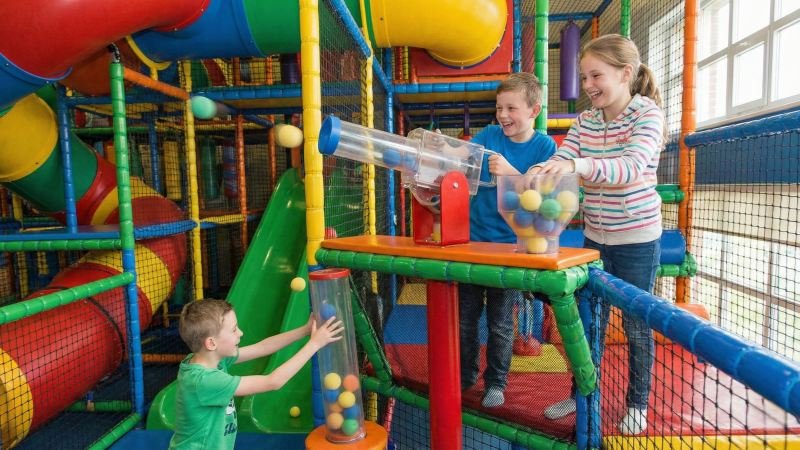
Encouraging social interaction and cooperative team play
Standard indoor playgrounds often suffer from “parallel play.” This means children play near each other, but not with each other. However, a Ballocity arena changes this dynamic entirely. The layout forces interaction across the play space. For example, one child on the ground level must feed foam balls into a vacuum tube. Meanwhile, another child on the upper level receives those balls to load their blaster.
This creates an immediate, unspoken partnership. Children who have never met begin to coordinate effortlessly. They form temporary teams to defend a “fortress” or work together to fill a centralized tipping bucket. In the Family Entertainment Center (FEC) industry, we compare this to the difference between a single-player arcade game and a multi-player laser tag match. The multi-player experience builds a social connection.
The payout for your business? Retention. When children make friends or feel part of a team, they do not want to leave. Better yet, they’re the ones dragging their parents back to the car asking when they can return to see their “team” again.
The psychological appeal of Cause and Effect mechanics for children
The core retention driver in a Ballocity system is the psychological loop of action and reaction. In a traditional soft play jungle gym, a child climbs a generic ramp and slides down. The experience is passive. Ballocity flips that script by giving the child control over their environment.
When a child presses a button on a blaster, a ball launches. When they pull a lever, airflow changes direction. This immediate feedback satisfies a child’s developmental need to master their surroundings. It is similar to the “dopamine loop” found in redemption arcade games where hitting a target yields an immediate result. However, Ballocity achieves this through physical activity rather than screen time.
Comparison of Play Types in Indoor Centers
| Feature | Static Soft Play | Interactive Ballocity |
|---|---|---|
| Child’s Role | Passive Observer/Climber | Active Controller |
| Feedback Loop | Low (Slide down, walk up) | High (Aim, shoot, score) |
| Engagement Type | Repetitive Motion | Strategic Thinking |
| Dwell Time | Shortens as novelty fades | Extends due to variety |
This sense of agency keeps boredom at bay. A child might tire of a slide after five turns. Conversely, trying to hit a moving target or filling a basket to trigger a “ball shower” presents a continuous challenge. This challenge keeps the dwell time high, increasing the likelihood of secondary spending on food and beverages by parents.
Expanding your target demographic to include older children and teens
A major challenge for many indoor playground owners is the “age cap.” Often, children over the age of eight find standard climbing structures “too babyish.” They lose interest quickly. Why lose a family of four just because the ten-year-old is bored?
Ballocity solves this operational problem by introducing competitive elements. The mechanics of aiming, dodging soft foam balls, and controlling territory appeal to the “tween” demographic (ages 8-12). It functions similarly to a safe, low-impact version of paintball or airsoft.
By incorporating this equipment, you effectively widen your addressable market. The facility becomes a viable destination for:
- Older Siblings: They stay entertained while the younger ones climb.
- Teen Parties: The interactive combat style fits older birthday themes.
- Active Gaming: It appeals to the demographic usually lost to video games.
Retaining this older demographic is crucial for maximizing ticket sales. If the 10-year-old wants to come, the whole family comes. Simple math: the interactive nature of the equipment directly correlates to higher foot traffic and increased ticket revenue per household.
What core components create this unique play experience?
What specific machinery defines a Ballocity system and separates it from a standard jungle gym?
A Ballocity system consists of three primary interactive components: pneumatic air cannons (blasters) for propelling soft foam balls, vacuum and conveyor transport systems for circulating ammunition, and a central dumping bucket that creates a timed visual spectacle. These elements work together to create a kinetic, self-sustaining play environment that encourages continuous physical activity.
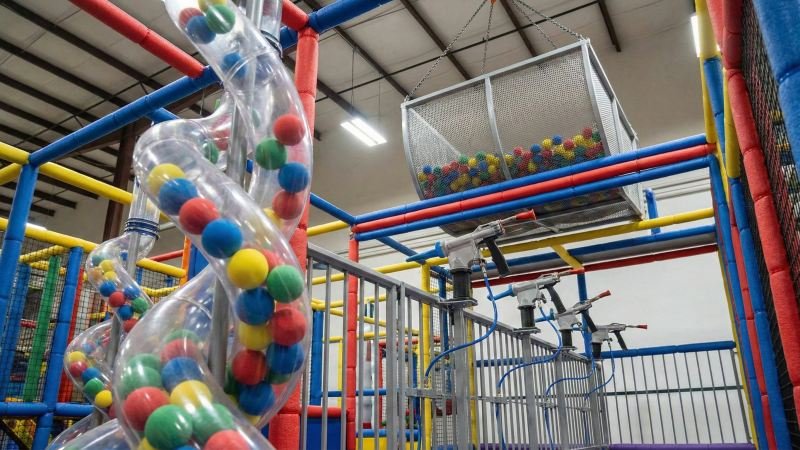
Pneumatic Air Cannons (Blasters) and Interactive Target Ranges
The “Blaster” is the heart of the interactive experience. These are stationary devices mounted on the play structure levels. They use compressed air to launch soft foam balls across the arena. Unlike video games where interaction happens on a screen, blasters provide tactile feedback. Children aim, load, and press a button to fire.
Most systems direct these blasters toward specific targets. These targets might include:
- Hanging Hoops: Suspended in the air to test accuracy.
- Light-up Sensors: Scoreboards that register hits (in advanced setups).
- Opposing Towers: Allowing friendly “battles” between children on different levels.
This setup mimics the engagement of an arcade shooting gallery but requires physical movement. For the venue owner, this is a key differentiator. It changes the play pattern from simple climbing to active skill-building.
Note: The firing range and air pressure settings of these blasters can vary significantly depending on the manufacturer and local safety regulations. Always verify the specific PSI (pounds per square inch) limits with your supplier to ensure they meet your region’s operational standards.
Vacuum Systems and Conveyor Belts for automatic ball transport
A common operational headache in ball pits is scattered balls. If balls stay on the floor, the fun stops on the upper levels. Ballocity solves this with an integrated transport system. Think of this as the circulatory system of the playground.
The Vacuum Loading System
Children feed balls into suction tubes located at ground level. The air pressure instantly sucks the ball up through clear, transparent pipes. Children love to watch the balls zip through the tubes, twisting and turning until they reach the upper decks or the collection basket. It turns the “chore” of picking up balls into a fun game.
The Conveyor Belt
In some designs, a conveyor belt carries balls up a ramp. This provides a steady stream of “ammunition” to the blasters on the second or third levels. It ensures that the play never stalls due to a lack of balls.
Efficiency Comparison: Manual vs. Automatic Transport
| Feature | Standard Ball Pit | Ballocity System |
|---|---|---|
| Ball Movement | Kids carry balls up manually | Vacuums/Belts move balls automatically |
| Play Flow | Often interrupted | Continuous and fast-paced |
| Visual Appeal | Static (balls sit on floor) | Kinetic (balls constantly moving in tubes) |
| User Experience | High effort for low reward | Low effort for high reward |
The Giant Dumping Bucket: Creating a central visual attraction
The giant dumping bucket serves as the visual anchor of the attraction. It functions similarly to the splash buckets found in water parks, but uses soft foam balls instead of water.
The mechanism is simple yet captivating. The vacuum systems described above continuously feed balls into a massive basket suspended near the ceiling. As the basket fills, suspense builds. Children (and parents) gather below, waiting for the tipping point. Once the basket reaches capacity, gravity takes over. It tips, showering hundreds of soft balls onto the play area below.
It creates a massive “cycle of anticipation.” Guests stay in the facility longer because they want to see the bucket dump “just one more time.” It provides a shared moment of excitement for everyone in the room, regardless of age.
Safety and Cost-Effectiveness for Venue Owners
Operators often worry that projectile-based games might carry high liability risks or expensive maintenance bills.
Ballocity systems are designed with intrinsic safety features and operational efficiency in mind, making them a low-risk investment for venue owners. The equipment utilizes soft, lightweight EVA foam balls that eliminate injury risks, while the pneumatic machinery requires significantly less maintenance than motorized rides, resulting in lower long-term operating costs.
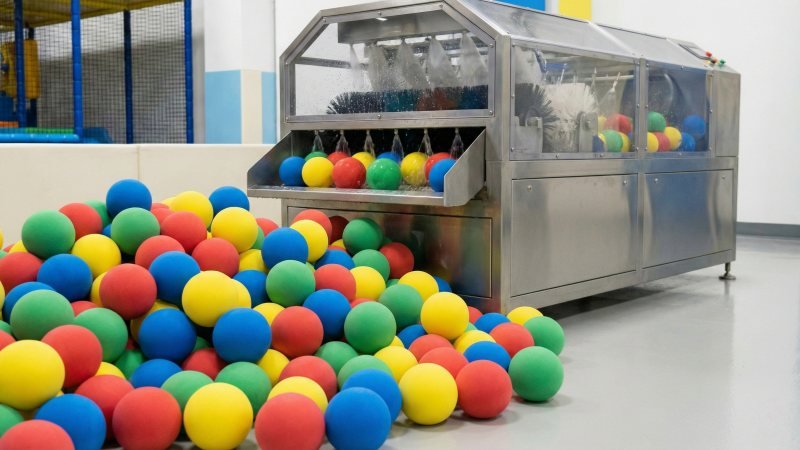
Safety specifications of the EVA foam balls
The primary concern for any parent or operator is the safety of the projectiles. Forget the hard, hollow plastic balls found in traditional ball pits; Ballocity uses spheres made from EVA (Ethylene-Vinyl Acetate) foam. This material is crucial for safety.
EVA foam is soft, sponge-like, and absorbs impact. When a child is hit by one of these balls, even at close range, the force is negligible. It feels similar to being tapped with a soft cushion rather than a hard object. This allows for the excitement of a “battle” without the risk of bruises or tears. Plus, these balls are too light to cause damage to the facility’s lighting or windows.
Note: The exact diameter and density of foam balls can vary between suppliers. It is critical to verify that the balls you purchase match the calibration of your vacuum tubes and blasters to prevent jamming or loss of pressure.
Efficient cleaning protocols and hygiene management
Hygiene is a top priority for increasing foot traffic; parents will not return to a dirty facility. Cleaning thousands of small balls might seem like a nightmare, but here’s the reality: the Ballocity system is actually easier to maintain than a standard ball pit.
Picture a traditional pit: balls sit stagnant at the bottom, collecting dust and debris. In a Ballocity arena, the balls are in constant circulation through the vacuum tubes and conveyors. This movement naturally prevents dust from settling.
For deep cleaning, operators use a dedicated Ball Washing Machine. This device works like a vacuum cleaner for the playground. You simply suck the dirty balls out of the pit, run them through the sanitizing machine, and shoot them back into the play area. This reduces a task that used to take hours of manual labor into a manageable routine.
Hygiene Management Comparison
| Cleaning Method | Traditional Ball Pit | Ballocity System |
|---|---|---|
| Ball Circulation | Static (collects dust) | Dynamic (constant movement) |
| Cleaning Process | Manual bagging and scrubbing | Automated ball washing machine |
| Labor Time | High (hours to days) | Low (routine maintenance) |
| Parent Perception | “Germ Pit” | “Active and Clean” |
Durability and low-maintenance requirements of pneumatic systems
From an operational standpoint, mechanical breakdowns kill profitability. Ever tried fixing a burned-out motor on a busy Saturday? Ballocity systems avoid this headache by relying on pneumatics (air power) rather than complex electric motors and gears located inside the play structure.
Pneumatic systems are incredibly durable. The heavy lifting is done by an air compressor, which is usually located in a separate, accessible utility room. This means there are very few moving parts inside the play area itself that can break.
Contrast this with a motorized kiddie ride or an electric bumper car, where motors can burn out and gears can strip from overuse. In a Ballocity system, the air blasters and vacuum tubes have no internal motors to fail. If a blockage occurs, it is usually just a matter of clearing a stuck ball, which can often be done without closing the attraction. This high reliability ensures maximum uptime and protects your revenue stream.
Integrating Ballocity into Your Venue Layout
Ballocity arenas are highly modular and designed to maximize vertical space, making them adaptable to almost any facility footprint or ceiling height.
Operators can install them as standalone centerpieces or retrofit them into existing soft play structures, allowing businesses to increase capacity and revenue per square foot without expanding the building’s physical walls.
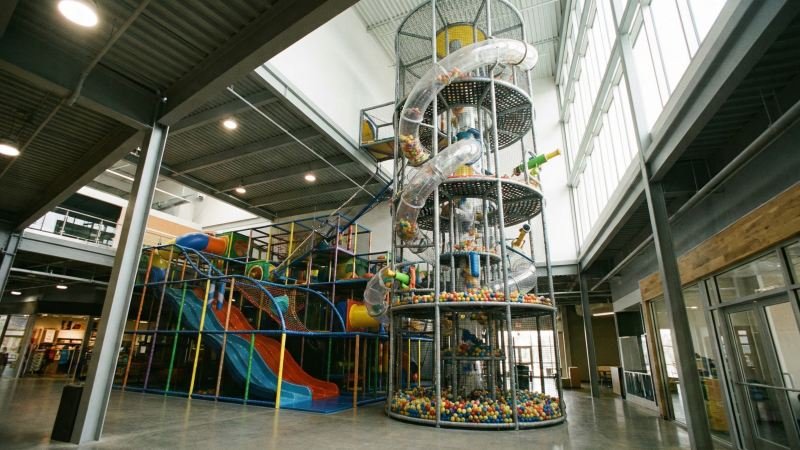
Customizing dimensions for various ceiling heights and floor plans
One of the biggest misconceptions is that you need a warehouse-sized room for a Ballocity system. The reality is that these structures are built on a modular grid system, similar to construction blocks. This allows designers to shape the arena around your building’s obstacles, such as support columns or HVAC ducts.
Maximizing Vertical Real Estate
The primary advantage of this system is verticality. If your floor space is tight but you have high ceilings, you can build up. A three-level Ballocity structure uses the same floor footprint as a one-level playground but triples the playable area. This is critical for locations in retail centers where rent is charged by the square foot.
- Low Ceilings: Designs can be spread out horizontally for buildings with standard 10-12 foot ceilings.
- High Ceilings: Systems can reach 20+ feet, utilizing gravity-fed spirals and towering dumping buckets. (Always check your specific equipment blueprints for required gravity clearances).
Layout Configuration Options
| Layout Type | Description | Best For |
|---|---|---|
| Centerpiece | A 360-degree structure placed in the middle of the room. | Large facilities wanting a visual “Wow” factor. |
| Corner Unit | Built into a corner using two walls for support. | Venues needing to maximize open floor space. |
| Galley Style | Long and narrow structure along a single wall. | Rectangular retail spaces or strip malls. |
Combining Ballocity with existing soft play structures
You do not always need to tear down your old equipment to add Ballocity. Because the underlying steel pipe structure is often compatible with standard soft play frames, the two can frequently be merged. This creates a “Hybrid” playground.
This is essentially upgrading your base infrastructure with a premium feature. You keep the foundational framework (the jungle gym) but add a high-performance component (the blasters and vacuums). Designers can install foam ball zones directly connected to your current slides and tunnels.
Benefits of a Hybrid System:
- Seamless Flow: Kids can run from the slide directly to a cannon without touching the floor.
- Cost Efficiency: You save money by utilizing the existing steel framework you already own.
- Revitalized Interest: It makes an old playground feel brand new to your regular customers.
Leveraging the attraction for Birthday Parties and Corporate Team Building
Integrating Ballocity is not just about the physical layout; it is about the business model layout. This attraction is unique because it supports structured team gameplay. This allows you to sell high-ticket packages that standard playgrounds cannot support.
Birthday Party Packages
Instead of just “1 hour of free play,” you can sell “The Ultimate Ball Battle.” This includes a referee (party host) who organizes games like Capture the Flag using the foam balls. Parents are willing to pay a premium for organized entertainment because it keeps the chaos managed.
Corporate and Teen Events
Most soft play areas are strictly for small children. However, because Ballocity involves aiming and shooting, it appeals to adults and teens. It functions similarly to a game of paintball but without the pain or mess. You can rent out the facility after hours to corporate groups for team-building events. The multi-level structure forces adults to communicate and strategize to win, making it a surprisingly effective corporate bonding tool.
Conclusion
The bottom line: Ballocity transforms a passive playground into an interactive revenue generator. By engaging a wider age range and encouraging social play, it directly boosts your foot traffic and dwell time.
Ready to upgrade your indoor playground? Contact us today for a custom quote.