-
Whatsapp: +86 15516933785
-
Email: hanlin@hanlinplayground.com
-
Address: Shangjie District, Zhengzhou City, Henan Province, China
-
Whatsapp: +86 15516933785
-
Email: hanlin@hanlinplayground.com
-
Address: Shangjie District, Zhengzhou City, Henan Province, China

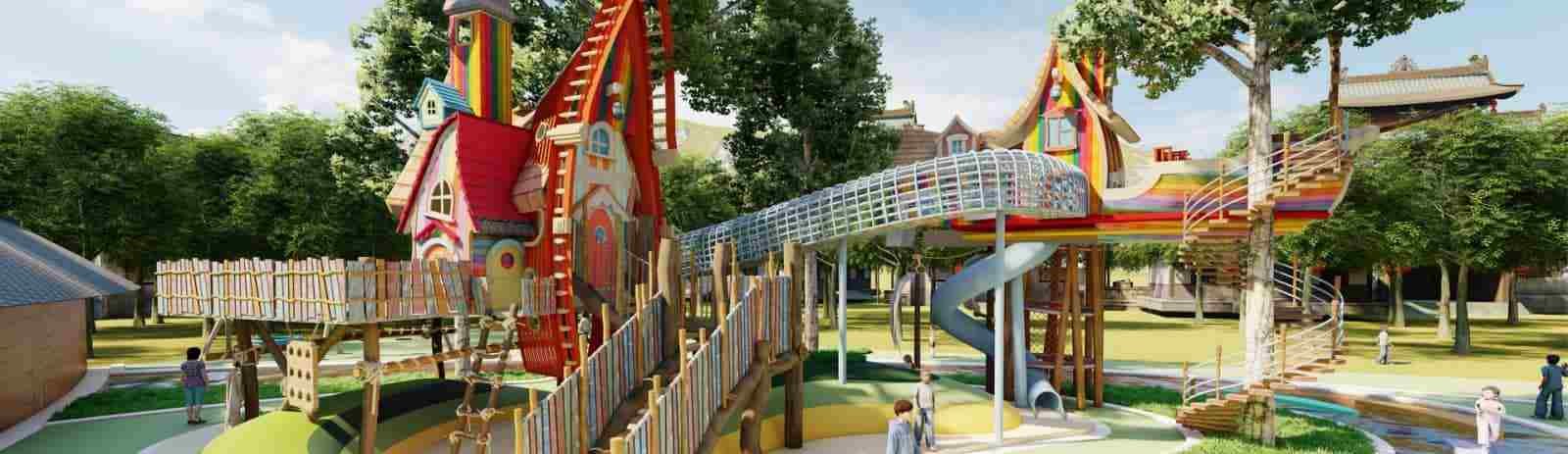
Ultimate Buyer’s Guide to Outdoor Playground Pirate Ships: Commercial and Residential Solutions

What are the most critical factors to consider when purchasing and installing an outdoor playground pirate ship?
Successfully purchasing and installing an outdoor playground pirate ship requires a comprehensive evaluation of commercial versus residential needs. Buyers must prioritize weather-resistant materials like LLDPE plastics and galvanized steel, strictly adhere to EN1176 safety standards, calculate total logistics costs, and execute precise site preparation. Beyond that, implementing a proactive maintenance schedule ensures long-term structural durability and continuous user safety.
Material Selection for Maximum Weather Resistance
What exactly makes an outdoor pirate ship playground withstand harsh weather year after year?
To maximize weather resistance, outdoor play structures require a strategic combination of high-grade materials. Specifically, commercial systems utilize UV-stabilized Linear Low-Density Polyethylene (LLDPE) for plastic components. They also rely on hot-dip galvanized steel pipes with specialized powder coatings for core structural integrity. To top it off, manufacturers choose either pressure-treated wood or synthetic wood-plastic composites to successfully prevent rot and pest degradation.
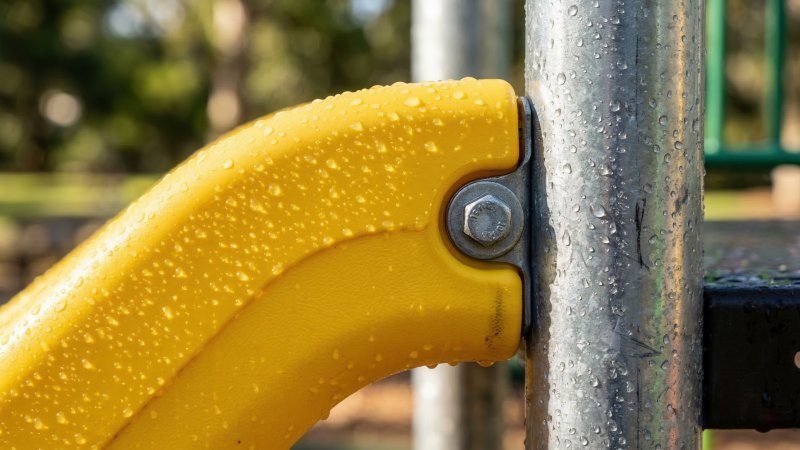
Evaluating LLDPE Plastic Components
Linear Low-Density Polyethylene (LLDPE) is the leading plastic for outdoor playgrounds. Manufacturers widely use it to create slides, ship wheelhouse roofs, and decorative bow panels.
Right out of the gate, LLDPE offers exceptional flexibility. Because of this, it resists cracking under high physical impact. More importantly, LLDPE contains specialized UV inhibitors. Ever wonder why cheap play structures look washed out and brittle after a single summer? It all comes down to UV inhibitors. These additives prevent the bright reds and blues of your pirate ship from fading in direct sunlight. Typically, high-quality playground plastics meet a UV-8 rating. This means the material can endure thousands of hours of sun exposure before degrading.
We can compare the rotational molding process of LLDPE to the solid casting of heavy-duty rubber swing seats. Both methods create a seamless final product. Therefore, the plastic has no weak welding lines that might split open during freezing winter temperatures.
Most commercial LLDPE components feature a wall thickness between 4mm and 6mm. However, because exact wall thickness and UV-resistance levels often vary based on different manufacturing equipment, you should carefully verify the exact material specifications directly with your supplier.
Galvanized Steel Pipe Thickness and Anti-Rust Coatings
The skeletal frame of any large pirate ship structure relies entirely on metal posts. Make no mistake, rust prevention has to be your top priority.
Industry-standard commercial support posts utilize hot-dip galvanized steel. Specifically, these pipes usually feature a 114mm outside diameter. Plus, the steel wall thickness typically measures between 2.0mm and 2.2mm. This robust thickness provides massive structural load capacity.
But let’s face it, raw galvanized steel isn’t enough. To maximize rust prevention, manufacturers apply a dual-layer protection system. We can compare this intense finishing process to the powder-coated sealing applied to commercial water park slide towers. It seals out moisture completely.
Here is the standard steel treatment process for weatherproofing:
- Acid Washing: Removes all surface oils and dirt from the steel pipe.
- Hot-Dip Galvanizing: Submerges the pipe in molten zinc to prevent internal and external rust.
- Electrostatic Powder Coating: Applies a thick layer of polyester powder paint, which is then baked at high temperatures.
This specific combination ensures the metal will not corrode, even in humid coastal environments.
Treated Wood vs Synthetic Alternatives
Many buyers want a realistic pirate ship aesthetic. Because of that, wood components remain highly popular for decking, ship hulls, and bridge planks. But here’s the catch: natural wood rots quickly when exposed to rain. That means buyers have to weigh pressure-treated wood against synthetic alternatives.
Pressure-treated timber undergoes a vacuum process. This process forces chemical preservatives deep into the wood fibers. This creates a barrier that effectively repels water, termites, and fungal decay. Usually, manufacturers use robust woods like Yellow Pine or Cedar.
In contrast, Synthetic Wood-Plastic Composite (WPC) blends recycled plastic with wood fibers. WPC requires zero staining or sealing. Even better, it completely eliminates the risk of painful wooden splinters.
The table below outlines the core differences for weather resistance:
| Material Type | Moisture Resistance | Fading Resistance | Splinter Risk |
|---|---|---|---|
| Pressure-Treated Timber | Moderate (Requires periodic sealant) | Low (Greys over time) | High |
| Wood-Plastic Composite (WPC) | Extremely High (Waterproof) | High (UV stabilized) | None |
| High-Density Polyethylene (HDPE) Lumber | Maximum (Completely solid plastic) | Very High | None |
Ultimately, WPC and HDPE lumber offer superior long-term weather resistance for outdoor pirate ships. That said, pressure-treated timber provides a more authentic, traditional maritime look.
Mandatory Safety Standards and Compliance
What are the precise safety rules an outdoor playground pirate ship must follow to protect children and prevent legal liability?
To guarantee public safety and legal compliance, commercial playground pirate ships must strictly adhere to international standards like EN1176 and carry CE certifications. These regulations dictate strict rules for structural integrity, preventing head entrapment, and establishing minimum guardrail heights. On top of that, facility operators must accurately calculate the equipment’s Critical Fall Height (CFH). This exact calculation dictates the thickness and type of impact-absorbing safety surfacing required beneath the entire play zone.
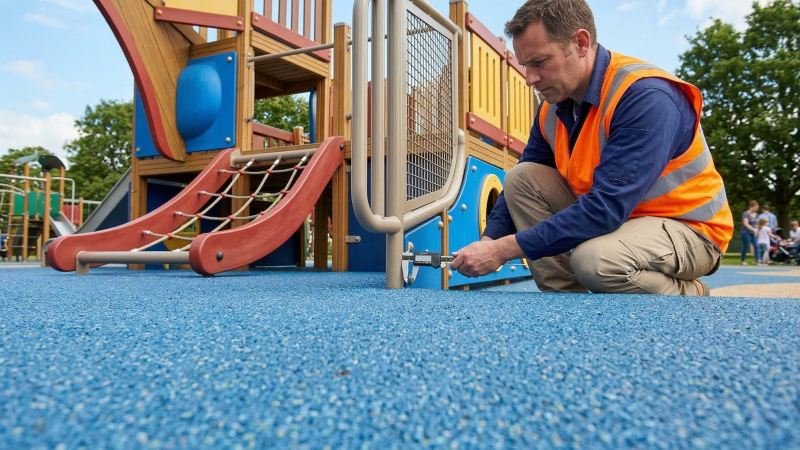
Meeting EN1176 and CE Certifications for Public Use
When purchasing a commercial pirate ship playground, strict adherence to safety standards is non-negotiable. Specifically, the EN1176 standard acts as the primary safety benchmark across Europe. Similarly, the ASTM F1487 standard serves this exact role in North America. These regulations mandate rigorous testing for every single component.
For example, safety inspectors carefully measure the gaps between the ship’s steering wheel bars and the upper deck railings. Why does this matter? It prevents fatal head and neck entrapment. According to regulations, any opening must be smaller than 89mm or completely larger than 230mm. We can directly compare this precise gap measurement process to the strict tolerance testing used when machining commercial carousel gears. Every single millimeter counts to prevent mechanical binding or physical injury.
Beyond the physical specs, a CE mark proves the play structure meets all European health and safety directives. It guarantees the paints and plastics are non-toxic. However, because specific regional certification requirements frequently vary based on your local municipality laws, you should always verify the exact compliance certificates and test reports directly with your supplier.
Calculating Critical Fall Heights
Critical Fall Height (CFH) is a crucial safety metric for any playground. It represents the maximum vertical distance a child can fall without sustaining a life-threatening head injury. Tracking down the accurate CFH is your absolute most important safety task.
How do you find the CFH on a pirate ship play structure? You must measure the distance from the highest designated play surface directly down to the ground. Importantly, this is not the top of the pirate ship’s decorative flag or plastic roof. Instead, it is the highest platform where a child can actually stand. For a large multi-level pirate ship, this is usually the main upper deck or the captain’s bridge.
If a child climbs a vertical rigging net to reach the ship’s deck, the CFH equals the maximum height of that climbing net. To ensure absolute accuracy in real-world conditions, safety inspectors use specialized impact-testing equipment. This professional device drops an instrumented metallic headform onto the surface to precisely measure rapid deceleration.
Selecting Appropriate Safety Surfacing
Once you know the exact CFH of your pirate ship, you must install the correct safety surfacing. Would you let a child jump off a 1.5-meter ledge onto raw concrete? Of course not. That’s why you absolutely cannot build a commercial playground on bare grass or hard surfaces. Instead, you need specialized materials that absorb kinetic energy. Think of safety surfacing like the heavy-duty shock absorbers used beneath industrial trampoline parks. Both engineered systems compress upon impact to prevent dangerous force from transferring into the user’s body.
There are several commercial options available. As a nice bonus, many buyers choose blue-colored surfacing to creatively mimic the ocean beneath the pirate ship.
| Surfacing Material | CFH Rating Capacity | Maintenance Level | Best Use Case |
|---|---|---|---|
| Poured-in-Place (PIP) Rubber | Very High (Up to 3.0m) | Low | High-traffic commercial theme parks |
| Engineered Wood Fiber (EWF) | High (Up to 3.6m) | High (Requires seasonal top-ups) | Budget-conscious public community areas |
| Interlocking Rubber Tiles | Medium (Up to 2.4m) | Low | Flat, square playground zones |
| Synthetic Turf with Foam Pad | Medium (Up to 2.4m) | Medium | Thematic residential or private school yards |
If your pirate ship deck sits at a height of 1.5 meters, your PIP rubber must be thick enough to absorb a fall from that specific height. Typically, this requires a 50mm thick base rubber layer. Because exact thickness requirements and impact ratings vary based on the surfacing brand, you must match the material’s certified depth directly to your ship’s CFH calculations to keep children safe from serious harm.
True Cost Analysis and Budgeting
How much does an outdoor playground pirate ship actually cost from factory production to final delivery?
The total cost of a playground pirate ship depends heavily on the project scale and procurement method. Specifically, large commercial B2B structures typically range from $5,000 to over $30,000. You also have to accurately calculate international freight container shipping and local import duties, which generally add 15% to 30% to the base factory price. On the flip side, residential DIY accessories for backyard builds usually cost between $10 and $150 per individual component.
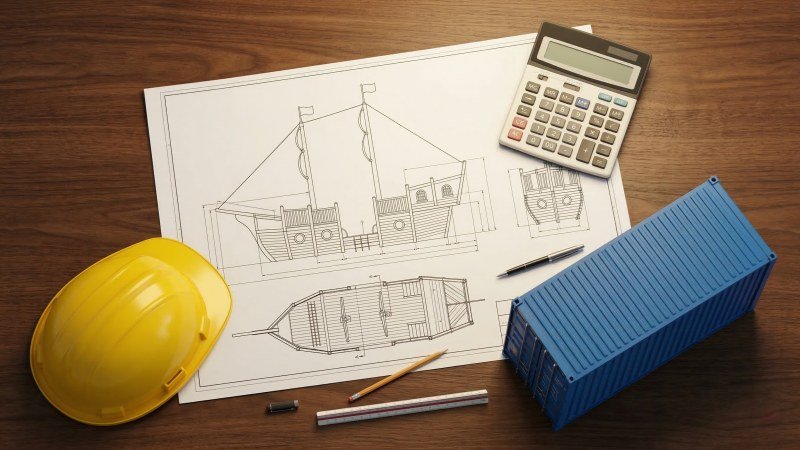
Large Scale B2B Procurement Price Ranges
When planning a commercial project, the base equipment price requires careful calculation. Manufacturers price these massive structures based on total play capacity and structural footprint. It’s simple math: a larger ship costs more.
At the entry-level, compact pirate ships designed for 15 children usually start around $5,000. Step up to medium-sized ships featuring multiple decks, and the average hits between $10,000 and $18,000. At the high end, enormous custom pirate ships accommodating 50 or more users easily exceed $30,000. We can directly compare this commercial pricing structure to large-scale modular soft play mazes. Adding extra vertical tiers or horizontal bridge connections significantly increases the final material cost.
| Pirate Ship Size | User Capacity | Estimated B2B Price Range | Typical Application |
|---|---|---|---|
| Compact | 10 to 20 children | $5,000 – $8,000 | Small preschools, local parks |
| Standard Multi-Deck | 25 to 40 children | $10,000 – $18,000 | Large residential communities |
| Mega Custom Fleet | 50+ children | $20,000 – $35,000+ | Major theme parks, resorts |
Because manufacturing costs frequently vary based on fluctuating global steel and raw plastic market rates, base prices are always subject to change throughout the year.
Freight Container Shipping and Import Duties
Buying the playground equipment is only the first financial step. Then comes the tricky part: you must transport these bulky components from the factory to your installation site. Playground equipment consumes massive cargo volume. As a result, international logistics companies calculate shipping costs using Cubic Meters (CBM).
A standard compact pirate ship usually requires a 20-foot shipping container. This container securely holds approximately 33 CBM of cargo. If you upgrade, a large multi-deck ship demands a 40-foot High Cube (40HQ) container. The 40HQ holds roughly 68 CBM. We can compare this complex logistics challenge to importing a full-sized commercial Ferris wheel. Both scenarios require precise volume planning to maximize expensive container space.
Don’t forget, buyers must pay mandatory import duties upon arrival at the destination port. Customs agencies classify playground equipment under specific Harmonized System (HS) codes. Typically, commercial play structures fall under HS Code 9506.99. Import taxes fluctuate greatly depending on your specific country. To avoid a costly headache, you must consult a licensed customs broker to estimate these government fees accurately.
Residential DIY Accessory Market Prices
Not every buyer needs a massive commercial play structure. Many parents build custom wooden pirate ships in their private backyards. Because of this, a massive retail market exists for individual DIY accessories.
These residential components are highly affordable. They easily transform basic wooden platforms into exciting maritime adventures. Usually, these parts feature lightweight plastic construction rather than commercial-grade steel.
Here are typical market prices for popular DIY pirate ship accessories:
- Plastic Steering Wheels: $15 to $30 per unit.
- Swivel Binoculars and Telescopes: $12 to $25 per unit.
- Decorative Pirate Flags with Hoists: $10 to $20 per unit.
- Molded Plastic Cannons: $40 to $80 per unit.
By purchasing these individual retail items, homeowners can easily control their backyard project budget.
Site Preparation and Installation Requirements
How do you properly prepare the ground and install a massive outdoor playground pirate ship to ensure structural stability?
Proper site preparation requires precise safety zone mapping and robust foundation anchoring. Your first step is to calculate the minimum footprint, including the mandatory obstacle-free fall zones around the ship. From there, you secure the main support posts using either direct concrete burial or surface-mount steel plates, depending on the existing terrain. Before anyone sets foot on it, certified technicians must complete a rigorous post-installation inspection checklist to verify bolt torque and structural alignment.
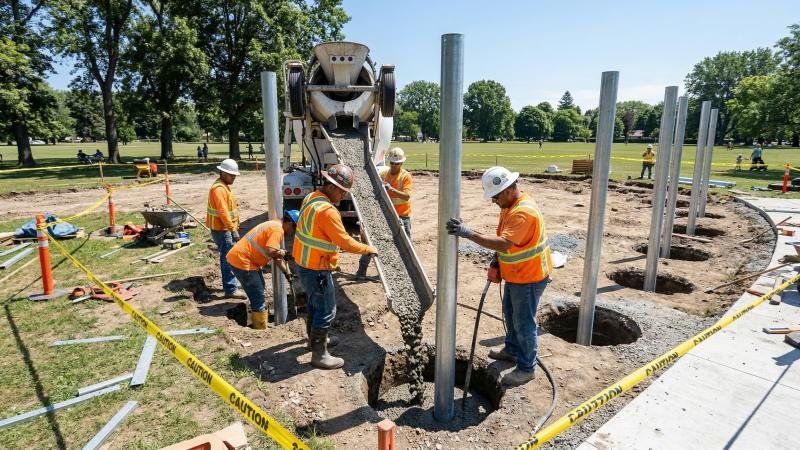
Minimum Footprint and Safety Zone Mapping
Before pouring any concrete, you must define the precise physical footprint of your pirate ship. The footprint simply represents the actual ground space the equipment occupies. But any seasoned engineer will tell you this measurement alone is never enough for a safe installation.
That means you must calculate the broader safety zone. Also known as the use zone, this is the mandatory clear space surrounding the entire ship. Children need this empty space to jump off decks or slide down safely. We can compare mapping this playground safety zone to laying out clearance aisles around a heavy-duty commercial swing set. Both installations require strict dimensional buffers to prevent dangerous user collisions.
Typically, international guidelines require an extra 1.8 meters of clearance in all directions from the furthest edge of the structure. For example, if your pirate ship footprint is 5 meters by 5 meters, your total safety zone must be at least 8.6 meters by 8.6 meters. You cannot place fences, benches, or trees inside this critical boundary. Always consult local municipal guidelines and the manufacturer’s installation manual to ensure your spacing meets regional code.
Foundation Types and Ground Anchoring
Once you map the safety zone, you must choose the correct foundation. The structural integrity of your playground depends entirely on solid ground anchoring. Industry professionals primarily use two distinct anchoring methods.
For starters, the in-ground mounting method remains the most popular choice for raw dirt or grass sites. Installers dig deep holes for every steel support post. They insert the posts and fill the holes with wet concrete. This creates a permanent, highly stable foundation.
If that’s not an option, the surface mount method is ideal if you already have a thick, level concrete pad. Here, the steel posts feature flat metal plates at the bottom. Installers use heavy-duty expansion bolts to secure these plates directly into the existing concrete.
We can directly compare these foundation choices to anchoring a massive commercial shade canopy system over a park seating area. Both structures demand serious pull-out resistance to handle extreme wind loads and dynamic user weight.
| Anchoring Method | Existing Ground Type | Installation Speed | Structural Stability |
|---|---|---|---|
| In-Ground (Concrete Footings) | Dirt, grass, sand | Slow (requires concrete curing time) | Maximum |
| Surface Mount (Bolted Plates) | Solid existing concrete | Fast | Very High |
Always ensure your foundation choice matches your specific soil conditions and site topography.
Post-Installation Inspection Checklists
After the installation crew finishes tightening the bolts and the concrete fully cures, the site is still not ready for children. A certified professional must perform a strict post-installation inspection.
Think of this final review like commissioning a newly installed industrial carousel. Every single static joint and structural connection requires physical verification before opening to the public. This process ensures the final assembly matches the manufacturer’s engineering blueprints perfectly.
Inspectors follow a standardized checklist to evaluate the newly built pirate ship:
- Plumb and Level Check: Verifying that all vertical steel posts are perfectly straight using a magnetic torpedo level.
- Hardware Torque Verification: Checking every single nut and bolt to ensure they meet the specific tightening torque requirements.
- Protrusion Inspection: Ensuring no sharp bolts extend outward where they could catch a child’s clothing.
- Weld Integrity Review: Visually inspecting all factory welds on the ship’s metal staircases and handrails for hairline cracks.
If the structure passes all these visual and physical tests, the installer issues a final handover certificate. This document officially proves the pirate ship is structurally sound and ready for active play.
Long-Term Maintenance and Durability Optimization
Proactive maintenance is the key to ensuring an outdoor playground pirate ship lasts for decades without breaking down.
To maximize long-term durability, facility managers must implement a strict preventative maintenance schedule. Maintenance teams must perform routine hardware tightening to eliminate dangerous structural vibrations. Alongside that, they need to apply specialized UV-resistant treatments to protect all plastic components from sun degradation. Come late autumn, operators must proactively manage winter weather by removing fabric sails and sealing exposed structural joints to prevent ice expansion damage.
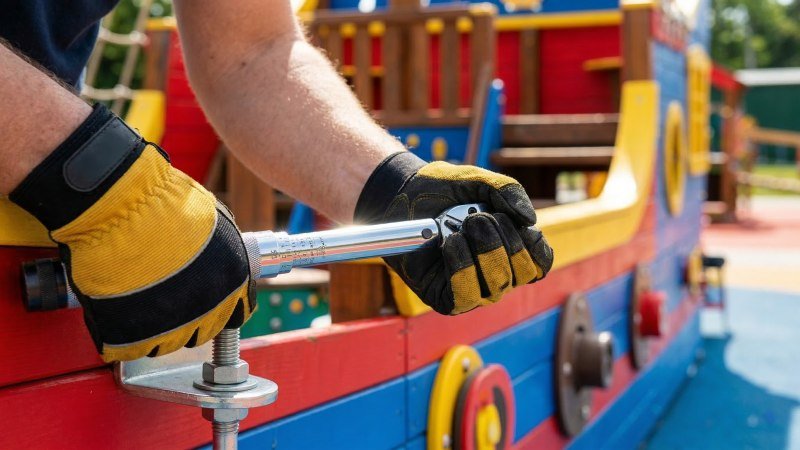
Routine Hardware Tightening Procedures
Children running and jumping create massive amounts of kinetic energy. Over time, this continuous movement causes micro-vibrations throughout the entire steel frame. Over several months of heavy use, structural bolts will inevitably back out.
Think of tightening these connections like inspecting the bolts on a commercial theme park roller coaster. Constant dynamic vibration inevitably loosens even the most secure fasteners. Think a single loose bolt on a heavy pirate ship bridge isn’t a big deal? It can quickly lead to a dangerous joint failure. To stop this before it starts, you must establish a monthly tightening schedule.
Always use a calibrated torque wrench for this job. You should strictly target major connection points. These include the main deck clamps, slide mounting brackets, and the central mast anchors. Typically, standard commercial playground deck clamps require tightening between 40 and 50 Newton-meters (Nm). However, because exact torque specifications frequently vary based on the specific bolt grade and manufacturer, you should always verify the precise torque range directly with your supplier.
Here is a recommended inspection frequency for key hardware:
| Hardware Component | Inspection Frequency | Common Issue to Check |
|---|---|---|
| Main Deck Clamps | Monthly | Backed-out threading, loose washers |
| Slide Anchors | Monthly | Plastic-to-metal separation |
| Moving Parts (Wheels, Binoculars) | Bi-Weekly | Worn bearings, missing set screws |
| Ground Anchor Bolts | Semi-Annually | Rust buildup, soil shifting |
UV Damage Prevention for Plastic Parts
The sun acts as the biggest enemy to your pirate ship’s bright colors. Intense Ultraviolet (UV) radiation slowly breaks down the chemical bonds in LLDPE plastic components.
Eventually, the plastic steering wheels and molded pirate cannons suffer from “chalking.” What does chalking mean? It means the plastic surface becomes powdery, faded, and highly brittle. We can compare this process to how unprotected fiberglass park benches fade and splinter without proper gel-coat maintenance.
To prevent this costly damage, you must act proactively. Your best bet is applying a commercial-grade playground plastic restorer semi-annually. These specialized liquid protectants replenish lost oils deep within the plastic. At the same time, they create a microscopic UV-blocking barrier on the surface.
Another solid tactic is installing permanent shade sails over the primary play zones. Heavy-duty shade fabric drastically reduces direct sun exposure. As a result, it significantly lowers the surface temperatures of the plastic slides, preventing thermal warping.
Managing Winter Weather and Seasonal Care
Winter weather brings heavy snow and highly destructive ice. Just like winterizing municipal splash pad piping systems, you must prepare your dry play structure for freezing temperatures.
Your immediate priority is to remove all canvas pirate sails and decorative fabric flags. Heavy snow accumulation will stretch, tear, and ruin these materials. Store them indoors until spring.
Once that’s done, closely inspect all plastic drainage holes. Tube slides and molded roof panels feature small weep holes to automatically release rainwater. If fallen leaves or dirt block these holes, trapped water will eventually freeze. As this solid ice expands, it generates extreme pressure. The result? It can easily split thick plastic panels completely apart.
“Ice expansion is responsible for nearly 60% of winter-related plastic playground fractures in cold climates.”
Throughout the season, check your safety surfacing daily during freezing temperatures. Engineered wood fiber and solid rubber tiles often freeze into dense, rock-hard blocks. When this happens, the surfacing completely loses its impact absorption capability. If the shock absorption is gone, you need to temporarily close the playground to ensure child safety.
Conclusion
At the end of the day, investing in an outdoor playground pirate ship is a major commitment that demands careful planning from start to finish. By selecting robust, weather-resistant materials, strictly adhering to safety and compliance standards, and accurately budgeting for logistics, you lay the groundwork for a successful installation. Whether you are building a sprawling commercial fleet for a theme park or adding DIY accessories to a residential backyard, precision in site preparation and dedication to routine maintenance are what ultimately guarantee decades of safe, imaginative play. If you need expert guidance on sourcing your equipment or clarifying technical specifications for your next project, please feel free to contact us.