-
Whatsapp: +86 15516933785
-
Email: hanlin@hanlinplayground.com
-
Address: Shangjie District, Zhengzhou City, Henan Province, China
-
Whatsapp: +86 15516933785
-
Email: hanlin@hanlinplayground.com
-
Address: Shangjie District, Zhengzhou City, Henan Province, China

How Much Does a Custom Stainless Steel Slide Cost? 4 Core Pricing Factors
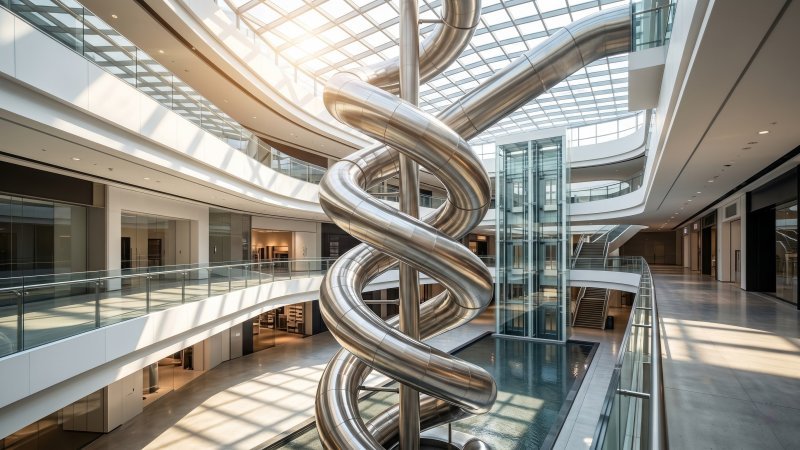
Are you curious about the specific investment required to bring a custom-built stainless steel slide to your project?
The total cost of a custom stainless steel slide typically ranges from $3,000 to over $20,000, depending on the complexity of the design and the materials used. The primary price drivers include the slide’s physical dimensions, the specific grade and thickness of the steel, the choice of surface finishes, and the requirements for engineering and installation. While a simple indoor straight slide is relatively affordable, a multi-story spiral tube slide made of marine-grade steel with a highly customized exterior represents the highest tier of investment.
Factor 1: Slide Dimensions and Path Complexity
The biggest cost driver for a custom slide is the total amount of metal and labor required. This is determined by the total vertical drop, the overall run length, and the path’s shape. Simple straight slides use standard bending techniques and less material, keeping the base price lower. However, complex spiral shapes or enclosed tubes demand advanced 3D modeling, specialized metal rolling, and extensive welding, resulting in a significantly higher final cost.
Calculating Total Height and Run Length Requirements
The size of your slide dictates the volume of raw stainless steel needed. You start by measuring the total vertical height—the exact distance from the top platform to the landing zone. Then comes calculating the run length, which is the actual physical path the slider travels.
If you have a standard floor-to-floor drop of 10 feet, a steep slide will use less metal than a gentle, sloping slide. Why does this run length matter to your bottom line? Because a shallower angle extends the slide’s physical footprint. Simply put, it eats up more raw steel sheets. Beyond just the surface area, a longer slide needs more internal support ribs to prevent the metal from deflecting under dynamic weight.
To understand this, think about fabricating standard commercial playground stairs. A short, steep staircase to a low platform uses minimal side stringers and fewer treads. Switch gears to a long, gradual ADA-accessible ramp, and you’re suddenly looking at extended side rails, more decking, and heavy-duty center supports. The manufacturing logic for a slide is identical.
Here’s another wrinkle: different age groups require different slide angles for safety. Because of this, the exact run length can vary based on specific design codes. You should verify the exact dimension ranges and safety requirements with your chosen supplier before finalizing your layout.
Cost Differences Between Straight, Curved, and Spiral Designs
The shape of the slide path drastically changes the fabrication process. It directly impacts the labor hours required on the shop floor.
Straight slides are the most economical option. Manufacturers cut flat steel sheets and bend them on a standard press brake. This process is fast and highly repeatable. The payoff? Labor costs stay well within reason.
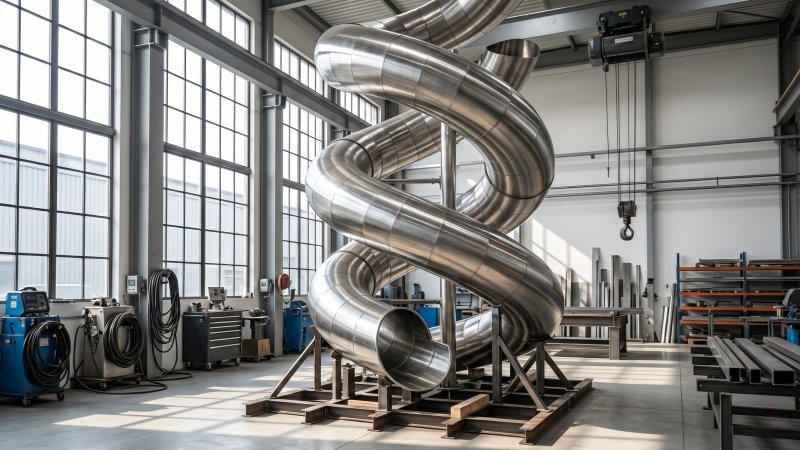
Curved or spiral slides are a completely different beast. Metal cannot simply be bent into a spiral. Instead, it must be carefully cut into complex geometric patterns. From there, fabricators use specialized plate-rolling machines to form the curves. To top it off, skilled welders must join these curved sections together seamlessly.
| Design Type | Manufacturing Process | Cost Impact |
|---|---|---|
| Straight | Standard cutting and linear press brake bending. | Low. Minimal labor and fast production. |
| Single Curve | Moderate plate rolling and basic seam welding. | Medium. Requires specific machinery setup. |
| Helical / Spiral | 3D CAD modeling, custom pattern cutting, and complex multi-axis rolling. | High. Labor-intensive welding and extensive grinding required. |
Creating a spiral slide is much like fabricating a custom helical water slide flume. You can’t just use off-the-shelf straight pieces. You must calculate flat patterns, roll the steel perfectly, and weld every joint by hand. This intense labor makes spiral designs a premium investment.
Open-Top vs Fully Enclosed Tube Structures
When designing your slide, you must choose between an open-top bedway or a fully enclosed tube. This single decision immediately affects your budget.
Open-top slides feature a standard U-shape. They require a single bottom sliding surface and two side guardrails. Enclosed tube slides, on the other hand, form a complete cylinder. They use more than double the amount of stainless steel.
“Switching from an open-top design to a fully enclosed 30-inch diameter tube generally doubles the raw material requirements and significantly increases welding hours.”
Enclosed tubes are notoriously harder to build. Welders must join two curved halves together. They must weld the outside structural seam for strength, and then they have to carefully blend and polish the inside seam so it is 100% flush and perfectly smooth for sliders. This internal polishing is difficult, tedious, and time-consuming.
It’s no surprise that enclosed tube slides are significantly more expensive. But if your project spans multiple floors, they aren’t optional—they’re required to prevent users from falling out during high-speed descents. The extra cost of an enclosed tube is absolutely necessary for safety compliance.
Factor 2: Material Grade and Thickness Selection
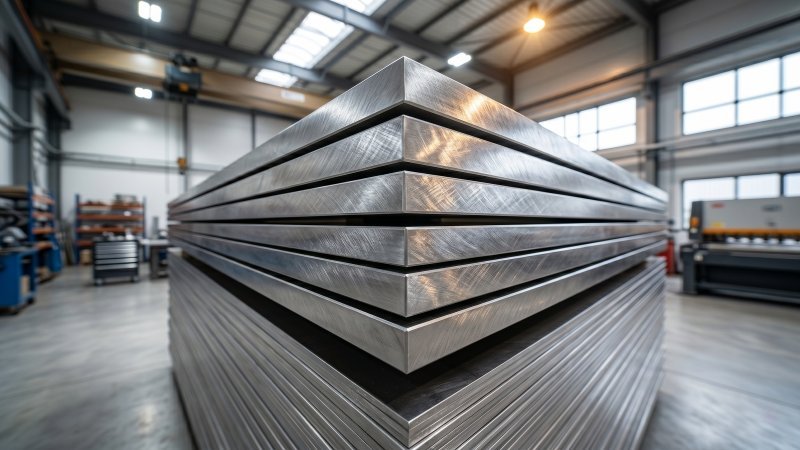
The price of a custom stainless steel slide fluctuates heavily based on the raw material’s composition and gauge. Upgrading from standard Type 304 to marine-grade Type 316 stainless steel typically increases raw material costs by roughly 20 percent. Furthermore, thicker metal requires more steel per square foot. It also demands heavier machinery for rolling and welding, which drastically drives up both material and labor expenses.
Evaluating 304 vs 316 Stainless Steel Applications
The specific alloy of stainless steel you choose creates the foundation of your budget. For the most part, manufacturers build custom slides using either Type 304 or Type 316 stainless steel.
Type 304 is the industry standard. It is highly durable and costs less. That makes it the go-to for indoor applications, shopping malls, or mild outdoor parks. Step up to Type 316, though, and you’re dealing with an upgraded, premium alloy. It contains a special element called molybdenum, which makes the steel highly resistant to harsh corrosion. Naturally, this extra element makes Type 316 significantly more expensive.
Choosing between these two grades is similar to specifying materials for different amusement park zones. If you are building an indoor soft play center, standard materials keep costs low. If you are building a seaside water park structure, engineers must use expensive marine-grade steel to prevent rust from saltwater and pool chemicals. The takeaway here? If you want to save money, Type 304 is the obvious choice—but only if the surrounding environment allows for it.
Determining Appropriate Metal Gauge for Structural Integrity
Metal thickness is measured in “gauges.” In metal fabrication, a lower gauge number means the metal is thicker.
Think a thicker gauge just means a slightly higher material bill? Think again. Thicker metal directly increases your project cost in two distinct ways.
First, you’re buying more mass. A 12-gauge steel sheet contains more raw steel than a thinner 16-gauge sheet, meaning the initial material invoice will be higher. Second, thicker metal is significantly harder to process.
Think about fabricating different types of park equipment. Bending thin metal for a standard playground roof canopy is extremely fast and uses light-duty machines. Compare that to cutting thick structural steel tubes for a high-ropes course tower, which requires powerful laser cutters and significantly slows down the production speed. Thicker slide metal acts the exact same way. It requires heavier plate rollers, slower cutting speeds, and much longer welding times. Every extra hour on the shop floor drives up the labor bill.
Assessing Environmental Factors for Material Durability
Your installation environment often dictates your material costs for you. You can’t just pick the cheapest metal and hope for the best if your environment is harsh.
For example, installing a slide near a swimming pool exposes the metal to chlorine vapor. Chlorine aggressively attacks standard steel. Try to save a few bucks by using Type 304 in this area, and the slide will quickly rust. The harsh reality is you will face massive replacement costs later. In these scenarios, paying the premium for Type 316 up front is mandatory, not optional.
Let’s be real—public parks experience heavy, constant use. A thin metal gauge might dent under repeated impact from heavy footwear. As a result, public installations often require a thicker gauge to prevent vandalism and severe wear. Upgrading the thickness strictly for environmental durability will raise your initial quote. At the end of the day, understanding your exact installation area helps you avoid buying more metal than you actually need, while ensuring you buy exactly what the site demands.
Factor 3: Surface Finishes and Aesthetic Treatments
Surface finishes and aesthetic treatments can increase the total fabrication cost by 10 to 30 percent. Standard brushed finishes are not only economical but required for the sliding surface to ensure safety. Conversely, adding high-end mirror polishing to the exterior shell, custom powder coating, or specialized anti-slip safety zones demands extensive hand-grinding, dedicated facility processing, and extra curing time, which significantly drives up the final price.
Standard Brushed vs High-End Mirror Polishing
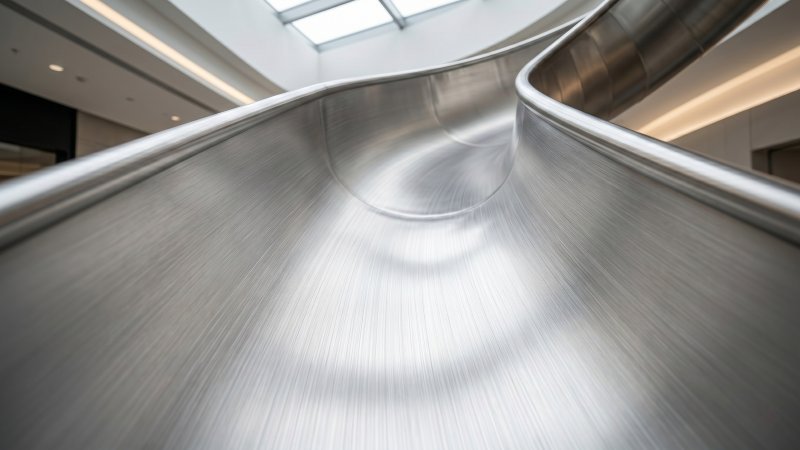
Standard brushed finishes represent the baseline cost for most projects and are a strict engineering requirement for the interior sliding surface. A brushed texture (such as a #3 or #4 finish) retains microscopic grooves that trap air and moisture. This prevents the dangerous “stiction” (vacuum effect) that causes bare skin or synthetic clothing to abruptly stick to ultra-smooth metal, which can lead to severe friction burns or fractures.
What happens when a client requests a high-end mirror finish? A mirror finish (#8) creates a flawless, reflective surface, but for strict safety and thermal reasons, we exclusively apply it to the exterior architectural shell of the slide. Polishing the exterior is incredibly labor-intensive. Fabricators have to buff the metal by hand using progressively finer abrasives and specialized polishing compounds.
Consider the process of finishing commercial playground equipment. Grinding off rough weld splatters on a standard swing set frame is fast and cheap. But polishing a custom architectural play sculpture to a perfect glaze takes hours of precision handwork. Mirror polishing the outside of a slide requires that same immense manual effort.
| Finish Type | Application Area | Cost Impact | Engineering Purpose |
|---|---|---|---|
| Standard Brushed (#4) | Interior Bedway (Mandatory) | Baseline Price | Traps air to reduce friction; prevents stiction. |
| Mirror Polished (#8) | Exterior Shell Only (Optional) | +15% to +25% | Purely aesthetic; highly reflective architectural look. |
Because of the sheer hours involved, selecting an exterior mirror polish will immediately inflate your final invoice.
Adding Powder Coating for Brand or Interior Aesthetics
Sometimes, plain silver stainless steel just doesn’t fit the architectural vision. That’s exactly why many clients opt for powder coating to add custom colors to the exterior of the slide. Powder coating applies a dry, electrically charged colored powder to the metal. Next, a massive industrial oven bakes the slide pieces to melt the powder into a tough, hard skin.
This aesthetic treatment adds direct cost because it requires an entirely separate manufacturing step. Workers have to move the slide into a specialized paint booth. The larger the slide sections are, the larger the required curing oven must be.
“Applying a custom powder coat finish to the exterior shell typically adds an extra $15 to $30 per square foot to the overall manufacturing cost, depending on the custom color formulation.”
Powder coating provides massive visual value for commercial spaces. An indoor theme park, for example, can blend the slide right into a jungle motif. But keep in mind, this extra step requires more handling, specialized spray equipment, and much longer lead times before that slide ever hits a truck.
Specialized Safety Treatments and Anti-Slip Edges
The entry platforms and exit run-out zones require serious engineering attention. Riders are transitioning from a fast sliding motion to standing up, creating a high risk for slip-and-fall accidents. This means you have to invest in specialized safety treatments.
Fabricators must apply flush, barefoot-safe modifications to these transition zones. We absolutely cannot use cheap industrial materials like raised diamond tread plates. In a playground environment, sharp industrial metal treads act like a cheese grater, causing severe lacerations if a rider falls. Instead, safety engineers specify flush, marine-grade epoxy aggregate coatings or integrated polyurethane soft-grip pads.
Applying these specialized safety edges is a precise, multi-step job. It is very similar to adding textured rubberized coatings to splash pad stairs. A bare metal step is cheap and fast to punch out, but adding a specialized, flush grip texture requires an entirely separate application and curing process. These safety additions represent a slight bump in the initial price, but they pay for themselves by ensuring compliance and preventing lawsuits.
Factor 4: Engineering, Logistics, and Professional Installation
Engineering, logistics, and professional installation typically add 20 to 40 percent to the base price of a custom stainless steel slide. Structural blueprints and safety certifications require licensed engineers, adding significant upfront fees. Furthermore, transporting oversized, pre-welded metal structures incurs premium freight charges, while complex on-site assembly demands highly paid specialized labor.
Costs of Custom Structural Blueprints and Safety Certifications
Before cutting a single piece of metal, manufacturers have to map out precise 3D CAD models. This structural engineering phase is non-negotiable. A custom slide is a heavy architectural modification to your building, and it must safely support dynamic, moving weight over years of use.
Think about designing a multi-level commercial play structure. A mechanical engineer must calculate the exact stress points and load capacities of the central towers. Similarly, a slide engineer has to calculate momentum, friction, and exact structural anchor tolerances. You are paying for highly skilled professional oversight.
“Creating custom structural blueprints and obtaining Professional Engineer (PE) stamps can add anywhere from $1,500 to $5,000 to the initial project phase.”
Beyond the engineering desk, you still have to pass local building inspections. Commercial installations require rigorous safety certifications (such as ASTM F1487 or EN 1176 standards for playground equipment). Structural requirements and specific building codes change drastically depending on your local jurisdiction. That’s why you should always verify the exact certification standards and engineering fees with your chosen supplier early in the planning stage.
Freight Rates for Shipping Oversized Pre-Welded Sections
Ever tried shipping a giant, oddly shaped steel cylinder? Transporting a custom slide is exceptionally expensive because you are essentially paying to ship air. The metal sections are bulky, awkward, and take up massive real estate on a trailer.
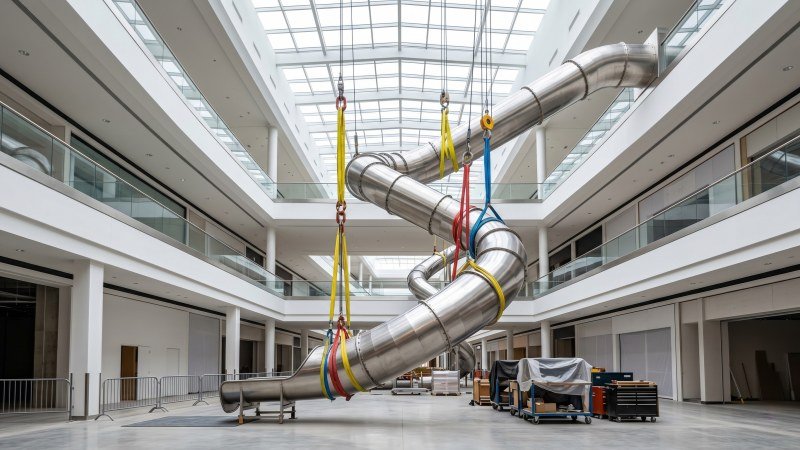
Transporting large slide components is identical to shipping giant fiberglass water slide flumes—you simply cannot pack them flat. That means standard Less-Than-Truckload (LTL) shipping rarely works. You will almost certainly need to book a Full Truckload (FTL) or a dedicated flatbed trailer. If the welded sections are extremely wide, logistics companies have to secure special oversized load road permits.
On top of the freight itself, fabricators must build custom, heavy-duty wooden crates to protect the metal from dents and road debris during transit. This customized industrial packaging alone adds significant material and labor costs to your final shipping invoice.
Modular Assembly vs On-Site Welding Expenses
How the slide actually connects together inside your building will make or break your installation budget. You generally have two structural choices: modular bolted assembly or seamless on-site welding.
Modular assembly relies on heavy-duty external flanges and precision-aligned bolts. Because the interior sliding path must remain 100% flush, seamless, and free of any snagging hazards or dangerous protrusions, all mechanical connections must be designed on the outside of the tube. Installers simply hoist the flanged pieces into place and bolt them together externally. This process is highly efficient, requires standard rigging equipment, and keeps labor costs relatively low.
On the flip side, on-site welding provides a perfectly seamless architectural appearance on both the inside and outside. However, it is an incredibly expensive route. Fabricators have to bring mobile TIG welding rigs inside your building. They must set up fireproof barriers and hire dedicated fire-watch personnel. To finish the job, skilled metalworkers must spend days hand-grinding and re-brushing the new welds just to make the interior bedway perfectly smooth and safe again.
| Installation Method | Connection Type | Labor Intensity | Cost Impact |
|---|---|---|---|
| Modular Assembly | External bolts and flanged joints. | Low. Fast mechanical fastening. | Economical. |
| On-Site Welding | Field-welded and ground joints. | High. Requires skilled tradesmen and fire safety protocols. | Premium. |
This difference is comparable to erecting a commercial playground. Bolting together modular play decks is a rapid mechanical process. Compare that to field-welding a bespoke architectural climbing structure, which takes hours and demands highly paid specialists. If you are working within a strict budget, opting for a modular bolted design with external flanges will easily save you thousands of dollars in installation fees.
Conclusion
Understanding these four core pricing factors is the crucial first step toward a successful custom slide project. By intelligently balancing dimensions, material grades, surface finishes, and safe installation methods, you can engineer a high-quality stainless steel slide that satisfies both your architectural vision and your financial parameters. To get a precise quote tailored to your specific site requirements and ensure full compliance with amusement safety standards, please contact us to speak directly with our engineering team.