-
Whatsapp: +86 15516933785
-
Email: hanlin@hanlinplayground.com
-
Address: Shangjie District, Zhengzhou City, Henan Province, China
-
Whatsapp: +86 15516933785
-
Email: hanlin@hanlinplayground.com
-
Address: Shangjie District, Zhengzhou City, Henan Province, China

How Much Does It Cost to Invest in a Viral Rainbow Slide? Site Requirements & ROI Guide
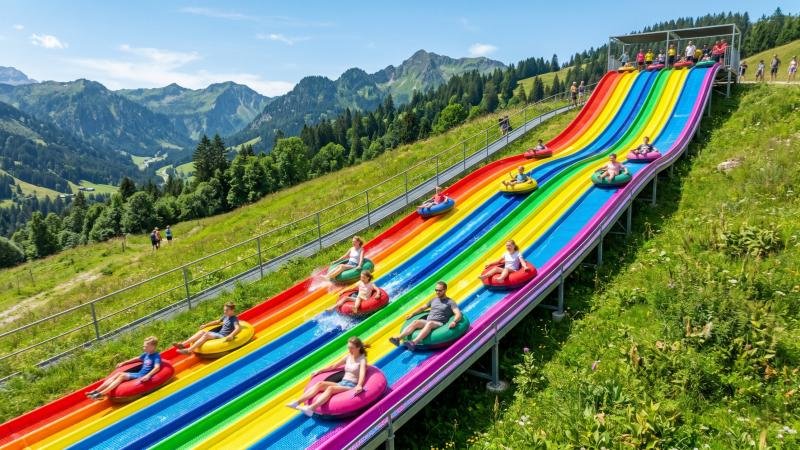
Are you wondering exactly what it takes to build a safe, profitable commercial rainbow slide for your amusement park or farm?
The total investment for a commercial rainbow slide typically ranges from $15,000 to $50,000, depending heavily on the track length and whether you build on a natural hill or require an artificial steel structure. A successful site requires a 3 to 20-degree incline, extensive safety buffers calculated by kinetic energy, and strategic ticket pricing, allowing operators to achieve a full return on investment within a single busy season.
Breakdown of Initial Investment and Equipment Costs
The initial investment for a commercial rainbow slide includes the interlocking plastic surface modules, essential safety accessories like hard-bottom snow tubes, and the expected shipping and installation labor fees. While a basic 50-meter setup on a natural hill might cost around $15,000, larger 100-meter tracks requiring custom steel structures can push the total budget closer to $50,000.
Per Square Meter Pricing for Interlocking Modules
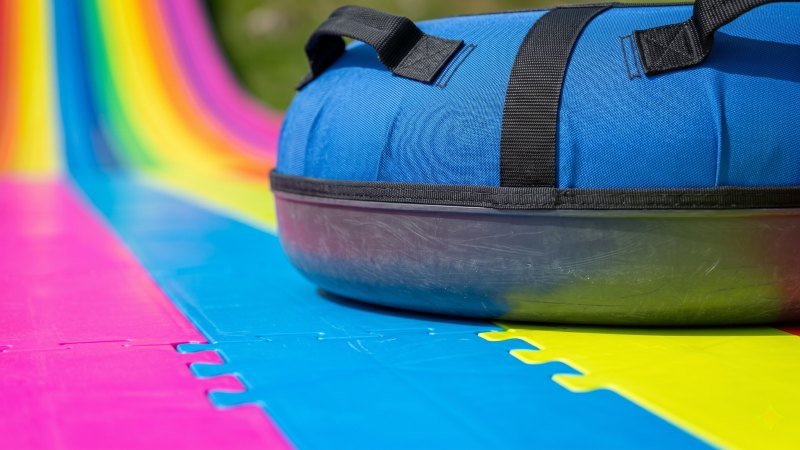
The biggest part of your budget goes to the actual sliding surface. These tracks use high-density polyethylene (HDPE) or polypropylene (PP) plastic tiles. That means you’re buying these interlocking modules by the square meter.
You’ll generally see wholesale prices range from $15 to $30 per square meter. Keep in mind, prices will shift based on plastic thickness, UV resistance ratings, and color customization. Please check directly with your chosen manufacturer to confirm the exact pricing and material specifications for your specific project.
How does this compare to other attractions? Think of these modules like the fiberglass sections of a water park slide. Just as a thicker fiberglass flume costs more but lasts longer, premium PP tiles cost more upfront but resist fading under harsh sunlight.
| Material Grade | Average Price (per sq meter) | Expected Lifespan | Best Use Case |
|---|---|---|---|
| Standard PP | $15 – $20 | 3 – 5 Years | Indoor parks or shaded areas |
| UV-Resistant HDPE | $22 – $30 | 5 – 8 Years | Outdoor open-air farm parks |
You need to calculate the total square footage of your planned track. For example, a standard dual-lane track that is 50 meters long and 3 meters wide covers 150 square meters. Do the math, and the base module cost alone hits around $3,000 to $4,500.
Accessories and Safety Gear Expenses
Got your track sorted? Now you need the hardware to ride it. Guests aren’t sliding on standard pool floats; they require specialized dry snow tubes with heavy-duty PVC tops and reinforced hard plastic bottoms.
A commercial-grade snow tube usually costs between $40 and $80 per unit. A standard park setup often requires at least 30 to 50 tubes to keep the lines moving smoothly. Plan to budget roughly $1,500 to $4,000 for sliding tubes. Here’s a pro tip from the field: always verify the exact weight limits and tube dimensions with your supplier, as heavy-duty models vary by manufacturer.
Let’s not forget the braking zone. You must invest in professional-grade safety buffers. At the end of the slide, guests traveling at high speeds need an engineered soft zone to stop safely without hazardous G-forces.
- Heavy-Duty Crash Mats: Commercial-grade impact absorbers usually cost $300 to $600 each.
- Artificial Turf for Braking: Adds about $8 to $12 per square meter for the extensive run-out zone.
Note: Always prioritize commercial-grade tubes. Using standard inflatable rings on a dry plastic track causes immediate friction burns and material failure.
Shipping and Installation Labor Fees
At the end of the day, getting this massive puzzle to your site adds to the total bill. Rainbow slide modules are bulky, and that translates to serious shipping container space.
Ocean freight for a standard 50-meter slide can range from $1,000 to $3,500. This depends heavily on global shipping rates and your specific port location.
After delivery, installation begins. The process is similar to snapping together a large modular playground flooring system, but it requires precise, laser-straight alignment. Most manufacturers send a lead technician to oversee the process. You will typically pay their travel, lodging, and a daily rate of $150 to $300.
On your end, you’ll supply the muscle. A crew of four workers can usually assemble a 50-meter track in three to five days. Factor in another $1,000 to $2,500 for local installation labor.
Essential Terrain and Site Infrastructure Requirements
To safely install a commercial rainbow slide, you need a site with a constant incline of 3 to 20 degrees and a minimum track length of 50 meters. The infrastructure requires either rigorously engineered civil groundwork on a natural hill or a custom-built steel support framework, along with an extensive flat braking zone that typically measures 30 to 50 meters to safely dissipate rider momentum.
Ideal Slope Angles and Length Calculations
Gravity is the engine that drives an unpowered rainbow slide. Nail the slope angle, or you’ve got a useless track.
If your slope is too flat, riders will get stuck midway. Push it too steep, and you’re engineering a launchpad. Industry standards suggest an ideal incline between 3 and 20 degrees. How do you avoid building a multi-thousand-dollar safety hazard? Always verify exact slope requirements with your equipment manufacturer, as friction coefficients change based on the specific plastic materials used.
You must also calculate the total length of the track. A typical commercial slide ranges from 50 to 150 meters long.
How do you calculate the drop? Think of it like designing a classic log flume water ride. The height of the starting platform dictates the total length needed for a smooth descent. A 10-meter vertical drop usually requires about 60 meters of track length to maintain a safe, thrilling speed without launching the rider into the air.
Natural Hills vs Artificial Steel Structures
You have two main ways to build the physical foundation for your slide. You can use the existing landscape, or you can build from scratch on flat ground.
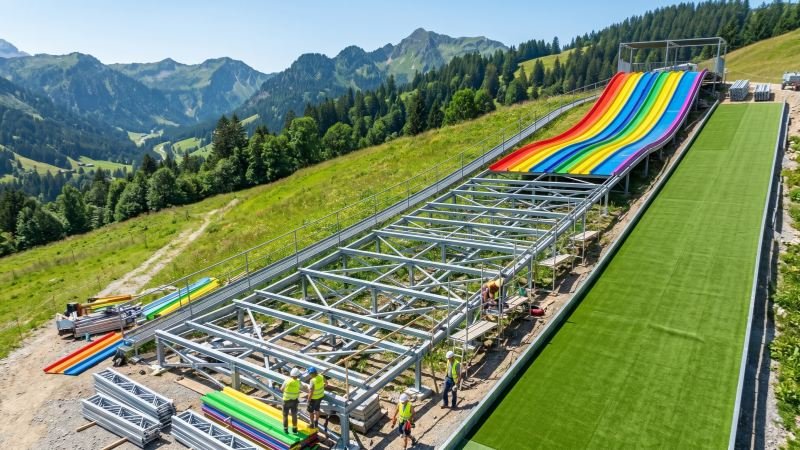
Sure, while utilizing a natural hill looks great for the budget, it requires rigorous civil engineering to prevent soil erosion, piping, and fatal landslides. You cannot simply grade the dirt and lay down a weed barrier. A professional site requires a comprehensive geological survey, proper slope drainage systems (such as French drains or interceptor ditches), slope stabilization (like 3D geomat or retaining walls), and deep soil anchors for the concrete foundations. This ensures the track does not catastrophically collapse after heavy rainfall.
Stuck with flat ground? You’re looking at a custom steel structure. This is similar to erecting the steel support towers for a commercial water slide. It requires deep concrete footings and structural engineering approval.
| Infrastructure Type | Upfront Construction Cost | Site Preparation Time | Best Suited For |
|---|---|---|---|
| Natural Hill | Low (if native soil is stable) | Medium (Requires proper drainage prep) | Mountain resorts, sloping farm land |
| Steel Structure | High | Slow (3-6 Weeks) | Flat amusement parks, urban plazas |
Note: Steel structures allow you to build custom wave shapes and camelback bumps into the track, which greatly enhances the rider experience.
Space Needed for the Buffer and Braking Zones
The ride doesn’t stop just because the hill does. The flat run-out at the bottom is the single most critical life-saving feature on your entire site.
This area is called the buffer and braking zone. When a rider reaches the bottom of a 10-meter vertical drop, they can easily reach limit speeds of nearly 50 km/h. To safely dissipate this immense kinetic energy, a massive braking zone is mandatory.
Engineering safety standards dictate that the safe buffer length must scale with the track’s speed and momentum, generally requiring at least one-third to one-half of the main track’s overall length. If your braking zone isn’t scaled to your kinetic energy, riders face a high risk of severe collisions or high-speed ejections upon hitting the terminal crash mats.
On top of that, this landing pad needs to be wider than the main track to account for tube spin-outs. Make sure your site plan includes a clear, paved walking path to guide guests safely away from the landing zone and back to the queue.
Maximizing Profitability and Calculating ROI
How can you quickly turn your new rainbow slide into a highly profitable attraction?
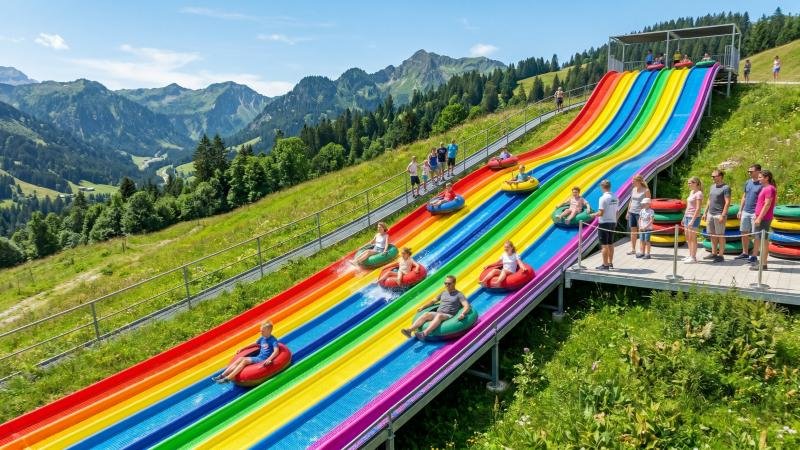
To maximize profitability and achieve a rapid return on investment, operators must implement strategic ticket pricing, optimize daily ride capacity, and leverage organic social media marketing. By balancing a high throughput of up to 300 riders per hour with low customer acquisition costs, most commercial slides can break even within a single busy season.
Ticket Pricing Strategies and Daily Capacity
Your revenue directly depends on how many guests can ride the slide each hour. If you don’t know your hourly capacity, you’re flying blind.
Think of a rainbow slide like a multi-lane mat racer water slide. It relies on a continuous, steady flow of guests to generate profit. The ride itself is incredibly fast. A typical 50-meter descent only takes about 10 to 15 seconds. With the right setup, a trained crew can dispatch a new rider very quickly.
If you operate a dual-lane slide, you can comfortably dispatch two riders every 30 seconds. This equals 240 riders per hour. Now, how do you capture that value? Don’t just sell single tickets; encourage repeat rides.
| Ticket Type | Suggested Price | Strategy Goal |
|---|---|---|
| Single Ride | $5.00 | Attract hesitant first-time riders. |
| 3-Ride Pass | $12.00 | Increase average transaction value. |
| All-Day Wristband | $25.00 | Maximize revenue from dedicated thrill-seekers. |
By offering a 3-ride pass, you create a perceived discount while securing a higher upfront payment.
Viral Marketing Benefits and Lowering Acquisition Costs
Customer acquisition cost is the amount of money you spend on marketing to get one visitor. The beauty of a rainbow slide? It naturally crushes this expense.
The bright, multi-colored tracks act as giant, highly visible billboards. They immediately draw the eye. Just like a massive, looping roller coaster becomes the visual icon of a theme park, your slide will become the focal point of your property.
Even better, that neon track is a magnet for user-generated content. Guests love taking videos of their friends speeding down the colorful lanes. They instantly share these videos on platforms like TikTok and Instagram.
This creates a viral marketing loop. Your guests essentially do your advertising for free. The payoff? You bleed less cash on paid local ads and dump those marketing dollars straight to your bottom line.
Estimating the Break-Even Timeline
When will you actually get your money back? Calculating your break-even point is surprisingly straightforward.
First, calculate your total initial investment. Let us assume a total setup cost of $30,000 for a dual-lane track. Next, calculate your daily net profit.
Imagine you average 200 riders per day. If your average ticket price is $5, you generate $1,000 in daily gross revenue. After subtracting daily labor and minor operational costs (roughly $200), your daily net profit is $800.
Divide your total investment by your daily net profit. In this scenario, $30,000 divided by $800 equals 37.5 days.
Run the numbers on a holiday weekend, and a well-managed slide can completely pay for itself in less than 40 operating days. After that point, nearly all ticket sales convert directly into profit for your business.
Key Maintenance and Operational Considerations
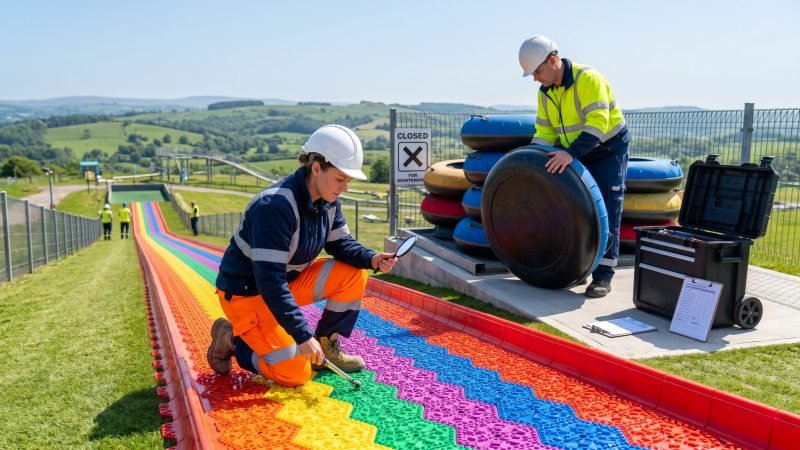
Successfully operating a rainbow slide requires a dedicated staff for traffic control, daily structural inspections of the track and foundations, and a zero-tolerance weather management protocol. By strictly regulating environmental conditions and replacing worn interlocking tiles promptly, operators can safely extend the lifespan of the attraction.
Staffing Needs for High-Traffic Days
Think you can run this with a skeleton crew on a Saturday? Think again. Similar to operating a commercial zip line, you absolutely need operators at both the launch platform and the landing zone to maintain safety.
At minimum, a standard dual-lane slide requires two staff members. The first employee works at the top starting platform. This person spaces out the riders, checks age or height requirements, and safely dispatches the tubes.
Down at the bottom, your second operator must quickly clear guests from the run-out area before the next tube descends. If your facility adds a mechanical tube conveyor belt to haul tubes back up the hill, you will likely need a third person to load the empty tubes onto the lift system.
Routine Inspections and Module Replacement
Daily safety checks are non-negotiable for any amusement ride. Workers must walk the entire track every morning before opening the park. They should actively look for cracked plastic, loose anchoring screws, separated module seams, and any signs of soil washout near the foundations.
The upside? Repairing a modular track is a breeze compared to patching a cracked fiberglass water slide. Because the track uses modular interlocking tiles, you only replace the broken pieces. You do not have to shut down the entire ride for a week. Workers simply snap out the damaged square and snap in a new one in minutes.
| Inspection Frequency | Action Required | Focus Area |
|---|---|---|
| Daily | Visual walk-through | Check for surface debris, loose tiles, and foundation stability. |
| Monthly | Hardware check | Tighten anchor bolts on the starting platform and retaining walls. |
| Annually | Deep cleaning | Power wash modules to remove dirt buildup. |
Strict Weather Protocols and Off-Season Storage
Weather directly impacts the fundamental physics of how your ride operates. HDPE and PP plastics offer predictable friction coefficients when entirely dry. But the second that high-polymer surface gets wet, friction drops off a cliff. You’re no longer running a dry slide; you’ve built an uncontrollable, high-speed water ride where run-out braking turf becomes entirely useless.
This means your operational protocol has to be bulletproof: This equipment must only operate in completely dry conditions. Operations must halt immediately at the first sign of precipitation—including light drizzle, morning dew, or heavy fog condensation—and the entire track must be thoroughly dry before reopening.
During the winter off-season, you must protect your investments. The plastic track itself can usually stay outside year-round, though UV protection sails can prevent fading. But here’s the catch: you must completely deflate and properly store the hard-bottom snow tubes in a dry, climate-controlled warehouse. Leaving these heavy-duty PVC tubes outside in freezing temperatures causes the materials to become brittle and catastrophically fail under load.
Conclusion
Let’s cut to the chase. Investing in a commercial rainbow slide is a highly effective way to increase foot traffic and generate fast returns for your amusement park, farm, or outdoor venue. By carefully managing your initial equipment costs, strictly adhering to civil engineering standards for your site infrastructure, and executing uncompromising safety and weather protocols, you can turn a relatively low upfront investment into a highly profitable, secure attraction. If you are ready to start planning your custom slide project, please contact us today to evaluate your site requirements and get a detailed quote.