-
Whatsapp: +86 15516933785
-
Email: hanlin@hanlinplayground.com
-
Address: Shangjie District, Zhengzhou City, Henan Province, China
-
Whatsapp: +86 15516933785
-
Email: hanlin@hanlinplayground.com
-
Address: Shangjie District, Zhengzhou City, Henan Province, China

How to Prevent Stainless Steel Slides from Overheating in Summer? Material & Safety Solutions
Ever shot a laser thermometer at a piece of bare 304 stainless at 2 PM in late July? If you have, you know exactly why we’re having this conversation. How can facility managers and playground designers effectively prevent stainless steel slides from overheating and causing severe contact burns during the summer months?
The most effective strategies to prevent stainless steel slides from overheating include optimizing the equipment’s spatial orientation to minimize direct sun exposure, installing physical barriers like tensioned shade sails, applying heat-reflective thermal coatings to exterior surfaces and structural supports, and replacing high-contact sliding beds with low-conductivity materials such as High-Density Polyethylene (HDPE).
Strategic Placement and Environmental Shading
Effective spatial arrangement is the first line of defense against summer heat. Rather than relying on costly material upgrades later, smart site planning lets you naturally protect equipment from the sun right out of the gate.
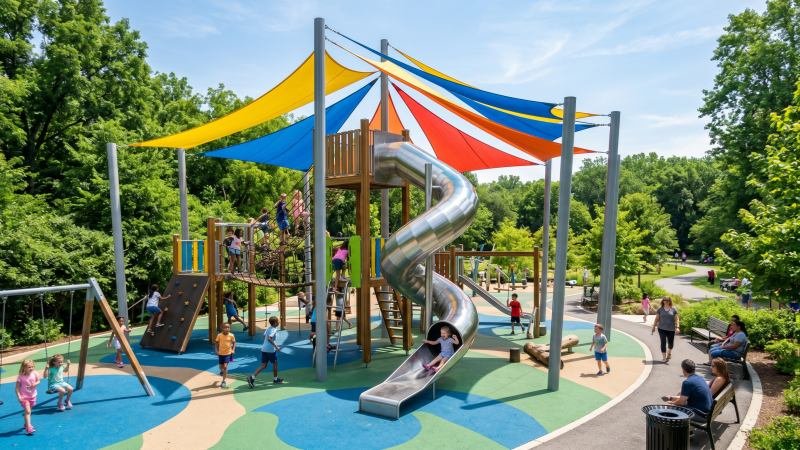
Playground designers prevent overheating by combining smart equipment orientation with physical environmental barriers. Specifically, positioning slide chutes to face north or east avoids the intense afternoon sun. Take it a step further by deploying tensioned shade sails and planting mature shade trees to block direct ultraviolet radiation, which significantly lowers the metal’s surface temperature.
Optimizing Playground Equipment Orientation
The simplest way to reduce heat absorption is through smart spatial planning. Why let the slide bake in the sun when you can easily turn it away? From an engineering standpoint, the position of the playground equipment directly impacts its surface temperature.
In the Northern Hemisphere, the sun sits in the southern sky during the hottest parts of the day. Because of this, direct sunlight is strongest between 12:00 PM and 4:00 PM. During this operational window, west-facing and south-facing surfaces absorb the most solar radiation.
As a rule of thumb, always orient stainless steel slide exits toward the north or east. Facing north utilizes the shadow cast by the playground structure itself. Likewise, facing east ensures the metal only receives the milder morning sun. This strategy is exactly like positioning park benches or picnic pavilions. You naturally place seating areas under shade and face them away from the harsh afternoon glare. A stainless steel slide requires the exact same sun-path planning to remain cool.
Always review the local sun path before installation. Since solar angles vary greatly depending on your specific geographic latitude and seasonal shifts, we advise you to verify the exact orientation layout with your landscape architect or site engineer.
Implementing Tensioned Shade Sails and Canopies
Let’s be real—sometimes, changing the slide’s direction just isn’t enough. In these scenarios, artificial shading becomes absolutely mandatory. Tensioned shade sails and rigid canopies are your most reliable defenses against high temperatures.
These structures stretch high-performance fabrics across steel support posts. By doing this, they intercept solar radiation before it ever hits the slide. This physical barrier stops the metal from heating up. Beyond that, shade structures actively reduce the overall ambient temperature of the play area.
When specifying a shade structure, the material is everything. Most commercial playgrounds rely on Commercial 95 High-Density Polyethylene (HDPE) mesh. This material allows hot air to escape upward while aggressively blocking sunlight.
| Shade Material Type | Average UV Blockage | Breathability | Best Use Case |
|---|---|---|---|
| HDPE Knitted Mesh | 90% – 98% | High | Large open play areas needing airflow. |
| Solid PVC Fabric | 100% | Low | Areas requiring complete rain and sun protection. |
| Metal Roof Canopies | 100% | None | Extremely durable structures for heavy snow or severe weather. |
“Effective shade design is not just a visual upgrade; it is a critical safety component for managing thermal risks on metal playground surfaces.”
Because tension strength and UV-blocking ratings can vary significantly among different manufacturers, always verify the exact material specifications with your supplier before cutting a PO.
Integrating Natural Landscaping and Tree Canopies
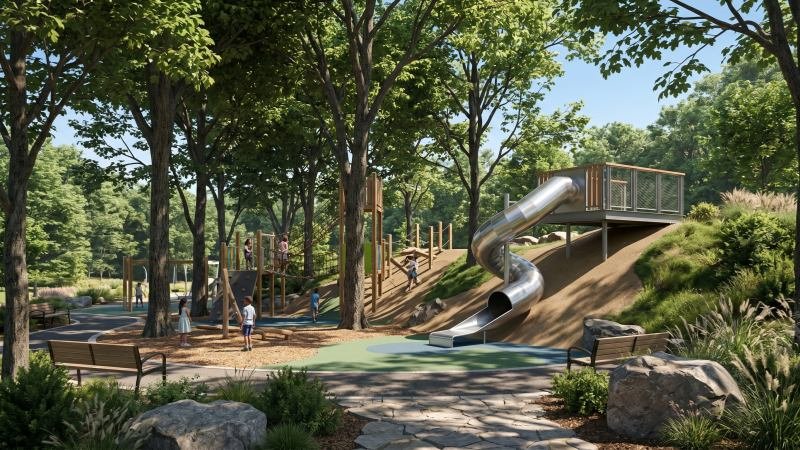
Nature often provides the most robust cooling solutions. Integrating trees into your playground design is an incredibly effective, long-term strategy. Think of trees as natural thermal shields for stainless steel slides.
For starters, mature tree canopies block direct sunlight, casting dense shadows over the equipment. On top of that, trees release moisture through their leaves. This biological process actually cools the surrounding air. The result? The microclimate around the playground becomes much more manageable.
This method mimics how large fabric shade structures over splash pads protect bare feet from hot concrete. The tree canopy creates a natural, protective buffer against intense solar radiation.
That said, careful planning is required. Designers must specify the right type of trees. Deciduous trees are usually the engineering standard here. They grow thick leaves in the summer to provide maximum shade, then drop their leaves in the winter. This allows the gentle winter sun to reach the playground, which helps melt snow and warm the area.
Safety remains the top priority. So, rule number one: do not plant trees with weak branches directly over the play equipment. Falling branches can cause serious structural damage or injury. Additionally, keep root systems far enough away from the slide’s concrete footings to prevent shifting over time.
Thermal Coatings and Surface Innovations
What if you’re stuck with an existing layout and cannot add enough shade to keep the bare metal cool?
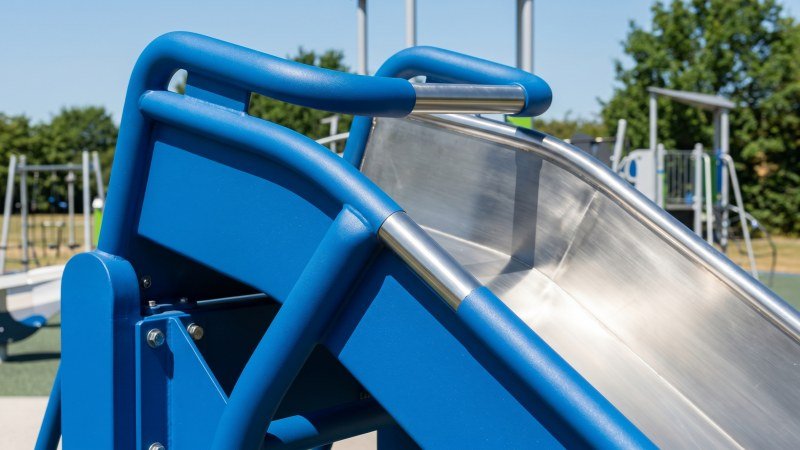
Facility managers can apply specialized thermal coatings and advanced surface wraps directly to the non-sliding, exterior elements of the stainless steel structure. Heat-reflective paints applied to the outer shell bounce solar radiation away, while thick polyurethane or PVC wrappings on handrails and support posts create a low-conductivity thermal barrier without compromising the slide’s essential low-friction mechanics.
Heat-Reflective Paint Applications
Standard stainless steel acts like a sponge for invisible infrared light from the sun. As you’d expect, the metal turns this light into intense heat. To combat this, manufacturers formulated heat-reflective paints containing special infrared-reflective (IR) pigments that bounce those invisible heat rays back into the atmosphere.
Crucial Engineering Note: These IR paints must only be applied to the exterior shell (the underside and outer walls) of the slide, never to the actual sliding path.
This application mirrors the heat-reflective coatings we use on outdoor basketball courts or commercial roofing. By applying a high-quality reflective coating to the slide’s outer chassis, you reduce the overall thermal mass of the equipment, which indirectly keeps the interior sliding surface cooler. Industry data shows that advanced IR exterior coatings can drop the overall ambient surface temperatures by 15°F to 20°F. Since thermal performance varies based on the specific chemical formulation, always verify the exact temperature reduction range with your coating supplier.
Polyurethane and PVC Wrapping Techniques
Sometimes, painting the metal falls short for high-touch areas like entry steps or support columns. In these instances, Polyurethane (PU) and Polyvinyl Chloride (PVC) wrapping techniques offer an excellent solution. Manufacturers bond a thick layer of these polymers onto exterior posts and safety barriers.
Want to see a safety inspector shut down your site on day one? Try putting PU or PVC on the sliding surface. According to strict safety standards, PU and PVC wraps are absolutely prohibited on the sliding chute itself. Polyurethane and PVC are naturally high-friction, anti-slip materials. If a child slides down onto a PVC-coated surface, the extreme friction will cause a sudden, violent deceleration. This “stick-slip” effect throws the child forward, risking severe friction burns, facial injuries, or broken bones.
Instead, reserve this process for where it belongs—much like how manufacturers coat playground swing chains. Just as raw metal chains are dipped in plastisol to prevent pinched fingers and extreme temperature transfers, wrapping a playground slide’s handrails and exterior supports insulates the child against thermal energy while maintaining a perfectly smooth, bare-metal (or HDPE) sliding path for a safe gravity descent.
| Coating Material | Thermal Insulation | Best Playground Application | Typical Lifespan |
|---|---|---|---|
| Heat-Reflective Paint | Moderate | Slide exterior shell, under-carriage | 3 to 5 Years |
| Polyurethane (PU) Wrap | High | Handrails, entry grab bars | 7 to 10 Years |
| PVC Liquid Dip | High | Swing chains, structural posts | 5 to 7 Years |
Durability and Upkeep of Coated Surfaces
Do these protective exterior layers last forever? Unfortunately, no. A commercial playground experiences constant physical abuse and harsh weather exposure, which will inevitably wear down any applied coating.
That means routine maintenance is non-negotiable. Facility managers must conduct weekly visual inspections of coated handrails and painted outer shells. You need to look for signs of peeling, bubbling, or deep scratches. This highlights another critical engineering reason why coatings are banned on the sliding path: if a coating chips or peels on the chute, it creates a dangerous “entanglement hazard.” A peeling edge can catch a child’s clothing drawstring or lacerate skin at high speeds, posing a severe strangulation or injury risk.
By keeping coatings strictly on the exterior and keeping manufacturer-approved touch-up kits on hand for small scratches, maintenance teams can ensure the equipment remains thermally protected without introducing structural hazards.
Material Alternatives and Hybrid Slide Designs
Are there structural modifications we can make to a slide so it naturally resists heat without relying on external shade?
Yes, manufacturers combat heat buildup by utilizing hybrid designs that replace high-contact metal zones with low-conductivity materials. Specifically, they swap out stainless steel sliding beds for High-Density Polyethylene (HDPE) plastics and integrate composite structures. Furthermore, utilizing insulated composite materials for handrails and entry steps prevents localized thermal burns.
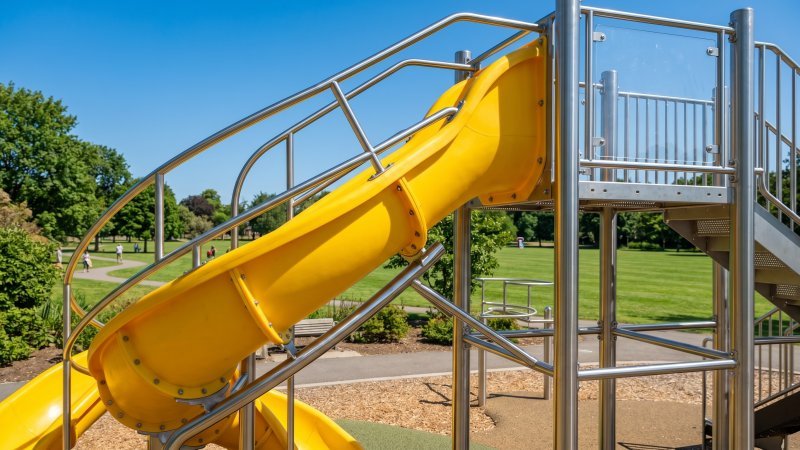
Replacing High-Contact Zones with HDPE Plastics
Stainless steel transfers heat in the blink of an eye. Because of this, the actual sliding bed becomes the most dangerous part of the equipment during summer. Why risk a severe injury and a massive lawsuit when a simple material swap solves the problem? To fix this, playground manufacturers routinely replace the main chute with High-Density Polyethylene (HDPE).
HDPE is a heavy-duty, commercial-grade thermoplastic. It possesses a significantly lower thermal conductivity than metal. As a result, it absorbs and retains a fraction of the solar heat. When a child sits on HDPE, the material won’t quickly transfer heat into their skin, and most importantly, it maintains the smooth, continuous, low-friction surface required for safe sliding mechanics.
This engineering approach matches modern commercial playground deck construction. Many playground platforms use a rigid steel core coated with a thick layer of textured PVC or rubber. The internal steel provides the structural backbone, while the outer plastic layer handles extreme temperatures and provides a safe contact point. A hybrid slide utilizes the exact same logic: plastic for the high-contact sliding bed and metal for the exterior support.
| Material | Thermal Conductivity (W/m·K) | Friction Level | Best Playground Application |
|---|---|---|---|
| Stainless Steel (304) | ~16.2 | Low | Structural frames, shaded sliding beds |
| HDPE Plastic | ~0.4 | Low | Slide chutes, high-contact sliding panels |
Designing Composite Structures for Maximum Safety
Let’s face it: public parks often require the extreme durability of metal but demand the thermal safety of plastic. Pure plastic slides can warp or crack under heavy vandalism. Conversely, pure metal slides act like frying pans in the summer.
To get the best of both worlds, designers rely on composite structures. A composite hybrid slide seamlessly combines two or more different materials. Typically, the primary support columns, safety barriers, and under-carriage consist of heavy-gauge stainless steel. Meanwhile, the actual sliding surface consists of roto-molded plastics.
This hybrid design delivers maximum structural integrity alongside thermal safety. Take the “tube-and-trough” hybrid framework found in many modern municipal parks. The outer structural ribs are stainless steel. However, the inner trough where children sit is made of thick, UV-stabilized plastic. This ensures the slide survives harsh public environments without acting as a dangerous heat sink.
Insulating Metal Handrails and Entry Steps
The slide chute isn’t the only thermal hazard on the platform. Children must climb steps and grip handrails before they slide down. It goes without saying, these bare metal entry components also overheat in direct sunlight. That’s why replacing or heavily insulating these specific touchpoints is a mandatory safety upgrade.
Safety inspectors frequently note that bare metal handrails cause rapid contact burns because children grip them tightly, maximizing skin contact. To engineer this risk out of the system, manufacturers replace bare steel grips with solid composite lumber or high-density marine-grade polymer sleeves. These materials block heat transfer entirely while providing excellent slip resistance.
For entry steps, designers often spec perforated metal overlaid with rubberized composite treads. The perforations allow hot air to flow through the structure, while the composite overlay prevents direct skin contact with the hot steel. By insulating the entry points, you drastically reduce overall injury rates before the child even reaches the slide.
Playground Safety Standards and Temperature Monitoring
Ensuring slide safety requires more than just good structural design; it demands active, boots-on-the-ground temperature monitoring protocols.
Park administrators prevent thermal injuries by strictly adhering to national playground safety guidelines and establishing active monitoring protocols. By utilizing handheld infrared thermometers and scheduling daily surface temperature checks, maintenance teams can systematically manage equipment before it reaches the dangerous contact burn threshold of 120°F (49°C).
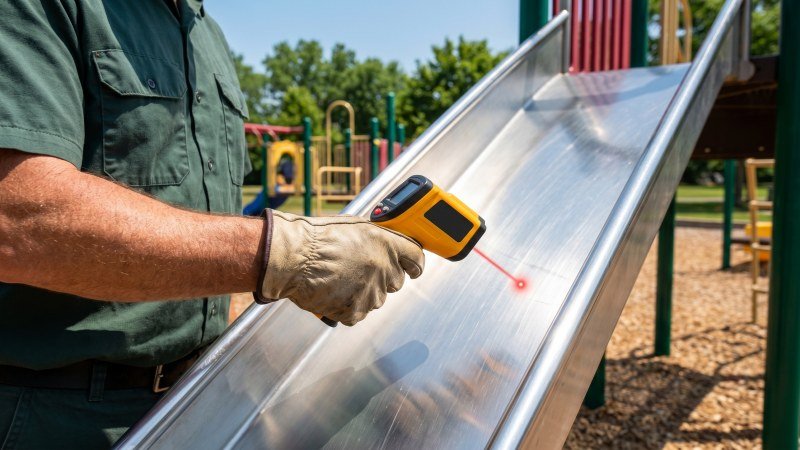
Navigating Thermal Burn Compliance Guidelines
Safety standards aren’t just suggestions; they exist to prevent severe accidents. Why guess if a slide is safe when established industry guidelines give you the exact parameters? The U.S. Consumer Product Safety Commission (CPSC) actively warns against placing bare metal slides in direct sunlight.
On the regulatory side, professionals follow standards like ASTM F1487. This specification covers public playground equipment safety. While it focuses heavily on structural integrity, it also highlights the severe dangers of thermal burns. Skin contact with metal at 120°F (49°C) can cause a second-degree burn in just three seconds. Because metal has a high thermal conductivity coefficient, it transfers its heat instantly upon contact.
This compliance process is identical to standard playground safety audits for fall zones. Just as safety inspectors routinely measure the depth of rubber mulch to ensure impact attenuation, playground managers must use CPSC guidelines to measure and manage hazardous thermal surfaces. Always verify your exact local regulatory details and testing standards with a Certified Playground Safety Inspector (CPSI).
Implementing Routine Surface Temperature Checks
Knowing the safety standards is only half the battle. You also have to actively measure the equipment in the field. A stainless steel slide can look perfectly safe while hiding dangerous thermal energy.
To stay ahead of this, maintenance teams must perform routine surface temperature checks. The tool of choice here is a standard handheld infrared (IR) thermometer. This device instantly measures surface heat without physically touching the metal. This practice is exactly like municipal pool operators performing routine water temperature and chemical checks throughout the day. It’s incredibly fast, highly accurate, and absolutely essential for preventive safety.
When should you temp the equipment? Schedule your daily inspections during peak solar radiation hours. Typically, this dangerous window falls between 12:00 PM and 3:00 PM. Always point the IR thermometer directly at the slide’s main chute and the upper starting deck, as these are the primary contact zones.
To ensure consistent safety, implement a strict daily temperature log.
| Surface Temperature Range | Safety Status | Recommended Maintenance Action |
|---|---|---|
| Under 100°F (37°C) | Safe | Normal play is fully allowed. No action is needed. |
| 101°F to 115°F (38°C – 46°C) | Warning | Monitor the equipment closely. Post warning signs for parents. |
| Over 115°F (46°C) | Danger | Close the slide immediately. Restrict public access until cooled. |
“A proactive daily temperature monitoring schedule is the most reliable defense against unexpected thermal injuries in public play areas.”
By establishing a clear and structured monitoring routine, you actively engineer the invisible heat hazards out of your park.
Conclusion
Let’s face it, managing the thermal risks of stainless steel slides is a baseline responsibility for maintaining a safe, compliant public play space. By implementing strategic environmental shading, applying specialized exterior coatings correctly (while strictly leaving the sliding path bare), integrating low-conductivity HDPE hybrid materials, and locking down a routine temperature monitoring schedule, facility managers can effectively neutralize the threat of summer contact burns. Taking these proactive engineering steps ensures that your playground equipment delivers the long-lasting durability of steel without turning into a seasonal liability. If you need further assistance with safety guidelines or are looking to upgrade your playground with heat-resistant materials, please feel free to contact us.