-
Whatsapp: +86 15516933785
-
Email: hanlin@hanlinplayground.com
-
Address: Shangjie District, Zhengzhou City, Henan Province, China
-
Whatsapp: +86 15516933785
-
Email: hanlin@hanlinplayground.com
-
Address: Shangjie District, Zhengzhou City, Henan Province, China

Integrating Amusement with Architecture: A Design Guide for Custom Stainless Steel Slides
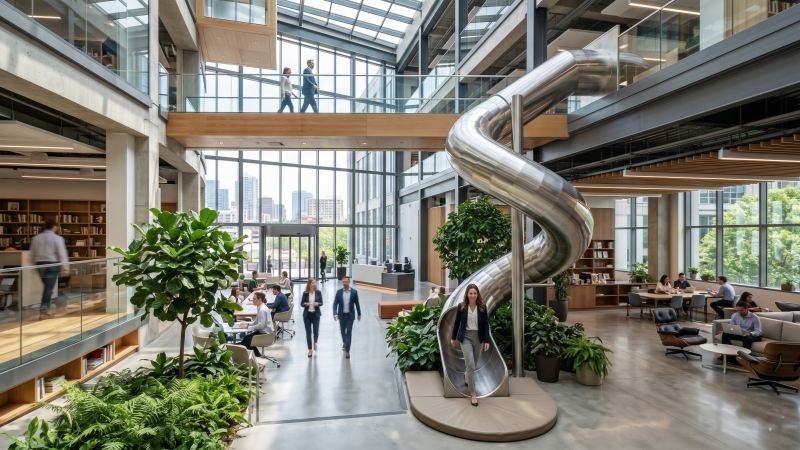
How do architects successfully integrate custom stainless steel slides into modern building designs to balance aesthetics, structural integrity, and public safety?
Architects achieve successful integration by carefully evaluating the building’s typology, calculating precise spatial requirements, and selecting appropriate materials like Grade 304 or 316 stainless steel. More importantly, locking down strict compliance with international safety standards and Class-A commercial manufacturing specifications transforms a functional metal chute into a safe, engaging architectural centerpiece.
Evaluating Architectural Typologies for Slide Integration
What types of buildings are best suited for integrating custom stainless steel slides?
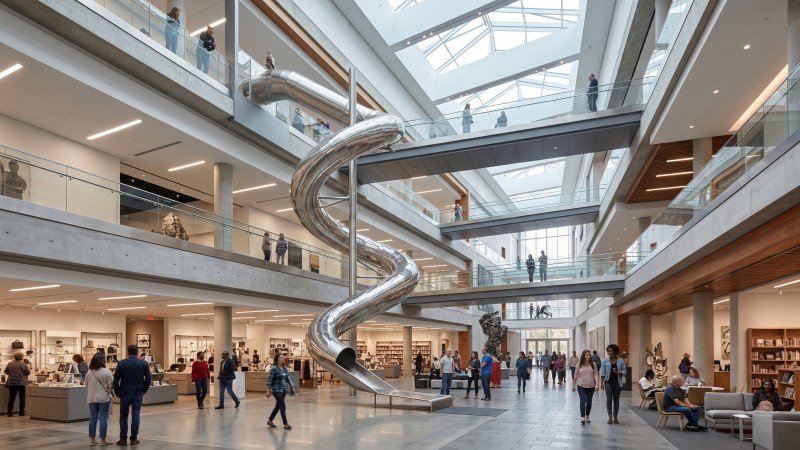
Custom stainless steel slides successfully integrate into commercial offices, retail centers, public museums, and premium residential layouts. These structures require specific spatial planning, such as multi-floor connectivity, open atriums, or distinct elevation changes. So, assessing the building’s primary function and traffic flow determines how effectively a slide enhances the overall architectural environment.
Commercial Offices and Modern Workspaces
Modern companies constantly seek new ways to motivate employees. Because of this, smart corporate architects often design workspaces that prioritize fun alongside efficiency. Integrating a slide between floors achieves both goals perfectly.
Just as enclosed multi-tier spiral climbing towers distribute users safely in public play parks, an indoor slide offers rapid, point-to-point descent for staff. Beyond that, it serves as a stunning visual centerpiece. For instance, the Corus Quay building in Toronto features a massive three-story indoor slide. This bold design choice instantly transformed a standard corporate atrium into an energetic, collaborative hub.
Are traditional stairs enough for today’s creative agencies? Probably not. An office slide encourages quick movement and sparks daily social interactions among different departments. That’s why you’ll typically see these installations planned near break rooms or main lobby areas. This strategic placement maximizes visibility and daily usage.
| Feature | Traditional Stairs | Custom Stainless Steel Slide |
|---|---|---|
| Primary Function | Two-way vertical movement | Fast, one-way descent |
| Space Required | High footprint per floor | Compact footprint, uses vertical voids |
| User Experience | Routine and mandatory | Engaging, voluntary, and energizing |
Retail Centers and Public Museums
How can brick-and-mortar retail centers compete with the rapid rise of online shopping? The answer lies in experiential architecture. Modern malls and public museums must offer unique experiences that visitors simply cannot replicate at home.
Adding a large-scale slide turns a simple building into a memorable regional landmark. For example, the City Museum in St. Louis is famous worldwide for its massive multi-story spiral slides. These unique structures draw thousands of visitors specifically for the architectural thrill. Similarly, high-end shopping centers use slide installations to dramatically boost holiday foot traffic.
On top of that, these massive centerpieces greatly increase visitor dwell time. Shoppers and museum guests naturally stay longer when they are actively entertained.
“Integrating a major play element like a slide directly into a commercial floor plan shifts the environment from a simple transit zone into an active destination.”
Architects usually position these giant slides in wide central atriums. This specific location ensures maximum spectator visibility across multiple levels. People watching others ride the slide actively adds to the overall energetic atmosphere of the retail space.
Premium Residential Layouts
High-end residential design increasingly embraces the concept of playful luxury. It’s no surprise that custom stainless steel slides are becoming highly popular in multi-level penthouses and custom-built mansions.
In a private home, a slide usually connects a private upper level to a main living area. Alternatively, it might seamlessly link a busy home office to a basement entertainment room. Just like integrating a bespoke indoor climbing structure or structural play mezzanine, adding a slide requires precise floor penetrations. You must carefully map these downward pathways without ever disrupting load-bearing walls or primary utility lines.
Let’s not forget that residential builds have strict spatial limits compared to massive commercial atriums. Homeowners often prefer compact slides that wrap tightly around an existing spiral staircase. This specific design technique saves highly valuable square footage.
Because ceiling heights and floor joist depths vary greatly from house to house, the necessary entry height clearance will change. The takeaway here? Always confirm the exact dimensional requirements and safety clearances with your slide supplier before finalizing the blueprints. Careful upfront planning ensures the slide fits perfectly into the home’s interior design without looking cluttered or out of place.
Essential Technical Specifications and Spatial Requirements
How do architects determine the exact physical dimensions and structural necessities when integrating a custom slide into a building design?
Architects determine physical dimensions by calculating standard slope angles, usually between 30 and 40 degrees, while ensuring adequate entry and exit clearances. But it doesn’t stop there. Successful integration requires specifying the correct steel thickness for long-term durability. It also involves engineering precise structural anchoring points at the floor slabs to safely support all dynamic loads.
Calculating Slope Angles and Entry or Exit Clearances
The slope of a slide directly dictates the descent speed. If you want the ride to be both thrilling and safe, nailing that angle is non-negotiable. Typically, commercial tube slides feature an average slope angle ranging from 30 to 40 degrees. If the angle is too steep, the rider goes too fast. Conversely, if it is too shallow, the rider might stop in the middle.
Just like calculating the deceleration lane for a commercial water slide or roller coaster brake run, you must provide enough flat space to safely absorb forward momentum. That means every single chute needs a specifically designed entry and exit zone.
- Entry Zone: This area needs a horizontal sit-down section. It usually includes a horizontal crossbar. This bar physically forces the user to sit down before sliding, preventing dangerous head-first entries.
- Exit Zone: The bottom requires a horizontal runout chute. This section safely decelerates the rider. It must also have a clear path ahead to prevent collisions.
Because structural ceiling heights and floor depths vary greatly across different projects, the exact slope angles and required runout distances can change. My advice? Always verify the exact spatial requirements and clearance ranges with your specific supplier during the initial drafting phase.
Standard Tube Diameters and Steel Thickness Guidelines
When you design a slide for commercial offices or retail centers, you must accommodate adult users. Because of this, dialing in the physical tube size is a major design factor. A standard commercial stainless steel tube slide typically measures about 30 to 32 inches (760mm to 810mm) in diameter. This size provides enough room for adults to slide comfortably without feeling claustrophobic.
Steel thickness is another critical specification. In the construction industry, metal thickness is often measured in gauges or millimeters. For a custom slide, thicker steel provides better dent resistance and significant noise reduction. Just as amusement ride engineers select heavy-gauge steel for theme park coaster cross-ties to prevent structural rattling, slide manufacturers use thicker steel to eliminate loud vibrations.
Most high-quality installations use steel plates that are 2.0mm to 3.0mm thick (roughly 14-gauge to 11-gauge). Thinner metal might save money initially, but it easily warps under continuous daily use.
| User Demographic | Typical Tube Diameter | Recommended Steel Thickness |
|---|---|---|
| Children Only | 24 – 28 inches | 2.0mm |
| Mixed Ages (All-Purpose) | 30 – 32 inches | 2.5mm |
| Heavy Commercial/Adults | 32+ inches | 3.0mm |
Structural Anchoring and Floor Slab Connections
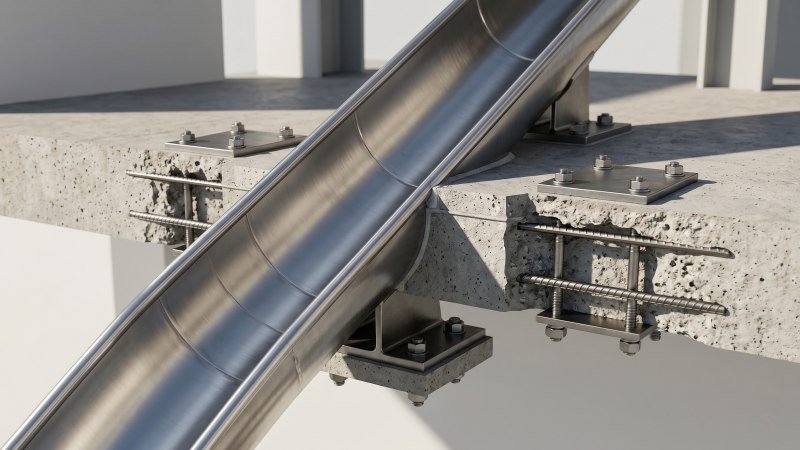
Stainless steel is incredibly heavy. A multi-story slide exerts massive static loads onto a building. And let’s not ignore the dynamic kinetic loads generated every time a person slides down. Think a few standard concrete anchors are enough for a three-story kinetic load? Think again. Securing the slide firmly to the building’s core structure is an absolute necessity.
Architects must carefully plan the floor penetrations. When you cut a void into a concrete floor slab, you must reinforce the perimeter with heavy steel framing. The slide itself usually connects to this framing using thick steel base plates. Installers secure these plates using heavy-duty expansion bolts or chemical anchors set deep into the structural concrete.
“Proper load distribution at the floor slab is critical to prevent structural stress over the building’s lifespan.”
For slides that span large vertical drops, base anchors aren’t going to cut it alone. In these cases, engineers design intermediate support arms. These heavy steel brackets extend from the main slide body and bolt directly into adjacent structural columns or load-bearing concrete walls. This method effectively transfers the weight away from the slide’s joints, ensuring the entire structure remains completely rigid.
Customization Capabilities and Material Science
What material choices and design customizations transform a standard metal chute into a visually stunning architectural feature?
Architects achieve this transformation by selecting the precise grade of stainless steel for specific environmental conditions and integrating clear polycarbonate viewing panels for visual connectivity. Once the metal is bent, applying advanced surface finishes and custom powder-coated colors allows the slide to either blend seamlessly with the surrounding interior design or stand out as a striking focal point.
Choosing Between Grade 304 and 316 Stainless Steel
Selecting the correct metal alloy is the foundation of any custom slide project. Does your project require standard durability or extreme weather resistance? The answer determines whether you should use Grade 304 or Grade 316 stainless steel.
Grade 304 is the absolute industry standard for most indoor applications. For example, commercial offices and retail malls rely heavily on Grade 304. It offers excellent structural strength and basic corrosion resistance. It is also highly cost-effective. But what if your site is located near the ocean or features an indoor water park?
In these demanding environments, you have to specify Grade 316 stainless steel. Grade 316 contains an additional element called molybdenum. This specific addition drastically increases the metal’s resistance to harsh chlorides. Chlorides include airborne sea salt and heavy pool chemicals. That’s exactly why Grade 316 prevents unsightly rust and structural degradation. This selection process matches how outdoor waterpark engineers specify marine-grade alloys for splash pool fittings instead of standard indoor hardware. Alloy availability and raw metal market shifts directly impact procurement budgets.
| Material Grade | Key Alloying Element | Best Application Environment | Cost Profile |
|---|---|---|---|
| Grade 304 | Chromium & Nickel | Dry indoor spaces, standard offices | Highly cost-effective |
| Grade 316 | Molybdenum | Coastal areas, humid indoor pools | Premium pricing |
Integrating Polycarbonate Viewing Panels
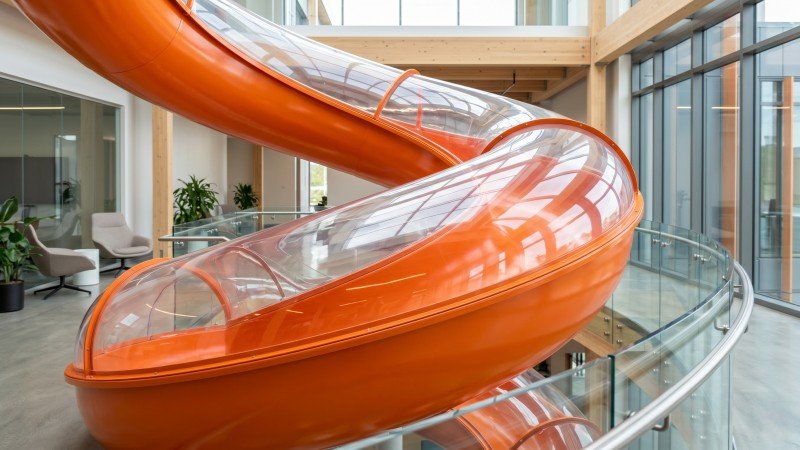
Fully enclosed metal tubes can sometimes feel dark and restrictive to the user. How do designers solve this spatial problem? They integrate transparent viewing panels directly into the top half of the stainless steel tube.
This design choice operates exactly like integrating transparent acrylic tunnels into underwater aquarium exhibits or theme park rides. The clear panels allow ambient building light to flood directly into the slide’s interior. Consequently, riders feel much more comfortable and less confined. Better yet, these transparent sections allow spectators outside to watch people sliding past. This visual connection greatly increases the kinetic energy of the surrounding architectural space.
Slide manufacturers specifically use polycarbonate for these windows, rather than standard glass or acrylic. Polycarbonate boasts extreme impact resistance. It will not shatter under heavy stress. Even better, it cold-bends cleanly in the factory. This flexibility allows it to perfectly match the precise curvature of the stainless steel tube.
To ensure a flawless fit, fabricators utilize heavy-duty architectural gaskets. They place these thick rubber seals exactly where the clear plastic meets the metal edges. This careful detailing creates a seamless transition that prevents unwanted vibration and structural rattling.
Advanced Surface Finishes and Custom Color Coatings
The exterior surface of a custom slide offers a massive canvas for architectural expression. You are certainly not limited to just a basic shiny silver appearance. Why spend thousands engineering a flawless descent only to wrap it in a dull, fingerprint-magnet finish? Advanced surface finishes allow the structure to match any interior design theme perfectly.
For a sleek, modern, industrial look, many designers specify a brushed matte finish. This specific mechanical treatment hides daily fingerprints and minor surface scratches extremely well. Flip the script, and a mirror-polish finish creates a highly reflective surface. This polished look serves as a striking, premium focal point in high-end commercial atriums.
If a client demands a specific brand color, manufacturers utilize industrial powder coating. Powder coating involves spraying dry, electrostatically charged paint particles onto the metal. Next, workers bake the steel in a massive industrial oven. This heating process melts the powder into a very hard, durable shell.
Just as steel framework elements for outdoor theme park attractions are powder-coated to endure high-traffic contact, a custom slide can feature precise RAL colors to perfectly match corporate branding. For instance, several major technology headquarters use brightly colored, powder-coated slides to physically reinforce their energetic brand identity. Coating catalogs provide a wide index of RAL choices to ensure precise aesthetic matching.
“Custom powder coating transforms a functional metal tube into a massive, integrated piece of branded corporate art.”
Resolving Safety Compliance and User Comfort Challenges
How do architects ensure that custom stainless steel slides remain completely safe and comfortable for public use?
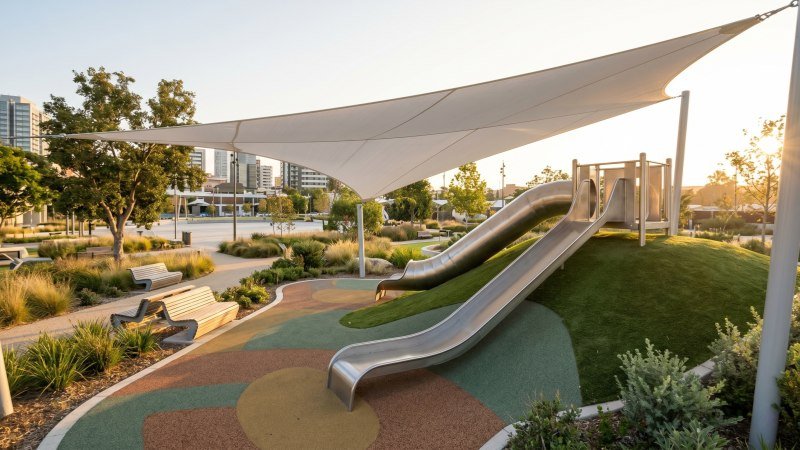
Architects ensure safety and comfort by utilizing seamless welding techniques to eliminate sharp edges and internal physical hazards. You also have to tackle thermal management strategies, such as architectural shade structures or heat-reflective coatings, to prevent skin burns in outdoor settings. And the ultimate gatekeeper? Every custom slide must strictly adhere to established international safety frameworks, specifically the ASTM and EN playground standards, to guarantee comprehensive structural compliance.
Seamless Welding Techniques to Prevent Physical Hazards
When individual metal tube sections join together, they create seams. If left raw or improperly finished, these seams pose a severe physical hazard to users. That’s why top-tier fabricators rely exclusively on Tungsten Inert Gas (TIG) welding during construction. TIG welding creates an incredibly strong structural bond between heavy stainless steel plates.
But as any metalworker knows, that initial pass leaves a raised bead of solid metal. Just as precision fabricators polish the tubular joints of commercial steel roller coaster tracks to ensure perfectly smooth wheel transit, slide builders must mechanically grind every internal slide seam completely flat. After aggressive grinding, technicians meticulously polish the interior joints.
This rigorous finishing process serves a vital safety purpose. A perfectly seamless interior ensures that riders never snag their clothing, shoelaces, or bare skin during a rapid descent. Even a millimeter of raised metal can cause serious friction burns or structural failure over time. That level of perfection is exactly why high-quality manufacturers invest heavily in manual polishing and digital surface inspections to guarantee a flawless glide path.
Thermal Management Strategies for Outdoor Sun Exposure
Outdoor slides absorb massive amounts of solar radiation. Direct afternoon sunlight quickly heats raw stainless steel to highly dangerous temperatures. If you skip thermal management, you’re building an oven, not a slide.
How do engineers mitigate this extreme heat gain? First, architects carefully analyze site-specific solar paths. They strategically position the slide under existing building overhangs, large structural canopies, or natural tree canopies. If natural shade is completely unavailable, designers often integrate custom tensile fabric shade sails directly above the slide structure.
Alternatively, manufacturers can apply specialized heat-reflective powder coatings to the exterior metal. This method works similarly to applying specialized UV-protective and heat-blocking finishes to outdoor steel playground platforms to minimize solar heat retention. Take it a step further, and some premium outdoor designs feature a dual-wall construction, leaving an air gap between the outer shell and the sliding surface to dissipate heat. Regional climate variations dictate the required efficiency of these thermal barriers.
Navigating ASTM and EN Playground Safety Standards
Custom slides must pass rigorous safety inspections before a building can legally open them to the public. In the United States, commercial designs must strictly comply with ASTM F1487 standards. Meanwhile, European projects follow the EN 1176 playground equipment guidelines.
These international frameworks dictate very specific safety metrics. For example, they strictly define the maximum allowable gaps within the structure to prevent accidental head or neck entrapment. They also regulate clothing entanglement hazards, specifically near the slide entrance and exit zones.
“Compliance with established playground standards transforms a custom architectural feature from a potential liability into a fully certified safe zone.”
Just as ride safety officials audit commercial amusement attractions before opening day, certified playground safety inspectors must physically validate the slide installation. They also ensure all exit zones feature adequate impact-attenuating surfacing, such as poured-in-place rubber flooring, to safely absorb falls.
| Safety Standard | Primary Region | Key Focus Areas for Custom Slides |
|---|---|---|
| ASTM F1487 | North America | Public use safety, head entrapment metrics, fall zones |
| EN 1176 | Europe | General safety requirements, specific test methods for slides |
| CPSC Guidelines | United States | Consumer product safety, hazard identification |
Structuring the Procurement and Installation Process
How do project managers successfully navigate the complex journey from ordering a custom stainless steel slide to completing its final installation?
Project managers structure this process by first conducting a precise site assessment and developing detailed 3D feasibility models. From there, it’s about coordinating manufacturing lead times and planning for sectional shipping to maneuver large components into existing buildings. The final hurdle? Highly trained technicians execute on-site assembly and conduct rigorous structural load testing to ensure the installation is stable and ready for public use.
Site Assessment and 3D Feasibility Modeling
Every successful installation begins with extreme precision. Before any metal is cut, engineers must thoroughly understand the physical space. That’s why the first step is always a comprehensive site assessment using advanced laser scanning technology. This scanning process creates a highly accurate digital point cloud of the entire building interior.
Why is this step so critical? A custom slide must weave perfectly through existing architecture. Armed with that data, designers import this point cloud into Building Information Modeling (BIM) software. They use this software to build a 3D feasibility model. This layout process is identical to how theme park engineers map complex dark ride tracks through dense structural grids to avoid hitting building columns.
The 3D model identifies potential physical clashes instantly. For example, it shows if the proposed slide path intersects with a hidden electrical conduit or a structural support beam. Fixing a layout mistake in a computer model takes minutes. However, discovering a space conflict during on-site installation costs thousands of dollars in delays.
Beyond clash detection, this detailed model allows the client to visualize the final product. Architects can digitally walk through the space to confirm sightlines and overall aesthetic flow before signing the final manufacturing approval.
Manufacturing Lead Times and Sectional Shipping
Custom stainless steel slides are massive architectural structures. You cannot simply buy one off a shelf and install it the next day. If you’re running the job, you need to budget for extended manufacturing lead times. Typically, engineering, fabricating, and finishing a custom slide takes between 12 and 16 weeks.
Once manufacturing is complete, how do you get a three-story metal tube inside a finished building? Ever tried maneuvering a 30-foot continuous steel tube through a standard commercial service elevator? It doesn’t work. Instead, fabricators build the slide in manageable segments. This strategy is identical to how installation crews maneuver large prefabricated steel track segments of an indoor roller coaster through standard commercial access points. Engineers cut the slide into distinct pieces, equipping each segment with heavy-duty joining flanges.
Next, logistics teams load these carefully padded sections onto flatbed trucks. Once it’s on site, contractors use standard freight elevators or temporary construction hoists to move the pieces to the correct floors.
Because factory workloads and global shipping logistics change constantly, delivery timeframes frequently fluctuate. The golden rule? Always lock down exact manufacturing lead times and freight dimensions with your specific supplier during the initial bidding phase.
| Project Phase | Typical Duration | Key Milestones |
|---|---|---|
| Engineering & 3D Modeling | 2 – 4 Weeks | Laser scanning, BIM integration, final client approval |
| Factory Fabrication | 8 – 10 Weeks | Steel cutting, bending, sectional joining |
| Logistics & Shipping | 1 – 2 Weeks | Custom crating, flatbed transport, site delivery |
On-Site Assembly and Structural Testing
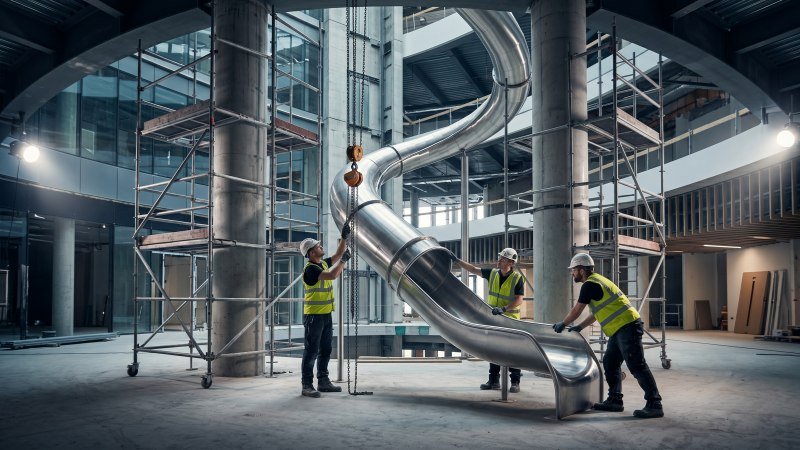
The final phase transforms individual steel pieces into a cohesive architectural feature. Installation teams begin at the bottom and slowly work their way up. They use manual chain hoists and temporary scaffolding to lift each heavy segment into place.
First, technicians bolt the massive base plates directly into the concrete floor slab. After the base is set, they connect each flanged section together using high-tensile steel bolts. This assembly process requires extreme precision. It closely mirrors how engineering crews assemble modular steel support frames for large theme park structures using careful hoist rigging. Every joint must align perfectly to prevent unwanted structural stress.
After bolting everything together, the installation team must prove the structure is secure. They cannot rely on visual inspections alone. Instead, they put the steel through its paces with rigorous structural testing.
- Static Load Testing: Workers place heavy industrial sandbags inside the entire length of the tube. This massive dead weight simulates the extreme load of multiple adults resting inside the slide simultaneously.
- Dynamic Load Testing: Once the static test passes, inspectors send heavy, weighted dummies down the chute. This specific test measures how the steel frame handles sudden vibrations and shifting momentum.
“Comprehensive load testing validates the engineering math, ensuring the final structure can handle decades of continuous kinetic stress without shifting.”
Only after the slide passes both the static and dynamic structural tests will the lead engineer sign off on the installation. At this point, the procurement and installation cycle is officially complete, and the slide is ready for riders.
Conclusion
Integrating a custom stainless steel slide into modern architecture is far more than a simple aesthetic choice; it is a rigorous exercise in multidisciplinary engineering. From selecting the optimal grade of steel and finalizing structural floor anchors to navigating stringent international safety guidelines and executing complex 3D logistical plans, every step requires precise attention to detail. By carefully following these fundamental technical, material, and procedural specifications, architects and project managers can successfully transform raw metal into an exhilarating, permanent architectural statement that enhances spatial interaction for decades to come.