-
Whatsapp: +86 15516933785
-
Email: hanlin@hanlinplayground.com
-
Address: Shangjie District, Zhengzhou City, Henan Province, China
-
Whatsapp: +86 15516933785
-
Email: hanlin@hanlinplayground.com
-
Address: Shangjie District, Zhengzhou City, Henan Province, China

How to Start a Commercial Trampoline Park: A Step-by-Step Guide
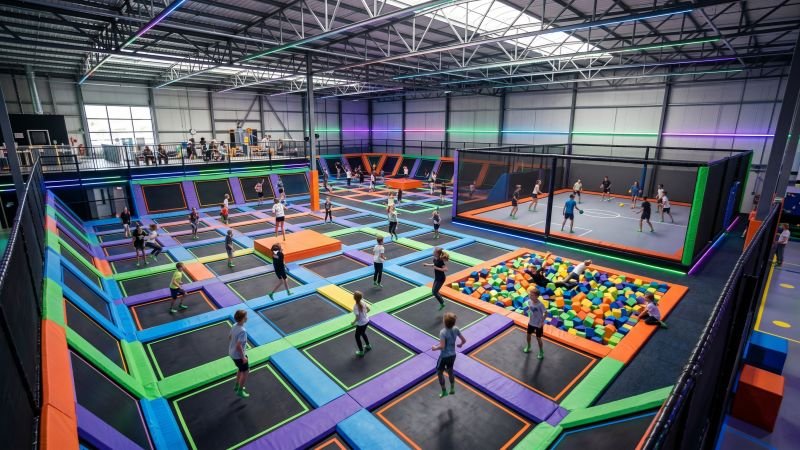
What are the essential steps required to successfully open and operate a profitable commercial trampoline park?
Starting a commercial trampoline park requires structuring a robust financial model, securing a building with appropriate zoning and high ceilings, and sourcing commercial-grade equipment. On top of that, operators must establish rigorous safety protocols, implement digital waivers, hire trained staff, and execute a targeted pre-launch marketing strategy to ensure long-term profitability.
Structuring the Business Plan and Financial Model
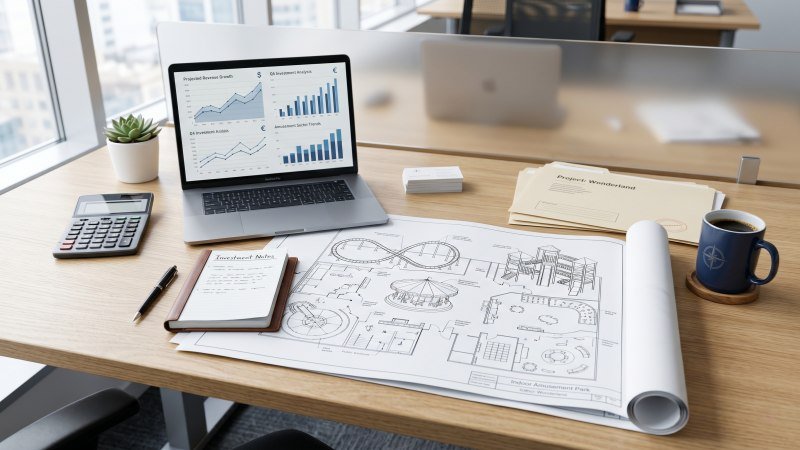
A robust business plan requires calculating precise initial capital for equipment and projecting daily operating expenses. You must also forecast profit margins through diverse revenue streams to successfully secure bank loans or private investor funding.
Calculating Initial Capital and Operating Expenses
Building a successful indoor park requires careful financial planning, which means locking down your initial capital needs first. Most commercial trampoline parks require between $300,000 and $1,500,000 to open. This wide range depends heavily on the facility size and location.
Just like a large-scale amusement park budgets for high-thrill roller coasters versus standard carousel rides, a trampoline park operator must weigh the costs of basic jump courts against premium attractions. Basic trampolines cost less. But throw in a complex ninja warrior course, and you’re looking at a significantly larger initial investment.
Your initial capital generally covers several major categories. You must budget for facility build-outs, equipment purchases, and initial franchise fees if applicable. Keep in mind that specific equipment costs and installation parameters can vary significantly based on the materials used. Always verify the exact pricing and technical specifications directly with your chosen supplier.
Operating expenses (OpEx) are your ongoing costs. These include monthly rent, employee payroll, utilities, and liability insurance premiums. Carefully calculating these numbers ensures you maintain a positive cash flow during early operations.
Typical Initial Capital Breakdown
| Expense Category | Estimated Percentage of Budget |
|---|---|
| Equipment and Attractions | 35% – 45% |
| Facility Build-Out and Leasehold Improvements | 30% – 40% |
| Working Capital and Reserves | 10% – 15% |
| Miscellaneous (Permits, Fees, Initial Marketing) | 5% – 10% |
Forecasting Profit Margins and Additional Revenue Streams
General admission tickets might drive your core business, but relying solely on jump time limits your financial growth. You must forecast additional revenue streams to achieve healthy profit margins.
Industry data shows that secondary spending is crucial. Items like grip socks, food and beverage (F&B) sales, and merchandise often yield high profit margins. For instance, grip socks alone can generate significant daily revenue because every jumper needs them for safety and hygiene.
Beyond the daily grind, group events provide reliable income. These include corporate team-building events and school field trips. When forecasting your financials, assign realistic revenue percentages to each category.
A well-managed trampoline park can eventually see profit margins between 25% and 35%. This happens after the business stabilizes and covers its fixed facility costs.
- Core Revenue: General admission and membership passes.
- F&B Sales: Snack bars and cafe operations.
- Merchandise: Required safety grip socks and branded apparel.
- Events: Birthday party packages and private facility rentals.
Acquiring Bank Loans and Investor Funding
Let’s be honest: securing funding is often the biggest hurdle for new operators. A bank will fund your project only if your financial model clearly proves that you can repay the debt. You need a compelling pitch deck to secure bank loans or attract investor funding.
Most independent park owners utilize Small Business Administration (SBA) loans. For example, the SBA 7(a) loan program is a popular choice. It offers favorable terms for facility build-outs and equipment purchases. However, banks will strictly evaluate your Debt Service Coverage Ratio (DSCR).
The DSCR measures your ability to pay back the loan using your operating income. A bank typically requires a DSCR of 1.25 or higher. This means your business generates 25% more income than required for debt payments.
If banks aren’t the route you want to take, you can seek private investor funding. Angel investors will scrutinize your projected profit margins. They want to see a clear path to return on investment (ROI). Because of this, your business plan must highlight your competitive advantage and diverse revenue streams.
Navigating Zoning Laws and Securing the Perfect Facility
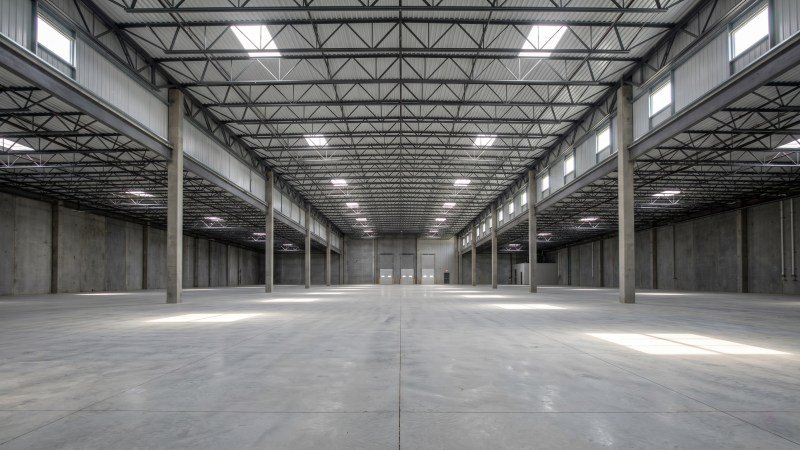
Securing the perfect facility requires finding a location with appropriate commercial or light industrial zoning and minimum clear ceiling heights of at least 18 feet. Successful site selection also depends on analyzing local demographics to confirm a dense population of target families.
Identifying Favorable Commercial Zoning Areas
Finding a massive building is only the first step. The real question is: will the city actually let you operate an amusement business there? Trampoline parks sit in a unique real estate category. They are similar to large indoor family entertainment centers (FECs) like multi-level laser tag arenas. Both require massive square footage but generate high retail foot traffic.
Because of this, you’re usually choosing between two zoning categories. These are Light Industrial and Commercial Retail. Light industrial spaces often provide the required square footage and high ceilings. However, these zones might lack sufficient parking. On top of that, cities often restrict retail operations in industrial parks.
On the flip side, large commercial retail spaces, like abandoned big-box stores, offer excellent visibility and parking. Yet, the rent is typically much higher. If a building’s current zoning does not permit indoor recreation, you must apply for a Special Use Permit (SUP). Securing an SUP takes time. It often involves public hearings and traffic impact studies.
Comparing Common Zoning Categories
| Zoning Type | Typical Building Size | Parking Availability | Retail Visibility | Lease Cost |
|---|---|---|---|---|
| Light Industrial | Very Large (30,000+ sq ft) | Often Limited | Low | Lower |
| Commercial Retail | Large (20,000+ sq ft) | High | High | Higher |
Assessing Minimum Ceiling Heights and Unobstructed Space
A trampoline park requires specific architectural features. The most crucial structural requirement is the clear ceiling height. Jumpers need ample vertical space to bounce safely without hitting rafters or HVAC ducts.
Typically, buildings need a minimum clear height of 18 to 24 feet from the floor to the lowest hanging roof obstruction. Keep in mind that the trampoline frame itself sits a few feet off the floor. Building clearance parameters and bounce height specifications might vary based on structural designs and jumping mat materials. Always make it a point to verify the exact height range and clearance details with your equipment supplier before signing a lease.
You also have to take a hard look at the building’s column spacing. Think of an indoor ice skating rink. You need a large, wide-open area. Support columns can severely disrupt your court layouts. A grid of columns placed too closely together will limit the size of your main jump arenas. Always look for clear-span buildings or facilities with widely spaced support columns.
Analyzing Local Demographics and Market Competition
A great building is useless if your target customers live too far away. That makes conducting a thorough demographic analysis absolutely essential. Your core customers are families with children aged 5 to 15. You must identify neighborhoods with a high concentration of these families.
Industry data suggests that most customers will not drive more than 20 minutes for a standard jump session. Thus, your primary market area is a 15-to-20-minute drive-time radius around the facility. Analyze the median household income within this radius. A successful park typically thrives in areas where the median household income exceeds $65,000. This ensures families have sufficient disposable income for entertainment.
While you’re at it, you need to evaluate market saturation. Are there competing indoor family entertainment centers nearby? Look at the population density compared to the number of competitors. A general industry benchmark is aiming for a population of at least 150,000 to 200,000 people per trampoline park within your target radius. If the area is heavily saturated, you must secure a significantly better location to capture market share.
Designing the Floor Plan and Sourcing Quality Equipment
Designing an effective floor plan requires partnering with certified equipment manufacturers who build durable, commercial-grade frames. You must strategically map out distinct play zones alongside comfortable rest areas to optimize internal traffic flow and maximize your facility’s operational capacity.
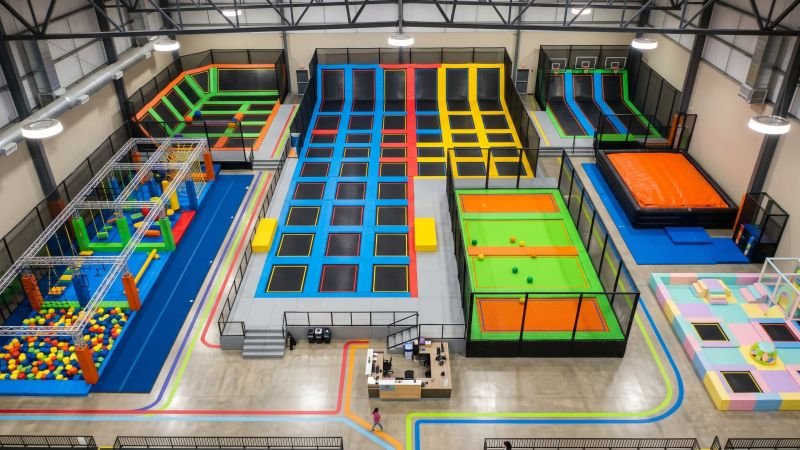
Evaluating and Selecting Trusted Equipment Manufacturers
Choosing the right manufacturer is your most critical physical investment. You’ve got to look way beyond basic catalog pictures. Think a standard recreational steel frame will hold up to hundreds of teenagers launching themselves off the walls every single day? It won’t. You need industrial-grade infrastructure. Commercial trampoline parks endure thousands of hours of constant, heavy impact.
Think of a large-scale indoor climbing facility. Just as auto-belay systems and steel climbing frame structures must withstand constant, heavy dynamic loads, your trampoline frames must survive relentless kinetic force. Rely on cheap residential-grade materials, and they will fail quickly. This failure causes facility downtime and severe revenue loss.
When evaluating manufacturers, scrutinize their engineering materials. For instance, industry-standard trampoline frames often utilize 80mm by 80mm galvanized steel tubing for structural integrity. However, frame dimensions, steel gauge thickness, and spring tension metrics might vary significantly based on your specific supplier and material availability. Because of this, you should always verify the exact specifications and weight capacities directly with your chosen equipment manufacturer.
Don’t forget to dig into the manufacturer’s warranty policies. Reliable suppliers offer extended warranties on steel frames and heavy-duty jumping mats. Always ask for case studies or references from other park operators.
Mapping Out Distinct Play Zones and Rest Areas
A large, empty grid of basic trampolines becomes boring quickly. Customers return for variety. To keep them coming back, you need to divide your floor plan into specialized interactive zones.
This strategy is very similar to designing an indoor water park. You naturally separate the aggressive wave pool from the quiet toddler splash pad. In the same vein, you must separate high-energy teenage jump zones from small children’s areas. This separation protects smaller guests and greatly improves overall satisfaction.
And let’s not overlook the importance of rest areas. Parents often stay for hours while their children play. If parents are uncomfortable, they will leave early. Make sure to design spacious viewing decks with comfortable seating and clear sightlines to the main courts.
Common Trampoline Park Play Zones
| Play Zone Type | Target Demographic | Core Activity |
|---|---|---|
| Main Free-Jump Court | All Ages | Open jumping across interconnected horizontal and angled wall trampolines. |
| Dodgeball Arena | Teens & Adults | Competitive team sports using soft foam balls on a dedicated grid. |
| Toddler Zone | Ages 5 and Under | Scaled-down jumps with softer padding, physically walled off from older kids. |
| Ninja Warrior Course | Older Kids & Teens | Obstacle courses requiring upper body strength, balance, and agility. |
Optimizing Internal Traffic Flow for Customer Experience
Internal traffic flow dictates how easily customers move through your building. Poor traffic flow creates frustrating bottlenecks during busy weekends. You must map the customer journey from the moment they walk through the front door.
Look at the layout of a modern family arcade. Successful arcades place the prize redemption counter far away from the entrance. This prevents a crowd of exiting people from blocking new customers trying to enter. You need to apply this exact same logic to your jump park.
First, position your check-in desks near the entrance to process waivers and payments quickly. Next, guide customers to locker rooms and shoe cubbies. This transition area must be wide enough to accommodate large families putting on grip socks. Finally, create a clear, unobstructed path from the lockers directly to the safety briefing area and the main courts.
By carefully planning these pathways, you reduce congestion and keep your customers happy.
Establishing Safety Protocols and Liability Safeguards
Establishing rigorous safety protocols requires strictly implementing ASTM standards and passing local safety inspections. On top of that, you must create bulletproof digital liability waivers and purchase comprehensive commercial liability insurance to financially safeguard against unavoidable accidents and legal claims.
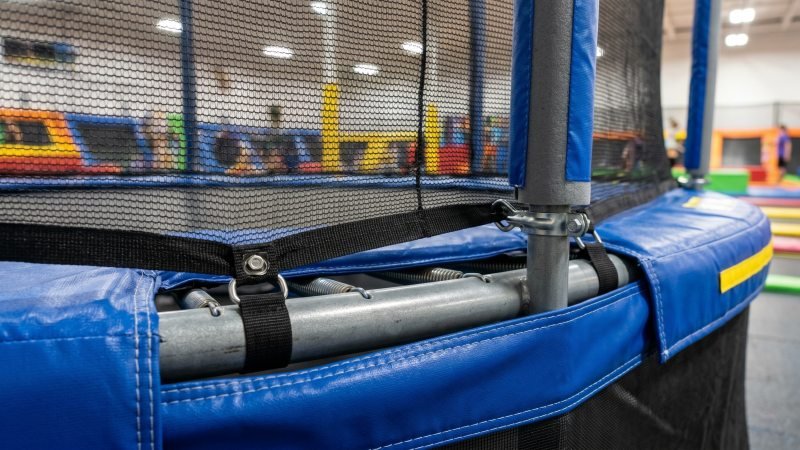
Implementing ASTM Standards and Local Safety Regulations
Safety isn’t just a moral obligation—it’s the absolute foundation of your business. You absolutely need to understand and apply industry-recognized safety frameworks. For commercial trampoline parks, this means following ASTM International guidelines. Specifically, the ASTM F2970 standard dictates the design, manufacture, installation, and operation of trampoline courts.
Want to risk your entire multi-million dollar investment over a loosely fitted safety pad or a missing spring? Of course not. Think of an indoor rock climbing gym. A climbing facility must follow strict auto-belay and harness inspection standards to prevent falls. Similarly, your jump park must adhere to rigid structural guidelines to prevent catastrophic equipment failures. This includes rules regarding redundant netting, spring coverings, and structural stability.
For instance, industry guidelines generally require impact-absorbing padding over all rigid frames. This padding is typically at least 2 inches thick. Always verify the exact padding thickness, foam density, and fire-retardant specifications with your equipment supplier to ensure compliance with local fire codes.
Local city inspectors will also evaluate your facility. They will check your emergency exits, fire suppression systems, and maximum occupancy limits. Failing these inspections will delay your grand opening. Save yourself the headache and hire an independent safety inspector to review your park before the city officials arrive.
Creating Bulletproof Digital Waivers
Because trampoline jumping carries inherent risks, you must transfer that risk away from your company to survive potential personal injury lawsuits. You do this through a liability waiver. A waiver is a legal contract where the customer agrees to accept the physical risks of jumping.
Just as a high-speed indoor go-kart track requires drivers to acknowledge the danger of crashing, you must require jumpers to acknowledge the risk of injury. Every single person entering the court must sign this document. For minors, a legal parent or guardian must sign it.
You must abandon old-fashioned paper waivers. Better yet, implement a centralized digital waiver system. Digital systems offer superior legal protection and operational efficiency. They prevent lost documents and integrate directly into your ticketing software. What’s more, digital waivers force customers to check specific boxes, proving they actually read the safety rules.
Comparing Paper vs. Digital Waivers
| Feature | Paper Waivers | Digital Waivers |
|---|---|---|
| Storage & Retrieval | Requires physical filing cabinets; hard to search. | Stored in the cloud; instantly searchable by name. |
| Legibility | Often ruined by messy handwriting. | Typed entries guarantee 100% accurate data. |
| Integration | None. Requires manual data entry at the register. | Syncs instantly with POS ticketing software. |
| Customer Convenience | Must be filled out upon arrival, causing long lines. | Can be signed at home via smartphone before arriving. |
Purchasing Comprehensive Commercial Liability Insurance
Let’s face facts: even with perfect equipment and solid waivers, accidents will still happen. That means purchasing a robust commercial liability insurance policy. Standard business insurance will not cover an amusement facility. You must work with a broker who specializes in high-risk family entertainment centers.
Insurance premiums are often one of the highest operating expenses for a jump park. Providers calculate your premium based on your park’s size, projected revenue, and safety protocols. Generally, you will need a policy offering at least $1 million per occurrence and $2 million in aggregate coverage.
If you want to secure the best rates, you have to proactively demonstrate your commitment to safety. Insurance underwriters want to see your documented daily inspection logs. They also want to review your digital waiver platform. Parks with documented, strict safety enforcement receive much lower insurance premiums than poorly managed competitors. Protecting your investment requires meticulous planning.
Assembling and Training a Capable Team
Assembling a capable team requires defining clear roles for court monitors and facility managers to ensure strict operational oversight. You must execute mandatory first aid training for all active floor staff and establish rigorous daily maintenance routines to prevent equipment failure.
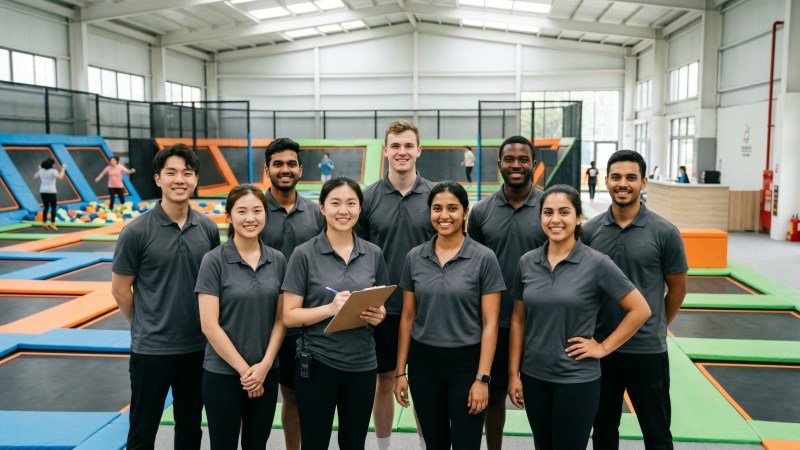
Defining Roles for Court Monitors and Facility Managers
Your staff acts as the heartbeat of your business, meaning you need to clearly define their daily responsibilities. The two most critical roles are court monitors and facility managers.
Court monitors are your frontline defense against accidents. They function exactly like lifeguards at a crowded indoor wave pool. They do not just stand around. Instead, they actively scan the jump zones, enforce capacity limits, and stop dangerous behavior immediately. You should assign one monitor to a specific zone rather than letting them wander.
Meanwhile, facility managers oversee the entire daily operation. They manage employee schedules, resolve customer disputes, and handle cash drawer audits. A strong manager constantly walks the floor to support the court monitors during busy weekend rushes.
Executing Mandatory First Aid and Emergency Response Training
Injuries can happen in any active amusement setting. Because of this, your team needs to know exactly how to handle emergencies. You cannot rely on panic or guesswork.
Every single court monitor and facility manager must hold valid CPR and First Aid certifications. However, basic online courses are not enough. You must hire certified instructors to conduct hands-on medical training inside your actual facility.
You’ve also got to run regular emergency response drills. Think about how a large theme park trains its staff for roller coaster evacuations. You need similar protocols. Your staff must practice how to isolate an injured jumper, clear the surrounding trampolines, and guide emergency medical technicians into the building.
Establishing Daily Maintenance and Inspection Routines
Human supervision is only half of the safety equation. Equipment naturally degrades under heavy, constant use. That translates to your staff performing thorough inspections every single morning before opening the doors.
Consider an indoor commercial go-kart track. The mechanics check tire pressure and steering linkages every morning. Similarly, your team must inspect the structural integrity of your jump arenas daily.
Staff must check jumping mats for small tears. They must ensure all safety pads are securely fastened over the metal frames. They should also be hunting for overstretched or missing springs. Base your exact replacement schedules and wear tolerances on the specific guidelines provided by your equipment supplier, as component lifespans depend heavily on daily usage rates.
Recommended Inspection Schedule
| Inspection Frequency | Key Equipment Checks | Responsible Role |
|---|---|---|
| Daily (Pre-Opening) | Check mats for tears, verify pad placement, sweep foreign objects from courts. | Court Monitors / Shift Leads |
| Weekly | Inspect springs for tension loss, check safety nets for holes, tighten loose frame bolts. | Facility Manager / Maintenance Staff |
| Monthly | Deep clean structural frames, inspect foam pit blocks, review digital inspection logs. | Facility Manager |
By strictly enforcing these daily routines, you drastically reduce downtime and create a highly professional environment.
Integrating Operational Systems and Pre-Launch Marketing
A successful launch requires integrating specialized point-of-sale (POS) ticketing software to flawlessly manage hourly capacity. You also need to aggressively pre-sell highly lucrative birthday packages and execute a targeted digital marketing strategy to ensure a heavily attended grand opening event.
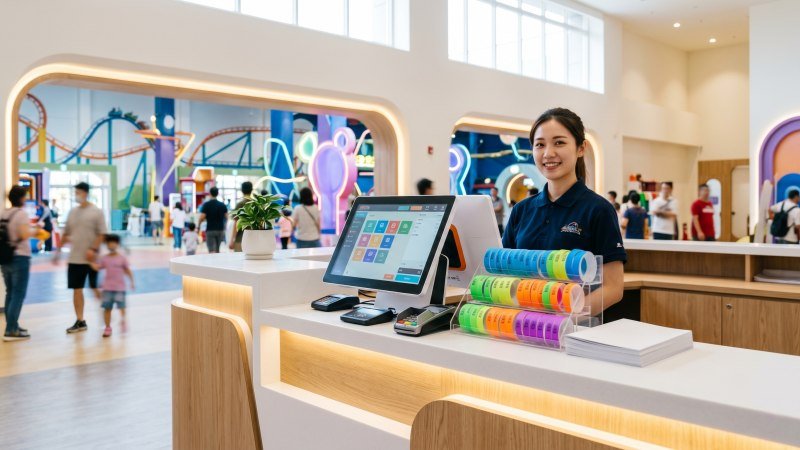
Setting Up Streamlined POS and Ticketing Software
Your point-of-sale system acts as the central brain of your facility. Try using a generic retail cash register, and it will fail miserably. Ever seen a front desk completely melt down because of a double-booked birthday party? It’s an operational nightmare you want to avoid. You need specialized family entertainment center (FEC) software. This software must manage time-based ticketing and strictly monitor your building’s capacity limits.
Think of an indoor laser tag arena. The operating software ensures that exactly thirty players enter the arena for a specific fifteen-minute session. In the same vein, your trampoline park POS must track exactly how many jumpers are on the floor at any given minute. This is exactly how you prevent dangerous overcrowding and angry customers.
Modern POS systems handle online bookings, on-site kiosks, and wristband printing simultaneously. Always verify hardware compatibility, such as RFID wristband frequencies and receipt printer interfaces, directly with your POS supplier before purchasing physical registers.
Promoting Lucrative Birthday Packages and Group Events
General admission tickets keep the lights on. However, private events generate your true profit. Industry data indicates that birthday parties and corporate group events often account for 30% to 40% of a successful park’s gross annual revenue. The takeaway? You need to start selling these packages weeks before you open your doors.
Why are these packages so profitable? Because you are bundling time, space, and food at a premium price. Similar to a commercial bowling alley offering automated lane rentals with pizza and soda, you must offer a stress-free experience. Parents will gladly pay a premium if you handle the entertainment, the food, and the cleanup.
You should design tiered party packages to accommodate different budgets. Begin promoting these options on your website early. Allow customers to book future dates online while your facility is still under construction. This strategy guarantees secured revenue before your grand opening.
Example Tiered Birthday Packages
| Package Tier | Jump Time | Included Amenities | Ideal For |
|---|---|---|---|
| Basic Bounce | 60 Minutes | Reserved table in open concourse, grip socks. | Smaller budgets, quick parties. |
| Premium Jump | 90 Minutes | Private party room, dedicated host, 2 pizzas. | Standard weekend birthday parties. |
| VIP Elite | 120 Minutes | Private room, unlimited drinks, custom merchandise. | High-end events, large groups. |
Executing a High-Impact Grand Opening Strategy
Opening your doors quietly is a rookie mistake. You’ve got to build immense local hype, which requires a calculated, multi-phase marketing timeline.
First, you must host a soft opening. Invite construction partners, local officials, and staff family members. This provides a safe environment for your team to test the POS systems and crowd control procedures. You will discover operational bottlenecks during this phase. Fix these issues immediately before inviting the paying public.
Next, launch a targeted digital marketing campaign for your official grand opening. Focus your advertising budget on social media platforms. Specifically, utilize geo-targeted ads aimed at parents living within a fifteen-mile radius of your building.
Offer compelling incentives for your first weekend. For instance, give away free annual passes to the first fifty customers in line. This specific tactic often creates a physical line around the building, which generates organic buzz and local news coverage.
Conclusion
Starting a commercial trampoline park is a complex but highly rewarding endeavor that requires meticulous planning across multiple business domains. By carefully structuring your financial model, selecting the right facility, prioritizing unwavering safety standards, and executing a strong pre-launch marketing campaign, you set the foundation for a thriving family entertainment center. As you transition from the initial planning stages to daily operations, continuous staff training and proactive equipment maintenance will ensure long-term profitability and customer satisfaction. If you are ready to take the next step in building your facility or need specialized support, please feel free to contact us.