-
Whatsapp: +86 15516933785
-
Email: hanlin@hanlinplayground.com
-
Address: Shangjie District, Zhengzhou City, Henan Province, China
-
Whatsapp: +86 15516933785
-
Email: hanlin@hanlinplayground.com
-
Address: Shangjie District, Zhengzhou City, Henan Province, China

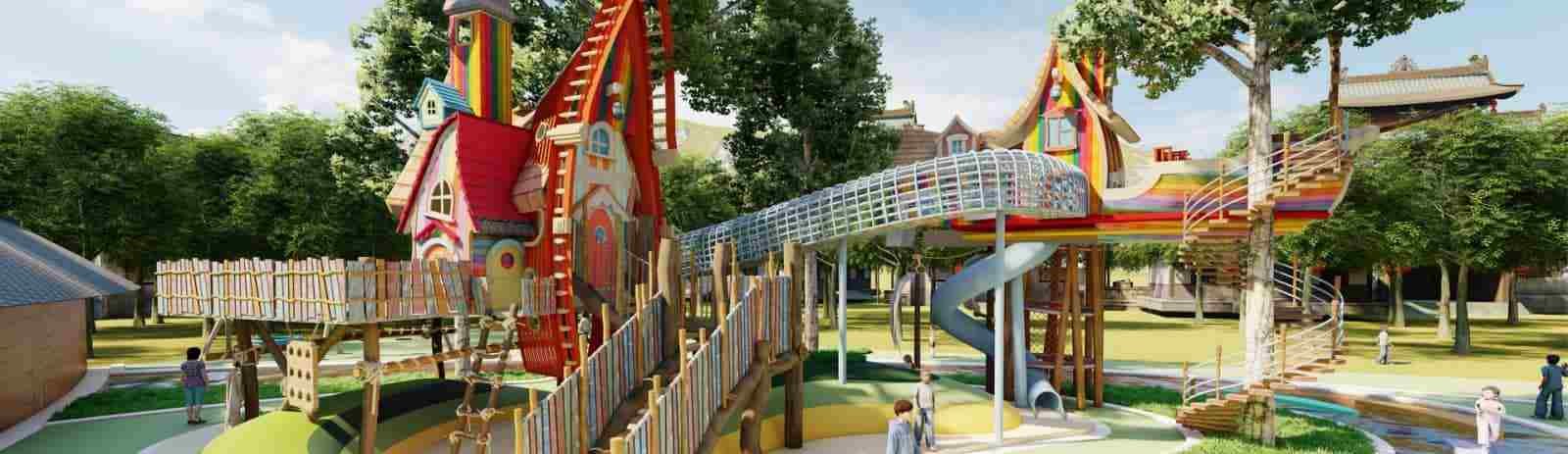
Kids Rope Course Construction Cost: How to Maximize ROI for All Ages
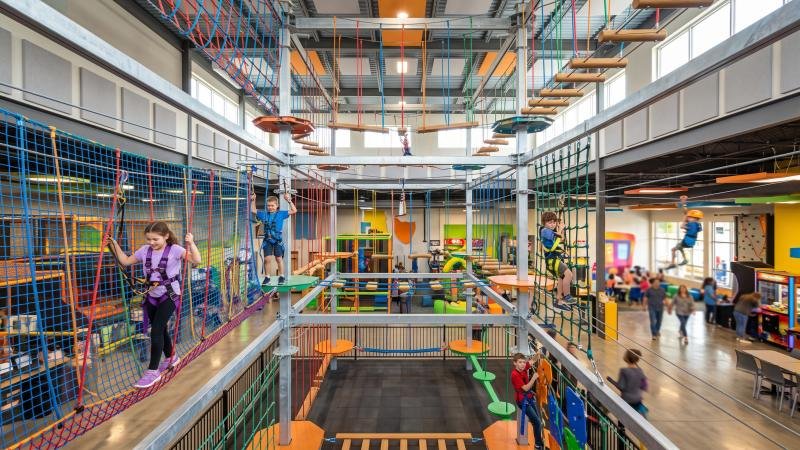
What are the true costs of building a kids rope course, and how can operators guarantee a high return on investment across all age groups?
The total construction cost for a commercial kids rope course typically ranges from $50,000 to over $250,000, depending heavily on structural materials, continuous belay systems, and site preparation. To maximize return on investment (ROI), operators must diversify revenue streams through group packages and food sales, implement multi-level layout designs that engage both toddlers and adults, and strictly control ongoing operational expenses like staffing and insurance.
Core Construction and Equipment Expenses
What exactly drives the upfront costs when you build a profitable kids rope course?
The core construction expenses for a kids rope course range from $50,000 to over $250,000, heavily depending on scale and location. These initial costs are primarily driven by structural materials, advanced safety belay systems, and necessary site preparations. Carefully managing these capital expenditures is essential to secure a rapid break-even point and maximize your overall return on investment.
Main Structural Materials and Hardware Installation
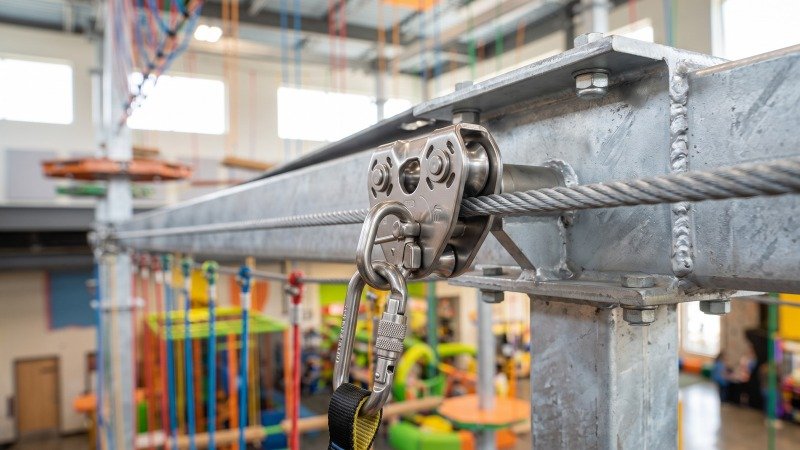
The foundation of your rope course budget lies in the structural framework. You must choose between wood and steel. This decision directly impacts your initial cost and long-term ROI. Wood looks great and saves you cash upfront. Steel, though, gives you bulletproof durability and slashes maintenance.
Why choose steel over wood? Think of the main structure like the steel framework of a large indoor trampoline park. Both attractions must support heavy, dynamic loads from multiple users moving simultaneously. Steel frames handle these dynamic stress factors better over time.
Hardware is your next major hurdle. You must purchase commercial-grade wire ropes, bolts, and junction platforms. Installation labor also requires specialized rigging crews.
| Material Type | Upfront Cost | Durability | Best Application |
|---|---|---|---|
| Treated Wood | Lower ($15k – $30k) | Medium (10-15 years) | Outdoor nature parks, woodland settings |
| Galvanized Steel | Higher ($35k – $70k) | High (20+ years) | Indoor FECs, urban outdoor spaces |
Because structural load requirements change based on indoor climate controls or outdoor weather conditions, always verify the exact load-bearing specifications and anti-corrosion steel grades with your material supplier. Choosing the wrong grade will lead to costly replacements later.
Choosing the Right Continuous Belay System
Safety equipment is not an area to cut corners. Would you trust your own kid on a cheap, unreliable harness? Neither will your customers. A Continuous Belay System (CBS) is the industry standard for kids rope courses.
What is a CBS? It is a specialized safety track. Participants connect their harness to the overhead cable at the beginning of the course. They cannot disconnect themselves until they reach the ground level at the end. This mechanism works exactly like a commercial zip line braking and trolley system. Once the equipment is locked onto the wire, the rider remains completely secured until a staff member releases them at the final platform.
Investing in a high-quality CBS dramatically increases your ROI. Expect to spend between $150 and $300 per trolley unit, plus the cost of the continuous metal track. While the initial hardware is expensive, it prevents accidental unhooking and reduces liability.
Here are the primary hardware components you will need:
- Overhead safety tracks: The metal lines guiding the user.
- Smart belay trolleys: The rolling devices that connect the user to the track.
- Full-body harnesses: Sized specifically for children and teens to prevent slipping.
Essential Site Preparation and Facility Upgrades
Site preparation is often the most overlooked cost in a business plan. Before you install a single rope, the physical site must be ready.
For indoor facilities, you must carefully evaluate the structural support system. You should never weld anchor points directly to existing roof trusses. Standard building roofs are designed for static loads (like snow or the roof itself), not the intense dynamic live loads of people jumping and swinging. On-site welding also weakens the existing steel structure. Instead, the safest and most compliant method is to build a freestanding steel frame that bolts directly into the concrete floor, remaining completely independent of the building’s roof. If you must utilize the ceiling space, you must use non-destructive beam clamps and hire a certified structural engineer (PE) to approve the dynamic load capacity.
On top of that, your HVAC system is going to need a serious look. Heat rises, and participants will get uncomfortably hot near the ceiling if air circulation is poor.
For outdoor facilities, ground preparation is the primary expense. You must conduct soil testing, and contractors must pour deep concrete footings to secure the support poles.
And let’s not overlook the ground beneath your feet—impact-absorbing flooring isn’t optional for either setting. You cannot simply build over bare concrete or dirt.
- Poured-in-place rubber (EPDM): Highly durable, accessible, but expensive upfront.
- Rubber mulch: Cheaper to install, but requires constant raking and topping up.
By accurately calculating these site upgrades early, you prevent sudden budget overruns that can instantly destroy your projected ROI.
Proven Strategies to Diversify Revenue Streams
Moving beyond standard admission ticket sales is critical to rapidly accelerating the return on investment for a newly constructed rope course.
To maximize your facility’s return on investment, you must implement diverse revenue streams that capture additional guest spending. The most effective strategies include hosting high-volume birthday parties, integrating high-margin food and beverage zones, and using tiered pricing to drive attendance during slower off-peak hours. These proven tactics transform a simple physical attraction into a comprehensive family entertainment center, significantly increasing the average revenue per visitor.
Maximizing Profits Through Birthday Parties and Group Events
Relying solely on walk-in traffic is a risky game. The reality? Group bookings are your lifeblood. Birthday parties and group events provide guaranteed, upfront revenue. Better yet, they pull in fresh demographics who might never have visited your facility otherwise.
Why are birthday parties so profitable? Parents want a hassle-free experience. They are willing to pay a premium if you handle the entertainment, food, and cleanup.
Consider a standard commercial laser tag arena. These businesses do not just sell 15-minute game sessions. Instead, they bundle gameplay with a private party room, pizza, and a dedicated host. Your rope course must adopt this exact model. By bundling climbing time with food and a private space, you instantly increase the transaction value.
| Revenue Source | Average Customer Spend | Predictability | Profit Margin |
|---|---|---|---|
| Walk-in Ticket | $15 – $25 | Low | Medium |
| Party Package (Per Child) | $35 – $50 | High | High |
Industry data shows that family entertainment centers often generate over 30% of their total annual revenue from party packages alone. The takeaway? Design premium packages that include branded grip socks, custom medals, or digital photos.
Integrating High-Margin Food and Beverage Zones
Why let your customers leave your building when they get hungry? If a family stays longer, they spend more money. Integrating a food and beverage (F&B) zone is a vital strategy to maximize your ROI.
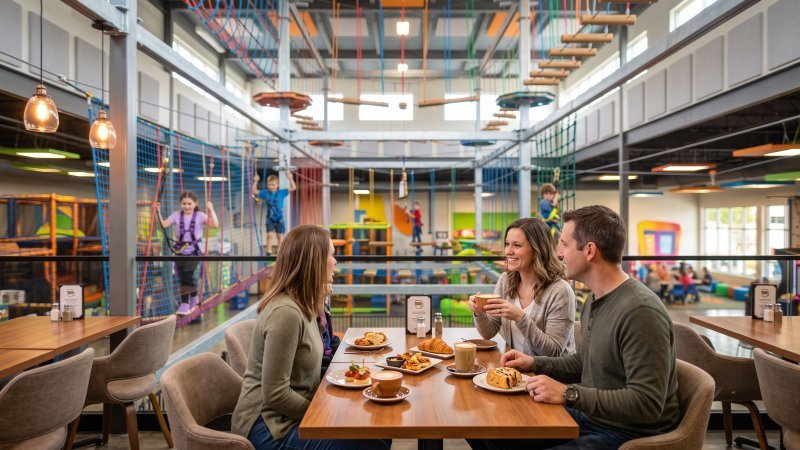
Parents often act as spectators while their children navigate the rope course, creating a captive audience. A well-placed café provides a comfortable seating area for parents. The real win? It flips idle waiting time into active spending.
You do not need to build a massive commercial kitchen. Simple items yield massive profits. Fountain drinks, bottled water, and premium coffee frequently offer profit margins exceeding 70%.
Think about a large indoor family entertainment center (FEC) with an arcade. A significant portion of its total facility profit comes directly from the concession stand and seating areas, not just the game tokens. Your F&B zone needs to operate on that exact same logic.
“A comfortable seating area with quality coffee can extend a family’s visit by an average of 45 minutes, directly increasing the likelihood of repeat ticket purchases.”
Implementing Smart Tiered Ticketing for Off-Peak Hours
How many empty Tuesday mornings can your balance sheet survive? Weekends are incredibly busy for FECs, but weekday mornings are notoriously dead. To cover your fixed overhead costs during these empty hours, you must implement smart tiered ticketing.
Tiered ticketing means charging different prices based on the time of day or the day of the week—a strategy known as yield management.
Just as a large indoor waterpark might offer deeply discounted “twilight tickets” to fill empty pools on a Tuesday evening, you must incentivize off-peak visits. If your facility is empty, any revenue generated is better than zero.
Here are a few proven ways to structure your pricing:
- Toddler Tuesday Mornings: Offer a 40% discount for parents bringing children under five during weekday mornings.
- Corporate Team Building: Sell flat-rate afternoon packages to local businesses for team bonding exercises.
- After-School Specials: Provide a slightly reduced rate between 3:00 PM and 5:00 PM to attract students before the dinner rush.
By strategically lowering prices during dead zones, you attract price-sensitive customers while preserving your premium pricing during your busy weekend hours. This approach ensures your rope course constantly generates revenue.
Designing Layouts That Engage the Entire Family
How can you design a layout that captures the attention of every age group so families stay longer and spend more together?
To maximize layout efficiency and family engagement, operators must segment the physical space into distinct, age-appropriate zones. By incorporating ground-level toddler areas, multi-level high-adrenaline elements for older guests, and side-by-side interactive tracks, you ensure that every family member participates. This comprehensive design strategy directly eliminates the “waiting parent” problem, dramatically increasing the average ticket purchase volume per household.
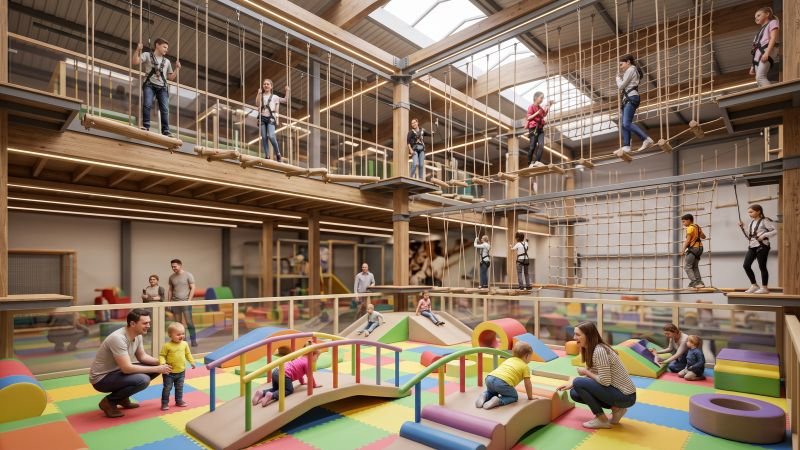
Ground-Level Exploratory Zones for Toddlers
Toddlers cannot safely use standard overhead belay systems. That means a dedicated ground-level exploratory zone is non-negotiable. Think of this like the dedicated toddler foam pit in a massive commercial trampoline park—it keeps small children safe from older, faster teenagers.
These zones typically feature small suspension bridges, low-hanging net tunnels, and basic balance beams. Because the obstacles are positioned just 12 to 18 inches off the ground, kids do not need complex safety harnesses. Even better, parents can walk right alongside them, building confidence for the child.
“Creating a harness-free zone for children under five allows younger siblings to participate safely, turning a single older child’s visit into a whole-family purchase.”
Safety padding is crucial here. You will need thick floor mats under all low-level elements to protect against minor tumbles. Always verify critical fall height ratings with your flooring supplier to ensure the rubber thickness fully complies with local safety codes.
Multi-Level Complex Challenges for Teens and Adults
Older teenagers and adult parents will quickly get bored with basic rope bridges. To secure their ticket sales, you must build vertically. By stacking the course into multiple levels, you provide scaled difficulty without consuming more expensive floor space.
The first elevated level might sit 10 feet high with stable, wide planks. But once you go up, you need to turn up the heat. Include high-adrenaline elements like swaying ninja steps, wobbly tightropes, and free-fall jump platforms on the upper levels. This progression works exactly like a commercial indoor climbing wall. The routes become progressively harder as the user climbs higher.
| Course Level | Target User | Example Element | Difficulty |
|---|---|---|---|
| Level 1 (Low) | Kids (Ages 6-9) | Wide wooden planks | Easy |
| Level 2 (Medium) | Tweens (Ages 10-13) | Spaced floating steps | Moderate |
| Level 3 (High) | Teens & Adults | Unstable rolling logs | Hard |
By offering a clear progression of difficulty, you challenge older guests to conquer the hardest path. That adrenaline rush is exactly what drives five-star online reviews and word-of-mouth marketing.
Interactive Parallel Tracks for Parent-Child Racing
Want to crank up replay value? Design interactive parallel tracks. This simply means building two identical obstacle paths side-by-side.
Instead of families moving slowly in a single-file line, they can race each other. This setup mimics a dual racing zip line at a large outdoor adventure park. A child can confidently race against their sibling or a parent on an equal playing field.
To make this layout choice even more profitable, install electronic timing buzzers at the start and end of the tracks. When guests see their exact completion times displayed on a screen, they naturally want a rematch. They will frequently buy another session to beat their previous record.
Managing Ongoing Operational Costs Effectively
Controlling monthly expenses without compromising safety or the overall customer experience is the key to sustained profitability.
To effectively manage ongoing operational costs, operators must proactively control their three largest recurring expenses: payroll, maintenance, and insurance. By utilizing open floor plans to reduce required staff, setting aside predictable budgets for mandatory daily upkeep and annual structural inspections, and strictly adhering to commercial safety certifications to lower insurance premiums, facilities can protect their profit margins. Consistently managing these backend overhead costs ensures that top-line revenue directly translates into long-term profit.
Optimizing Staffing Requirements Through Smart Design
Labor is consistently the highest monthly expense for any family entertainment center. That means optimizing your floor plan for minimal staffing from day one.
Are you really going to pay three extra staff members to watch a hidden corner of your facility? If your rope course has structural blind spots, you have to hire more floor monitors. Think of this exactly like a commercial indoor trampoline park. If the trampoline zones are separated by high walls, you need a dedicated referee for every single room. However, if the facility uses an open floor plan with clear sightlines, a single staff member can safely monitor a much larger zone.
Take it a step further: bottleneck your harnessing and briefing zones. Instead of having staff run across the building to help new guests, force all traffic through a single entry gate. This allows one employee to check harnesses, deliver safety instructions, and manage the entry line simultaneously.
Budgeting for Annual Inspections and Routine Maintenance
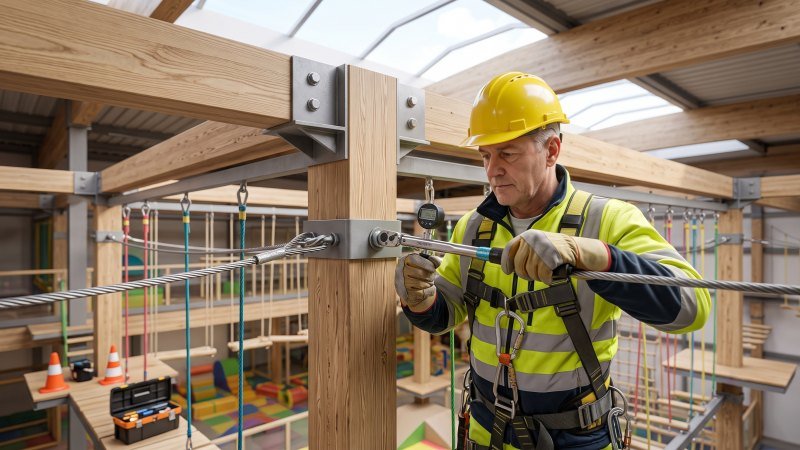
Ropes fray, cables stretch, and bolts loosen over time. If you aren’t budgeting for relentless maintenance, you’re building a liability. Ignoring small repairs will eventually lead to massive structural failures.
Routine maintenance is divided into daily tasks and annual professional inspections. This process is very similar to how theme parks manage commercial roller coasters. The park staff performs daily visual track walks, but third-party engineers conduct comprehensive yearly stress tests.
| Maintenance Type | Frequency | Estimated Cost | Core Action |
|---|---|---|---|
| In-House Visual Check | Daily | Internal Payroll | Checking harnesses and moving trolleys |
| Hardware Tightening | Monthly | $200 – $500 | Torquing bolts and adjusting cable tension |
| Third-Party Inspection | Annually | $2,000 – $5,000 | Professional ACCT or EN structural audit |
You must systematically replace high-friction hardware like pulleys and carabiners. Because the replacement schedule for these components varies based on facility humidity and usage rates, adhere strictly to your equipment manufacturer’s specified wear limits. Budgeting roughly 3% to 5% of your initial construction cost annually for replacement parts is a safe industry standard.
Navigating Insurance Premiums and Safety Certifications
Insurance premiums will consume a significant portion of your operating budget. Because rope courses involve heights, insurance providers view them as high-risk attractions. However, you can actively reduce your monthly premiums by proving your commitment to safety.
First, you must obtain proper certifications. Organizations like the Association for Challenge Course Technology (ACCT) or ASTM International set strict safety standards. If your course passes an ACCT-certified inspection, insurance companies will often lower your rates. They know a certified course is statistically less likely to experience severe accidents.
“Documented staff training is the single most effective tool an operator has to negotiate lower liability insurance premiums.”
Beyond physical hardware, your paper trail has to be bulletproof. Every daily safety checklist, staff training log, and customer liability waiver must be stored securely. If an incident occurs, your insurance provider will immediately demand these logs. If you cannot produce them, your premiums will skyrocket, or your coverage may be dropped entirely. By investing in digital waiver software and rigorous training protocols, you protect both your guests and your bottom line.
Conclusion
Building a highly profitable kids rope course requires balancing upfront capital with smart, long-term business strategies. By investing in high-quality structural materials and continuous belay systems, you create a fundamentally safe environment that parents trust. When you combine this robust infrastructure with diversified revenue streams—like food and beverage zones and premium party packages—your facility immediately increases its earning potential. Furthermore, designing an inclusive layout that challenges teenagers while providing safe zones for toddlers ensures that the entire family stays engaged and spends more. By strictly managing backend operational costs, particularly labor and insurance, you protect your bottom line, ensuring that your initial construction investment yields maximum returns for years to come.
To get a customized cost estimate and business plan tailored to your specific site, please contact us.