-
Whatsapp: +86 15516933785
-
Email: hanlin@hanlinplayground.com
-
Address: Shangjie District, Zhengzhou City, Henan Province, China
-
Whatsapp: +86 15516933785
-
Email: hanlin@hanlinplayground.com
-
Address: Shangjie District, Zhengzhou City, Henan Province, China

Franchise vs. Independent Trampoline Park: Which is More Profitable?
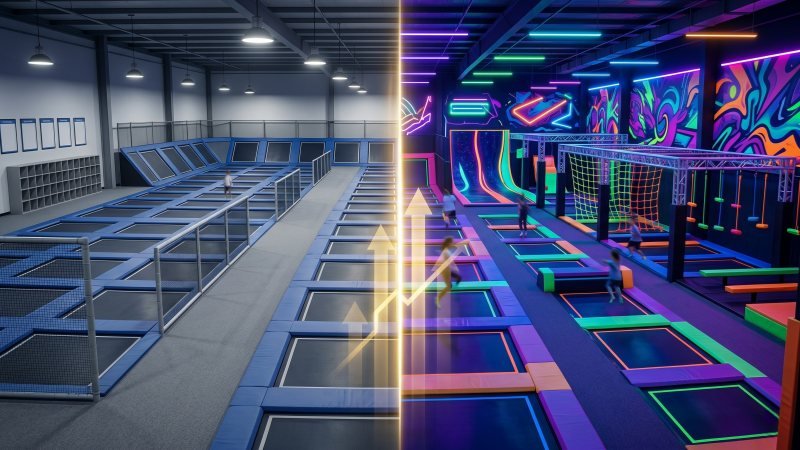
When deciding to open a new family entertainment center, is it more profitable to buy into a franchise or build an independent trampoline park?
Both franchise and independent trampoline parks offer distinct paths to profitability, but independent parks generally yield higher long-term net profit margins (18% to 22%) by eliminating initial brand fees and ongoing royalties. On the flip side, franchises offer a faster path to launch and easier loan approval due to established brand recognition, though mandatory ongoing fees typically reduce their net margins to approximately 10% to 13%. At the end of the day, the most profitable model depends on your initial liquid capital, operational expertise, and the specific demographic size of your chosen location.
Upfront Capital and Hidden Investment Costs
What is the true cost to open the doors of a new trampoline park?
The initial capital required to open a trampoline park ranges from $300,000 to $1.5 million. A franchise requires a non-refundable upfront fee of $30,000 to $60,000. It also demands a minimum net worth of $1.5 million. Look at it from the independent side—you avoid these strict brand fees. This allows owners to spend 100% of their starting budget directly on physical equipment, safety padding, and building improvements.
Franchise Fees and Required Liquid Assets
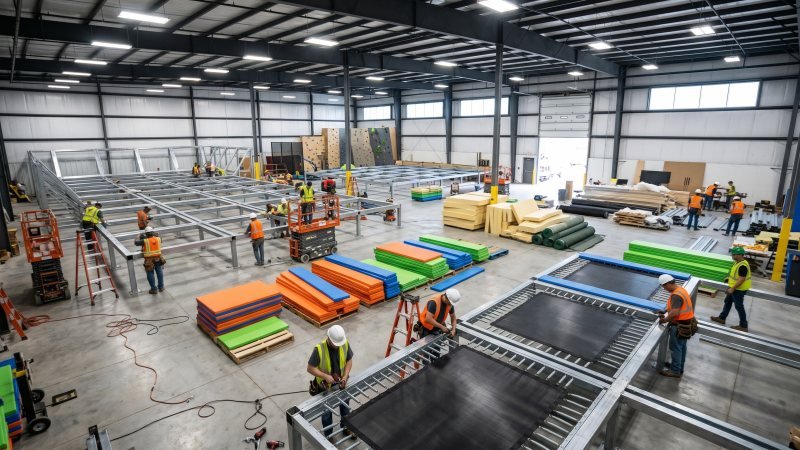
Buying into a brand name requires significant cash before you even lease a building. First, you must pay the initial franchise fee. This is a one-time payment simply for the right to use the brand’s name. Usually, this fee costs between $30,000 and $60,000.
Here is the reality of dealing with parent companies: they have strict financial rules for new owners. You cannot simply use a small business loan to cover everything. Most major brands require you to have $300,000 to $500,000 in liquid assets. Liquid assets mean pure cash or stocks you can sell quickly. Add to that, they typically demand a total net worth of over $1.5 million.
Why do they ask for this? Think of these cash requirements like the heavy-duty steel framework of a main jump court. Just as the steel frame supports the weight of dozens of jumpers, strong financial backing ensures the park can survive slow opening months. But ask yourself: are you truly prepared to freeze a massive chunk of your working capital before opening the doors? For many new operators, locking up half a million dollars in cash is a massive hurdle.
Independent Setup and Avoiding Vendor Markups
Building an independent park changes the financial rules completely. You do not pay any franchise fees. Instead, your money goes directly into your facility. You can control exactly where every single dollar is spent.
But here is the real margin-killer in a franchise: the vendor markup. Franchises often force you to buy equipment from a specific list of approved suppliers. These forced purchases include everything from the ninja courses to the grip socks. Because the franchise takes a cut from the supplier, these approved vendors often charge 20% to 40% more.
As an independent owner, you can shop around. You can buy directly from global manufacturers. For instance, you might find a high-quality dodgeball court for $80,000 instead of the $110,000 an approved vendor charges.
Here is a quick look at how these initial startup costs compare:
| Cost Category | Franchise Park | Independent Park |
|---|---|---|
| Initial Brand Fee | $30,000 – $60,000 | $0 |
| Required Liquid Cash | $300,000 – $500,000 | Flexible (Based on your budget) |
| Equipment Sourcing | Fixed (Approved vendors only) | Flexible (Open market) |
| Vendor Markups | 20% – 40% higher | 0% (Direct pricing) |
By avoiding these brand fees and hidden markups, independent parks often cost hundreds of thousands of dollars less to build. When the dust settles, this lower initial cost means you have less debt to pay off when you finally launch your business.
Analyzing Long-Term Profit Margins
How do ongoing brand fees affect the actual take-home pay of a trampoline park owner over time?
An independent trampoline park generally achieves a higher long-term net profit margin of 18% to 22%, as the operator retains all generated revenue. Flip that to a franchise park, and the net profit margin typically drops to 10% to 13%. This reduction occurs because franchise owners must pay mandatory ongoing royalties and national advertising fees, which continuously consume 6% to 9% of their total gross sales.

The True Cost of Ongoing Royalties and Brand Funds
Operating a franchise means you must share your earnings. Parent companies do not just take a cut of your profits. Instead, they take a percentage of your gross sales. This is a crucial difference.
Gross sales represent every single dollar that comes through the door. You must pay the franchise fee before paying for rent, payroll, or utilities. Typically, a trampoline park franchise requires a 5% to 6% royalty fee. On top of that, you must pay a 1% to 3% national advertising fund fee.
Let us look at a realistic scenario. Imagine your park generates $1,500,000 in gross sales annually. A combined 8% fee means you pay $120,000 directly to the franchisor. You must pay this massive amount even if your park actually loses money that year.
Think of these continuous fees like the high-capacity blower motors used for a stunt airbag. The motor must constantly draw power to keep the bag safely inflated, pulling electrical resources continuously. Similarly, ongoing royalties continuously draw cash from your business account, regardless of the park’s current attendance or profitability.
Let’s be brutally honest about national advertising funds—they rarely help your specific location directly. You are funding national television commercials that might air three states away. Is it truly worth losing a large chunk of your revenue for broad brand awareness?
Keeping Full Revenue as an Independent Operator
Independent park owners do not pay these recurring brand fees. Because of this, their profit margins look vastly different. By operating independently, you keep 100% of your gross sales.
What happens to that extra $120,000 every year? You keep it as pure profit. Alternatively, you can directly reinvest it back into your facility. You can buy replacement trampoline springs, upgrade your safety padding, or install a new interactive climbing wall. Independent owners have the financial freedom to constantly build a better customer experience.
Here is a clear comparison of how revenue distribution affects your bottom line:
| Financial Metric | Franchise Park | Independent Park |
|---|---|---|
| Estimated Annual Gross Sales | $1,500,000 | $1,500,000 |
| Royalties & Brand Fees (8%) | -$120,000 | $0 |
| Remaining Revenue for Expenses | $1,380,000 | $1,500,000 |
| Estimated Net Profit Margin | 10% to 13% | 18% to 22% |
The data above illustrates a standard industry baseline for indoor family entertainment centers.
It doesn’t take a math genius to see that keeping your revenue directly boosts your long-term success. Over a standard ten-year commercial lease, those franchise fees can cost you over a million dollars. As an independent owner, that money stays in your own pocket. This builds a much stronger, more profitable business model over time.
Securing Business Loans and Financing
Securing a commercial bank loan is a critical hurdle, and your choice of business model heavily influences the lender’s approval process.
Securing a commercial loan is generally faster and easier for franchise trampoline parks because banks favor established brands with proven historical financial data. However, independent park operators can still successfully secure financing by presenting a comprehensive, data-driven business plan that demonstrates strong local market demand and a clear path to profitability.
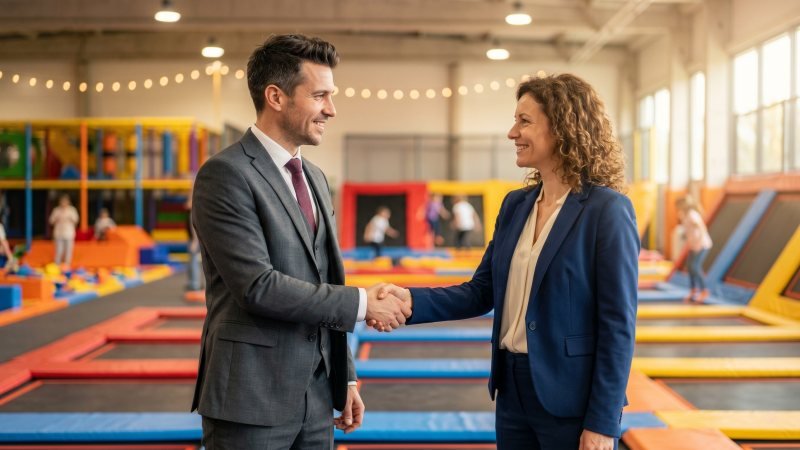
Bank Preferences for Established Brands
Getting a multi-million dollar commercial loan is a strict process. Banks are inherently risk-averse institutions. Because of this, they heavily favor lending money to businesses with a proven track record.
When you apply for a loan as a franchisee, the bank is not just looking at you. They are evaluating the entire parent company. Franchise brands possess years of operational data. They know exactly how many visitors a standard park attracts. They also have the hard data on average ticket sales and expected failure rates.
Think of a bank’s risk assessment like the redundant safety netting systems used on commercial trampoline courts. Just as multiple layers of netting prevent a jumper from hitting the hard ground, a franchise’s historical data provides a financial safety net for the bank. The bank knows the business model works.
Take it a step further: many established franchises are already registered with national lending programs. For instance, in the United States, being on the Small Business Administration (SBA) Franchise Directory drastically speeds up the loan approval process. The bank already trusts the brand. As a result, they mostly just need to verify your personal credit and local real estate choices.
Proving Financial Viability for Independent Parks
On the flip side, an independent trampoline park is completely unknown to a bank. You do not have a national brand backing your application. That puts the entire burden of proving the park’s viability squarely on your shoulders. How do you convince a risk-averse banker that your vision will actually cash flow?
To secure financing, independent operators must build an incredibly detailed business plan. You cannot simply present a good idea. You must provide hard data.
Creating a Winning Business Plan
Your loan application must clearly outline your market research. You need to show local demographic studies proving there are enough families in your area. You must also provide a strict competitor analysis.
You also have to bring exact equipment quotes to the table. Banks will scrutinize what you are buying.
Note: Trampoline structural specifications, such as steel frame gauge and spring tension load limits, determine the longevity of the equipment acting as the bank’s collateral. Always verify the exact testing data and safety certifications with your manufacturer. Including these detailed durability specs in your loan application proves you are investing in reliable, long-lasting assets.
Here is a quick look at how the loan application process compares:
| Financing Factor | Franchise Park | Independent Park |
|---|---|---|
| Lender Trust Level | High (Based on brand history) | Low (Requires heavy proof) |
| Approval Speed | Faster (Often pre-registered) | Slower (Requires deep review) |
| Required Data | Provided mostly by the franchisor | Generated entirely by the owner |
| Collateral Needs | Standard | Often higher to offset risk |
While getting a loan independently is harder, it is highly possible with the right preparation. A strong presentation showing high-quality equipment and smart local marketing will win over lenders.
Maximizing Revenue Through Operational Control
Complete operational control empowers park owners to optimize their daily income streams without corporate restrictions.
Independent operators maximize revenue by controlling all internal business decisions, allowing them to keep 100% of ancillary sales. Unlike franchises with fixed rules, independent parks can quickly introduce high-margin, custom food and beverage options. More importantly, they possess the agility to instantly launch localized promotions and adjust pricing tiers to capture demand during slow periods.
Creating Profitable In-House Food and Beverage Options
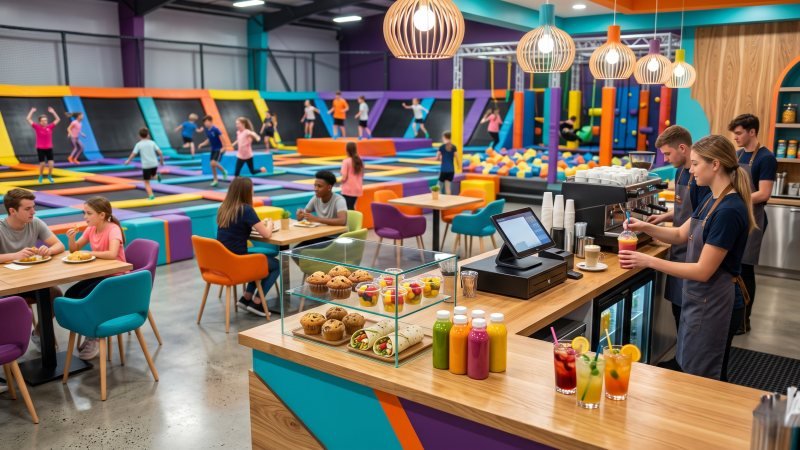
Food and beverage (F&B) sales are a massive income source for family entertainment centers. Often, these cafe sales make up 20% to 30% of a park’s total revenue.
When you own a franchise, the parent company dictates your menu. You must sell their specific pizza brands and approved snacks. You also have to buy these supplies from their mandatory vendors. Because of this corporate red tape, you miss out on finding cheaper local ingredients.
Operating independently changes this completely. You can build a custom cafe tailored exactly to your community. You can sell high-margin items like gourmet coffee, local craft sodas, or specialized baked goods. Items like fountain drinks and fresh pizza often carry gross profit margins of 70% to 80%. Why leave an 80% gross margin on the table just to appease a corporate menu mandate? As an independent owner, you keep all of that profit.
Think of menu control like the modular design of a modern ninja warrior course. In a modular system, if a specific climbing obstacle is unpopular, you can quickly swap it out for a warped wall to keep guests actively engaged. Similarly, having complete control over your food menu lets you instantly swap out slow-selling snacks for highly profitable items tailored to local tastes.
Agility in Local Market Ticket Pricing and Promotions
Your ability to change prices quickly is a huge advantage. Franchise parks often have rigid, nationwide pricing structures. If a franchise owner wants to run a special discount, they typically need corporate approval. This approval process can take weeks.
Independent operators have total agility. You can react to your local market instantly.
For example, imagine a sudden rainstorm hits your city on a Tuesday morning. As an independent owner, you can immediately post a “Rainy Day Flash Sale” on your social media. You can instantly lower jump tickets by 20% to drive immediate foot traffic. A franchise simply cannot move that fast.
Beyond flash sales, you can engineer highly customized local partnerships. You can offer specialized discount rates for nearby school districts, local sports teams, or community churches.
Here is a comparison of operational flexibility:
| Operational Action | Franchise Park | Independent Park |
|---|---|---|
| Menu Changes | Requires corporate approval | Instant implementation |
| Flash Sales & Discounts | Slow (Corporate red tape) | Fast (Owner’s discretion) |
| Local Partnerships | Must align with national brand | Fully customizable |
| Ancillary Profit Retention | Subject to ongoing royalties | 100% kept by the owner |
At the end of the day, controlling your operations allows you to capture every possible dollar in your specific town.
Matching the Business Model to Your Location
The physical location and demographic size of your target market play a definitive role in selecting the most profitable operational strategy.
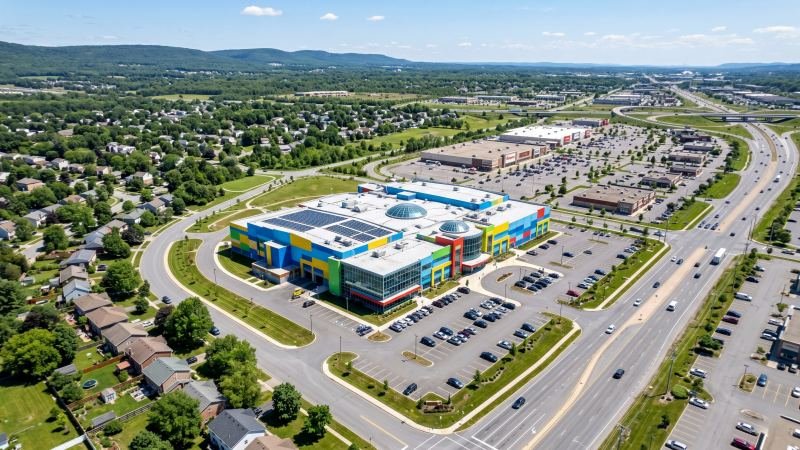
A franchise model often maximizes profitability in large, high-traffic commercial zones because its established brand recognition quickly captures broad, regional audiences. Switching gears, an independent park is generally more profitable in smaller suburban markets or localized community centers, as the smaller footprint requires significantly lower overhead and relies on localized, repeat foot traffic rather than expensive national marketing.
High-Traffic Commercial Zones
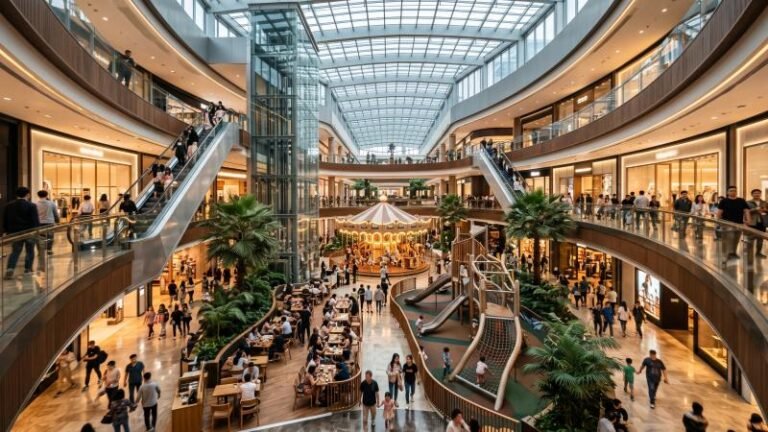
Placing your facility in a major retail hub deeply impacts your financial strategy. High-traffic commercial zones typically feature busy shopping malls and major highways. Naturally, these prime areas command very high monthly rent. To survive this high rent, you must secure a massive volume of daily visitors.
In these massive markets, a franchise model usually excels. National brands act as automatic customer magnets. When tourists or busy shoppers see a recognized brand name, they instantly trust the facility. That built-in brand recognition does the heavy lifting, pulling in thousands of casual, one-time visitors.
Typically, parks in these dense commercial zones require a massive physical footprint. They usually span 25,000 to 40,000 square feet. This massive size allows them to handle high weekend capacity without creating dangerous bottlenecks.
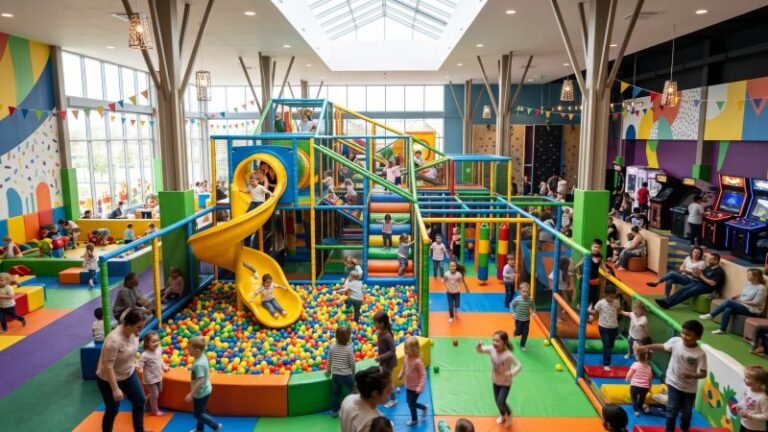
Think of a high-traffic commercial location like a massive, multi-level indoor soft play structure. The sheer scale and bright exterior naturally draw children from all across the building. Similarly, a recognized franchise brand automatically draws potential customers from across a busy commercial district.
Note: Minimum ceiling clear heights, typically required to be between 18 to 20 feet for standard commercial trampoline courts, can vary based on local building codes and specific equipment designs. Therefore, always verify the exact spatial and structural requirements directly with your equipment supplier before signing a high-rent commercial lease.
Smaller Suburban Markets and Community Centers
Not every profitable park needs to be located in a massive city center. In fact, smaller suburban markets offer incredible profit potential for independent operators.
Suburban areas have lower population densities. Because of this, paying high royalty fees for national franchise marketing is often a waste of capital. Instead, an independent model thrives here. Independent parks usually operate in smaller buildings. These facilities often range from 10,000 to 15,000 square feet. This means the monthly rent is drastically lower, reducing your financial risk.
Here is the strategic advantage of suburban parks: they thrive on deep community loyalty. You do not need thousands of random tourists to be profitable. Instead, you need local families to visit repeatedly. Independent operators can quickly build this loyalty. They can easily host local school spirit nights, neighborhood fundraisers, and customized birthday parties.
Here is a clear breakdown of how location optimally matches the business model:
| Location Type | Best Suited Model | Typical Facility Size | Primary Customer Base |
|---|---|---|---|
| High-Traffic Commercial | Franchise | 25,000+ sq. ft. | Broad regional traffic and tourists |
| Smaller Suburban Market | Independent | 10,000 – 15,000 sq. ft. | Local families and repeat visitors |
By matching your operating model directly to your specific town size, you tightly control your overhead costs. This strategic alignment is absolutely vital for ensuring your long-term profitability.
Conclusion
Let’s wrap this up. Choosing between a franchise and an independent trampoline park fundamentally alters your financial future. Franchises offer an easier starting point with streamlined bank approvals and a proven operational playbook, but they demand high liquid assets and continuous royalty payments that cut into your net income. Independent parks demand more upfront entrepreneurial grit and rigorous planning, but they reward operators with total creative control, zero brand fees, and significantly higher long-term profit margins. Assess your starting capital, your desired level of autonomy, and your target location carefully before making a commitment.
If you are analyzing a potential building or looking for cost-effective, high-quality equipment options tailored to your chosen business model, please contact us today!