-
Whatsapp: +86 15516933785
-
Email: hanlin@hanlinplayground.com
-
Address: Shangjie District, Zhengzhou City, Henan Province, China
-
Whatsapp: +86 15516933785
-
Email: hanlin@hanlinplayground.com
-
Address: Shangjie District, Zhengzhou City, Henan Province, China

Party Rental Essentials: Top 5 Most Popular Portable Playground Combinations
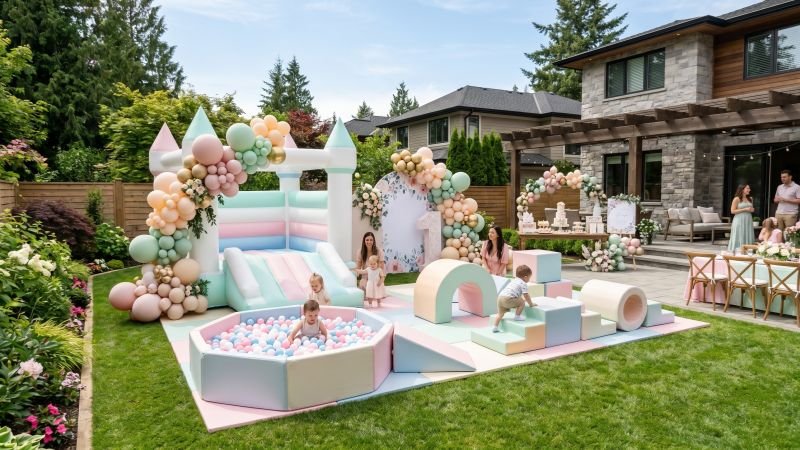
What are the most popular portable playground combinations for party rental businesses to invest in?
The top five portable playground combinations include the classic soft play and ball pit duo, toddler bounce houses with attached slides, pastel mat sets with perimeter fencing, mini obstacle courses with pop-up tunnels, and mixed media play spaces featuring wooden climbing arches. These highly requested setups maximize child safety, offer premium visual appeal for modern events, and provide an excellent return on investment for rental operators.
Combination 1: The Classic Soft Play and Ball Pit Duo
Why is the classic soft play and ball pit duo the top choice for portable playground rentals?
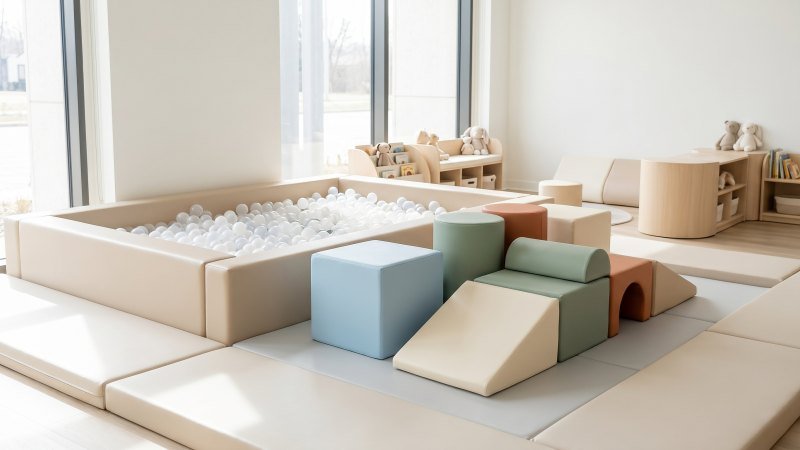
The soft play and ball pit combination is the most requested portable playground setup. It provides a safe, highly visual, and easily cleanable environment for toddlers. This equipment typically features high-density polyurethane foam blocks for building and a shallow pit filled with crush-proof commercial balls. It offers a return on investment for rental companies while delivering secure entertainment for young children.
Essential Foam Block Shapes and Pit Sizes
Rental businesses need the right mix of equipment to succeed. Right out of the gate, you need to lock down the proper foam block shapes. Cubes, cylinders, wedges, and step-and-slide sets form the core of this combination. Cubes offer a structural foundation. Wedges act as simple ramps for crawling infants. Meanwhile, cylinders introduce rolling motions to develop early balance.
Think of these basic foam shapes as the modular building blocks of your commercial rental inventory. Just as you might link different inflatable obstacle course sections together depending on the venue’s length, you can reconfigure these soft blocks to fit any room layout. High-density foam ensures the blocks keep their shape after repeated commercial use.
Once your blocks are sorted, nailing down the correct ball pit size is your next critical step. A pit that is too small looks unimpressive to clients. Conversely, a pit that is too large costs more to fill and takes much longer to clean.
“Choosing the right ball pit size directly impacts your setup time and your client’s overall satisfaction.”
Here is a breakdown of common commercial ball pit sizes:
| Pit Size (Feet) | Estimated Ball Count | Ideal Number of Toddlers | Best Venue Type |
|---|---|---|---|
| 4 x 4 | 500 – 800 | 1 – 2 | Small Living Rooms |
| 6 x 6 | 1,500 – 2,000 | 3 – 5 | Standard Patios |
| 8 x 8 | 3,000 – 4,000 | 6 – 8 | Rented Banquet Halls |
Best Event Types for This Setup
Where does this classic combination perform best? This setup shines brightly at events focused on very young children. First birthdays are the most common market for this equipment. Parents want safe, visually appealing entertainment for babies who are just learning to walk.
Here is where this setup really earns its keep: it is perfect for indoor weddings. Event planners frequently rent soft play areas to keep toddlers occupied during long receptions. Since the equipment does not require electricity, you can set it up silently in the corner of a formal dining room.
Beyond that, community centers and indoor playdates are prime targets. Are you targeting corporate family days? This combination works perfectly there, too. It serves as a secure, defined containment zone. Parents can relax nearby while keeping a close eye on their children.
Unlike larger inflatable attractions, the soft play and ball pit duo requires zero constant airflow to function. This makes it a much quieter and less intrusive option for formal indoor gatherings. It truly is the reliable workhorse of the toddler rental market.
Combination 2: Toddler Bounce House with Attached Slide
How does a toddler bounce house with an attached slide maximize your rental profitability?
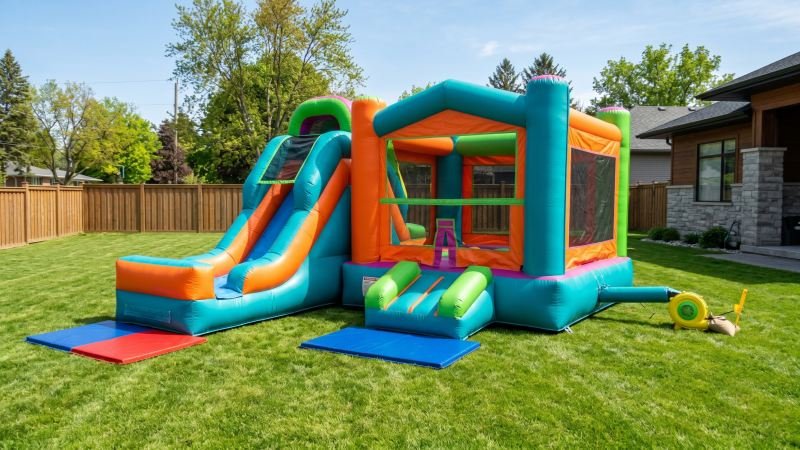
A toddler bounce house with an attached slide maximizes profitability by combining active jumping and sliding into one compact unit. It specifically serves the two-to-five age range by offering contained physical activity. This combination commands higher rental rates than a standard bouncer while occupying a similar physical footprint, thereby increasing revenue per square foot for event operators.
Footprint and Power Supply Needs
Before you even think about deployment, you have to map out the exact physical space and safety clearance required for this equipment. A toddler bounce house with a slide needs far more room than just the inflatable itself. You must account for the blower tube (which is typically 4 to 5 feet long to keep children safely away from the motor) and strictly enforced fall-off zones.
According to strict commercial safety standards like ASTM F2374 and EN 14960, you cannot simply leave a foot of space around a bouncer. These standards require a minimum of 4 feet (1.2 meters) of unobstructed clearance on all closed sides. Furthermore, the open exit areas, like the bottom of the slide, require extended impact zones that can reach up to 11.5 feet (3.5 meters) to prevent a child from sliding off the landing pad and hitting a hard surface.
Therefore, a 10×10 foot standard bouncer with its blower tube attached has an actual physical footprint of at least 10×15 feet, requiring a clearance zone of roughly 18×20 feet.
Got the space figured out? Good. Now let’s talk power. Ever had a breaker trip right in the middle of a packed birthday party? It is a logistical nightmare. Inflatables require a constant stream of air. Most toddler combos use a 1.0 HP or 1.5 HP blower. These blowers typically require a dedicated 15-amp or 20-amp electrical circuit. Because motor specifications can vary, always verify the exact electrical load with your equipment supplier to prevent tripped breakers during an event.
| Inflatable Type | Dimension (Base) | Est. Footprint (with Blower) | Required Safe Clearance Zone | Typical Blower Size |
|---|---|---|---|---|
| Standard Bouncer | 10×10 ft | 10×15 ft | 18×20 ft | 1.0 HP |
| Combo with Slide | 12×12 ft | 12×17 ft | 20×25 ft (Slide Exit Area) | 1.5 HP |
Managing Traffic for Larger Parties
Add an attached slide into the mix, and you completely change the dynamic of how children move through the play area. In a standard bouncer, children jump and stay inside. With a slide combo, children enter, jump, climb, and slide out. This creates a continuous loop of movement.
Managing this flow is exactly like operating a multi-lane commercial inflatable obstacle course. You must establish a clear starting point and a clear exit point to prevent bottlenecks. If children try to climb up the slide while others are sliding down, collisions will undoubtedly happen.
“Effective traffic management increases your equipment’s hourly capacity while significantly reducing the risk of accidental collisions.”
To manage this effectively, you should set firm capacity limits. Industry data shows a standard toddler combo safely holds four to six children at once. If a party has twenty children attending, you must establish a strict rotation system.
Here are key methods to maintain a steady traffic flow:
- Designated Entrances: Place safety mats only at the designated climbing ramp.
- Clear Landing Zones: Ensure the area at the bottom of the slide remains completely clear of obstacles or waiting children.
- Timed Rotations: Use three-minute jump intervals during high-traffic events to ensure every child gets a turn.
Combination 3: Pastel Mat Set with Fencing and Animal Hoppers
Why are pastel mat sets with perimeter fencing and bouncy animal hoppers becoming a top-tier investment for toddler party planners?
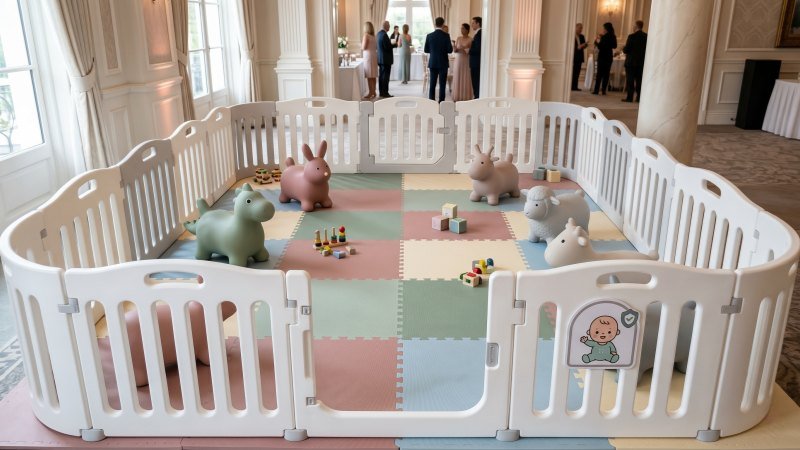
This combination provides a visually appealing, highly secure containment zone optimized for infants and toddlers. High-density EVA foam mats create a hygienic, shock-absorbing floor, while modular fencing actively prevents wandering. Furthermore, adding low-to-the-ground animal hoppers delivers safe physical activity without the fall risks associated with elevated play structures.
Why Fencing is Crucial for Toddler Safety
Let’s be blunt: safety dictates every move we make in this industry. Think you can skip the perimeter and just lay down the mats? Think again. Toddlers are naturally curious. They will wander away from the play area if given the chance. Therefore, installing a sturdy physical barrier is absolutely essential.
Think of toddler fencing like the safety netting used on a commercial trampoline park structure. A trampoline park uses heavy-duty nets to define jumping zones and prevent accidental falls into structural framing. Similarly, a rental operator uses plastic play yard fencing to establish a strict, protected boundary. This boundary securely keeps toddlers inside. Simultaneously, it keeps older, rougher children out of the delicate play zone.
“A secure perimeter allows parents to observe safely from a distance, dramatically increasing overall client satisfaction.”
Without a sturdy fence, animal hoppers can quickly bounce out of the designated safe zone. A toddler might bounce directly off the padded mat and onto a hard concrete patio. Consequently, fencing eliminates this specific hazard entirely.
Most commercial playpens use panels that are roughly 24 inches tall. This specific height is perfect because it reliably prevents a two-year-old from climbing over, yet allows adults to easily step inside to assist a child.
Selecting Trending Color Palettes
Now, let’s pivot to the aesthetic side of the equation. Historically, children’s party rentals heavily featured loud, bright primary colors like fire-engine red and sunshine yellow. Today, the rental market has completely shifted.
Clients now demand highly aesthetically pleasing setups. They want play equipment that seamlessly blends into elegant party decor. As a result, pastel and neutral color palettes currently dominate the rental market.
Why does color matter so much to your bottom line? It directly impacts the client’s event photography. A muted sage green and soft beige mat set looks incredibly sophisticated in a backyard garden setting. It does not clash with the host’s carefully planned balloon garlands or floral arrangements.
Let us examine the difference in market demand based on recent industry observations:
| Color Palette Style | Common Hues | Best Suited Event Themes | Client Booking Demand |
|---|---|---|---|
| Primary | Bright Red, Blue, Yellow | Traditional Carnivals | Steadily Declining |
| Pastel | Dusty Rose, Mint, Lilac | Modern First Birthdays | Extremely High |
| Neutral | Beige, Ivory, Taupe | Boho Chic, Weddings | Consistently Strong |
To maximize your rental bookings, you must invest in pastel or neutral animal hoppers. A white bouncy horse or a soft pink bunny hopper will rent much faster than a bright neon one. Ultimately, stocking these trending palettes positions your business as a premium service provider, allowing you to charge higher rental rates. Throw in some low-to-the-ground animal hoppers, and you deliver safe physical activity without the fall risks associated with elevated play structures.
Combination 4: The Mini Obstacle Course with Tunnels
Why should you add a mini obstacle course with tunnels to your portable party rental inventory?
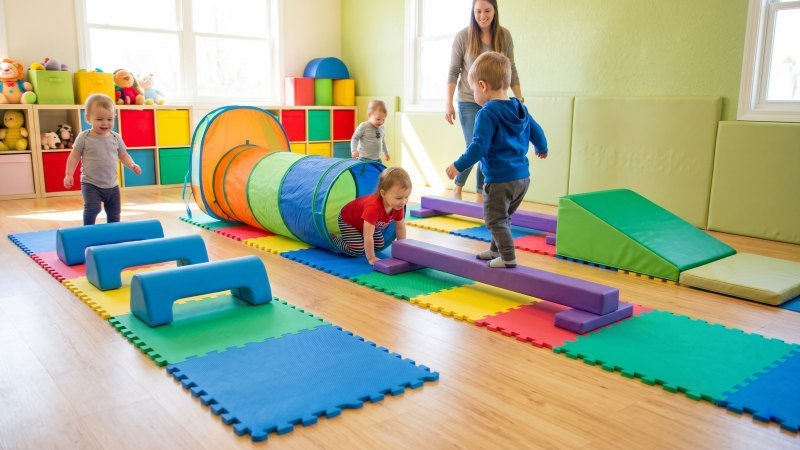
A mini obstacle course with pop-up tunnels offers a highly interactive, scalable play environment that actively engages older toddlers. This combination utilizes interlocking foam hurdles, crawl-through tubes, and balance beams to create a guided physical challenge. It allows rental operators to charge premium rates for a structured activity while maintaining a flexible footprint that easily transitions between venues.
Encouraging Active Play and Motor Skills
How do you keep active three-year-olds completely engaged for a full two-hour party? You must give them a clear, physical objective. A mini obstacle course provides exactly that. Unlike standard ball pits where children often remain stationary, an obstacle course forces continuous forward movement.
Children crawl through dark tunnels, step over small foam barriers, and walk across low balance beams. This sequence directly targets a child’s gross motor skills and spatial awareness.
Think of designing an obstacle course like setting up a large-scale inflatable maze attraction. You intentionally place specific walls and dead-ends to guide participants along a safe, continuous path. Similarly, you arrange foam wedges and nylon tubes to guide toddlers safely through a deliberate physical challenge.
“A well-designed obstacle course transforms random jumping into focused, goal-oriented play.”
Rental operators who offer structured courses often see higher repeat bookings. Parents appreciate equipment that actively burns off energy while aiding their child’s physical development.
Adapting to Indoor and Outdoor Venues
The real engineering advantage of this combination? It offers incredible location versatility. You can easily deploy a mini obstacle course in a small living room or across a large grassy backyard. However, your installation and anchoring methods must change drastically depending on the surface environment.
When operating outdoors, wind load is the single greatest hazard. If a sudden gust of wind hits soft play equipment or a lightweight tunnel, it can roll away or become a dangerous projectile. To counter this, heavy-duty metal ground stakes driven deep into the soil are the undisputed gold standard for outdoor grass installations.
You must never rely solely on sandbags on grass if stakes can be used. Sandbags are strictly a secondary alternative designed only for hardscapes (like concrete patios) where driving a stake is physically impossible. To mitigate any tripping hazards from the stakes, professional operators drive the stakes flush with the ground and utilize bright stake covers.
| Venue Environment | Recommended Base Layer | Required Anchoring Method | Post-Event Cleaning Focus |
|---|---|---|---|
| Indoor (Carpet/Wood) | Interlocking EVA Foam Mats | Rubberized Non-Slip Grips | Surface Sanitization Wipe-Down |
| Outdoor (Grass/Soil) | Heavy-Duty Vinyl Tarp | Metal Ground Stakes (Driven Flush/Covered) | Deep Soil and Grass Stain Removal |
| Outdoor (Concrete) | Heavy-Duty Vinyl Tarp | Heavy Commercial Sandbags / Water Weights | Deep Scuff and Dirt Removal |
For indoor events, anchoring relies entirely on friction. You will use non-slip grips beneath the mats so the course does not slide across slick floors. By mastering the correct engineering and anchoring techniques for both environments, you effectively double your potential rental market year-round while keeping children completely safe.
Combination 5: Mixed Media Play with Climbing Arches and Rockers
Why are event planners increasingly requesting mixed media play setups with climbing arches and rockers for premium toddler parties?
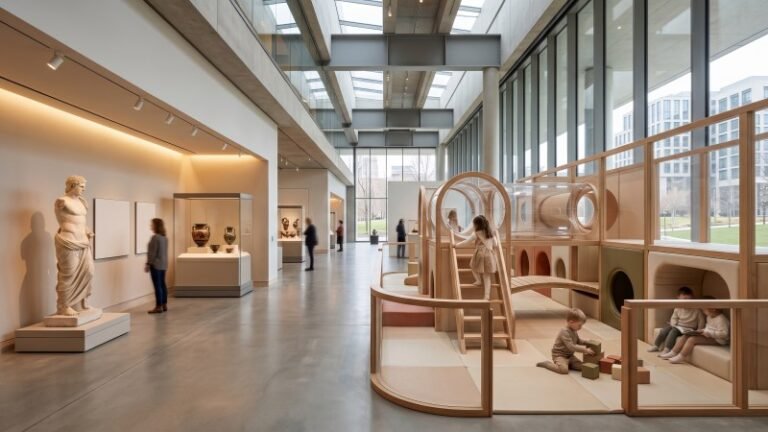
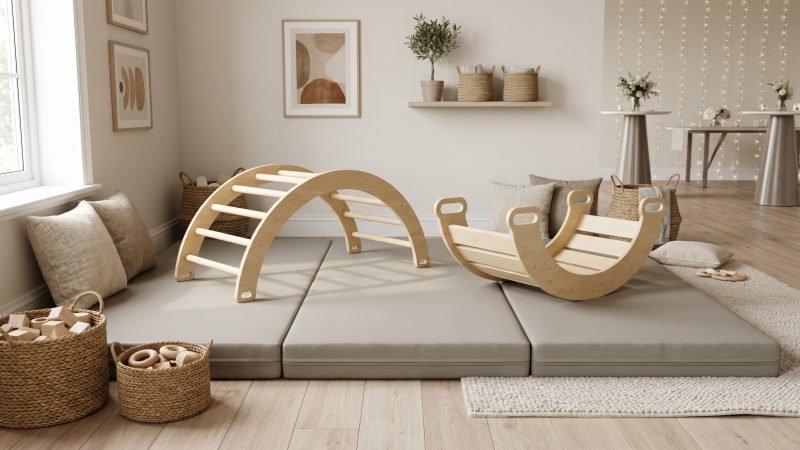
A mixed media portable playground blends traditional vinyl soft play with natural wooden elements like climbing arches and rockers. This combination introduces open-ended, Montessori-style play to the party rental market. It attracts high-budget clients who prioritize educational value and organic aesthetics over standard equipment, allowing operators to command premium pricing.
Integrating Montessori Elements into Party Rentals
From a structural standpoint, integrating wooden Montessori elements completely transforms your rental offering. Standard toddler rentals rely strictly on foam and vinyl. Meanwhile, mixed media setups introduce sealed birch or beech wood. Wooden climbing arches encourage self-directed physical exploration. Toddlers can safely climb over the wooden rungs. Alternatively, they can flip the arch upside down, and it suddenly becomes a rocking boat.
Think of adding wooden arches to a standard vinyl play zone like introducing premium mechanical rides to a traditional inflatable carnival. The new materials and physical mechanics instantly elevate the perceived value and the overall play experience. Industry data indicates that mixed-media packages frequently command a 20% higher rental rate.
But here is the critical engineering catch: introducing rigid wooden structures into a play zone requires a massive upgrade to your safety flooring. Standard 10mm to 25mm EVA puzzle mats used for basic soft play are entirely inadequate here. They fail to meet the Head Injury Criterion (HIC) required by standards like ASTM F1292. If a toddler falls from the top of a rigid wooden arch onto thin EVA foam, they risk severe injury. You must pair wooden climbing structures exclusively with professional-grade crash mats—such as thick EPE foam cores wrapped in heavy-duty PVC—engineered specifically for fall impact attenuation.
Maintenance and Cleaning Considerations
When it comes to teardown, you have to implement specialized cleaning protocols. Want to see your premium wooden inventory ruined in a single afternoon? Just treat it like PVC. Mixed media equipment requires mixed maintenance strategies. You cannot treat natural wood the same way you treat PVC vinyl.
This process is exactly like maintaining a high-end commercial playground space. You use specific pH-neutral sealants to wipe down wooden play structures, whereas you can use heavier commercial disinfectants on synthetic rubber play mats. Wood requires delicate handling. Prolonged moisture exposure will cause the wood to warp or splinter, and harsh bleach will quickly strip the protective varnish.
“Properly segmenting your cleaning process is the only way to prevent irreversible chemical damage to premium wooden inventory.”
Here is a standard processing breakdown for mixed inventory:
| Material Type | Primary Cleaning Agent | Moisture Tolerance | Required Drying Method |
|---|---|---|---|
| Sealed Wood Arches | Mild pH-Neutral Soap | Extremely Low | Immediate Towel Dry |
| PVC Crash Mats | Commercial Disinfectant | High | Air Dry Permitted |
By strictly separating your cleaning procedures during post-event breakdown, you significantly extend the lifespan of your inventory. Fast turnaround times require trained staff who understand these material differences.
Conclusion
At the end of the day, choosing the right portable playground combinations is what makes or breaks your ability to scale and keep clients coming back. Whether you prioritize the high throughput of bounce house slides, the modern aesthetic of pastel playpens, or the boutique appeal of wooden Montessori elements, understanding the unique requirements of each setup will elevate your offerings. By optimizing your inventory around these five most popular combinations—and strictly adhering to engineering and safety standards—you can effectively meet diverse market demands while maintaining top-tier safety and profitability.
If you are looking to expand your inventory or need further advice on the best equipment configurations for your specific market, please contact us today!