-
Whatsapp: +86 15516933785
-
Email: hanlin@hanlinplayground.com
-
Address: Shangjie District, Zhengzhou City, Henan Province, China
-
Whatsapp: +86 15516933785
-
Email: hanlin@hanlinplayground.com
-
Address: Shangjie District, Zhengzhou City, Henan Province, China

The Ultimate Guide to Starting a Family Entertainment Center
What are the essential steps required to successfully start and run a profitable family entertainment center?
Starting a successful family entertainment center requires conducting a comprehensive market feasibility study, securing adequate funding through commercial loans or private investors, and selecting a strategic physical location. Beyond the build-out, operators must carefully curate a high-ROI attraction mix and establish robust management systems, including specialized POS software and comprehensive staff training, to ensure long-term operational profitability.
Conducting a Reliable Market Feasibility Study
Why is a market feasibility study the most critical first step when opening a family entertainment center?
A reliable market feasibility study systematically evaluates your local demographic data, competitive landscape, and projected financials to determine if your family entertainment center concept will be profitable. This data-driven analysis proves the viability of your business model to investors and prevents you from investing capital into an unsustainable market.

Defining Your Core Demographic and Trade Area
Before building a facility, you must know exactly who will visit. Because of this, locking down your trade area isn’t just a suggestion; it’s mandatory. A trade area is the geographic zone where the majority of your customers live. Just as a high-capacity roller coaster requires a minimum ridership per hour to justify its operational costs, a family entertainment center needs a specific population base to sustain its daily footprint.
Generally, your trade area is broken down into three distinct drive-time zones.
| Trade Area Zone | Drive Time | Expected Visitor Share | Visit Frequency |
|---|---|---|---|
| Primary | 0 – 15 minutes | 50% – 60% | High (Monthly) |
| Secondary | 15 – 30 minutes | 20% – 30% | Medium (Quarterly) |
| Tertiary | 30 – 60 minutes | 10% – 20% | Low (Annually) |
Here is where the real work begins: analyzing the demographics within these zones. You are looking for specific household characteristics. For example, a successful center often requires a high concentration of families with children aged 2 to 12. And don’t ignore the wallet size—household income matters immensely. You need to ensure the local median income supports discretionary spending on entertainment. If the population density is too low, the business will struggle to survive.
Analyzing Competitors to Find Market Gaps
Once you know who is coming, look closely at who you are up against. This step prevents you from opening a business that the market does not actually need. You must look at both direct and indirect competitors. Direct competitors include other indoor amusement parks or trampoline arenas. Indirect competitors include movie theaters, bowling alleys, or public parks.
Is the local market begging for another standard trampoline park? Probably not. Similar to how an arcade operator balances ticket-redemption games with video simulators to prevent machines from cannibalizing each other’s revenue, your facility must offer experiences that do not already saturate the local market.
To find these gaps, conduct a competitive matrix analysis. Specifically, visit competitor locations and record the following data:
- Target Audience: Are they catering to teenagers or toddlers?
- Price Point: What is their average cost per visitor?
- Attraction Mix: Do they lack specific offerings like laser tag or soft play?
- Quality of Service: Is their facility clean and well-maintained?
By identifying what competitors lack, you can position your business to serve unmet needs. For instance, if local centers only target teenagers, a clear gap exists for a toddler-focused indoor playground.
Calculating Realistic Break-Even Points
At the end of the day, the math has to pencil out. Calculating your break-even point is absolutely mandatory. This is the exact moment when your total revenue equals your total expenses. At this point, you are not losing money, but you are not making a profit either.
To calculate this, you must separate your costs into two distinct categories. First, identify your fixed costs. These are expenses that stay the same regardless of how many guests visit. Rent, insurance, and management salaries fall into this category. Second, determine your variable costs. These expenses change based on visitor volume. Examples include hourly staff wages, food costs, and redemption prizes.
“A precise break-even analysis dictates your daily attendance requirements and directly guides your pricing strategy.”
To estimate your incoming revenue, you will use a metric called Per Capita Spending (Per Cap). This is the average amount one single guest spends per visit. For example, if a guest spends $15 on admission and $5 on food, the Per Cap is $20. Knowing your exact costs and projected Per Cap allows you to calculate exactly how many daily visitors you need to keep the doors open. If your local population cannot realistically support that daily visitor number, the project is not financially feasible.
Securing the Necessary Funding and Capital
Securing funding for a family entertainment center requires a comprehensive approach that includes estimating precise startup costs, leveraging Small Business Administration (SBA) loans, and securing equity through private investors. A successful funding strategy relies on presenting a well-structured financial model that minimizes lender risk and clearly demonstrates a high return on investment to potential equity partners.
Estimating Total Startup Costs Accurately
Are you prepared to risk millions on a rough guess? Of course not. That makes building a hyper-accurate budget your absolute first move. Underestimating costs is a common trap that leaves projects severely underfunded right before opening day.
Just as a laser tag arena needs to account for both the visible player vests and the hidden computer servers, your budget must track both obvious physical assets and hidden administrative fees. We generally divide these startup costs into four main buckets.
| Cost Category | Typical Items Included | Estimated Budget Percentage |
|---|---|---|
| Hard Costs (Build-Out) | Construction, plumbing, electrical, HVAC, flooring. | 40% – 50% |
| Equipment & Attractions | Arcades, trampolines, go-karts, kitchen gear. | 25% – 35% |
| Soft Costs | Architect fees, permits, legal fees, insurance. | 10% – 15% |
| Working Capital | Six months of payroll, marketing, initial inventory. | 10% – 15% |
When budgeting for major attractions, remember that freight and installation are separate expenses. For example, standard commercial trampoline park structures often have installation costs ranging from $15 to $25 per square foot. But here is a pro tip: always verify the exact freight rates and installation specifications directly with your equipment supplier, as these figures fluctuate based on materials and global shipping conditions.
Always include a contingency fund. Construction delays happen. A contingency fund of 10% to 15% protects your project from unexpected financial shocks.
Navigating SBA Loans and Traditional Bank Financing
Most operators do not pay for an entire facility with cash. Instead, they use commercial debt.
Traditional bank loans require an excellent credit score and a proven track record of business success. Approaching a bank is much like presenting the structural engineering blueprints for a multi-level indoor go-kart track; the bank’s underwriters want absolute proof that the mechanics are completely sound before giving the green light. If you are a first-time operator, a traditional commercial loan is often very difficult to secure.
When traditional commercial routes stall out, smart operators pivot to the Small Business Administration (SBA). The SBA does not lend money directly. Instead, they guarantee a portion of the loan provided by a partner bank. This guarantee greatly reduces the bank’s risk.
- SBA 7(a) Loan: This is the most popular option. You can use it for working capital, equipment, and leasehold improvements. It typically requires a personal equity injection of 10% to 20%.
- SBA 504 Loan: This loan is specifically for purchasing major fixed assets. You use this if you are buying the real estate and the physical building for your facility.
“Lenders do not fund ideas; they fund data-backed business models.”
To secure these loans, your application must be flawless. You will need a detailed business plan, tax returns, and the feasibility study you previously completed.
Pitching to Private Investors and Syndicates
If you lack the 20% cash down payment for a bank loan, you will need to find private investors. These investors provide capital in exchange for equity, which is a percentage of ownership in your company.
Private investors usually fall into two groups. Angel investors are wealthy individuals looking for high-return projects. Syndicates are organized groups of investors pooling their money together to fund larger operations.
When pitching to these groups, your focus must shift. Banks care mostly about your ability to repay a fixed monthly debt. Investors operate on a totally different wavelength; they care about the overall Return on Investment (ROI). They want to know exactly how fast their money will multiply.
Your pitch deck must clearly highlight three crucial elements:
- The Market Gap: Show them exactly why your local area desperately needs this specific entertainment venue.
- The Management Team: Prove that you have the right people to run the daily operations successfully.
- The Exit Strategy: Explain exactly how and when they will get their money out of the business, whether through a future buyout or profit-sharing distributions.
Keep your presentation entirely focused on the numbers. Investors appreciate passion, but they ultimately invest in profits. Show them clear, conservative revenue projections, and they will be much more likely to fund your project.
Strategic Site Selection and Facility Layout
Strategic site selection and facility layout involve choosing a property that meets strict zoning and architectural requirements while designing an interior floor plan that optimizes customer traffic flow. Success requires balancing the financial implications of real estate acquisition with the physical constraints of heavy amusement equipment to ensure a safe, high-capacity entertainment environment.
Weighing the Pros and Cons of Leasing vs Buying
Choosing whether to lease a vacant retail space or purchase land to build from scratch is a massive decision. This choice dictates your initial capital requirements and your long-term operational flexibility.
Leasing an existing building is generally the fastest way to open your doors. This is similar to buying a refurbished arcade cabinet; it gets you up and running quickly with lower upfront costs, even if you can’t heavily customize the outer shell. You avoid the heavy burden of property taxes and major structural maintenance. Plus, a solid lease can unlock premium, high-traffic retail anchors that would cost a fortune to purchase outright.
But let’s be realistic, leasing comes with heavy trade-offs. You are restricted by the landlord’s rules. More importantly, you do not build equity in the property.
If you have the capital runway, owning the real estate gives you total control. You can design the exact building you need from the ground up. Over time, the physical property itself becomes a valuable asset.
| Feature | Leasing a Facility | Buying/Building |
|---|---|---|
| Upfront Capital | Lower | Significantly Higher |
| Speed to Market | Fast (6-12 Months) | Slow (18-24 Months) |
| Customization | Limited by existing structure | Total control |
| Asset Value | None (renting space) | Builds real estate equity |
Ultimately, your choice depends heavily on your funding strategy and local real estate availability. Many first-time operators choose to lease to conserve cash for high-quality attractions.
Zoning Laws and Ceiling Height Requirements
Once you find a potential location, you must confirm it legally and physically supports an entertainment venue. This means navigating municipal zoning laws and assessing the building’s structural dimensions.
Zoning laws dictate exactly what type of business can operate in a specific area. Many commercial zones allow retail stores but strictly prohibit large assembly uses like amusement centers due to traffic and noise concerns. You must check the local zoning map to ensure “indoor recreation” or “family entertainment” is a permitted use. If it is not, you will face a long, expensive process to request a zoning variance, which is never guaranteed.
Beyond legal permission, the physical structure must meet specific industry standards. Ceiling height is often the dealbreaker for existing buildings.
Most modern attractions require significant vertical clearance. For example, standard indoor ropes courses and multi-level laser tag arenas typically require a minimum clear ceiling height of 20 to 24 feet. Always verify the exact structural dimensions and load-bearing requirements directly with your attraction supplier, as these specifications vary widely depending on the manufacturer and the specific equipment model. A building with standard 12-foot drop ceilings is practically useless for anything other than basic arcade games.
And don’t overlook the parking ratio. Municipalities often require one parking spot for every two or three guests based on maximum building capacity. If the lot is too small, you cannot legally open.
Designing Floor Plans for Optimal Traffic Flow and Safety
After securing the building, you must design the interior floor plan. A poorly designed layout creates dangerous bottlenecks and directly reduces customer spending.
Think of your floor plan like the track layout of a go-kart circuit. You want smooth, continuous movement without sharp dead-ends that cause pileups. Your goal is to guide guests logically from the entrance, past the highest-margin attractions, and comfortably into rest areas.
“Efficient traffic flow is not just about safety; it is the invisible engine that drives continuous guest spending.”
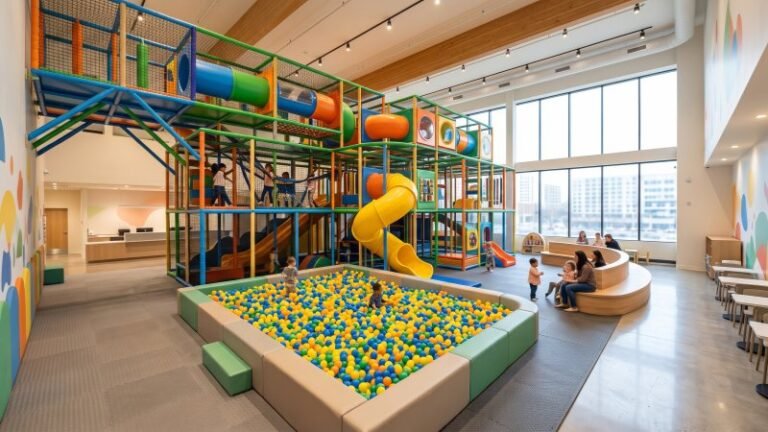
First, establish clear sightlines. Parents must be able to see their children easily from central seating areas. If parents feel anxious because they cannot locate their kids, they will leave early. Place seating strategically around the perimeter of active zones like soft play structures.
Second, control the entry and exit points. A single, wide entrance area equipped with clear signage and efficient ticketing kiosks prevents frustrating lines. Keep the redemption counter—where guests trade tickets for prizes—near the exit. This setup encourages one last transaction before they leave, but ensures the inevitable crowd does not block arriving guests.
Third, separate conflicting energy zones. You must keep loud, high-energy areas away from zones meant for relaxation. For instance, do not place a noisy redemption arcade directly next to a private birthday party room or a quiet dining area. Proper acoustic planning and physical separation ensure all guests have a positive experience.
Selecting High-ROI Attractions and Equipment Mix
Selecting a high-ROI attraction mix requires balancing large, highly visible anchor attractions that draw guests into the facility with smaller, high-turnover games that generate continuous revenue. By strategically combining high-capacity physical activities with a modern arcade and premium adult-focused amenities, operators can extend the average guest length of stay and significantly boost per capita spending.
Balancing Anchor Attractions with High-Turnover Games
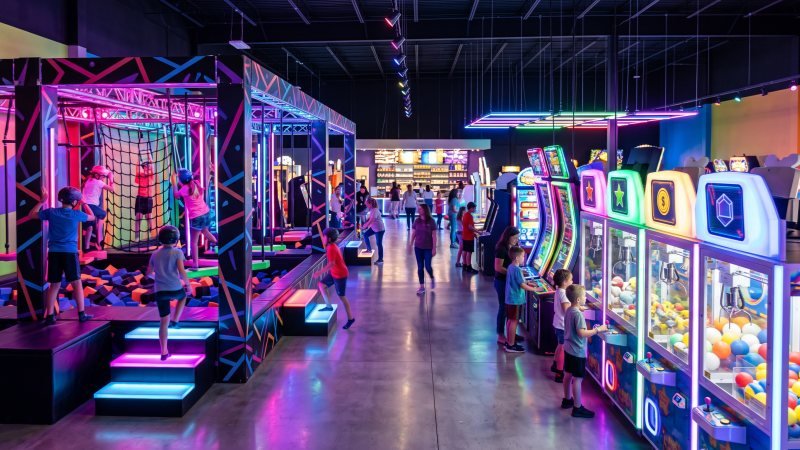
The core of a profitable entertainment center is its equipment mix. You must carefully balance “anchor” attractions with high-turnover experiences.
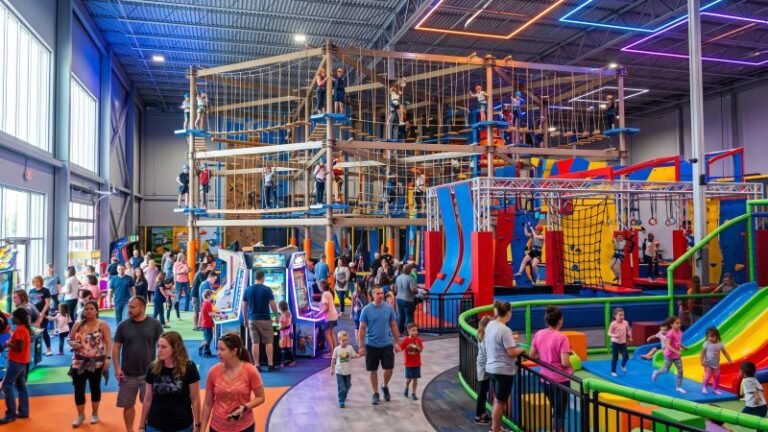
Think of anchor attractions like the main drive motor on a large Ferris wheel; they do the heavy lifting to keep the operation moving. Anchor attractions are large, immersive experiences that are the primary reason a guest decides to visit your facility. Examples include multi-level laser tag arenas, indoor go-kart tracks, or massive trampoline parks. These attractions are heavily promoted in marketing materials. However, they often have lower profit margins due to high staffing requirements and slow throughput (the number of guests who can play per hour).
On the flip side of the floor plan, high-turnover games act as your fast-paced cash generators. These include mini-bowling, bumper cars, or virtual reality (VR) pods. These attractions have a very fast cycle time. A guest can complete a game in three to five minutes. Because they process guests rapidly, they generate cash quickly and require very little staff supervision.
To maximize revenue, you must force interaction between these two categories. Do not cluster all the anchor attractions in one corner. Instead, strategically place high-turnover games along the walkways leading to the anchor attractions. This layout ensures guests spend money on smaller games while waiting for their scheduled time slot in the laser tag arena.
Maximizing Profit Margins with Modern Arcades
Want to know the real secret to boosting your bottom line without adding square footage? It’s all in the card system. Arcades are the undisputed profit engines of the modern entertainment center. While anchor attractions draw the crowds, the arcade often generates the highest profit margin per square foot.
Industry data consistently shows that a well-optimized arcade can account for 30% to 50% of a facility’s total revenue. To achieve this, you must move away from outdated coin-operated machines and embrace cashless card systems.
Card systems dramatically increase spending. When guests use a plastic card or an RFID wristband instead of physical tokens, the psychological barrier to spending drops. Even better, ditching physical tokens gives you the power to pull the lever on dynamic pricing. You can easily lower game prices on slow Tuesday mornings to drive traffic, and raise them during busy Saturday afternoons.
The key to a high-ROI arcade is the mix of game types. You should aim for a specific ratio:
| Arcade Game Category | Description | Recommended Mix Ratio |
|---|---|---|
| Redemption Games | Skill games that dispense digital tickets for prizes. | 60% – 70% |
| Video & Simulators | Racing games, shooters, and immersive VR setups. | 20% – 30% |
| Merchandisers | Cranes and claw machines offering direct physical prizes. | 10% – 15% |
“Redemption games are not just games; they are a psychological loop that keeps guests playing long after they initially planned to stop.”
Integrating Premium Food and Beverage Areas for Adults
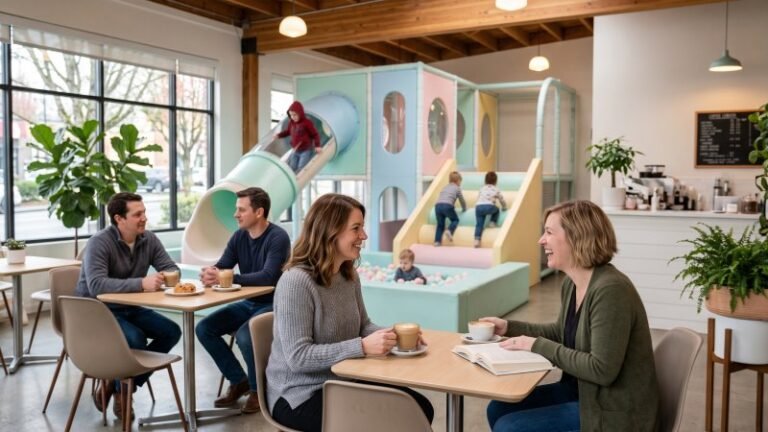
A critical mistake new operators make is focusing exclusively on children. While kids play, parents pay. If parents are bored or uncomfortable, they will cut the visit short.
That’s exactly why treating your Food and Beverage (F&B) program as a premium anchor is non-negotiable. A modern facility must offer more than just stale pizza and fountain soda. You need to create an environment where adults actively want to spend time.
This means upgrading the menu to include fast-casual artisan options, such as flatbread pizzas, gourmet sliders, and craft coffee. The real operational kicker? If local regulations allow, incorporating a bar that serves craft beer and wine is a massive revenue multiplier.
Adults sitting comfortably with good food and a beverage will allow their children to play much longer. This extended “Length of Stay” directly increases total spending. Design the F&B seating area with clear sightlines to the main play zones, comfortable lounge furniture, and fast Wi-Fi. By treating the parents as primary guests rather than just chaperones, you significantly increase your overall profitability.
Setting Up Operations and Management Systems
Establishing a solid operational foundation requires integrating robust Point of Sale (POS) and digital waiver software, building a rigorously trained staff, and executing a targeted pre-opening marketing campaign. These integrated management systems ensure compliance, streamline daily guest processing, and generate immediate cash flow before the physical doors even open.
Choosing the Right POS and Digital Waiver Software
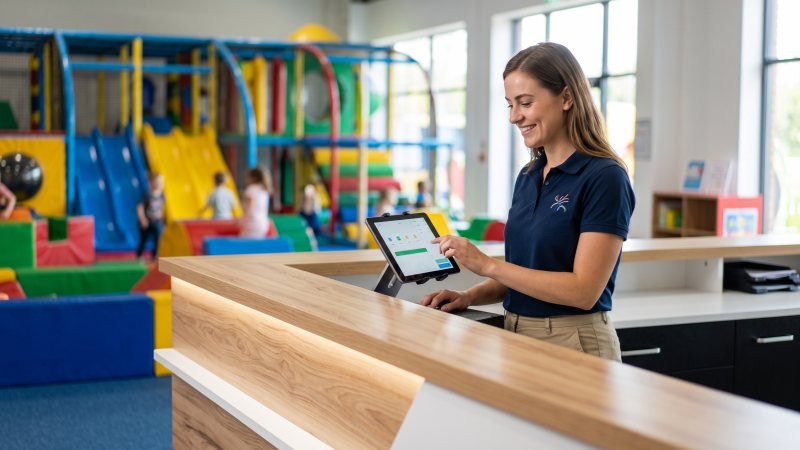
Your Point of Sale (POS) software is the central nervous system of your business. A modern POS system controls the flow of data across your facility, just like a central mainboard dictates the payout rate of a ticket redemption game. You cannot rely on basic retail cash registers. Instead, you need industry-specific software designed for family entertainment centers.
A proper system must seamlessly handle multiple revenue streams at once. It must manage front-desk admissions, online birthday party bookings, and food and beverage inventory. On top of that, it has to communicate flawlessly with your arcade card readers. This allows guests to use one single card or wristband for everything in the building.
What happens when your waiver kiosk crashes at 2 PM on a rainy Saturday? The whole building grinds to a halt. Digital waivers are equally important for risk management. If your facility includes active attractions like trampolines or climbing walls, liability waivers are legally mandatory. Because paper creates dangerous bottlenecks, deploying a rock-solid digital waiver platform is mandatory. Guests should be able to sign these documents online before they leave home.
Because data security protocols and API integration capabilities vary significantly between POS software and third-party hardware, always verify the exact compatibility requirements and PCI compliance standards directly with your software provider. Ensuring these systems talk to each other perfectly prevents launch-day computer crashes.
“Frictionless entry is the first step to a positive guest experience; digital waivers eliminate the front-door bottleneck.”
Structuring Your Hiring and Staff Training Programs
Equipment does not deliver great customer service; your employees do. Hiring the right people at the right time is critical for a successful launch. You cannot hire your entire staff two weeks before opening. Instead, you must follow a tiered hiring structure.
| Staff Tier | Role Examples | Hiring Timeline | Primary Training Focus |
|---|---|---|---|
| Tier 1 | General Manager, Operations Manager | 90-120 days before opening | System administration, P&L management, safety protocols. |
| Tier 2 | Shift Leads, Arcade Technicians, Head Chef | 45-60 days before opening | Machine repair, conflict resolution, food safety. |
| Tier 3 | Party Hosts, Ride Attendants, Cashiers | 15-30 days before opening | Guest experience, emergency stops, POS operation. |
Safety training must be your absolute highest priority. Ride attendants must know exactly how to execute an emergency stop on a spin zone bumper car. Party hosts must know how to handle food allergies.
The operational takeaway? Never cut corners on the training timeline. Host “soft opening” events where staff can practice serving friends and family. This low-pressure environment allows them to make mistakes and learn the POS system before paying customers arrive.
Implementing Pre-Opening Marketing Strategies
Marketing your facility should not start on opening day. Launching an entertainment center without pre-opening marketing is like starting a roller coaster halfway up the lift hill; you will lack the necessary momentum to succeed.
You must start building local hype at least 90 days before you open. First, build a high-quality website that captures email addresses. Offer a “Founder’s Club” discount to the first 500 people who subscribe. This builds an eager audience for your grand opening announcements.
With the audience locked in, it is time to start pre-selling. You do not need an open building to sell future birthday party packages. Use your architectural renderings and attraction lists to sell party slots for your second and third months of operation. This strategy generates crucial early cash flow.
To cap it off, tap into the local community network. Reach out to local schools, youth sports leagues, and charities. Offer them exclusive preview nights. By hosting these community leaders first, they will naturally spread positive word-of-mouth marketing throughout your primary trade area.
Conclusion
Getting a highly profitable family entertainment center off the ground is a heavy lift that demands operational discipline at every turn. From calculating your exact break-even point and securing commercial funding to optimizing your floor plan and installing cashless arcade systems, each step directly impacts your long-term success. By approaching the project methodically, focusing equally on engaging children and providing a premium experience for adults, you can create a thriving local destination. If you need further guidance on structuring your feasibility study, selecting the perfect equipment mix, or refining your operations plan, please contact us to ensure your launch is a complete success.