-
Whatsapp: +86 15516933785
-
Email: hanlin@hanlinplayground.com
-
Address: Shangjie District, Zhengzhou City, Henan Province, China
-
Whatsapp: +86 15516933785
-
Email: hanlin@hanlinplayground.com
-
Address: Shangjie District, Zhengzhou City, Henan Province, China

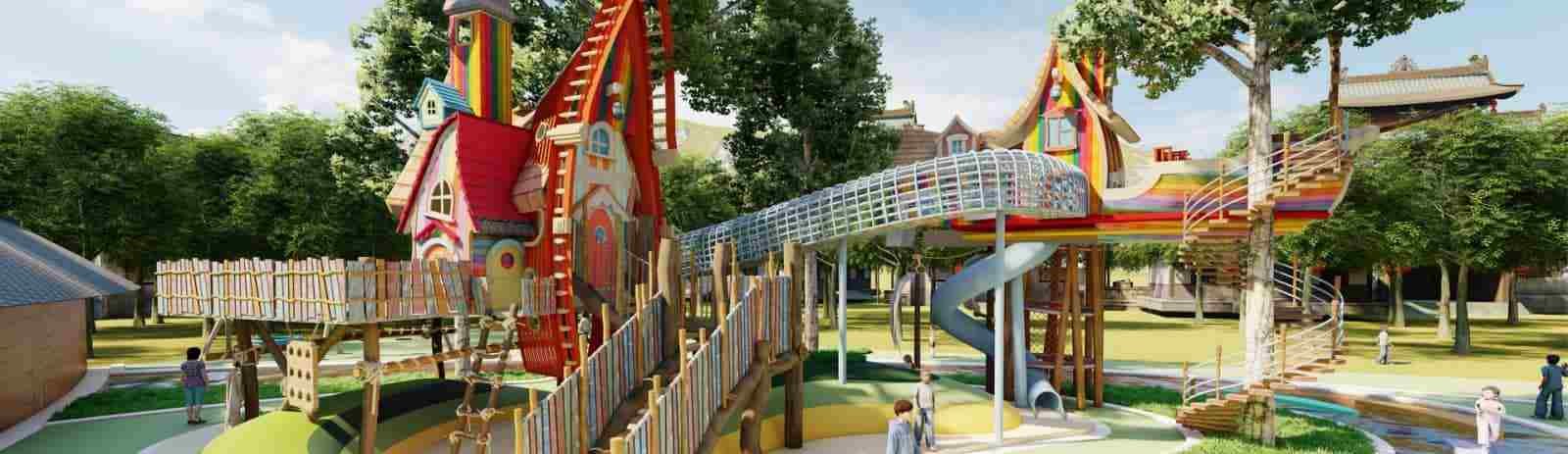
How to Choose an Outdoor Rope Net Bridge? Uncovering High-Durability Playground Net Materials
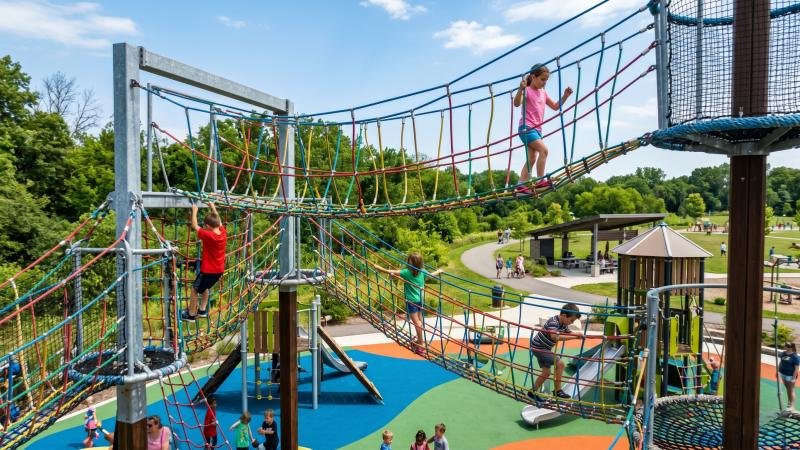
What are the most critical factors to consider when choosing a high-durability outdoor rope net bridge for a commercial playground?
Choosing a high-durability outdoor rope net bridge requires evaluating the internal material composition, specific weaving structures, and applied chemical coatings. Specifically, buyers must select synthetic fibers with galvanized steel wire cores, verify the presence of UV stabilizers and hydrophobic treatments, and match the overall weave density and mechanical connectors to the specific environmental challenges of the installation site.
The Anatomy of High-Durability Playground Ropes
What exactly gives high-durability playground ropes the strength to safely support dozens of children at once?
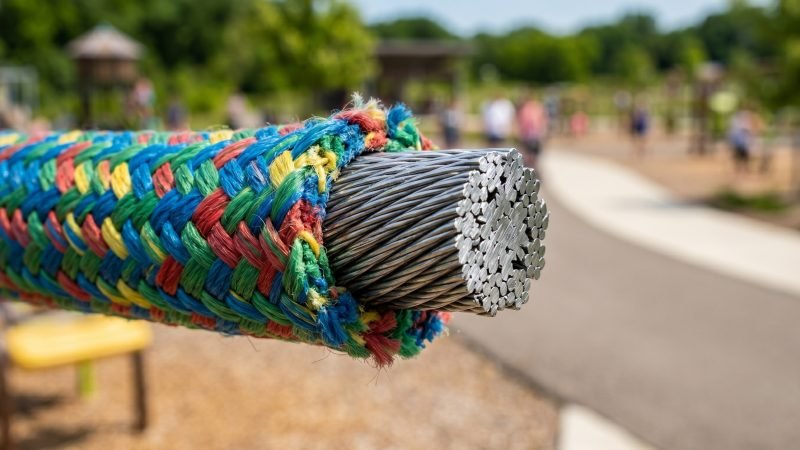
High-durability playground ropes achieve their strength through a composite structure. They combine soft synthetic outer fibers with an internal galvanized steel wire core. As a result, this hybrid anatomy handles extreme tensile loads while providing a safe, comfortable grip for users.
Synthetic Fibers Compared: Polyester vs Nylon vs Polypropylene
When building an outdoor rope net bridge, the outer material matters greatly. Manufacturers typically use three main synthetic fibers. They definitely do not all perform equally under heavy use, so knowing the exact differences between these polymers isn’t just trivia—it’s essential for structural safety.
| Fiber Type | Key Characteristic | Typical Application in Playgrounds |
|---|---|---|
| Polyester | Low stretch, high strength | Standard for commercial net bridges |
| Nylon | High stretch, shock absorbing | Used where dynamic impact is expected |
| Polypropylene | Lightweight, floats on water | Low-budget or temporary play structures |
Polyester is the undisputed industry standard for outdoor rope net bridges. It holds its shape extremely well under tension. Plus, it maintains a comfortable, soft grip. Nylon, on the other hand, stretches significantly when pulled. Think of nylon like the elastic springs in a playground trampoline system. It is great for absorbing sudden shocks, but the trade-off is an unstable, bouncy walking surface on a bridge floor. Polypropylene is the cheapest option. The catch? It wears down quickly under heavy foot traffic.
Since raw material grades vary between manufacturers, the specific tensile strength and stretch percentage of these fibers can fluctuate. Always verify the exact load rating and material specifications with your supplier before purchasing.
The Role of Galvanized Steel Wire Cores
Synthetic fibers provide a comfortable grip, but they cannot safely hold the weight of multiple children on their own. This is where the steel core does the heavy lifting.
A standard heavy-duty playground rope usually contains a core made of multiple steel wire strands. Typically, manufacturers use a 6-strand steel wire configuration. These wires are twisted together to form a solid backbone. Why do we not just use bare steel cables? Bare cables are abrasive and dangerous for children to grab. The composite rope solves this problem completely by hiding the industrial strength inside a soft jacket.
Here’s the critical part: those internal wires must be galvanized. Galvanization coats the steel with a protective layer of zinc, stopping rust from forming inside the rope. It is a very similar process to how heavy-duty steel chains for commercial swing sets are treated to prevent corrosion. That way, even if moisture penetrates the outer fabric, the internal structure remains structurally sound.
Yarn Extrusion and Material Tensile Strength
To truly understand rope durability, we have to look at how the fibers are made. The manufacturing process directly impacts the final strength of the bridge.
The journey begins with yarn extrusion. Factories melt raw plastic pellets into a thick liquid, then push this liquid through a metal plate full of tiny holes, called a spinneret. This process forces the liquid polymer into continuous, solid filaments. You can compare this to how solid plastic playground handles are manufactured. While injection molding pushes plastic into a closed die to make a solid part like a handle, extrusion pushes the liquid through open holes to make long, continuous threads.
The speed at which these newly formed threads cool down changes their internal structure. Slower cooling allows the plastic molecules to align perfectly. That molecular alignment is exactly what generates massive tensile strength—the maximum amount of pulling force the material can take before it breaks, usually measured in kilonewtons (kN). Ropes with highly aligned molecular structures can handle much heavier loads without snapping. The takeaway? Precision extrusion directly translates to a safer, more resilient net bridge.
Advanced Coating and Weatherproofing Technologies
How do outdoor playground ropes survive years of harsh weather without breaking down?
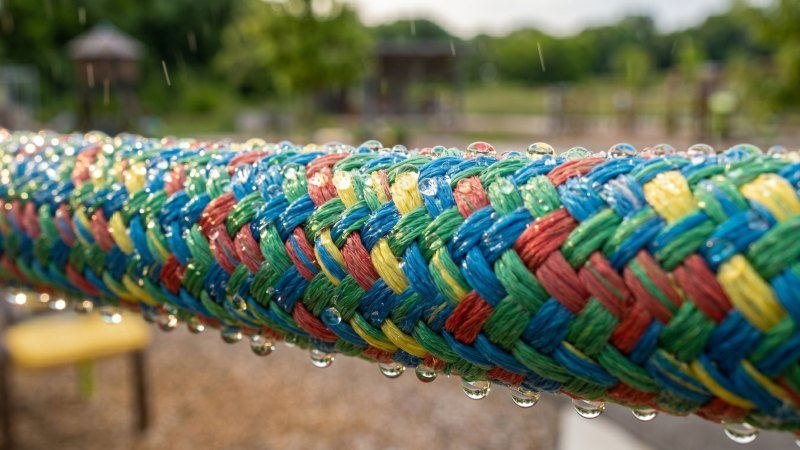
High-durability playground ropes survive severe weather through specialized chemical treatments applied during manufacturing. Specifically, factories integrate UV stabilizers directly into the polymer mix and apply hydrophobic coatings to the exterior. Through these treatments, the ropes actively repel water, prevent structural degradation from sunlight, and block the growth of organic matter like mildew.
UV Stabilizers for Prolonged Sun Exposure
Sunlight is the biggest enemy of outdoor playground plastics. Specifically, ultraviolet (UV) rays break down the molecular bonds inside synthetic yarns, making the rope dangerously brittle over time. That’s why top-tier manufacturers integrate UV stabilizers during the production phase.
What exactly are UV stabilizers? They are chemical additives mixed into the raw plastic before extrusion. You can compare this to how powder coating protects steel playground support posts from oxidizing. The powder coat acts as a permanent, bonded shield. In the exact same way, UV stabilizers absorb or reflect the harmful radiation before it damages the core fibers.
Engineers measure UV resistance using the Kilo-Langley (KLY) scale. For commercial playgrounds, netting usually requires a rating between 300 and 500 KLY. Keep in mind, this required rating can change depending on your geographic location and local sun intensity.
| Material Condition | Expected Lifespan | Surface Texture | Structural Integrity |
|---|---|---|---|
| Untreated Rope | 1 to 2 years | Becomes brittle and chalky | High risk of sudden snapping |
| UV-Stabilized Rope | 5 to 10+ years | Remains flexible and smooth | Maintains original tensile strength |
Hydrophobic Treatments Against Rot and Mildew
Why is standing water so dangerous for netting? Moisture trapped inside rope fibers promotes the rapid growth of rot and mildew. Worse, wet ropes become dangerously slippery for children. To engineer around this, manufacturers apply strong hydrophobic treatments to the finished ropes.
These treatments typically involve polyurethane-based dips or sprays that create a microscopic seal around the individual yarns. Because of this seal, water simply beads up and rolls off the surface. This is very similar to how heavy-duty canvas covers for commercial playground sandboxes are treated with industrial sealants—forcing the rainwater to shed instantly rather than soaking in.
Beyond that, blocking moisture prevents the internal steel wire core from rusting prematurely, and mildew cannot grow without trapped water. The result is a highly effective defense line that drastically reduces long-term maintenance costs.
“Hydrophobic sealing is not just for waterproofing; it is a critical anti-microbial defense line for high-traffic commercial playgrounds.”
Colorfastness Testing in Extreme Climates
Visual appeal is absolutely crucial for commercial playgrounds. But let’s be real, bright colors fade fast under harsh weather. This fading makes the entire play structure look old, neglected, and potentially unsafe. To counter this, top manufacturers run strict colorfastness testing to guarantee long-lasting aesthetics.
Testing facilities use Xenon arc chambers to simulate years of intense sunlight and heavy rain, exposing the rope samples to accelerated weathering cycles. Afterward, quality control inspectors grade the color retention using standardized international scales.
The most common industry metric is the Blue Wool Scale, which ranges from 1 to 8. A rating of 7 or 8 indicates excellent colorfastness under extreme conditions. At the end of the day, using high-grade tested pigments ensures your rope net bridge maintains a vibrant appearance for years, preserving the visual appeal of the entire play space.
Rope Construction and Weaving Techniques
The physical construction method of a playground rope directly dictates its load distribution, wear resistance, and structural stability. Advanced weaving techniques interlock fibers to maximize tensile strength while eliminating weak friction points. This precise geometric arrangement guarantees the mesh won’t unravel under heavy dynamic loads, ensuring long-term safety for commercial play structures.
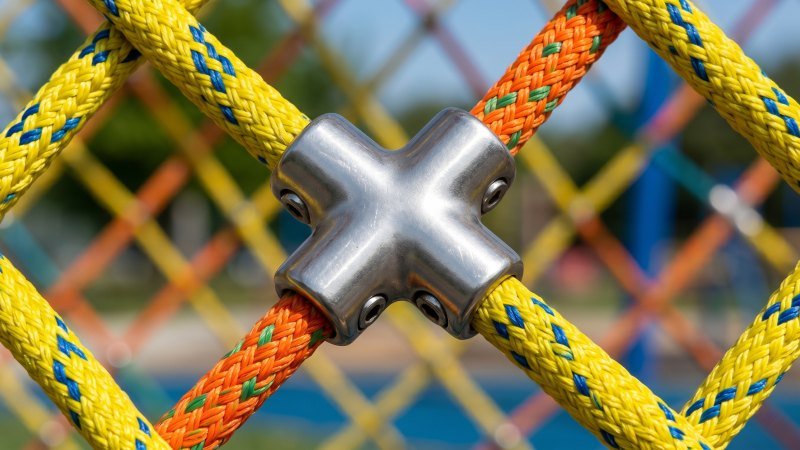
Braided vs Twisted Rope Structures
Factories generally manufacture ropes in two main ways: twisting or braiding. Twisting is the older, more traditional method where large bundles of yarn are simply spun in the same direction. Conversely, a braided rope weaves multiple smaller strands over and under each other in a complex, interlocking pattern.
For high-durability playground bridges, braided rope is significantly superior. Twisted ropes have a major mechanical flaw. When heavy weight is applied, the rope naturally tries to untwist. You can compare this to a coiled suspension spring on a playground zip-line brake; it naturally wants to uncoil when pulled. This untwisting action creates a highly unstable walking surface.
Braided ropes, however, lock their strands into place. The opposing weave patterns cancel out the twisting forces. Because of this, the bridge floor remains flat and stable when children walk across it.
Knotted vs Knotless Mesh for Wear Reduction
When building a net bridge, the individual ropes must intersect to form a grid. Historically, manufacturers tied physical knots at every single intersection. Today, modern commercial playgrounds increasingly rely on knotless mesh designs.
Why are physical knots such a liability? First, a knot creates a permanent, sharp bend in the rope, acting as an unnatural stress concentration point. You can compare this to sharply bending a steel playground support tube; the crease immediately becomes the weakest point of the entire structure. Industry testing shows that a physical knot can reduce a rope’s total breaking strength significantly.
Worse still, knots protrude from the surface. This creates high-friction bumps that constantly rub against children’s shoes, wearing out much faster than the rest of the rope.
| Connection Type | Structural Impact | Wear Resistance | Best Use Case |
|---|---|---|---|
| Traditional Knots | Lowers overall tensile strength | Poor; knots create high-friction wear points | Low-traffic or decorative nets |
| Mechanical Connectors | Maintains full rope strength | Excellent; smooth aluminum or plastic joints | Steel-reinforced commercial nets |
| Woven Knotless | Distributes load evenly | High; creates a flat, smooth play surface | Standard synthetic climbing nets |
For heavy-duty ropes containing steel wire cores, tying a knot is nearly impossible without kinking the steel. To get around this, manufacturers achieve a “knotless” grid using heavy-duty aluminum or high-density plastic cross-connectors. These smooth mechanical joints hold the intersecting ropes firmly together without bending the core.
The Impact of Weave Density on Friction Resistance
Weave density refers to how tightly the outer synthetic yarns are packed together. In the manufacturing industry, this is often measured by the number of “picks per inch” (PPI). A higher PPI means the yarns are woven very closely together.
What happens when hundreds of grit-covered shoes pound that rope day after day? High weave density becomes your first line of defense. If the rope has a loose, low-density weave, tiny abrasive particles easily slip between the yarns. Once inside, the dirt acts like sandpaper, slowly grinding away at the internal fibers and the steel core every time the rope flexes.
Flip that around: a high-density weave creates a tight, impenetrable armor. It physically blocks dirt and sand from entering the rope structure. Think of this like the difference between an open chain-link playground enclosure and a solid HDPE safety panel. The tight weave leaves no gaps for foreign objects to enter. In short, specifying a high-density weave is one of the most effective ways to extend the lifespan of an outdoor net bridge in a busy playground.
Matching Net Materials to Specific Environments
Selecting the correct playground netting requires matching the material’s physical properties to the local environment. Coastal areas demand marine-grade anti-corrosion components, sub-zero climates require cold-resistant polymer blends, and urban centers necessitate maximum abrasion resistance. Tailoring your material choice to these localized threats prevents premature structural failure and ensures long-term safety.
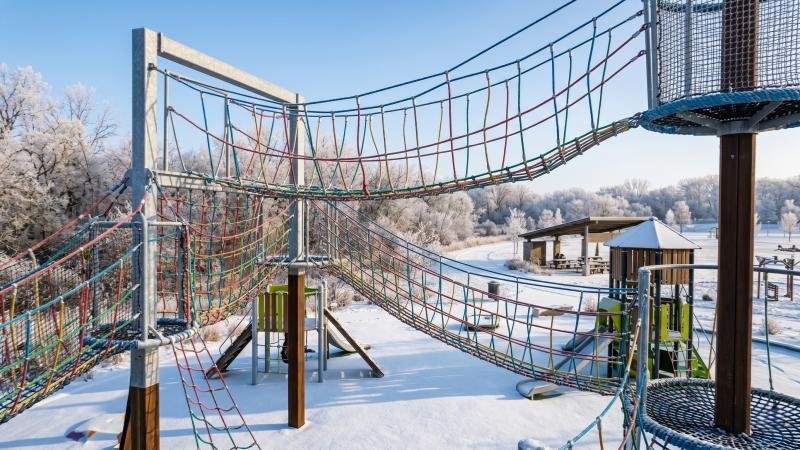
Anti-Corrosion Needs for Coastal Playgrounds
Think standard galvanized steel will survive a beachfront installation? Think again. Coastal environments destroy standard playground equipment rapidly. The constant exposure to airborne salt and high humidity accelerates metal oxidation. While the synthetic outer rope jacket naturally resists water, the internal steel wire core and the connecting hardware remain highly vulnerable to rust.
Because of this, coastal rope net bridges require severe anti-corrosion upgrades. You can compare this structural upgrade to specifying hot-dip galvanized steel for a marine splash pad structure instead of standard powder-coated park posts. Standard aluminum connectors will quickly pit and fail. Instead, you must utilize 316 marine-grade stainless steel for all mechanical joints and structural anchor points.
On top of that, the internal wire core requires a specialized, heavy-duty zinc coating. Because the exact micron thickness of this zinc coating can vary significantly based on different material suppliers, you should carefully verify the specific galvanization ratings with your manufacturer to guarantee marine compliance.
| Component | Standard Inland Material | Required Coastal Upgrade |
|---|---|---|
| Internal Wire Core | Standard electro-galvanized steel | Heavy-duty hot-dip galvanized steel |
| Cross Connectors | Aluminum or high-density plastic | 316 marine-grade stainless steel |
| Anchor Shackles | 304 stainless steel | 316 marine-grade stainless steel |
Maintaining Material Flexibility in Sub-Zero Temperatures
Ever wonder why some nets shatter instead of stretching after a hard freeze? Winter weather drastically alters the physical state of synthetic ropes. When temperatures drop below freezing, standard plastic fibers undergo a process called glass transition. As a result, the soft outer jacket hardens, loses its elasticity, and becomes dangerously brittle.
If children jump heavily onto a frozen net bridge, the stiff synthetic fibers can snap rather than stretch. This type of structural failure is very similar to how standard EPDM playground rubber safety tiles can crack during a hard freeze if they lack proper cold-weather chemical additives.
To engineer out this danger, manufacturers create specialized cold-weather ropes using modified polymer blends. These specialized formulas lower the material’s freezing point, ensuring the bridge remains flexible and safe to use even at freezing temperatures.
“A playground net bridge must maintain its dynamic load-absorbing properties regardless of the ambient temperature to prevent catastrophic fiber snapping.”
Maximum Abrasion Resistance for High-Traffic Urban Areas
Urban city parks face a completely different environmental threat: intense, non-stop friction. These playgrounds often see hundreds of visitors daily. Add to that the fact that city environments are filled with microscopic concrete dust and abrasive street grit.
When thousands of rough shoes track this grit onto the rope bridge, it acts like industrial sandpaper. Standard ropes will fray quickly under this intense mechanical wear. Because of this extreme wear, high-traffic urban nets require maximum abrasion resistance, usually achieved by utilizing a much thicker synthetic outer jacket around the internal core.
Beyond the rope itself, urban nets benefit from reinforced impact zones. Just as high-wear areas under playground swings require extra-thick rubber wear mats to prevent holes, high-traffic net bridges require heavy-duty, tamper-proof connectors. These durable connectors physically shield the rope intersections from direct foot traffic. At the end of the day, increasing the physical thickness of the protective rope jacket is the most reliable defense against extreme urban wear and tear.
Conclusion
Let’s wrap this up. Selecting the right outdoor rope net bridge goes far beyond choosing an attractive color or a basic size. It demands a rigorous understanding of material science, from the molecular alignment during yarn extrusion to the marine-grade capabilities of the mechanical connectors. By prioritizing steel-reinforced synthetic fibers, high-density braided structures, and environment-specific weatherproofing, playground planners can ensure maximum safety and longevity for their play spaces. Investing in the proper materials upfront fundamentally reduces long-term maintenance costs and guarantees a secure environment for children to explore.
If you need further guidance on specifying the exact materials or safety standards for your next commercial playground project, please contact us.