-
Whatsapp: +86 15516933785
-
Email: hanlin@hanlinplayground.com
-
Address: Shangjie District, Zhengzhou City, Henan Province, China
-
Whatsapp: +86 15516933785
-
Email: hanlin@hanlinplayground.com
-
Address: Shangjie District, Zhengzhou City, Henan Province, China

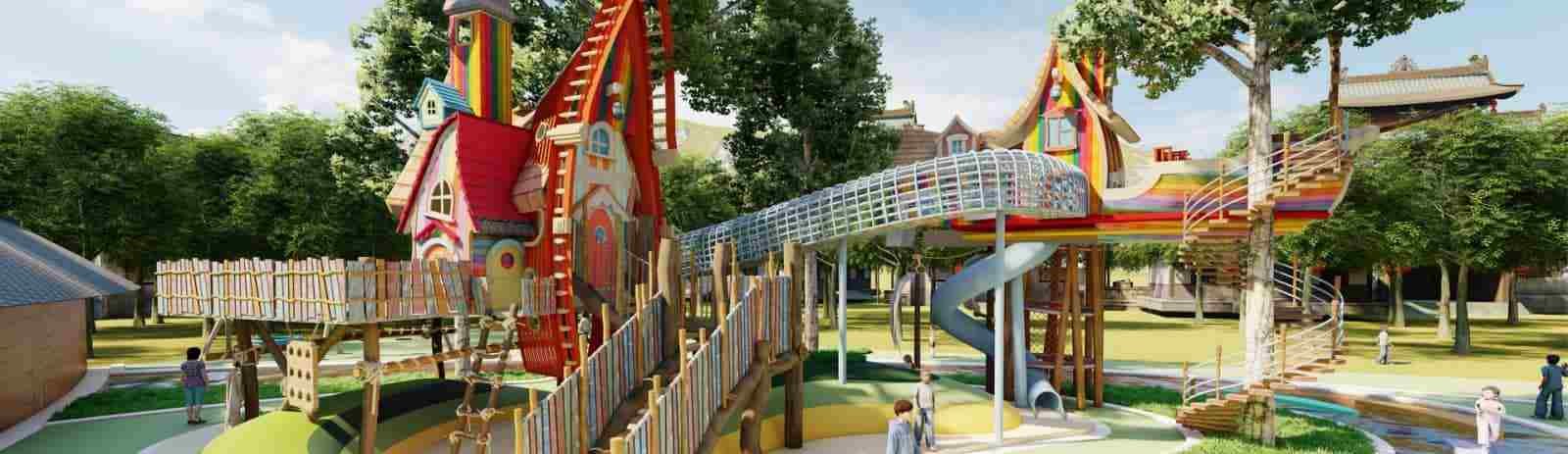
Popular Trends in Trailer Playgrounds: Maximizing Revenue for Mobile Amusement Businesses
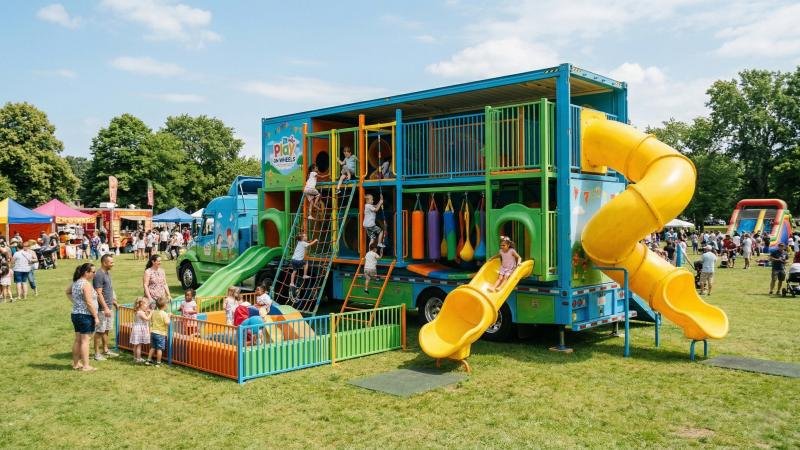
Are you looking for the most effective strategies to maximize your rental revenue with modern trailer playgrounds?
Maximizing revenue in the mobile amusement industry requires leveraging the latest trailer playground trends, including quick-deploy soft play systems, climate-controlled interiors, and hybrid trampoline layouts. By targeting high-profit markets like corporate events and RV parks, while strictly adhering to safety, maintenance, and strategic purchasing protocols, operators can significantly increase their return on investment and build a sustainable, year-round business.
Top Design Innovations and Functional Upgrades
Are you wondering what new design features make modern mobile playgrounds so profitable for rental operators?
The top design innovations include quick-deploy foldable soft play systems, hybrid obstacle layouts, and built-in climate control. These functional upgrades drastically reduce setup times and expand target demographics to older children. More importantly, they guarantee year-round operation regardless of extreme weather. Bottom line, these features directly maximize a rental business’s return on investment.
Quick-Deploy Foldable Soft Play Systems
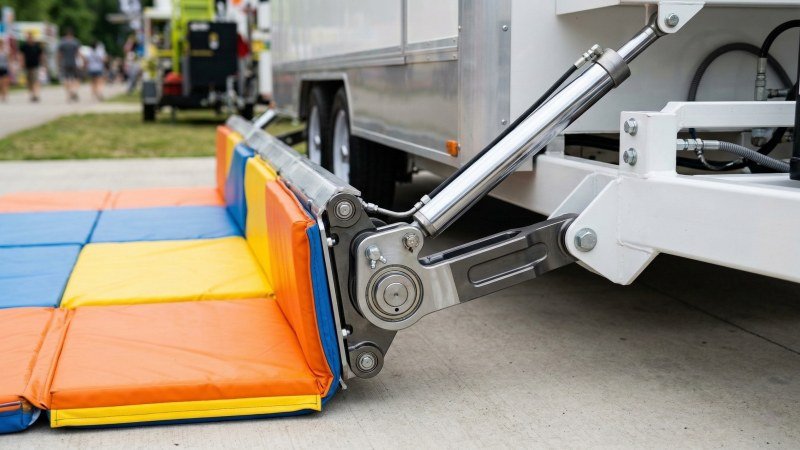
We all know time is money in this business. That’s why rapid deployment is the absolute lifesaver for modern playground trailers. Ever tried wrestling with a frozen bounce house blower at 6 AM in November? It’s a nightmare. We used to spend hours inflating bounce houses or manually assembling metal frames. Today, engineers use quick-deploy foldable soft play systems.
These systems operate similarly to the hydraulic folding mechanisms found on portable carnival rides, such as mobile Ferris wheels or drop towers. The walls and floors attach directly to the trailer chassis with heavy-duty steel hinges. When you park the trailer, hydraulic panels simply fold out to create the play floor. Then, the soft play components slide into pre-measured slots.
This innovation cuts setup time drastically. Older equipment often required a three-person crew working for two hours. Now, a modern folding trailer can be fully operational in just 15 minutes with a single operator. The result? This lower labor requirement directly increases your daily profit margin. You can easily book three or four parties in a single Saturday.
On top of that, these quick-deploy systems utilize commercial-grade, fire-retardant PVC vinyl. This material handles constant folding without cracking. Keep in mind, hinge weight capacities and vinyl thicknesses vary by manufacturer. So, always verify the exact technical specifications with your supplier before purchasing to ensure the system can handle high-volume commercial use.
| Feature | Traditional Inflatable Setup | Quick-Deploy Trailer System |
|---|---|---|
| Average Setup Time | 60 – 120 minutes | 15 – 20 minutes |
| Required Labor Crew | 2 – 3 workers | 1 worker |
| Power Requirement | Continuous loud blower | Battery or brief generator use |
Hybrid Layouts Featuring Trampolines and Obstacles
Let’s look at another game-changer: the shift from single-activity units to hybrid layouts. A standard ball pit only entertains toddlers. To maximize revenue, mobile businesses need to capture a wider age range. To solve this, manufacturers now combine multiple activities into one compact trailer.
A hybrid layout typically features a small trampoline zone and a multi-level obstacle course. Think of it like a condensed version of a massive indoor family entertainment center (FEC), where every square inch is optimized to fit interactive elements without wasting floor space. Children can jump on the trampoline, crawl through a tunnel, and slide into a ball pit.
This diverse design keeps kids engaged much longer. According to industry rental data, hybrid trailers see a 40% higher repeat booking rate than standard single-activity units. Parents feel they get better value because the equipment entertains multiple age groups simultaneously.
To achieve this safely, builders use high-tensile steel frames to support the dynamic bouncing weight. To back that up, they install heavy-duty mesh netting between zones to prevent collisions.
Climate-Controlled Interiors for All-Season Rentals
Let’s be real, weather is the biggest enemy of the outdoor event rental industry. Rain or extreme heat often forces operators to cancel bookings and issue refunds. To engineer our way out of this problem, premium trailer playgrounds now feature fully enclosed interiors.
These units use rigid fiberglass or insulated aluminum composite panels. Inside, they are equipped with commercial roof-mounted air conditioning and heating units. This setup is very similar to the climate control systems used in premium mobile escape room trailers or high-end mobile arcade units. It keeps the indoor temperature consistently comfortable, regardless of the outside weather.
Think about it: with a climate-controlled trailer, your business becomes a true year-round operation. You can confidently book outdoor parties in a freezing winter or a sweltering summer. This capability entirely eliminates seasonal downtime. In regions with harsh climates, operators report up to a 60% increase in annual revenue.
These trailers usually require a dedicated portable generator to power the units continuously. Since insulation R-values and cooling capacities vary based on the specific construction materials used, it is crucial to ensure the unit you select matches your local climate demands.
Most Profitable Target Markets to Capture
So, which specific customer segments offer the highest return on investment for your mobile playground business?
The most profitable target markets include private residential birthday parties, local community festivals, corporate events, and family-friendly RV parks. These segments provide high daily rental rates, consistent repeat bookings, and diverse revenue streams. By targeting these specific demographics, operators can maximize their equipment utilization and achieve a faster return on investment.
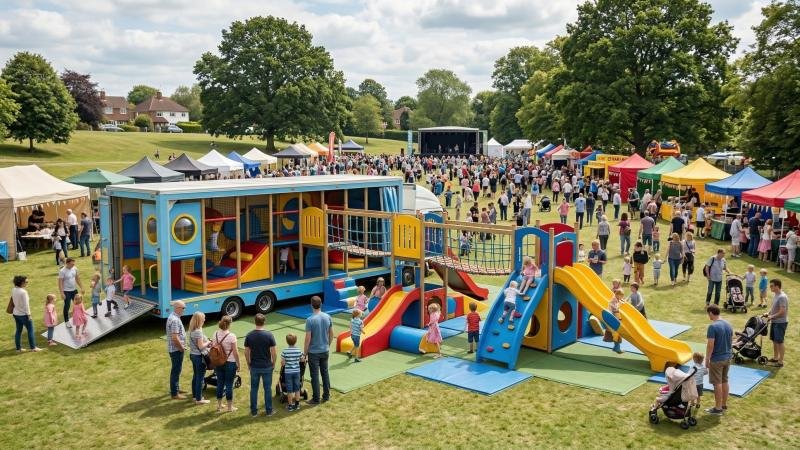
Private Residential Birthday Parties
Private birthday parties are the financial foundation of the mobile amusement industry. Why do parents love this option? Simply put, they pay a premium for total convenience. A trailer playground delivers an entire entertainment center right to a customer’s front door.
Think of this service like a mobile video game theater. The equipment arrives, entertains the guests, and leaves. The host never has to supervise complicated setups or clean up a messy house. Because of this, residential bookings offer incredibly consistent weekend cash flow. Industry rental data shows that residential parties account for roughly 60% of standard mobile amusement bookings.
Even better, these events usually only require a two-to-four-hour rental block. That means you can easily schedule two or three parties in a single day. This rapid turnover maximizes your daily revenue potential.
But here’s the catch: residential driveways have strict size limitations. Because trailer lengths and turning radiuses vary significantly between models, operators must always measure their exact spatial dimensions. You’ve got to ensure your equipment can safely navigate typical neighborhood streets and cul-de-sacs before accepting a booking.
Local Community Festivals and Corporate Events
While residential parties offer consistent volume, large-scale events deliver massive profit margins. Local community festivals, school carnivals, and corporate family days are incredibly lucrative targets for any mobile rental operator.
At these events, you are not just entertaining a dozen kids. Instead, you are processing hundreds of children over a full day. Similar to operating a temporary mechanical ride at a county fair, your trailer becomes a high-capacity anchor attraction. Because corporate entities have larger entertainment budgets, their day rates are typically 200% to 300% higher than standard residential fees.
Beyond the immediate cash, corporate events provide unmatched local marketing exposure. When hundreds of parents see your clean, professional equipment at a town festival, they will ask for your business card. Naturally, one successful festival appearance often leads to dozens of private party bookings later in the year.
“Securing just three corporate family day contracts per season can entirely cover the annual financing cost of a premium mobile playground unit.”
| Market Segment | Average Rental Duration | Profit Margin Potential | Primary Business Benefit |
|---|---|---|---|
| Residential Parties | 2 – 4 Hours | Moderate | High volume of consistent weekend bookings. |
| Corporate Events | 6 – 8 Hours | Very High | Premium day rates and excellent brand exposure. |
Family-Friendly RV Parks and Campgrounds
The RV park and campground industry represents a rapidly growing B2B market for mobile playgrounds. Today, campgrounds must offer robust amenities to attract modern traveling families. But breaking ground on a permanent, concrete-based playground requires expensive permits, site preparation, and long construction delays.
Trailer playgrounds offer a perfect “turnkey” solution for these businesses. A campground owner can simply purchase or lease a unit, park it on an empty concrete pad, and instantly upgrade their family amenities. Much like a summer camp might lease modular inflatable water parks for a peak season, a campground can deploy a mobile playground to handle the summer family influx.
Campgrounds with dedicated children’s entertainment report up to a 25% increase in weekend occupancy rates. Parents will actively choose an RV park that keeps their kids safely entertained. For mobile rental operators, this opens a unique long-term revenue stream. Instead of renting by the hour, you can lease your equipment to a campground for an entire month or season. This strategy provides guaranteed, passive income during peak travel months.
Key Safety and Maintenance Considerations
Are you aware of the critical safety protocols and maintenance routines required to keep a mobile playground profitable and legally compliant?
Proper safety and maintenance considerations directly protect your investment and prevent costly liability claims. Essential practices include securing loose playground components for highway transit, implementing daily sanitization for soft play vinyl, and strictly adhering to commercial towing weight limits. By mastering these protocols, operators ensure continuous equipment availability, pass state amusement inspections, and maintain a spotless reputation with clients.
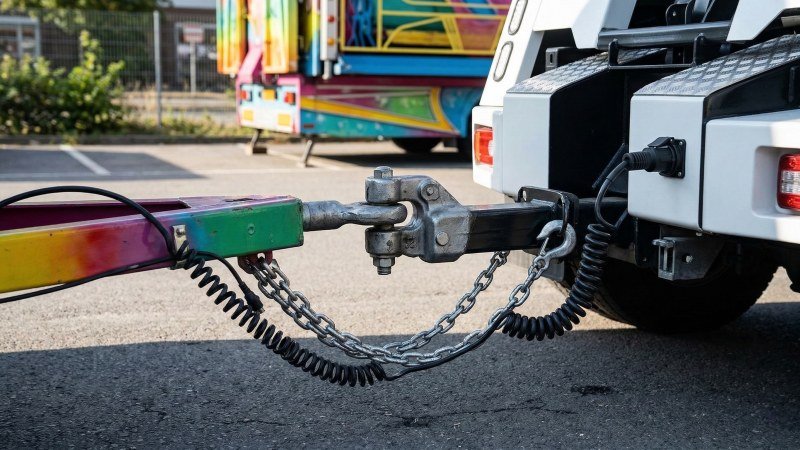
Securing Equipment for Highway Transportation
Highway travel is extremely tough on commercial amusement equipment. Continuous vibration, sudden braking, and severe wind shear can easily damage your investment. That’s why securing your trailer playground properly is absolutely vital before every trip.
Think of this process like preparing a mechanical carnival ride for a cross-country move. Every movable part must be locked down. First, operators must secure all folding hydraulic panels with heavy-duty steel safety pins. By doing this, the panels cannot accidentally deploy while driving at highway speeds.
Let’s talk about the inside. Loose interior components require strict attention. Items like foam building blocks, padded rocker toys, and loose balls must be packed into heavy-duty cargo nets. Operators must then anchor these nets directly to the trailer’s internal D-ring tie-downs. Using industrial-grade ratchet straps prevents internal components from smashing against the trailer walls during transit.
Because structural load limits and exact D-ring locations vary widely based on the manufacturer’s design, always verify the approved tie-down points and strap tension ratings with your supplier. Following these specific guidelines prevents structural warping over time.
Efficient Cleaning Protocols for Soft Play Materials
In the family entertainment industry, hygiene is a major selling point. Parents will actively inspect your equipment. That means implementing efficient cleaning protocols is a direct investment in your business reputation.
Cleaning a mobile playground is very similar to sanitizing a commercial indoor trampoline park. Operators must use the correct chemicals to protect the equipment. For instance, you should never use harsh bleach on PVC soft play vinyl. Bleach quickly strips away the commercial fire-retardant coating. Instead, operators must use EPA-registered, hospital-grade, non-toxic botanical disinfectants. These specific cleaners kill bacteria and viruses without degrading the vinyl fabric.
Do you really want your road crew spending three hours wiping down individual pit balls by hand? Obviously, cleaning thousands of plastic pit balls manually is a massive waste of labor. To maximize efficiency, successful rental businesses invest in commercial ball-washing machines.
“A standard commercial ball-washing machine can automatically vacuum, scrub, disinfect, and dry up to 10,000 plastic balls in a single hour.”
Because vinyl thicknesses and specialized antimicrobial coatings can vary based on the specific materials used during manufacturing, always verify the approved list of chemical cleaning agents with your supplier before applying any new product to avoid voiding your warranty.
Weight Distribution and Towing Capacity Limits
Understanding towing mechanics is non-negotiable for mobile amusement operators. Ignoring commercial towing limits leads to catastrophic accidents and voided insurance policies. You must perfectly match your tow vehicle to your playground trailer. Is it really worth risking a catastrophic highway rollover just to max out a smaller tow rig?
Rule number one: understand the Gross Vehicle Weight Rating (GVWR). The GVWR is the absolute maximum loaded weight of the trailer. Your truck’s towing capacity must comfortably exceed this number. Beyond that, proper weight distribution inside the trailer is critical to prevent dangerous trailer sway, often called fishtailing.
Exactly like balancing the weight distribution when hauling a multi-unit mobile rock climbing wall, the payload must be distributed properly over the axles. The golden rule of hauling is the 60/40 split. Specifically, 60% of the interior cargo weight must sit in front of the trailer axles, closer to the truck. Meanwhile, 40% sits behind the axles.
Don’t forget to monitor the tongue weight. This is the downward pressure the trailer applies to the truck’s hitch.
| Hauling Metric | Standard Industry Recommendation | Danger Zone (Avoid) |
|---|---|---|
| Tongue Weight | 10% to 15% of total trailer weight | Under 10% (Causes severe sway) |
| Cargo Distribution | 60% Front / 40% Rear | Heavy weight loaded in the far rear |
| Towing Capacity | Truck capacity is 20% over Trailer GVWR | Maxing out truck limits exactly |
Because hitch classes, axle weight ratings, and structural payloads vary significantly across different custom builds, always verify the exact GVWR and required hitch specifications with your trailer manufacturer prior to purchasing a tow vehicle.
Purchasing Strategies for High ROI
How can mobile amusement operators strategically purchase trailer playgrounds to ensure the highest possible return on investment?
Maximizing ROI requires a calculated purchasing strategy focused on long-term profitability rather than just the initial price tag. Operators must carefully evaluate the immediate deployment benefits of turnkey solutions against the targeted demographic appeal of custom builds. Furthermore, selecting certified manufacturers ensures continuous compliance and minimizes liability risks. Finally, analyzing the total cost of ownership guarantees accurate pricing models and sustainable business growth.
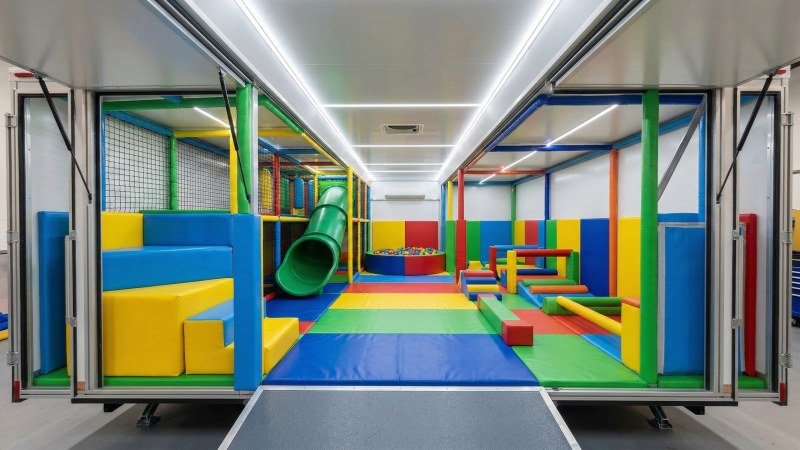
Evaluating Turnkey Solutions Versus Custom Builds
When starting a mobile amusement business, you face a major decision. Should you buy a turnkey solution or a custom build? Both options offer different paths to profitability.
A turnkey solution is a pre-designed, ready-to-operate trailer. Think of this like purchasing a standard commercial bounce house from a catalog. It is fully engineered, tested, and ready to rent immediately. As a result, turnkey units provide the fastest path to generating revenue. You bypass long engineering phases and manufacturing delays.
On the flip side, a custom build allows you to design every inch of the equipment. You can dictate the exact color schemes, activity zones, and branding. This is similar to commissioning a bespoke inflatable obstacle course for a specific corporate client. Custom trailers help you stand out in highly saturated rental markets.
The catch? Custom builds require significantly more upfront capital. Additionally, they often take months to construct. Since build times and custom engineering fees vary greatly between projects, operators should secure guaranteed production timelines in writing before committing capital.
| Purchasing Option | Initial Investment | Average Manufacturing Time | Best Business Application |
|---|---|---|---|
| Turnkey Solution | Lower | 2 – 4 Weeks | Rapid market entry and immediate cash flow. |
| Custom Build | Higher | 12 – 16 Weeks | Brand differentiation and niche market targeting. |
Choosing Reliable Manufacturers and Certifications
How do you know if a trailer manufacturer is truly reliable? Choosing the right builder is critical for your long-term success. A poorly built unit will constantly break down and eat into your margins.
You need to treat this process like vetting a manufacturer for a permanent multi-story indoor playground structure. The most crucial factor is safety certification. Reliable manufacturers build their equipment to strict international safety standards. In the amusement industry, these standards include ASTM International guidelines in the United States or EN specifications in Europe.
These certifications prove that the materials are non-toxic, structurally sound, and fire-retardant. Without them, you cannot legally operate in many jurisdictions. To make matters worse, major commercial insurance providers will simply refuse to cover uncertified equipment. Always request physical copies of a manufacturer’s compliance certificates. Never rely on verbal promises.
“Investing in certified commercial amusement equipment lowers your annual liability insurance premiums by up to 30%.”
Because local municipal regulations differ by region, always verify the exact compliance requirements with your local authorities or state amusement ride inspectors before purchasing to ensure your equipment is legally viable in your operating area.
Calculating Total Cost of Ownership
Many new operators only look at the initial purchase price of a trailer. Let me tell you, this is a dangerous financial mistake. To guarantee a high ROI, you must calculate the Total Cost of Ownership (TCO).
What exactly is TCO? It is the complete financial picture of operating the equipment over its entire lifespan. Think of this like analyzing the profitability of a fleet of commercial laser tag vests. You cannot just count the upfront cost of the vests. You’ve got to include battery replacements, software updates, and daily cleaning supplies.
For a trailer playground, TCO includes several ongoing expenses. First, you’ve got to factor in commercial liability insurance. Second, calculate routine maintenance costs, such as replacing worn soft play vinyl or repairing hydraulic hinges. Third, consider secure commercial storage fees during the off-season. Lastly, if you use a business loan, you must include the monthly interest payments.
By understanding your true TCO, you can accurately set your hourly rental rates. You will know exactly how many bookings you need each month to break even. Carefully reviewing your structural warranty terms, anticipated storage fees, and financing interest rates will provide a clear picture of your true TCO.
Conclusion
Wrapping this up, entering the mobile amusement industry with a trailer playground is a highly strategic business move with immense growth potential. By understanding the shift towards quick-deploy systems and climate-controlled environments, operators can outpace traditional inflatable rentals. Focusing your marketing efforts on high-margin segments like corporate events and expanding RV parks will secure a steady stream of revenue. Most importantly, prioritizing highway safety, rigorous maintenance, and calculating the true total cost of ownership ensures that your investment remains protected and profitable for years to come.
If you are ready to upgrade your mobile amusement equipment and capitalize on these industry trends, please contact us today to discuss your specific business needs.