-
Whatsapp: +86 15516933785
-
Email: hanlin@hanlinplayground.com
-
Address: Shangjie District, Zhengzhou City, Henan Province, China
-
Whatsapp: +86 15516933785
-
Email: hanlin@hanlinplayground.com
-
Address: Shangjie District, Zhengzhou City, Henan Province, China


Safety Standards and Buying Guide for Rope Net Bridges
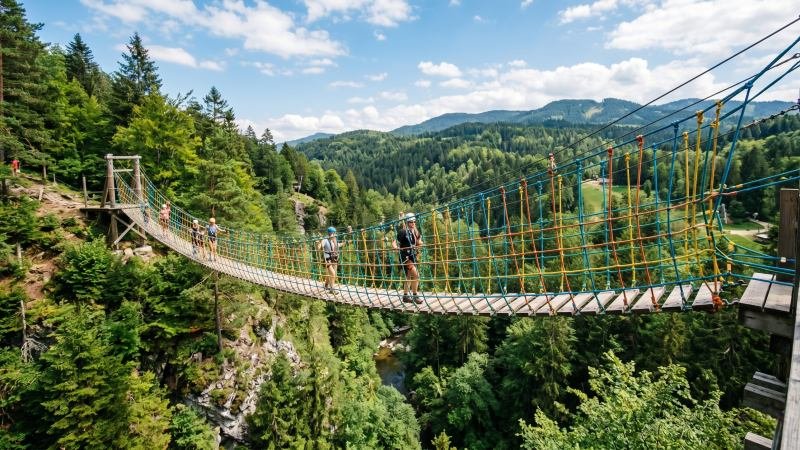
What does it actually take to build a rope net bridge that won’t end up in a lawsuit?
To ensure a safe and durable rope net bridge, you must strictly comply with established breaking strength codes, adventure park certification requirements like EN 15567, and mandatory annual maintenance routines. But compliance is just the baseline. A successful installation requires selecting appropriate materials like 316 stainless steel or UV-stabilized synthetics, executing precise pre-tensioning, and sourcing from manufacturers that provide verifiable traceability tags and custom sizing capabilities.
Safety Compliance and Maintenance Standards
To hit safety compliance, rope net bridges must strictly adhere to certified breaking strength limits, highly specific mesh size restrictions to prevent entrapment, and standardized adventure facility testing protocols like EN 15567 or ASTM F2959. Beyond the build phase, facility managers must perform rigorous annual inspections and monitor specific wear triggers to prevent structural failure and guarantee long-term operational safety.
Essential Breaking Strength and Anti-Entrapment Mesh Codes
Let’s talk about the heavy lifting first: what exactly is breaking strength in this context? It is the absolute maximum load a net can hold before the fibers snap. Think of it like the maximum load-bearing capacity of the main steel cables holding up a canopy walkway or a commercial zipline. If you push the system past its critical limit, it breaks.
For commercial rope net bridges, the outer border ropes usually require a minimum breaking strength of 30 kN (kilonewtons). At the same time, the inner mesh ropes typically need a strength of at least 7.5 kN to absorb kinetic impacts. Keep in mind, though, these specific load capacities can naturally vary depending on the exact synthetic fibers or wire grades used. That’s why you should always verify the exact load ranges and test data with your specific supplier before making a purchase.
Now, let’s tackle a detail that catches too many designers off guard: mesh size. Unlike construction debris nets, public rope bridges face strict “entrapment hazards.” If the holes in a side guard net are around 100 mm, a child’s body could slip through, but their head would get trapped, creating a severe strangulation risk. If the walking surface mesh is too large, it swallows a user’s foot, causing severe ankle fractures during dynamic movement.
| Specification | Standard Safety Requirement | Primary Engineering Purpose |
|---|---|---|
| Side Guard Net Mesh | < 89 mm (approx. 3.5 inches) | Prevents head and torso entrapment for children and toddlers. |
| Walking Surface Mesh | 20 mm – 30 mm (Highly dense) | Prevents foot entrapment and tripping hazards during active walking. |
| Minimum Border Rope | 30 kN | Supports the main structural pre-tensioning of the bridge. |
Understanding EN 15567 and ASTM F2959 Certification Requirements
Ever wonder how these systems actually get signed off for public recreational use? In the adventure and leisure industry, you cannot use temporary construction standards. The engineering gold standards for permanent installations are EN 15567 (European standard for Sports recreational facilities – Ropes courses) and ASTM F2959 (Standard Practice for Aerial Adventure Courses).
These strict regulations dictate exactly how a bridge must support dynamic human loads over a 10 to 20-year lifespan. To pass these certifications, the net and its anchoring systems must undergo rigorous engineering calculations to ensure they can handle multiple adults bouncing or swaying simultaneously.
Just like different structural support columns in a multi-level ropes course support different maximum weights, these standards dictate the safety margins required for public access. The takeaway here? Choosing a net manufactured in compliance with EN 15567 or ASTM F2959 guarantees that the product is actually designed for permanent public recreation, not just a temporary construction site.
Mandatory Annual Inspections and Wear Triggers
Installing a secure rope bridge is only the first step. Over time, constant foot traffic and daily weather exposure will inevitably weaken the ropes. Because of this reality, mandatory annual inspections aren’t just red tape—they’re your operational lifeline. You cannot simply install a bridge net and forget about it.
The Role of Removable Test Cords
How do safety inspectors actually test a net after it is already installed? Quality safety nets designed for adventure parks come with built-in test cords. These are extra strands of the exact same rope lightly attached to the main net. Every 12 months, a maintenance worker removes one of these test cords. Next, an independent laboratory tests this specific cord to check its remaining breaking strength. If the aged test cord breaks too easily in the lab, the entire bridge net must be retired and replaced immediately.
Identifying Daily Wear Triggers
Besides the annual laboratory test, ground maintenance teams must actively monitor the bridge for daily wear triggers. These are physical warning signs that the net is losing its structural integrity.
- Fraying Fibers: Surface threads breaking apart or looking fuzzy due to constant shoe friction on the walking surface.
- Chemical Degradation: Unusual rope discoloration or melting caused by harsh cleaning chemicals or improper maintenance.
- Deformed Mesh: Individual net holes that are stretched beyond their safe entrapment limits.
When these warning signs appear, the net can no longer bear dynamic human loads safely. Logging these visual triggers weekly prevents catastrophic accidents on your project site.
Material Selection for Durability and Aesthetics
Selecting the ideal material requires balancing environmental resilience with structural design goals. You must carefully choose between marine-grade 316 stainless steel for permanent structures and high-strength synthetic fibers for specialized applications. On top of that, evaluating specific UV degradation ratings ensures the chosen netting retains its critical load capacity and visual transparency over its entire intended lifespan.
316 Stainless Steel vs High-Strength Synthetic Fibers
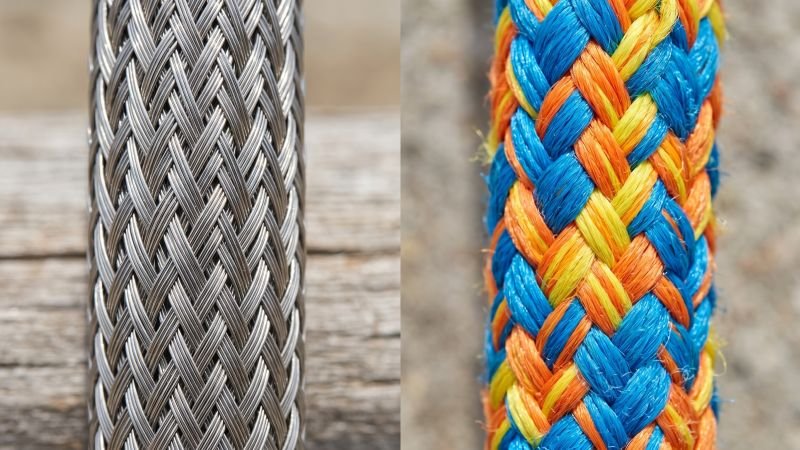
When planning a bridge project, your first major engineering decision involves selecting the core netting material. You generally have two primary options on the market: 316 stainless steel wire mesh, or high-strength synthetic fibers like industrial polyester. This choice is exactly like deciding between a rigid steel truss system for a permanent canopy walk versus using flexible webbing for an indoor adventure park climbing net. Each specific material serves a completely different structural purpose.
Right out of the gate, 316 stainless steel provides ultimate longevity for outdoor infrastructure. Steel manufacturers specifically add the element molybdenum to this exact metal alloy. The payoff? This chemical addition provides extreme resistance to aggressive rust and saltwater corrosion. Because of this, stainless steel mesh is the perfect solution for coastal bridge projects or permanent public walkways. However, metal cable mesh is heavy and requires a higher initial financial investment.
On the flip side, synthetic fiber ropes offer excellent flexibility and a softer touch for barefoot or light-shoe environments. Materials like high-tenacity polyester are very lightweight and simple for rigging crews to handle. Plus, manufacturers can dye these synthetic ropes in various custom colors to seamlessly match specific landscape architecture designs. However, synthetic materials naturally wear out much faster than steel cables.
| Key Feature | 316 Stainless Steel Mesh | High-Strength Synthetics (Polyester/Nylon) |
|---|---|---|
| Best Application | Permanent outdoor bridges, coastal areas, high-vandalism zones. | Indoor adventure parks, covered treehouses, colored structural designs. |
| Corrosion Resistance | Extremely high (marine-grade alloy). | Not applicable (plastics do not rust). |
| Lifespan | Decades (with minimal maintenance). | 3 to 5 years (requires strict UV monitoring). |
| Initial Cost | High. | Low to Moderate. |
UV Resistance and Weather Degradation Rating
Why does a brightly colored nylon bridge net suddenly turn dangerously brittle and pale after just one summer? The culprit is ultraviolet (UV) degradation. The sun constantly emits highly energetic, invisible UV rays. Over time, continuous exposure to these powerful rays slowly breaks down the essential molecular bonds inside synthetic plastics.
This makes understanding official UV resistance ratings absolutely critical for safe outdoor engineering projects. Untreated synthetic safety ropes can easily lose up to 50% of their critical breaking strength within just two years of direct sun exposure. To actively prevent this structural failure, quality net manufacturers extrude special chemical UV stabilizers directly into their plastic yarns during production.
For example, high-grade UV-stabilized polyester retains its load-bearing strength significantly longer than cheap, untreated nylon netting. However, even chemically treated ropes will eventually degrade over time. Constant rain, freezing winter temperatures, and high humidity heavily accelerate this natural aging process. So, make it a standard operating procedure: always request the specific UV degradation rating and the laboratory accelerated weathering test reports from the factory before purchasing any synthetic safety netting.
Balancing Load Capacity with Visual Transparency
Landscape architects frequently face a highly difficult structural challenge. They need the bridge guardrails to be incredibly strong to stop a heavy falling person safely. At the exact same time, they want the side nets to be almost completely invisible. They want tourists and pedestrians to enjoy clear, unobstructed views of the surrounding natural scenery.
Thick, bulky ropes certainly provide obvious, reliable structural strength. Unfortunately, thick ropes also block the landscape view and quickly create a heavy, closed-in feeling for the bridge users. This challenge is common when designing glass-bottom panels on a high-altitude suspension bridge or a treetop observation deck. You want the barrier to be as transparent as possible for the view, but it must be robust enough to withstand high winds and human impact forces.
To successfully achieve this delicate balance, engineers often specify thin stainless steel wire rope netting for the side guards. For instance, a tightly hand-woven mesh using just 1.5mm or 2.0mm steel wire can successfully hold heavy human impact loads while preventing entrapment. Meanwhile, this very thin wire profile creates a high percentage of open visual space, often exceeding 85%. The result is safety netting that practically disappears from a short viewing distance.
Engineering Guidelines for Installation
Proper installation requires calculating the correct pre-tensioning to ensure a stable walking surface and establishing precise tension control across the entire span. It also means utilizing heavy-duty anchoring hardware and applying seamless rope splicing techniques to eliminate weak points along the bridge edges.
Calculating Optimal Pre-Tensioning and Deflection
A critical engineering mistake is confusing a “fall arrest catch net” with a “walkable bridge net.” A catch net requires deep sag to absorb kinetic energy when someone falls from above. However, a rope net bridge serves as the primary walking surface.
Have you ever seen a walking bridge net installed with exaggerated sag (e.g., 5% to 10% depth)? It creates a highly dangerous “funnel effect.” When multiple tourists step onto the bridge, gravity pulls everyone uncontrollably toward the lowest center point, leading to severe collisions and trampling hazards.
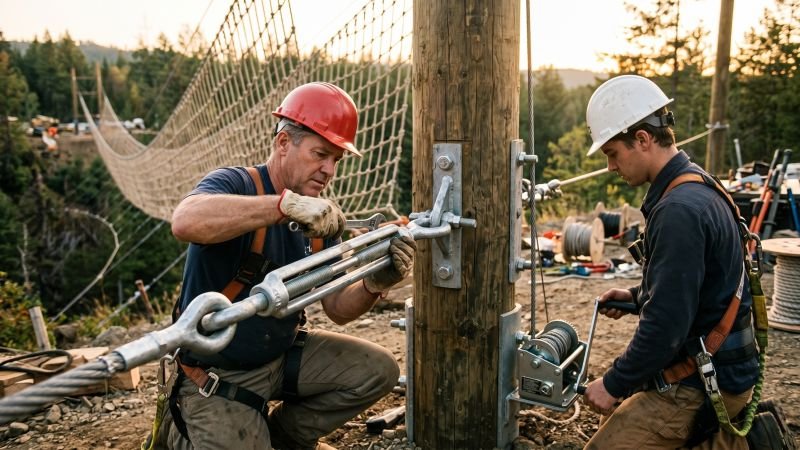
Instead, a rope net bridge requires strict pre-tensioning. Installers must stretch the walking net tightly across the span to create a stable, flat, and predictable surface. While a slight natural deflection will occur when under human load, the goal is to minimize this bounce as much as possible. Installers use mechanical turnbuckles and specialized rigging winches to pull the border ropes taut. Just like tensioning the main support cables on a suspension footbridge, establishing the correct tension ensures the entire structure holds its designed shape under heavy foot traffic.
Secure Anchoring and Seamless Splicing Techniques
A rope net is only as strong as its weakest attachment point. You can buy the strongest netting in the world, but if the anchors fail, the entire system fails.
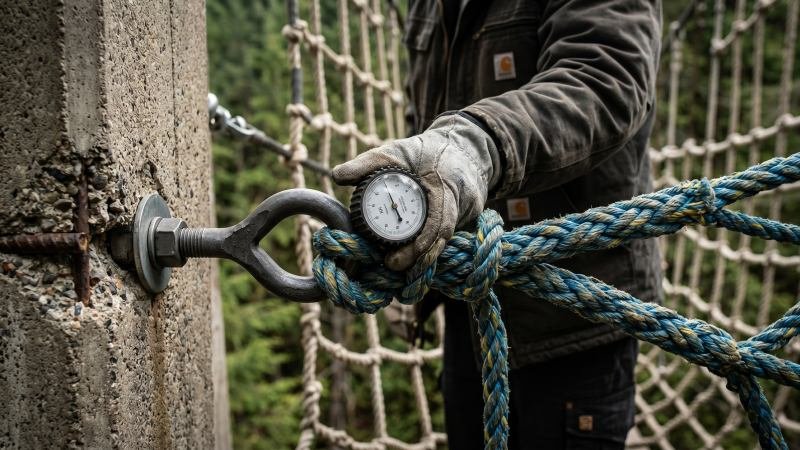
Rule number one: you must always attach the net to primary structural elements. This means drilling directly into reinforced concrete pillars, heavy timber pylons, or welding attachments to heavy steel I-beams. Never anchor a safety net to secondary structures like decorative wooden handrails. Installers typically use heavy-duty forged steel eye bolts or load-rated steel carabiners to attach the border ropes.
Once anchored, you have to get your spacing right. If anchors are placed too far apart, the border rope will stretch too much between the attachment points, creating dangerous gaps.
| Installation Component | Industry Best Practice | Engineering Purpose |
|---|---|---|
| Anchor Spacing | Every 200 mm to 500 mm along the edge. | Prevents dangerous gaps from forming between the net and the bridge structure. |
| Anchor Hardware | Forged steel eye bolts or industrial carabiners. | Resists extreme shear forces during active movement. |
| Lacing Rope Strength | Must equal or exceed the net’s breaking strength. | Ensures the seam does not become a structural weak point. |
Executing Seamless Splicing
Often, a long bridge requires joining two separate nets together. This process is called splicing or lacing. When joining nets, the seam must be perfectly seamless. You cannot simply tie basic knots.
Instead, riggers use a dedicated lacing rope to weave the two border panels together. Think of this process like splicing two heavy-duty zipline cables together; the joint must be just as strong as the main line. The lacing rope must weave through every single outer mesh square of both nets. If you skip a mesh square, you instantly create a weak gap. By executing seamless lacing, engineers guarantee the joined nets behave as one unified, solid structure.
Manufacturer Criteria and Purchasing Guide
To ensure a safe and successful procurement process, you must select a manufacturer that provides comprehensive traceability tags and certified factory testing reports. Beyond standard documentation, a qualified supplier must demonstrate the engineering capacity to manufacture custom-sized nets that perfectly fit the complex, non-standard layouts of your specific bridge structure.
Traceability Tags and Factory Testing Reports
When you source main structural cables for a suspension footbridge, you always demand a mill certificate to prove the steel’s exact grade. Purchasing commercial safety netting requires the exact same rigorous documentation. You cannot rely on a simple visual inspection alone. Instead, you must strictly demand traceability tags and official factory testing reports.
Let’s look at traceability tags first. Every professional safety net must feature a permanent identification label sewn directly into the border rope. This heavy-duty tag acts as the official passport for your netting. It clearly displays the exact date of manufacture, the specific batch number, and the designated material type. If a structural issue ever occurs on site, safety inspectors will immediately check this tag to trace the net back to its original production line. Never purchase a commercial safety net that is missing this permanent identification label.
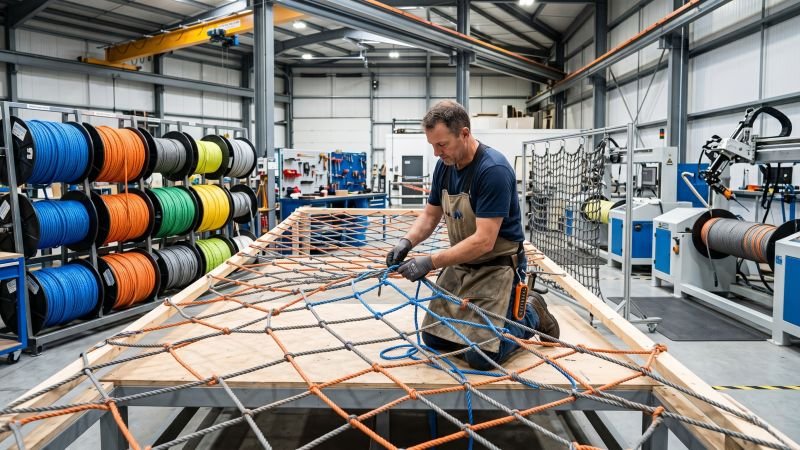
After the tags, dig into the factory testing reports. A trustworthy manufacturer will always test their finished ropes on industrial tensile testing machines before shipping them to your site. These official documents prove the absolute maximum breaking strength of your specific batch of mesh.
Custom Sizing Capabilities for Complex Layouts
Many buyers mistakenly assume safety nets only come in standard rectangular rolls. However, modern pedestrian bridges rarely use simple, perfectly straight designs. Instead, landscape architects frequently design bridges with curved walkways, sloping elevations, and highly irregular anchor point geometries.
Think about it—trying to force a standard square net onto a curved bridge creates highly dangerous structural gaps, right? This is exactly like trying to install a rigid, flat wooden deck onto a twisted, spiraling ropes course platform. It simply will not fit correctly, and it will inevitably fail under mechanical pressure.
Because of this, your chosen manufacturer must possess advanced custom sizing capabilities. A premium supplier will take your project’s specific Computer-Aided Design (CAD) drawings and manufacture a net that exactly matches your unique geometric layout. They will precisely calculate the required angles, corner tapers, and varying walkway widths before weaving the material. This careful custom manufacturing ensures the final net pulls perfectly tight across every single inch of the bridge infrastructure. Ultimately, this eliminates any hazardous loose areas along the edges and guarantees a perfectly secure installation.
Conclusion
Let’s be clear: building a secure and legally compliant rope net bridge requires far more than simply stringing up a heavy mesh. It demands a rigorous commitment to adventure park engineering safety standards, from verifying the exact breaking strength and anti-entrapment mesh sizes, to calculating the precise pre-tensioning needed to provide a stable walking surface. By prioritizing EN 15567 or ASTM certified testing, strictly following mandatory annual maintenance routines, and partnering with a specialized manufacturer capable of producing traceable, custom-fitted netting arrays, you can confidently guarantee both the structural integrity and the architectural beauty of your pedestrian walkways.
If you are ready to engineer your next structural netting project with certified safety and precision, please contact us today for expert guidance.