-
Whatsapp: +86 15516933785
-
Email: hanlin@hanlinplayground.com
-
Address: Shangjie District, Zhengzhou City, Henan Province, China
-
Whatsapp: +86 15516933785
-
Email: hanlin@hanlinplayground.com
-
Address: Shangjie District, Zhengzhou City, Henan Province, China
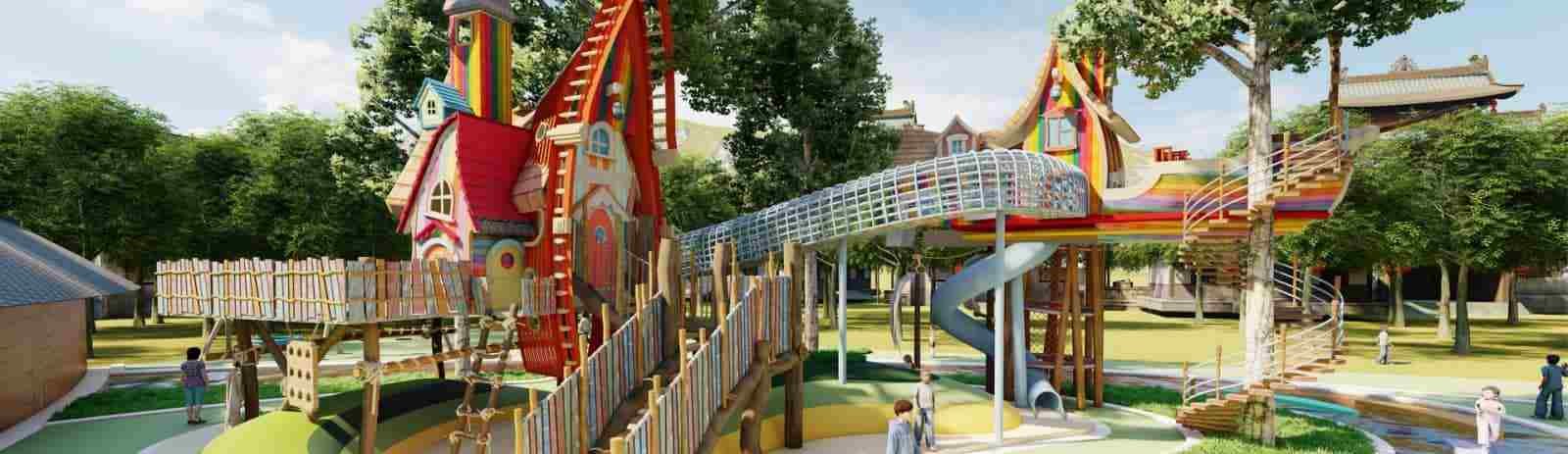
The Secret Weapon to Boost Park Attractions: Custom Unpowered Rope Net Bridges
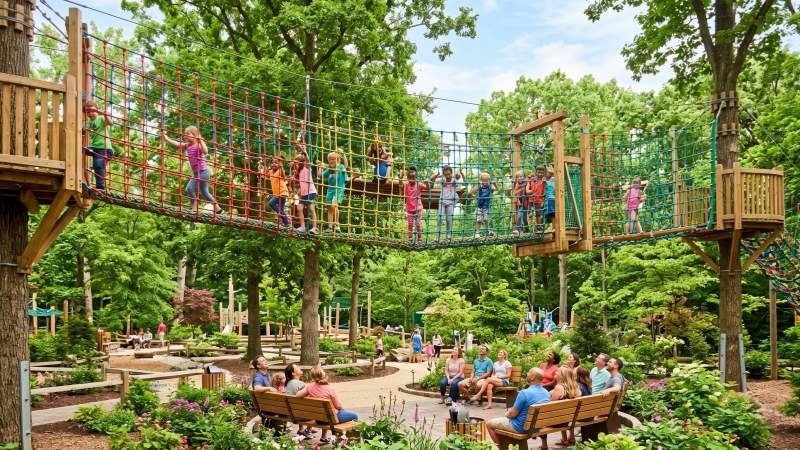
What makes custom unpowered rope net bridges the ultimate secret weapon for boosting amusement park attractions?
Custom unpowered rope net bridges serve as highly engaging, low-maintenance attractions that maximize park real estate and increase investment returns. By offering continuous physical play without reliance on mechanical power, these dynamic structures seamlessly integrate into natural landscapes while adhering to strict commercial safety standards.
Driving Higher Park Foot Traffic and Investment Return
How exactly do custom unpowered rope net bridges increase both foot traffic and the overall investment return for amusement parks?
Custom unpowered rope net bridges increase investment return by acting as high-capacity anchor attractions that draw families without needing electricity or constant mechanical upkeep. As any seasoned operator knows, higher daily visitor throughput combined with slashed operational expenses directly improves profit margins, all while creating a unique physical play experience that encourages repeat visits.
Eliminating High Mechanical Maintenance Costs
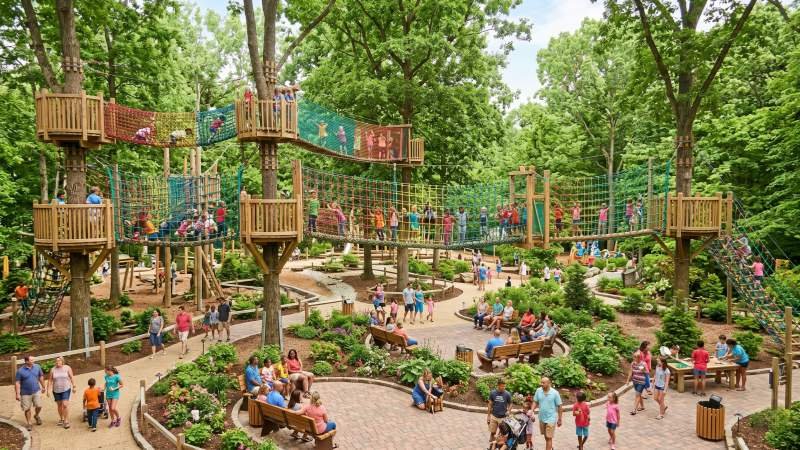
Let’s talk overhead. Traditional amusement rides drain budgets quickly—requiring constant electricity to run and a steady stream of expensive replacement parts. Want to know the fastest way to bleed your maintenance budget? Rely entirely on motorized components. Unpowered attractions, on the other hand, rely entirely on gravity and human movement, removing the need for complex drive systems.
Maintaining a mechanical ride is similar to servicing a roller coaster’s complex braking system, demanding specialized electrical engineers and frequent, revenue-killing downtime. Maintaining an unpowered rope bridge is more like inspecting a commercial high ropes course. While it lacks motors, it still requires trained professionals to monitor cable tension, hardware integrity, and metal fatigue. The payoff? Park owners save thousands of dollars annually by avoiding expensive electrical and mechanical labor.
And here’s the real kicker: mechanical failures cause rides to close unexpectedly. Ever calculated the hidden cost of ride downtime on a busy summer Saturday? It frustrates visitors and tanks park reviews. Unpowered rope bridges offer near-zero downtime. They stay open all day, every day.
“Removing mechanical dependencies is the fastest way to stabilize a park’s operational budget.”
To clearly see the financial difference, look at the comparison below:
| Cost Factor | Mechanical Attractions | Custom Unpowered Rope Net Bridges |
|---|---|---|
| Energy Consumption | High (Constant electricity needed) | Zero |
| Daily Maintenance | Sensor checks and heavy lubrication | Routine structural and tension inspections |
| Technician Level | Certified electrical engineers | Trained Maintenance Personnel / Certified Inspectors |
| Expected Downtime | High during technical faults | Nearly zero |
Keep in mind, specific maintenance schedules for wire rope tensioning or netting replacement can vary based on the exact materials used. Always verify the maintenance timelines and material specifications directly with your manufacturer.
Extending Visitor Stay Times for Families
You already know the golden rule of park management: when families stay longer, they spend more money on food, drinks, and souvenirs. Boosting that visitor “dwell time” is a top priority, and custom unpowered rope net bridges nail this metric perfectly.
Why do these structures keep families engaged? Active play is simply far more captivating than passive entertainment. Instead of waiting in a long line for a two-minute mechanical ride, children engage in continuous physical activity. Beyond that, rope net bridges allow kids to explore at their own pace, climbing, balancing, and navigating different routes.
This type of open-ended play holds a child’s attention for a very long time. Often, children will play on a massive rope structure for over an hour. Meanwhile, parents can rest in nearby seating areas, preventing the family from getting tired and leaving the park early.
Are your current attractions processing visitors fast enough? Rope bridges act as high-capacity hubs. Hundreds of visitors can use a large bridge simultaneously, ensuring nobody feels rushed.
- Continuous Engagement: No waiting in lines means zero frustration.
- Physical Challenge: Kids burn energy and feel a sense of accomplishment.
- Multi-Age Appeal: Different bridge sections can cater to toddlers and teenagers alike.
The bottom line? By keeping children actively entertained and giving parents a chance to relax, unpowered rope bridges successfully extend the total time a family spends on your property.
Adapting Designs to Unique Terrain and Landscapes
How can park developers seamlessly fit custom rope net bridges into difficult or uneven outdoor spaces?
Custom unpowered rope net bridges adapt to unique terrain by utilizing flexible anchoring systems that mold to existing topography rather than requiring expensive land grading. Because the tensioned netting acts as a dynamic suspension system, operators can easily stretch these attractions across natural ravines, connect them between mature trees, or weave them into established structures following engineering approval.
Utilizing Natural Slopes and Forest Environments
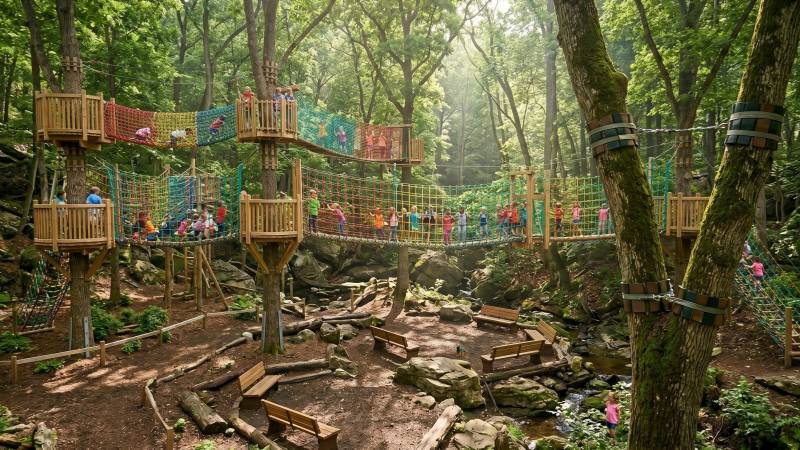
Many amusement parks feature unused hills or dense woods. Typically, building on these rough areas requires moving tons of dirt. Custom rope bridges solve this problem elegantly because they float above the ground. You simply don’t need to flatten the earth.
Working with a forest layout is highly effective. Instead of clearing trees, park planners use them. This process mimics how an elevated zip-line course uses thick tree trunks as structural anchors instead of building expensive new steel towers. The rope nets simply stretch across the natural gaps.
The result? Parks can turn “dead space” into a highly profitable attraction. A woodland adventure park, for instance, can suspend a sprawling net bridge over a steep 15-degree slope, giving children a thrilling sense of height without leaving the safety of the net.
“Building with nature, rather than bulldozing over it, preserves the park’s visual appeal while adding massive play value.”
When attaching heavy nets to live trees, installers use specialized friction bands. These bands hold the weight while protecting the tree bark. Always verify the specific load ranges and tree-size requirements with your manufacturer to ensure a safe installation.
Here are the primary ways parks use natural terrain:
- Ravine Crossings: Spanning wide nets across small valleys or rocky streams.
- Tree-to-Tree Pathways: Creating elevated walking trails through the forest canopy.
- Hillside Climbing: Using a natural slope to support an angled climbing net.
Integrating with Existing Commercial Play Structures
Not every budget allows for a brand-new, standalone footprint. Often, you just need to breathe new life into aging equipment. Subject to strict structural engineering review, custom rope net bridges can connect to existing commercial play structures.
Think of this process like adding a massive, tensioned sail to an existing ship mast. You cannot simply clamp it on without calculations. Because rope bridges generate massive dynamic pulling forces when dozens of children jump simultaneously, structural engineers must first evaluate the older play tower. The existing foundation and support posts were originally designed for static downward weight. Therefore, they often require professional reinforcement to handle these new, powerful lateral shear forces.
Once engineering safety is confirmed, bridging the empty gap between two previously separated play zones creates one massive, unified attraction. Kids stay engaged much longer because the play route is now continuous.
| Feature | Standalone Rope Bridge | Integrated Rope Bridge |
|---|---|---|
| Space Required | Large open area | Minimal (Uses existing empty gaps) |
| Engineering Need | Standard ground anchors | Requires structural review of old posts |
| Play Value Impact | Creates a new zone entirely | Revitalizes aging playground sections |
To connect a rope bridge to an older metal or wooden play tower, installers use custom steel clamping brackets. Verify the exact bracket dimensions and tension tolerances with your manufacturer to ensure seamless compatibility with your original equipment.
Essential Safety and Durability Standards for Commercial Use
Protecting park visitors is the non-negotiable priority for any operator. Therefore, commercial unpowered rope net bridges must strictly adhere to international playground safety standards, such as ASTM F1487 or EN 1176. These standards mandate rigorous load testing to ensure high weight capacities, along with the use of specialized, weather-resistant materials to prevent structural degradation. Why risk your park’s reputation on sub-par rigging? Adhering to these codes guarantees long-term durability and passenger safety under heavy daily commercial use.
Meeting Commercial Weight Capacity and Load Testing
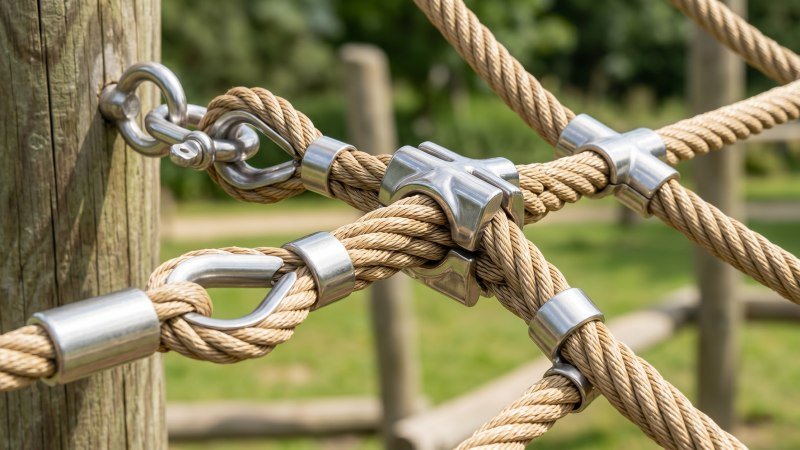
How do you sleep at night knowing fifty children are jumping on a suspended net? You rely on extremely strict load testing. In commercial playgrounds, engineers measure two distinct types of weight: static load (the basic, resting weight of the materials) and dynamic load (the massive force created when children run, jump, and bounce).
This engineering approach mirrors how a commercial giant swing’s support cables are rated. The cables must handle thousands of pounds of sudden tension at the bottom of the swing arc, not just the riders’ resting weight. Rope nets use a high “safety factor” to absorb these sudden shocks.
A standard safety factor in the amusement industry is usually a 5:1 ratio. This means if the expected maximum human weight is 1,000 pounds, the net is built to hold at least 5,000 pounds. To achieve this, testing facilities use heavy hydraulic machines to pull the ropes until they finally snap, scientifically determining the exact breaking strength of the equipment.
“Proper load testing transforms a simple rope net from a backyard toy into a safe, commercial-grade attraction.”
Ensuring Weather Resistance with Specialized Materials
Outdoor park equipment faces relentless attacks from the sun, rain, and snow. Cheap ropes will quickly rot or lose their structural integrity. That’s exactly why commercial rope bridges must use highly specialized materials to survive the elements.
Most heavy-duty commercial nets use an engineered combination of steel wire cores and synthetic outer braids. The inner steel wire provides massive structural strength, while the soft outer layer is usually made of tough polyester or polypropylene treated with strong UV inhibitors. This chemical treatment stops the harsh sun from making the ropes brittle.
This protective process is just like applying heavy-duty gel coating to a water park slide to prevent the underlying fiberglass from cracking and fading. Naturally, all metal connection points must also survive wet outdoor conditions without rusting.
Here is a breakdown of standard weather-resistant materials:
| Component | Typical Commercial Material | Primary Protective Benefit |
|---|---|---|
| Inner Core | Galvanized steel wire | Prevents snapping under heavy tension |
| Outer Braid | UV-treated polyester | Stops sun damage and plastic fraying |
| Connectors | 304 or 316 Stainless Steel | Prevents dangerous rust in wet environments |
Keep in mind that UV resistance ratings and steel grades can vary depending on your regional climate. Always verify the precise material specifications and weather-resistance guarantees with your supplier before making a purchase.
Evaluating and Selecting a Reliable Manufacturing Partner
Identifying a reliable partner requires strictly assessing the factory’s turnkey OEM and ODM capabilities and verifying their installation expertise through documented past projects. A competent manufacturer provides end-to-end service, from drafting precise 3D engineering models to executing final on-site assembly, ensuring the structure exactly matches your park’s specific needs safely.
Assessing Turnkey OEM and ODM Capabilities
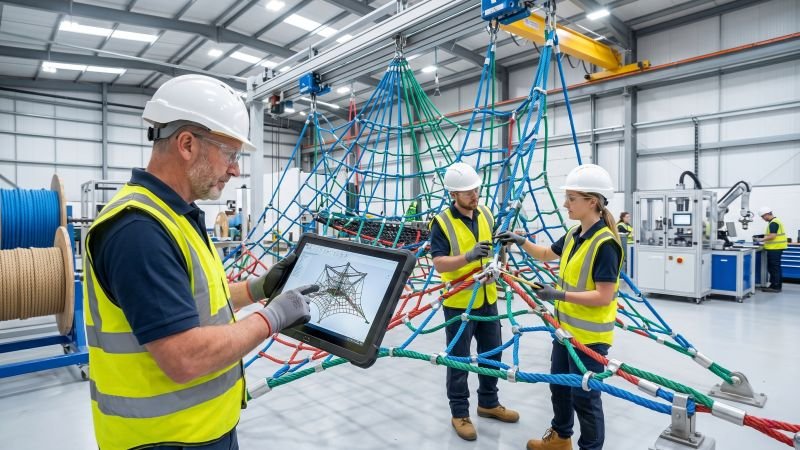
Buying a massive playground structure is not like buying standard park benches. You need a partner who understands complex spatial design and structural loads. This makes assessing a manufacturer’s OEM (Original Equipment Manufacturer) and ODM (Original Design Manufacturer) capabilities crucial.
If you already have a complete architectural blueprint, you need strong OEM services to precisely build what you drew. Conversely, if you only have an empty plot of land, you need strong ODM services to engineer and design the structural layout from scratch.
Think of this relationship like working with a commercial water slide manufacturer. You don’t just buy random fiberglass tubes; the manufacturer calculates water flow dynamics and designs custom curves specifically for your pool’s footprint. Similarly, a turnkey rope bridge factory handles every single step: designing the layout, engineering the tension points, and manufacturing the nets in-house.
Think about it: choosing a turnkey provider eliminates dangerous communication errors. When separate companies design and build a product, fatal mistakes happen. A turnkey factory takes full responsibility for the entire project lifecycle.
Verifying Installation Expertise Through Past Projects
Manufacturing strong ropes is only half the battle. Properly installing them is equally vital. An incorrectly tensioned net is dangerous, no matter how strong the raw materials are. You must rigorously verify a supplier’s installation expertise.
How? Examine their portfolio of past projects. You would never hire a team to erect a massive Ferris wheel if they’ve only built small merry-go-rounds. You need concrete proof that they have successfully managed large, heavy-duty commercial installations.
Start by asking for case studies of projects similar to yours. If you are building a forest bridge, ask for woodland examples. Look closely at their anchoring techniques in those photos, and request references from other park operators to confirm the supplier’s reliability in the field.
When reviewing a manufacturer’s past projects, zero in on these key details:
- Scale of Projects: Have they built structures as large as your planned design?
- Terrain Complexity: Can they handle uneven ground or unusual attachment points?
- Operational Status: Are their past projects still safely operating today without major issues?
Conclusion
Custom unpowered rope net bridges offer an unparalleled opportunity to transform unused park spaces into highly profitable attractions. By eliminating exorbitant mechanical maintenance costs and extending the time families spend at your venue, these structures dramatically boost your overall investment return. Add to that their unique ability to adapt to natural slopes and integrate with existing equipment, making them incredibly versatile. As long as you prioritize commercial safety standards and select a reliable manufacturing partner with proven engineering capabilities, upgrading your park’s physical play zones is one of the smartest, lowest-risk investments you can make this season.
Ready to elevate your park attractions and bring a custom design to life? Contact us today to get a tailored proposal and quote!