-
Whatsapp: +86 15516933785
-
Email: hanlin@hanlinplayground.com
-
Address: Shangjie District, Zhengzhou City, Henan Province, China
-
Whatsapp: +86 15516933785
-
Email: hanlin@hanlinplayground.com
-
Address: Shangjie District, Zhengzhou City, Henan Province, China

What Is Soft Play Equipment?
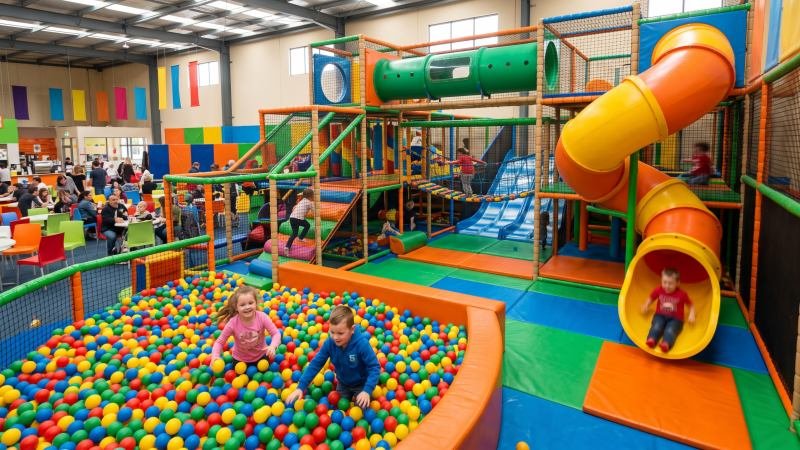
Have you ever wondered what exactly makes those brightly colored, heavily padded indoor playgrounds so structurally safe and engaging for children?
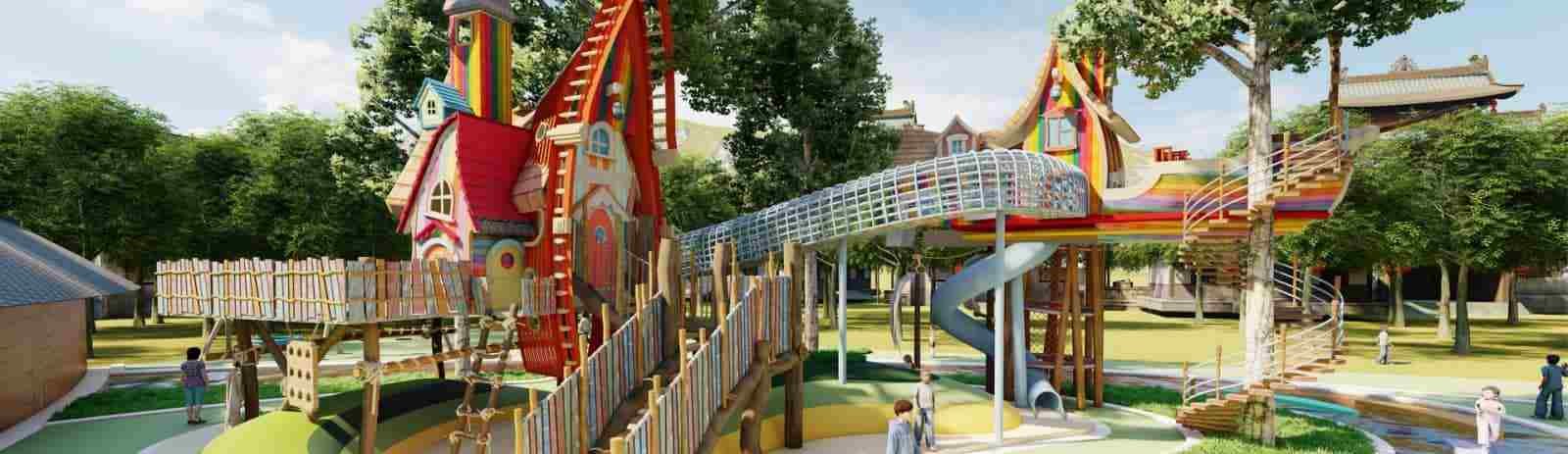
Soft play equipment refers to commercial-grade play structures purposefully built for indoor environments using impact-absorbing materials. These modular systems combine high-density foam cores with heavy-duty PVC covers to create a completely padded environment, allowing children to safely develop motor skills, process sensory input, and interact socially without the injury risks associated with traditional outdoor metal or hard plastic playgrounds.
Core Materials and Safety Standards Used in Manufacturing
If you’ve been around the block in family entertainment, you know that building safe, commercial-grade soft play equipment requires a precise combination of specialized materials.
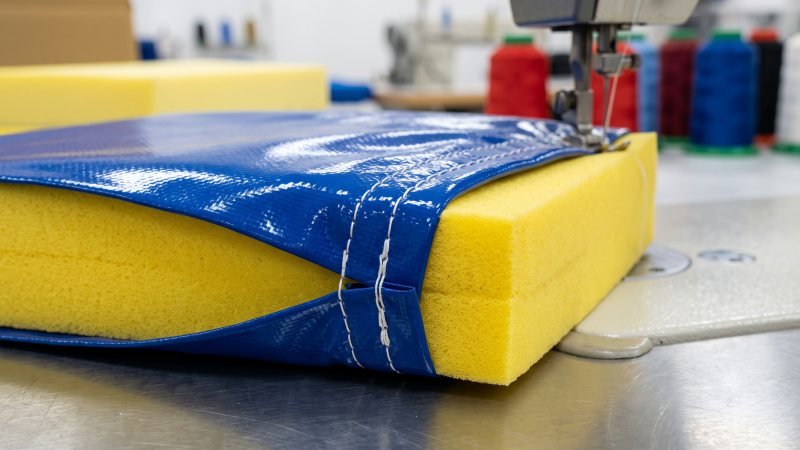
Commercial soft play equipment relies on two primary components: a shock-absorbing high-density foam core and a durable PVC outer cover. These materials work together to meet strict international safety standards. In the field, this ensures impact absorption, fire resistance, and structural integrity during high-traffic indoor play.
High-Density Foam Cores
The interior of any soft play structure defines its safety. On the manufacturing floor, that means using high-density polyurethane (PU) foam. This material acts as the primary shock absorber, doing the heavy lifting to protect children from injuries during falls or collisions.
It’s a lot like the padding used in professional gymnastics crash mats. Both setups demand a material that compresses on impact but instantly snaps back to its original shape. If the foam is too soft, a falling child might sink through and hit the hard floor beneath. Conversely, if the foam is too hard, it defeats the purpose of “soft” play. After all, what good is a soft play area if it feels like landing on concrete?
To achieve the right balance, manufacturers measure foam quality using density ratings.
| Foam Density Rating | Primary Application | Characteristics |
|---|---|---|
| Low (Under 20 kg/m³) | Avoided in commercial play | Compresses entirely; lacks durability. |
| Medium (20-30 kg/m³) | Wall padding, decorative elements | Soft touch; not meant for bearing body weight. |
| High (35-45 kg/m³) | Climbing blocks, floor mats, steps | Excellent load-bearing capacity; high rebound rate. |
Beyond just density, you have to look at Indentation Load Deflection (ILD). ILD measures how much weight it takes to compress the foam. High-traffic areas require a high ILD rating. Because foam specs shift depending on the exact design, always verify the precise material specifications with your chosen supplier.
PVC and Vinyl Outer Covers
If the foam is the muscle, the outer cover is the skin. That means the exterior has to survive constant friction, pulling, and the inevitable bodily fluids. To handle that abuse, manufacturers typically use industrial-grade PVC (Polyvinyl Chloride) tarpaulin or heavy-duty vinyl.
Why not use standard canvas or cotton fabric? Because heavy-duty PVC provides a completely non-porous surface. That barrier ensures spills and moisture never penetrate the fabric to reach the foam inside. Once foam gets wet, it breeds mold and must be destroyed. PVC prevents this entirely.
Industry-standard covers usually feature a thickness of 0.45mm to 0.55mm. On top of that, they utilize a high yarn count, often rated at 1000D (Denier). This rating measures the thickness of the individual threads woven into the fabric backing.
Key properties of high-quality PVC covers include:
- Tear Resistance: Prevents splitting at the seams during heavy use.
- Fire Retardancy: Treated to self-extinguish and resist catching fire.
- Anti-Toxicity: Free from harmful chemicals, making it safe for children to touch and occasionally mouth.
- UV Resistance: Prevents the bright colors from fading, even under strong indoor lighting.
International Safety Certifications to Look For
Sourcing the right materials is only half the battle. Once assembled, the final product has to survive rigorous laboratory testing. Different regions enforce strict safety compliance standards.
When evaluating equipment, you must ensure it meets the specific regulations of your geographical area.
| Standard Name | Region | Primary Focus of Testing |
|---|---|---|
| ASTM F1918 | North America | Specifies safety performance for soft contained play equipment. Focuses on structural integrity and entrapment hazards. |
| EN 1176-10 | Europe | Governs fully enclosed play equipment. Tests for fire safety, emergency exits, and impact attenuation. |
| CPSIA | United States | Restricts the levels of lead and phthalates in children’s products. |
| REACH | Europe | Regulates the registration and use of chemical substances to protect human health. |
At the end of the day, a manufacturer should always hand over a Certificate of Compliance (CoC). This document proves that independent testing facilities have verified the materials. For instance, testing ensures the PVC cover does not contain dangerous levels of phthalates. It also confirms the foam meets specific flammability requirements, such as the NFPA 701 standard for textiles. Without these certifications, a commercial facility faces severe liability risks.
Key Developmental Benefits for Toddlers and Children
Ask any childhood development expert, and they’ll tell you commercial soft play environments are non-negotiable for early physical and cognitive growth.
Soft play equipment provides a safely enclosed, padded environment that actively stimulates pediatric development. On a practical level, these structures build gross motor skills through controlled physical challenges. They also offer vital sensory input and facilitate organic social interactions among children. The end result? It accelerates both physical milestones and cognitive processing.

Enhancing Gross Motor Skills
Gross motor skills involve using large muscle groups. That means children need constant movement to develop these muscles, and soft play areas serve as a perfect training ground. For instance, toddlers must use their arms and legs simultaneously to climb over a foam cylinder. By forcing that movement, this action builds crucial bilateral coordination.
Think of this process like the design of a commercial trampoline park. In a trampoline park, the spring tension directly trains aerial balance. In the same way, the slight give of high-density foam trains a toddler’s core stability. Because the floor shifts slightly beneath them, they have to constantly adjust their balance to stay upright.
Industry data from pediatric occupational therapists shows significant improvements in physical milestones. In fact, navigating padded obstacles reduces falling frequency in everyday life.
Sensory Processing and Therapeutic Uses
Sensory processing is how the brain organizes information from the senses. Many children struggle with this mental integration. Because of this, soft play offers powerful therapeutic benefits. It’s no surprise that special education centers frequently utilize these padded environments to help children regulate their emotions.
These setups heavily target two hidden senses. First, the vestibular system manages balance and spatial motion. Second, the proprioceptive system handles body awareness. When a child crashes into a thick foam mat, they receive deep pressure therapy.
Consider the mechanics of a professional foam pit used in extreme sports training facilities. The thousands of loose foam cubes provide continuous, full-body resistance and feedback. A dense foam ball pit functions in the exact same way. It provides uniform pressure across a child’s entire body. The payoff is that this deep pressure has a highly calming effect on an overstimulated nervous system.
| Sensory System | Soft Play Activity Example | Primary Therapeutic Benefit |
|---|---|---|
| Vestibular (Balance) | Rocking on curved foam shapes | Improves spatial orientation and equilibrium. |
| Proprioceptive (Awareness) | Crawling under heavy padded blocks | Regulates emotional outbursts through deep pressure. |
| Tactile (Touch) | Touching different vinyl textures | Decreases touch sensitivity and tactile defensiveness. |
Social Interaction in Safe Environments
Indoor playgrounds naturally force children into shared spaces. As a result, these areas become active hubs for social development. Children must learn to navigate safely around others. Before they even realize it, they’re practicing sharing and turn-taking.
Early childhood experts categorize play into different developmental stages. First, toddlers engage in parallel play. They play next to each other but do not interact. But once they hit the soft play structures, the environment pushes them toward cooperative play.
For example, moving a large, padded puzzle block often requires two children. They must communicate to achieve a shared goal. Better yet, the padded environment completely removes the fear of physical injury. With that anxiety gone, shy children feel much more confident joining group activities.
“A well-designed soft play area removes physical barriers, allowing children to focus entirely on social negotiation and cooperative problem-solving.”
The structural design of these playgrounds also influences behavior. Just as an amusement park maze directs foot traffic into specific rooms, soft play tunnels funnel children into shared hubs. They must peacefully negotiate right-of-way in a narrow padded tube. By doing this, it builds critical conflict resolution skills in a very low-risk setting.
Popular Types of Indoor Soft Play Structures
What are the most common commercial soft play structures you will find in a modern indoor playground?
The commercial soft play industry relies on a core set of modular structures designed for maximum engagement. At the ground level, these include ball pits for full-body immersion, soft block sets for architectural building, and interactive sensory wall panels for tactile feedback. When combined, these components form the physical foundation of any professional indoor play environment.
Ball Pits and Crawl Tunnels
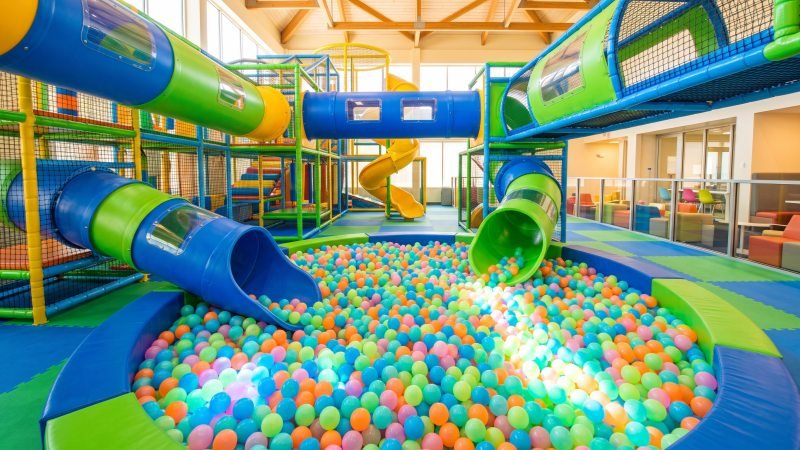
Ball pits are the centerpiece of most commercial play areas. Structurally, they consist of thick, foam-padded perimeter walls containing thousands of crush-resistant plastic balls. Typically, manufacturers make these balls from Low-Density Polyethylene (LDPE), a specific plastic that prevents the balls from crushing flat under heavy weight.
To back that up, commercial ball diameters usually range from 7cm to 8cm. This specific sizing is critical to prevent choking hazards. But keep in mind, since ball pit depth and diameter regulations can vary based on regional safety laws, always verify the exact dimensions and material specifications with your equipment supplier. A standard 3×3 meter commercial pit often requires upwards of 10,000 individual balls to achieve the correct depth.
Connected directly to these pits, you will often find crawl tunnels. These are heavy-duty, PVC-wrapped foam cylinders that safely bridge different areas of a playground.
Think of these crawl tunnels like the enclosed tube slides in a massive commercial water park. They safely control the physical flow of traffic. More importantly, they provide a fully enclosed route from one high-traffic section to another. To keep things visible, manufacturers often install clear acrylic windows inside the tunnels. That simple addition means parents and operators can maintain visual supervision at all times. Have you ever tried to track a moving toddler through a crowded play maze?
Soft Block Sets and Climbing Ramps
Soft block sets are loose, modular pieces of equipment. They consist of geometric foam shapes completely sealed in heavy-duty vinyl. Unlike fixed playground structures, these pieces are entirely mobile.
These blocks function much like oversized, padded building bricks. Operators can endlessly reconfigure the blocks to build completely new structural layouts within the same square footage. This flexibility keeps the play environment fresh and engaging day after day.
Climbing ramps frequently accompany these block sets. Ramps are inclined foam wedges used instead of traditional stairs, providing a seamless, padded elevation change. To handle the incline, manufacturers typically stitch anti-slip textured fabrics into the vinyl on the upward slope. That grip stops children from sliding backward while climbing.
| Equipment Type | Common Shape | Primary Structural Function |
|---|---|---|
| Foundation Blocks | Large Cubes | Serve as stable bases for building temporary towers. |
| Action Blocks | Cylinders | Used as rolling obstacles or seating elements. |
| Elevation Blocks | Wedges / Ramps | Create safe, padded pathways to higher play levels. |
Interactive Sensory Wall Panels
Floor space in a commercial venue is highly valuable. When things get tight, interactive sensory wall panels are your best structural solution. These are flat, padded boards mounted securely to structural walls that contain built-in mechanical or tactile elements.
Common features include large spinning gears, sliding plastic pegs, or sections of highly textured fabrics. Instead of requiring children to climb or crawl, these panels focus entirely on manual manipulation.
Consider the physical layout of control panels in a commercial arcade cabinet. A sensory wall utilizes the same design principle. It concentrates multiple interactive levers, wheels, and buttons into a single, space-saving vertical interface.
In real-world applications, it can boost user capacity by up to 20% without expanding the physical footprint of the playground. It’s an easy way to transform empty vertical walls into highly engaging equipment.
Age-Appropriate Zone Planning
How do commercial indoor playgrounds keep children of vastly different ages safe within the same building?
Commercial facilities separate users by age using dedicated, age-appropriate zone planning. This strategic layout prevents physical collisions between larger children and smaller toddlers. On top of that, it ensures the equipment dimensions precisely match the physical capabilities of each specific age group, maximizing both safety and operational efficiency.
Infant and Baby Areas 0 to 18 Months
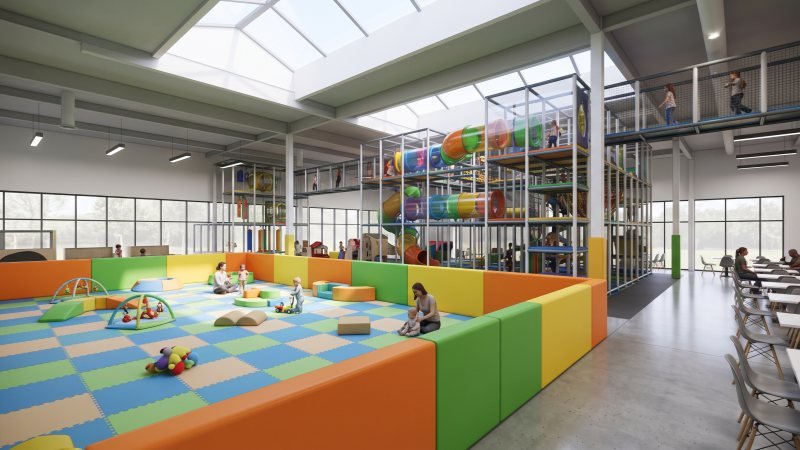
Infants require an incredibly controlled environment. Because of this, designers carve out dedicated micro-zones restricted to babies who are crawling or just learning to stand. These areas focus entirely on floor-level engagement.
Think of this area like the zero-depth entry section of a commercial wave pool. It provides a highly controlled, slow-paced environment safely away from the turbulent deep end. From an engineering standpoint, infant zones rely on flat foam mats, low-profile perimeter walls, and soft freestanding interactive shapes.
Safety dictates that equipment in this zone remains extremely low to the ground. Usually, structures do not exceed 10 inches in height. To enforce that boundary, designers use padded partition walls to separate this area from older children. You’ll typically see these barrier walls sitting around 18 to 24 inches high. This sweet spot allows parents to easily step over while keeping wandering babies safely contained. Just remember, local building codes dictate the exact barrier specs, so always verify with your supplier.
Toddler Play Zones 18 Months to 3 Years
Toddlers are highly mobile but still lack advanced physical coordination. To match that energy, toddler zones introduce slight elevations and basic problem-solving challenges. These areas bridge the gap between flat crawling mats and complex multi-level structures.
Consider the mechanical layout of a junior carousel ride at an amusement park. It offers independent movement but strictly limits the speed and range of motion. Similarly, a toddler zone introduces early climbing concepts, but keeps the risk level completely minimized.
In this zone, you will typically find single-level or two-level play structures. If you look at the specs, manufacturers include low-angle foam ramps, miniature ball pits, and short open slides. Operators must ensure clear sightlines across the entire zone. Parents usually supervise from the immediate perimeter rather than climbing inside. To keep the floor flowing, industry layout data suggests allocating at least 15 to 20 square feet per toddler. Sticking to that spacing prevents overcrowding and accidental bumps during active play.
School-Age Active Play 4 to 12 Years
School-age children demand high-energy, physically challenging environments. To handle the demand, this zone features the largest and most complex equipment in the facility. Designers utilize towering, multi-level grid structures that heavily maximize vertical building space.
Structurally, these areas function like a multi-story indoor climbing gym. They use rigid steel pipe frames completely covered in thick foam padding. Inside this massive structural grid, children navigate through intricate mazes, steep enclosed tube slides, and suspended rope bridges.
Unlike the infant or toddler zones, the school-age area encourages rapid, continuous movement. To manage this high traffic, manufacturers design complex flow pathways. They ensure children cannot get trapped in structural dead ends. By doing this, you keep the operational capacity high during peak weekend business hours. Can you imagine the gridlock if a dozen eight-year-olds got stuck at the top of a tower?
| Target Age Group | Primary Design Focus | Typical Structure Height | Parental Supervision Style |
|---|---|---|---|
| Infants (0-18 Mo) | Floor-level exploration | Under 10 inches | Direct physical contact |
| Toddlers (18 Mo-3 Yrs) | Basic climbing & sliding | 1 to 2 levels (Up to 4 ft) | Close perimeter observation |
| School-Age (4-12 Yrs) | Complex vertical mazes | 3 to 4 levels (Up to 15 ft+) | Relaxed facility monitoring |
Why Businesses Are Investing in Soft Play Areas
Why are commercial property owners and retail operators suddenly pouring capital into padded indoor play structures?
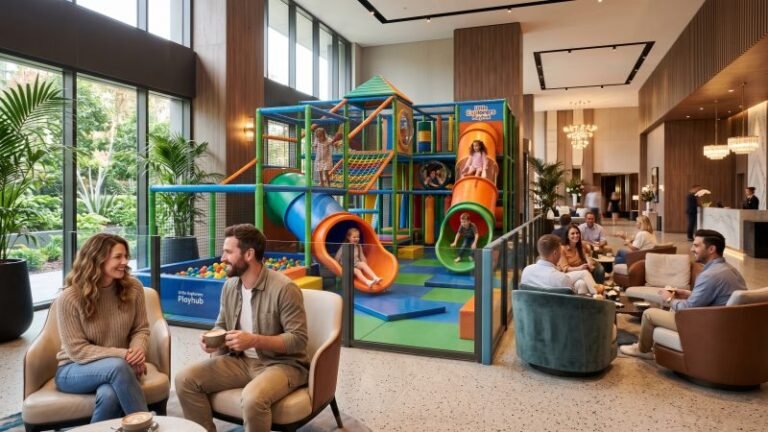
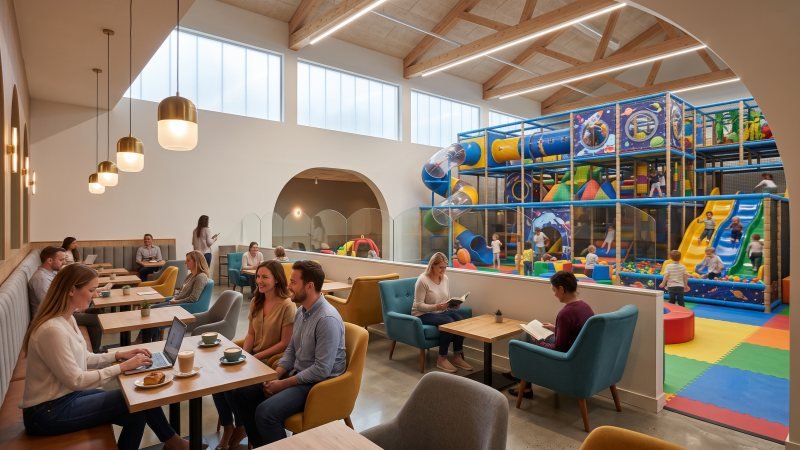
Businesses invest in commercial soft play equipment because it directly drives revenue through two distinct operational models. For starters, as an auxiliary amenity, it significantly increases customer dwell time and secondary spending in retail environments. On the flip side, as a standalone attraction, it generates direct admission profit while leveraging a highly durable, low-maintenance hardware footprint.
Increasing Dwell Time in Retail and Restaurants
When parents visit a restaurant or shopping mall, a restless child often cuts the trip short. When that happens, businesses bleed potential sales. Soft play areas solve this exact operational bottleneck. They act as a highly effective family anchor.
Think of this setup like the arcade section in a commercial bowling alley. The primary business is bowling, but the arcade captures secondary time and spending. Drop a padded play corner into the mix, and it changes the entire dynamic. Parents stay on the premises longer. They feel relaxed enough to order another cup of coffee, browse extra retail aisles, or upgrade their meal.
“A contained play unit transforms a quick operational transaction into a prolonged hospitality experience, directly impacting the average transaction value per family.”
According to commercial retail studies, adding a contained play unit can increase a family’s average dwell time by up to 50%. Even better, this extended stay often correlates with a 20% to 30% increase in food and beverage spending per table. When executed right, the play equipment acts as a passive, silent salesperson for your primary business.
Creating Profitable Standalone Indoor Playgrounds
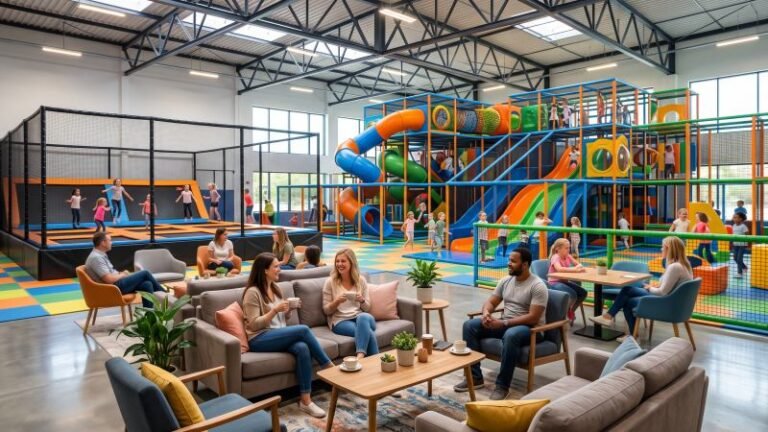
If you want to go all in, you can build entire businesses around this equipment. Standalone indoor playgrounds operate as independent family entertainment centers (FECs). In this specific business model, the soft play structure is the primary product. Operators generate immediate revenue through direct admission tickets. Beyond the door charge, they sell highly profitable group birthday party packages.
Consider the revenue mechanics of a commercial roller skating rink. The operator charges a flat admission fee for guests to access a specialized physical floor. A soft play center works identically. Customers pay directly for time-limited access to the specialized padded grid.
The initial capital expenditure (CapEx) to build a large-scale grid can be substantial. But the gross margins on daily admission and party bookings are incredibly high. A standard 5,000-square-foot facility often targets a full return on investment (ROI) within 18 to 24 months. Of course, square footage costs and capacity limits fluctuate, so always get hard numbers from your equipment supplier.
Low Maintenance and High Durability ROI
Investors strongly prefer commercial assets with predictable, slow depreciation. Soft play equipment excels in this exact financial metric. Unlike mechanical amusement park rides or electronic arcade cabinets, padded structures contain zero complex moving parts. That means you aren’t reliant on expensive specialized technicians for routine daily upkeep.
The complete lack of motors, digital screens, or electrical wiring drastically lowers ongoing operational expenses (OpEx). If a vinyl block gets damaged, the operator simply unzips and replaces that single modular piece. They do not have to shut down the entire facility for repairs. With that kind of modularity, you guarantee continuous daily uptime.
| Equipment Asset Class | Moving Parts | Routine Maintenance Requirement | Expected Uptime |
|---|---|---|---|
| Electronic Arcade Games | High (Buttons, Screens) | Specialized technician needed | Moderate |
| Mechanical Rides | High (Motors, Gears) | Strict daily mechanical inspection | Moderate |
| Commercial Soft Play | Zero | Basic surface sanitization | Very High |
This hardware offers an exceptionally long operational lifespan. Most commercial-grade structures easily endure five to seven years of heavy daily foot traffic before requiring significant structural refurbishment. Bottom line: this low-maintenance durability secures a highly stable, long-term return on investment for the facility owner.
How to Clean and Maintain Your Play Equipment
Maintaining indoor play structures ensures they remain sanitary and structurally safe for daily use.
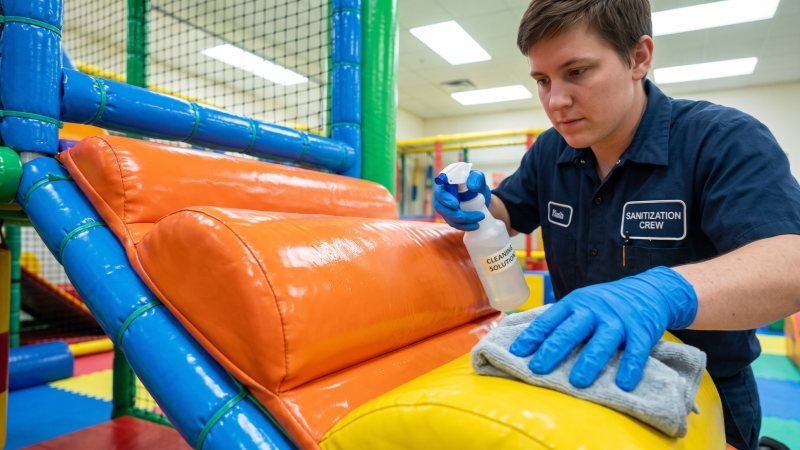
Commercial soft play equipment requires a strict two-part maintenance protocol. On a daily basis, operators must perform surface sanitization using non-toxic, vinyl-safe cleaning solutions to prevent bacterial growth. Alongside that, staff must conduct routine physical inspections to identify and repair minor structural wear before it becomes a major safety hazard.
Daily Sanitization Best Practices
Why should you never use standard household bleach on commercial play structures? In reality, harsh chemicals strip away the vital UV-resistant and fire-retardant coatings. That’s why operators have to use specialized, non-abrasive sanitizers.
Consider the cleaning protocols used for commercial gym mats or wrestling rings. Maintenance staff must achieve high-level disinfection without destroying the waterproof vinyl upholstery. Following that same logic, indoor playground operators typically use diluted quaternary ammonium (quat) solutions. These solutions effectively kill germs but remain completely safe for children’s skin.
Just a word to the wise: chemical resistance varies based on specific vinyl manufacturing processes, so always run your cleaning solvent list past your equipment supplier. Using the wrong chemical can instantly void your warranty.
For the general play area, staff should wipe down all high-touch surfaces at the end of every business day. When it comes to deep cleaning, you need specialized machinery. Take commercial ball pits—they act like giant dirt sponges. To combat this, professional facilities deploy automated ball-washing machines. These vacuums suck up the balls, scrub them in an antibacterial bath, and blow them back into the pit dry. Industry data shows a commercial ball washer can process up to 15,000 balls per hour, drastically reducing manual labor costs.
Inspecting for Wear and Tear
Cleaning alone does not guarantee safety. That makes daily physical inspections non-negotiable. Staff must visually scan the entire facility before unlocking the front doors for customers.
Think of this process like the daily track walk required for commercial roller coasters. Ride operators do not wait for a cart to break down. Instead, they actively hunt for loose bolts before the park even opens. Indoor playground staff must apply this exact same preventative mindset. They must catch a tiny tear in the vinyl before a child pulls the foam out.
Operators should focus on high-stress connection points. For example, you need to check the heavy-duty zip ties holding the safety netting to the steel frame. If a single zip tie snaps, the netting sags, instantly creating a dangerous entrapment hazard.
| Inspection Area | Specific Hazard to Look For | Required Action |
|---|---|---|
| Vinyl Seams | Fraying threads or splitting joints | Patch immediately with commercial vinyl cement. |
| Safety Netting | Broken zip ties or stretched mesh | Replace broken ties to maintain strict tension. |
| Floor Mats | Separated Velcro joints between pads | Realign and firmly press Velcro seams together. |
| Pipe Foam | Exposed steel where foam is torn | Wrap new foam padding and secure it tightly. |
At the end of the day, locking in a strict, documented maintenance schedule extends the lifespan of your equipment. It prevents expensive structural replacements and protects your business from liability claims.
Conclusion
Understanding the engineering, developmental benefits, and operational mechanics behind indoor padded playgrounds is what separates a successful commercial space from a liability. When you prioritize high-density materials, strict safety certifications, and age-appropriate zoning, you build a highly profitable environment that families want to visit week after week. If you are ready to design your own commercial play area or need expert guidance on equipment selection, please feel free to contact us today.