-
Whatsapp: +86 15516933785
-
Email: hanlin@hanlinplayground.com
-
Address: Shangjie District, Zhengzhou City, Henan Province, China
-
Whatsapp: +86 15516933785
-
Email: hanlin@hanlinplayground.com
-
Address: Shangjie District, Zhengzhou City, Henan Province, China

The Ultimate Guide to Making Your Museum Kid-Friendly with Interactive Play Equipment
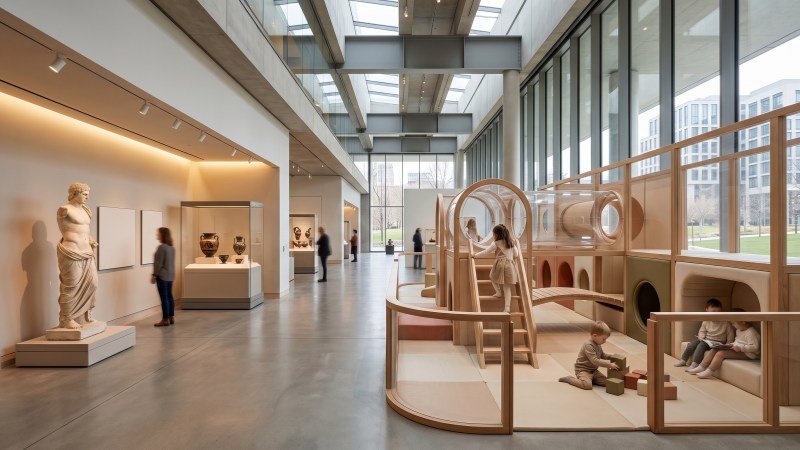
How can museums successfully transform traditional exhibition spaces into highly engaging, kid-friendly environments without compromising their core educational mission?
Museums can achieve a kid-friendly environment by strategically installing thematic soft play areas, sensory wall panels, and custom interactive equipment in transition zones or underutilized lobbies. This targeted approach safely channels childhood energy, extends family dwell time, increases secondary revenue, and preserves the serene atmosphere of traditional galleries through acoustic management and cohesive architectural design.
Strategic Placement and Design of Museum Play Zones
How exactly do you integrate active play areas into a traditional museum without disrupting the core exhibition experience?
Strategic placement of museum play zones requires isolating high-energy activities in transition areas or underutilized lobbies while using acoustic dampening materials. This approach ensures that interactive equipment complements the educational environment rather than overwhelming quieter galleries. Consequently, it effectively manages visitor flow and preserves architectural integrity.
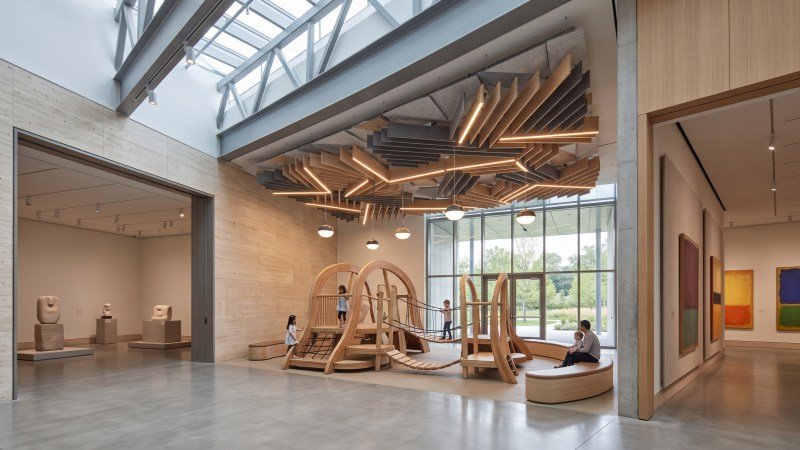
Utilizing Lobbies and Exhibit Transition Spaces Effectively
Museum curators wrestle with “museum fatigue” among young visitors constantly. That makes placing your interactive equipment in the exact right spot absolutely crucial. Lobbies and connecting hallways aren’t just dead space—they are prime real estate for physical play.
Think about it: just as exhibit designers use architectural vestibules to control climate and lighting between distinct historical galleries, a transition play space acts as a sensory buffer. Kids burn off physical energy in the lobby before they step foot into a quiet art gallery. Better yet, utilizing these dead zones prevents nasty bottlenecks inside the main exhibits.
Consider your facility’s standard traffic flow. When families walk through the doors, kids are usually bouncing off the walls. A bespoke climbing structure right in the ticketing atrium captures that initial burst of energy. On the flip side, dropping equipment right between two massive exhibit halls serves as a much-needed sensory reset.
- Ticketing Atrium Corners: Captures immediate energy upon arrival.
- Connecting Hallways: Acts as a physical break between deep learning sections.
- Covered Courtyards: Maximizes unused square footage without altering the indoor layout.
Harmonizing Play Structures with Your Existing Architecture
Play equipment has to look like it belongs in your institution. That means designers must strictly align the equipment’s visual identity with the building’s core aesthetic. Sure, bright primary colors work perfectly in dedicated children’s museums. But for historical societies or fine art museums? You need muted tones and premium finishes.
Take material choices, for example. Swapping out standard primary-colored plastics for faux-wood grain or brushed aluminum components creates a seamless visual transition. It’s exactly like how exhibit designers use concealed track lighting to highlight a delicate artifact—you get the function without exposing the modern electrical wiring to the viewer.
When you’re specifying custom powder-coating colors or wood-laminate finishes, always demand physical material swatches from your play equipment manufacturer to ensure the final structures perfectly match your museum’s interior design palette.
| Feature | Standard Commercial Play | Museum-Integrated Play |
|---|---|---|
| Color Palette | Bright Red, Blue, Yellow | Earth tones, muted greens, custom RAL |
| Surface Materials | Exposed steel, basic netting | Wood veneer, clear acrylic, hidden joints |
| Structural Form | Blocky, standard square grids | Organic shapes, customized sculptural elements |
Implementing Sound-Controlled Enclosures for Active Play
Let’s face facts: active play generates serious noise. That makes acoustic management a mandatory part of your layout planning. You can’t just slap a high-energy slide next to a quiet historical reading room and expect peace without proper acoustic barriers.
“Effective acoustic zoning transforms a potentially disruptive playground into a seamlessly integrated educational feature.”
To strike this balance, savvy institutions rely on sound-controlled enclosures. These physical barriers are engineered specifically to absorb or deflect sound waves away from quiet zones. Common structural solutions involve installing transparent, shatterproof polycarbonate walls or applying impact-resistant acoustic wall treatments that don’t mess with your overhead fire sprinkler coverage. By utilizing materials with a high Noise Reduction Coefficient (NRC) and Sound Transmission Class (STC) rating—think flush-mounted acoustic ceiling foams and laminated safety glass—you effectively trap high-frequency sounds without introducing impact or overhead hazards.
Choosing the Right Play Equipment for Educational Environments
Selecting the right educational play equipment comes down to matching the physical interactivity level to specific age groups. Institutions need to integrate low-impact sensory panels for focused learning, heavily padded thematic soft structures for early motor development, and complex kinetic installations for the older kids. This targeted approach guarantees that your interactive elements reinforce the educational narrative instead of distracting from the primary exhibits.
Thematic Soft Play Areas for Toddler Safety and Engagement
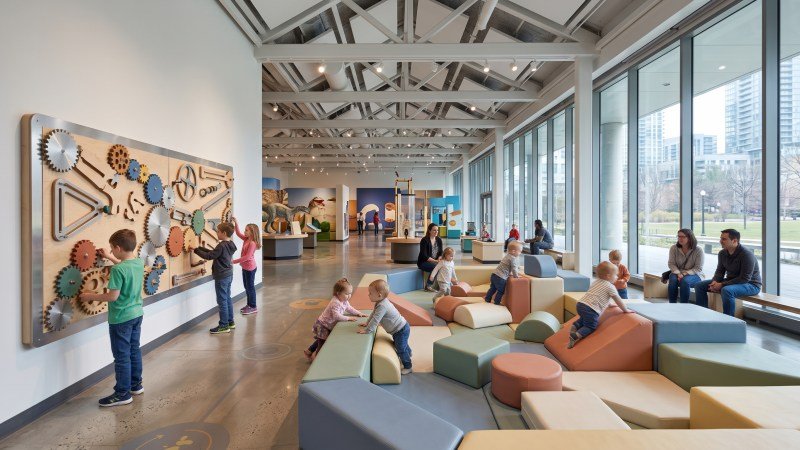
Toddlers process the world primarily through touch and gross motor movement. Honestly, what value does a traditional glass display case offer them? Almost none. Instead, thematic soft play structures deliver a physically forgiving environment where toddlers can actually engage with your museum’s concepts.
Think of a thematic soft play area like a physical, walkable diorama. Just as a natural history diorama uses sculpted resin and painted backdrops to build a habitat, soft play utilizes sculpted high-density foam to construct a safe, explorable world. For instance, an aviation museum might roll out soft, foam airplanes for toddlers to climb over. On the other hand, an art museum might deploy giant, soft geometric shapes modeled after a specific abstract painting.
“Integrating thematic shapes into soft play bridges the gap between passive observation and active physical learning for early childhood demographics.”
Sensory Wall Panels for Quiet Interactive Learning
How do you engage a child who feels completely overwhelmed by massive, physical climbing structures? You hand them focused, localized activities. Sensory wall panels deliver highly engaging, tactile experiences without encouraging kids to run or jump around your galleries.
Because these panels are completely self-contained units mounted directly to flat surfaces, they are perfect for maintaining a calm atmosphere near text-heavy informational displays. Children can spin gears, solve tactile mazes, or manipulate magnetic elements. This localized interaction mimics the function of a push-button audio guide or an interactive touchscreen kiosk—it keeps the user engaged in one specific spot without causing a physical disruption.
You can customize sensory panels to match almost any educational subject.
| Museum Type | Appropriate Sensory Panel Concept | Educational Benefit |
|---|---|---|
| Science & Technology | Interlocking mechanical gear walls | Demonstrates cause-and-effect and basic physics |
| Natural History | Textured fossil-rubbing stations | Provides tactile feedback of historical artifacts |
| Fine Arts | Magnetic color-mixing wheels | Introduces color theory through hands-on practice |
Custom Interactive Installations for Older Children
Kids over the age of seven outgrow basic soft play in a heartbeat. They demand physical challenges combined with cognitive problem-solving. To hold their attention, your custom interactive installations must incorporate complex, multi-step activities.
Similar to how a digital exhibit relies on sequential logic to navigate a menu, a kinetic play installation requires sequential physical steps. Take pneumatic tube systems—they’re highly popular in modern science centers for a reason. Children feed light scarves or foam balls into air-powered tubes and watch them travel across the room, adjusting air valves to change the pathway. The result? A direct, hands-on lesson in fluid dynamics and air pressure.
Other successful installations for older children include:
- Suspended Net Courses: These structures challenge spatial awareness and balance, often themed as canopy walks in botanical exhibits.
- Augmented Reality (AR) Climbing Walls: These blend physical climbing with digital projections, turning a basic wall into a changing geography puzzle.
- Collaborative Construction Zones: These areas feature large-scale, modular building blocks where groups must work together to build arches or bridges.
By transforming abstract educational concepts into tangible, physical challenges, these advanced structures prompt older children to spend significantly more time actively processing the information.
Maximizing ROI and Streamlining Daily Maintenance
Integrating commercial play equipment maximizes your Return on Investment (ROI) by significantly extending family dwell time—which naturally drives secondary spending in food and retail. Beyond that, specifying easy-to-clean materials and adhering strictly to commercial safety standards slashes your long-term liability and minimizes the daily labor required for facility upkeep.
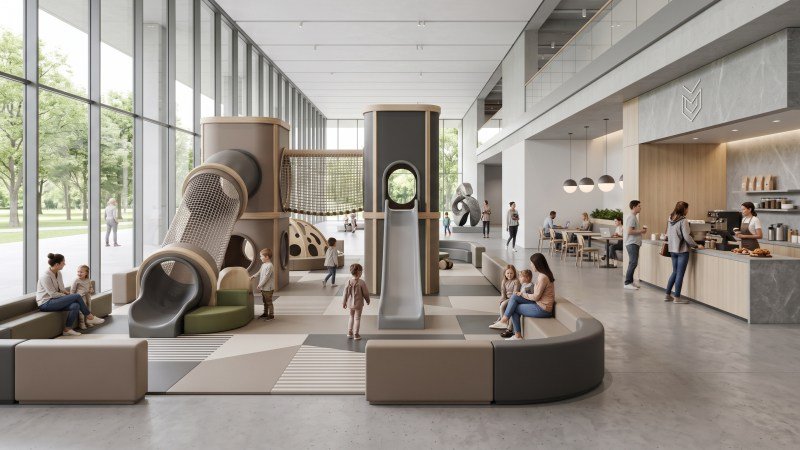
Driving Revenue Through Extended Family Dwell Time
Let’s be real: museums operate on tight budgets. Increasing secondary spending isn’t just nice to have; it’s vital for your financial health. Extended visitor dwell time is the primary metric driving this extra revenue. Put simply, the longer a family stays inside your building, the more money they drop at the register.
If a family bails after just 90 minutes because the kids are getting restless, they are definitely skipping the museum cafe. But add a strategically placed play zone to provide a necessary energy reset? Now, families routinely extend their visit to three or four hours. That extended stay directly translates to lunch purchases, gift shop visits, and a serious bump in annual membership conversions.
“Adding a dedicated interactive children’s zone can increase a family’s average stay duration by up to 30%, directly correlating to a bump in on-site food and beverage sales.”
Think of this strategy the exact same way you optimize a museum gift shop layout. A well-designed retail routing forces a slower walking pace to trigger impulse buys. Similarly, an engaging play zone successfully anchors families in your facility for a much longer stretch.
Meeting Commercial Safety Standards in Public Venues
Safety compliance in public venues? It’s completely non-negotiable. Museums face heavy foot traffic and massive potential liability. Because of this, your interactive equipment must strictly meet commercial safety guidelines (like ASTM F1918), rather than flimsy residential standards.
Just as an archival display case demands specialized shatterproof safety glass to protect both the artifact and the visitor, a play structure requires specific impact-absorbing surfacing. The thickness of your safety flooring is strictly dictated by the equipment’s “critical fall height.” Since exact impact attenuation ratings fluctuate based on specific foam densities and varying local building codes, always work closely with your equipment manufacturer. Verify those exact fall height specifications upfront to ensure your installation remains fully compliant.
Selecting Easy-to-Clean Materials for High-Traffic Upkeep
Your maintenance staff already handles a grueling daily schedule. The last thing you want is a new play zone adding hours of heavy scrubbing to their shift, right? You avoid this entirely by exclusively choosing non-porous, commercial-grade materials.
Heavy-duty 18-ounce commercial vinyl and smooth high-density polyethylene (HDPE) plastics are industry heavyweights for a reason. They resist stains, repel moisture, and wipe down in seconds. On the flip side, steer clear of exposed fabrics or overly complex rope nets—they just trap dust and demand specialized vacuuming. This material selection logic is identical to choosing polished concrete floors over carpet for a main exhibit gallery. Nail the right foundational surface, and you’ll drastically cut down your ongoing janitorial labor.
| Material Type | Best Museum Application | Daily Cleaning Method |
|---|---|---|
| Commercial Vinyl | Soft play blocks and padding | Quick wipe with standard mild surface sanitizer |
| HDPE Plastic | Activity panels and slides | Spray and wipe; highly resistant to deep scratches |
| Clear Polycarbonate | Transparent observation windows | Mild soap and warm water with a microfiber cloth; strictly avoid ammonia-based glass cleaners to prevent material embrittlement |
Conclusion
Upgrading a museum to cater effectively to children and families is a heavy-hitting strategic investment that balances active engagement with your institutional aesthetics. By aggressively analyzing your floor plan to position active zones in transitional spaces, choosing age-appropriate thematic equipment, and prioritizing commercial-grade materials, you’ll transform an ordinary walkthrough into a memorable, day-long family destination. Ready to evaluate your space and explore custom interactive installations? Please contact us to begin planning your museum’s future.