-
Whatsapp: +86 15516933785
-
Email: hanlin@hanlinplayground.com
-
Address: Shangjie District, Zhengzhou City, Henan Province, China
-
Whatsapp: +86 15516933785
-
Email: hanlin@hanlinplayground.com
-
Address: Shangjie District, Zhengzhou City, Henan Province, China

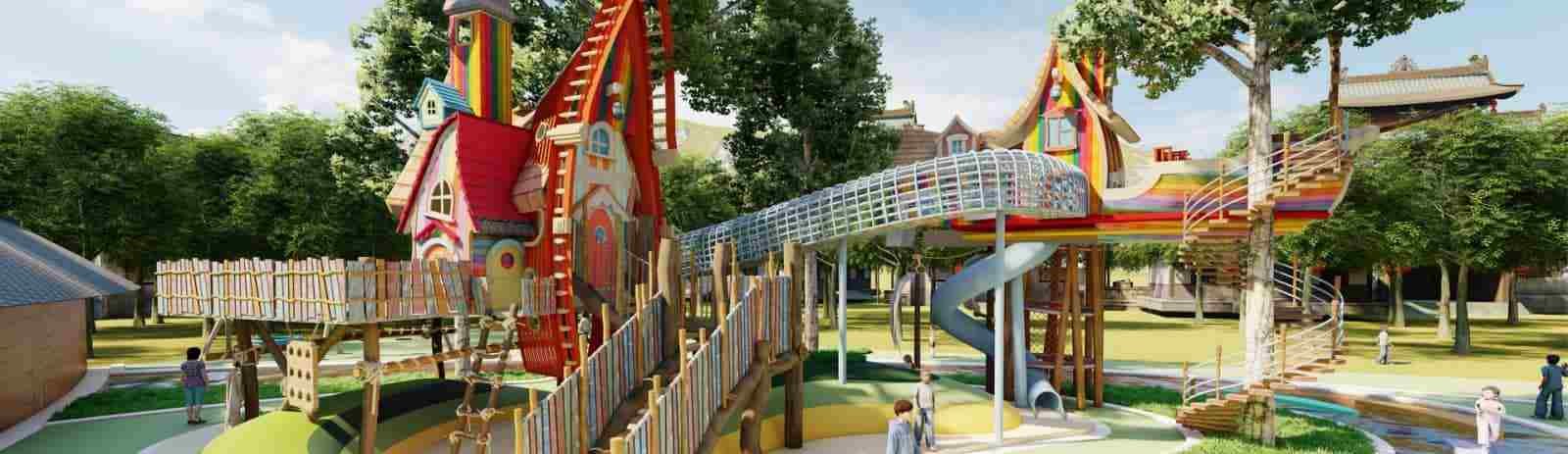
How to Start an Amusement Park
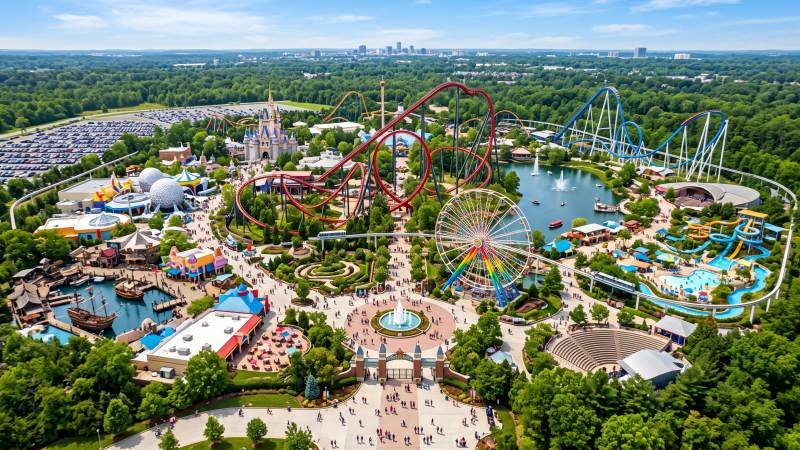
What are the essential steps and financial requirements to successfully build and open an amusement park from the ground up?
Starting an amusement park requires conducting a comprehensive feasibility study, securing substantial capital ranging from $500,000 to over $50 million, and navigating strict zoning laws and safety permits. Developers must then source reliable rides, design an efficient layout for guest flow, and execute pre-launch ticket sales to guarantee operational success and immediate cash flow.
Crafting a Profitable Business Plan
What are the essential components of a business plan that ensures a new amusement park remains financially viable?
A profitable business plan requires conducting local market research, defining a clear park theme, and forecasting revenue streams. This strategic document validates the concept’s financial viability before committing any capital to construction or equipment.

Conducting Local Market and Feasibility Research
How do you know if your city actually needs another roller coaster? Before you even sketch a layout, you must conduct a thorough feasibility study. Think of this market research as the concrete foundation of a massive drop tower ride. Without a solid, tested base, the entire structure will eventually collapse.
A feasibility study examines the local population, regional tourism trends, and existing entertainment competition. For example, industry data shows that regional amusement parks typically draw about 70% of their total attendance from a 50-mile radius. Because of this, your primary research must focus heavily on this specific geographic zone. You need to know exactly who lives nearby and how much disposable income they have.
| Feasibility Component | Industry Focus | Key Metric to Measure |
|---|---|---|
| Demographics | Analyzing the local population base. | Average household income and age distribution. |
| Competition | Identifying direct and indirect rivals. | Proximity of other parks, zoos, or family entertainment centers. |
| Accessibility | Evaluating site location and traffic flow. | Proximity to major highways and public transit systems. |
Defining Your Park Theme and Target Demographic
Are you building an intense thrill park for teenagers, or a gentle fairy-tale zone for toddlers? You simply cannot be everything to everyone. Defining a specific target demographic early on is crucial for your park’s survival.
A strong, cohesive theme helps your park stand out in a crowded market. Take it from the heavy hitters: heavily themed parks often see higher guest spending than standard “iron parks” (a term for parks featuring un-themed mechanical rides resting on bare concrete). For instance, Universal Studios succeeds wildly by targeting older children and adults with intense, movie-based intellectual properties. In contrast, Legoland intentionally designs its scale and aesthetics specifically for families with children aged two to twelve.
“A well-executed theme transforms a standard mechanical ride into an immersive experience, allowing operators to command a premium admission price.”
Aligning Theme with Operations
Your chosen theme will dictate everything else in your business plan. It influences the types of food you sell, the merchandise you stock, and the specific atmosphere you create. Ultimately, a clear theme makes marketing your park much easier and much more effective.
Forecasting Revenue Streams and ROI
Where exactly does the park’s money come from? Admission tickets are realistically just the beginning of your revenue streams. To calculate a reliable Return on Investment (ROI), you must accurately forecast all per capita spending (widely known in the industry as “per cap”).
Look at the historical data: gate admissions account for about 50% to 60% of total amusement park revenue. On the other side of the ledger, in-park spending makes up the remaining 40% to 50%. You must strategically plan for multiple income sources to maximize profitability.
- Gate Admissions: General entry tickets, annual season passes, and VIP fast-lane upgrades.
- Food and Beverage (F&B): Quick-service restaurants, snack carts, and themed dining experiences.
- Merchandise: Branded apparel, souvenirs, and ride-specific photo packages.
- Upcharge Attractions: Skill games, arcades, and specialized experiences like zip lines.
When forecasting your daily revenue, you must calculate how many guests can actually experience your attractions each hour. This critical metric is known as Theoretical Hourly Ride Capacity (THRC). Because THRC parameters can vary significantly based on different control systems and loading procedures, always verify the exact capacity specifications with your ride manufacturer to ensure accurate revenue forecasting.
Calculating Startup Costs and Securing Funding
How much capital is truly required to get a new amusement park off the ground, and where does that funding originate?
Starting an amusement park requires significant capital, typically ranging from $500,000 for small indoor centers to over $50 million for outdoor regional parks. Developers must accurately estimate land, construction, and equipment expenses, then acquire commercial loans, SBA financing, or private equity to cover the initial outlay.

Estimating Land, Construction and Equipment Expenses
Site development is often the most hidden expense in park planning. Before erecting a single ride, you must invest heavily in underground infrastructure. Think a flat patch of dirt is ready for a 50-ton steel structure? Hardly. You will need high-capacity water lines, extensive paving, and massive electrical grids to support the facility.
Once the infrastructure is spec’d out, you must price the actual amusement rides. A standard family carousel might cost around $250,000. Meanwhile, a custom steel roller coaster can easily exceed $15 million. You must also factor in the heavy electrical load requirements for these machines. The necessary operating voltage and peak amperage draw will change depending on the specific ride model. For that reason, always verify the exact electrical specifications with your ride supplier to avoid costly infrastructure upgrades later.
| Expense Category | Small Family Entertainment Center | Regional Amusement Park |
|---|---|---|
| Land & Site Prep | $100,000 – $500,000 | $5,000,000 – $15,000,000 |
| Rides & Attractions | $200,000 – $1,000,000 | $10,000,000 – $30,000,000 |
| Facilities & Buildings | $150,000 – $400,000 | $3,000,000 – $10,000,000 |
Securing Commercial Loans and SBA Financing
Amusement parks are highly capital-intensive projects. Because of this immense upfront load, traditional banks often view them as high-risk investments. To secure a commercial bank loan, you need excellent personal credit, a flawless business history, and substantial collateral.
But here is a practical workaround for many developers: the Small Business Administration (SBA) 504 loan program. This program is specifically designed to fund real estate and heavy machinery. Under this specific structure, a traditional bank covers 50% of the loan, a Certified Development Company (CDC) covers 40%, and the park developer only needs to provide a 10% down payment. It’s a mechanism that drastically lowers your initial cash burden.
Pitching to Private Investors and Syndicates
Debt financing alone is rarely enough to build a modern park. Realistically, you will need private equity from angel investors, venture capitalists, or private syndicates. When pitching to investors, focus entirely on cash flow rather than just colorful concept art. Prove exactly how quickly they will see a return on their investment based on realistic attendance projections.
“Investors do not fund roller coasters; they fund predictable cash flows generated by daily turnstile clicks.”
Some developers also partner with Real Estate Investment Trusts (REITs). A REIT might buy the raw land and lease it back to the park operator. This strategy frees up massive amounts of upfront capital, which you can then deploy to buy more rides and heavily market your grand opening.
Navigating Legal Requirements and Insurance
What legal and insurance hurdles must you clear before opening the gates to your new amusement park?
Opening an amusement park requires strict compliance with local zoning laws, land use permits, and rigorous ride safety certifications. Additionally, securing comprehensive commercial liability insurance is legally mandatory to protect the business from massive financial risks associated with guest injuries and property damage.
Understanding Zoning Laws and Land Use Permits
Where can you legally build a giant Ferris wheel? Ground zero for any build is completely understanding local zoning laws. City planners divide land into specific zones, and amusement parks typically require heavy commercial or specialized entertainment zoning. Navigating the zoning board requires strict attention to detail, as every single condition must be approved before construction can begin.
During this process, local governments will demand a detailed traffic impact study to ensure your park will not cause major highway gridlock. You also have to factor in strict noise ordinances, as neighboring residential areas will not tolerate late-night operational noise. Securing these permits takes significant time and community negotiation.
Obtaining Local Amusement Ride Safety Certifications
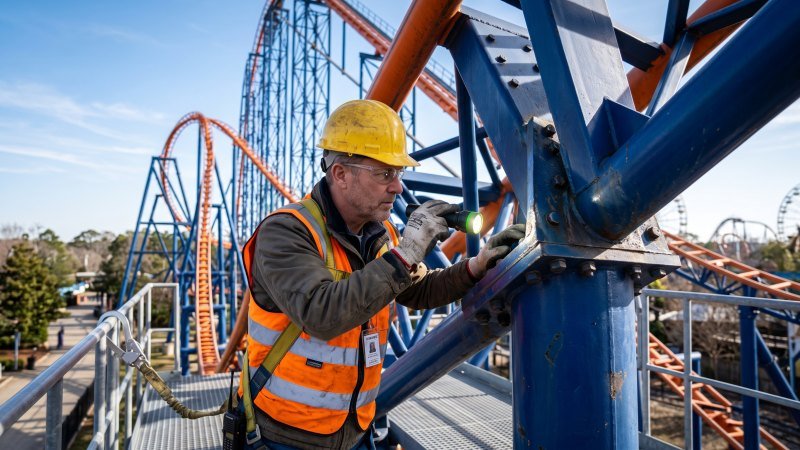
You cannot simply plug in a ride and start selling tickets. State and local authorities mandate strict safety certifications. In the United States, most states adopt the ASTM F2291 standards for amusement ride design and manufacturing.
Before opening day, state inspectors will thoroughly examine every mechanical attraction. They review the engineering blueprints and check the Non-Destructive Testing (NDT) records for the steel tracks. Inspectors want to ensure the absolute structural integrity of the ride vehicles and restraint systems. Always consult your ride manufacturer’s manual and your local state inspector to confirm the exact testing schedules required for your specific attractions.
Securing Comprehensive Commercial Liability Insurance
Amusement parks operate heavy machinery at high speeds. To protect your massive investment against inherent risks, you must secure comprehensive commercial liability insurance. You literally cannot open your doors without it.
General liability insurance is the most critical policy. For instance, industry data shows that most regional parks maintain a minimum of $2 million per occurrence in general liability. As a standard industry practice, they usually layer on a $5 million to $10 million umbrella policy for catastrophic events.
“Insurance underwriters will closely review your safety manuals and operator training logs before issuing a final policy quote.”
| Insurance Type | Primary Coverage Focus |
|---|---|
| General Liability | Guest injuries, slip-and-fall accidents, and ride-related incidents. |
| Property Insurance | Damage to your rides, buildings, and infrastructure from fire or severe weather. |
| Workers’ Compensation | Medical expenses and lost wages for employees injured on the job. |
Insurance premiums are a major ongoing operating expense. Maintaining an impeccable safety record through strict daily procedures is the only way to keep your annual premiums manageable.
Sourcing Equipment and Designing the Park Layout
How do you select the right mix of attractions and design a park layout that maximizes guest spending?
Designing a successful amusement park layout requires selecting certified ride manufacturers, balancing high-capacity thrill attractions with gentle family zones, and strategically optimizing pathway geometry. Intelligent guest flow management directly increases daily attraction capacity and maximizes per capita spending.
Selecting Reliable Ride Manufacturers and Vendors
Selecting a ride manufacturer requires prioritizing a flawless safety record and guaranteed long-term support. Your best bet is to hit major industry trade shows like the IAAPA Expo to inspect ride vehicles in person and review structural engineering portfolios.
Don’t just look at the shiny new hardware, though. You must evaluate a manufacturer’s aftermarket support. You will inevitably need replacement parts, making it vital to work with vendors who offer fast shipping on critical components. Keep in mind that manufacturing lead times for large custom rides can range from 12 to 24 months. Always confirm exact manufacturing lead times and shipping dimensions with your supplier before finalizing your construction timeline.
Balancing Thrill Attractions with Family Zones
To maximize your attendance, you must balance extreme thrill attractions with dedicated family zones. Industry data consistently shows that multi-generational families drive the highest merchandise and food sales.
Ever wonder why you always end up walking past three snack stands and a family ride on your way to the exit? It’s all calculated. Your equipment roster needs strategic variety. For example, regional parks often anchor their layout with two major steel coasters to draw teenagers. Then, they surround these anchors with high-capacity flat rides, such as scramblers and teacups, to satisfy younger siblings and parents.
“A well-balanced ride portfolio keeps the entire family inside the park gates for eight hours instead of four, doubling their potential dining expenses.”
| Attraction Category | Target Demographic | Footprint Requirement | Typical Dwell Time |
|---|---|---|---|
| Major Thrill Coasters | Teens and Young Adults | Very Large (Acres) | 60 – 90 Minutes |
| Family Flat Rides | Parents and Children | Medium (Standard Pad) | 15 – 30 Minutes |
| Kiddie Attractions | Toddlers (Under 48″) | Small (Compact Pad) | 10 – 20 Minutes |
Optimizing Guest Flow and Queue Management
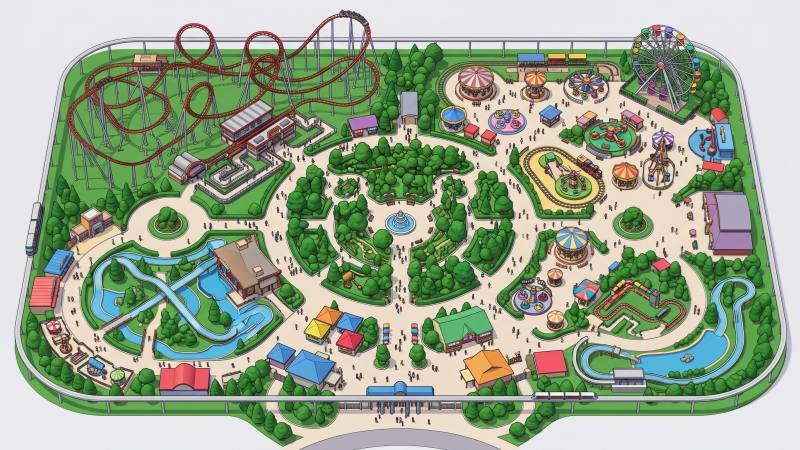
How do you prevent massive crowds from gridlocking your main midway? Optimizing guest flow is essential for a safe and profitable operation. Think of crowd movement like the block brake system on a roller coaster track. If one section jams, the entire system grinds to a halt.
Start by designing circular or “looping” pathways. You must strictly avoid dead ends, which trap guests, cause frustration, and completely kill retail foot traffic. Instead, use a “hub and spoke” layout that funnels guests from a central plaza outward into distinctly themed lands.
From there, you need to design efficient, switchback queue lines to keep waiting guests compacted into a small footprint. Ensure you design queue capacities based on the ride’s THRC and local fire code spatial requirements. Keeping the lines moving efficiently ensures guests spend less time waiting and more time buying food.
Preparing for Operations and Pre-Launch
How do you successfully transition from an empty construction site to a fully functioning, profitable amusement park on opening day?
Preparing for operations requires hiring certified ride operators, establishing rigorous emergency safety protocols, and launching strategic pre-sales campaigns. Successfully executing these pre-launch steps guarantees a safe environment and secures immediate cash flow before the physical gates ever open.
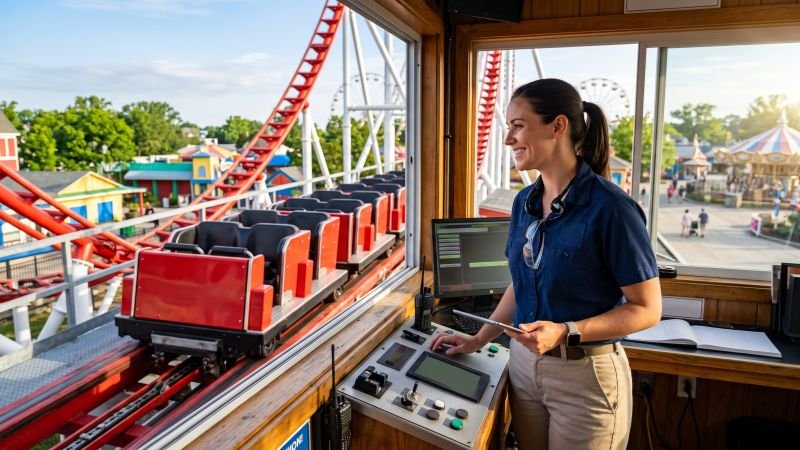
Hiring Certified Ride Operators and Maintenance Techs
You simply cannot run a massive theme park with untrained staff. Your maintenance team is the backbone of daily operations; without their daily sign-off, the park cannot function.
Your immediate priority is hiring highly certified maintenance technicians holding specific credentials from organizations like AIMS or NAARSO. Every single morning, these technicians inspect track welds, test restraint locking pins, and troubleshoot complex electronic sensors.
Would you trust a $15 million kinetic machine to someone who just skimmed a handbook? Absolutely not. You need to hire and train your front-line ride operators to load guests efficiently and monitor the main dispatch panel. Always utilize the specific operator training curriculums provided by your ride manufacturer. Properly trained staff will dramatically reduce accidental ride downtime and ensure maximum daily throughput.
Establishing Safety Protocols and Emergency Procedures
You must establish rigid safety protocols long before you welcome your first guest. Standard Operating Procedures (SOPs) dictate daily tasks, while Emergency Action Plans (EAPs) outline exact responses to critical, unexpected incidents.
For example, your park must enforce a strict weather policy. Industry standards dictate that if lightning strikes within a five-mile radius, all outdoor rides must close immediately. Because wind speed thresholds for safe operation heavily depend on the aerodynamic profile of the ride vehicles, always verify the exact maximum operating wind speeds with your ride supplier to ensure safe daily operation.
| Emergency Scenario | Trigger Event | Immediate Staff Action |
|---|---|---|
| Severe Weather | Lightning detected within 5 miles. | Clear all outdoor ride queues and unload platforms. |
| Power Grid Failure | Complete electrical blackout. | Engage backup power systems to safely return ride vehicles to the station, or initiate controlled high-angle evacuation procedures. Never manually release restraints outside of designated evacuation zones. |
| Medical Emergency | Guest illness on a ride vehicle. | Halt dispatch and call on-site EMTs to the station. |
Selling Advance Tickets and Season Passes
Strategic pre-launch marketing creates immediate and necessary cash flow. Start by offering heavily discounted “Founding Member” season passes online. These early buyers quickly become your most loyal brand ambassadors. The numbers don’t lie: industry data shows that season pass holders historically visit a regional park three to four times per year, guaranteeing steady in-park spending across the entire calendar.
“Selling season passes during the pre-launch phase secures essential operating capital and guarantees baseline attendance during your critical first season.”
You should also actively partner with local businesses to sell discounted bulk ticket packages for corporate summer picnics. This specific sales strategy effectively fills your park on typically slower weekdays.
Conclusion
At the end of the day, building a successful amusement park is a massive undertaking that blends imaginative entertainment with rigorous structural planning. From dialing in the perfect business plan and securing multimillion-dollar funding to establishing flawless safety protocols and optimizing guest flow, every step requires precision. By treating your facility as a meticulously engineered system rather than just a collection of mechanical rides, you create a safe, highly profitable destination that guests will visit for generations. If you need further guidance on structuring your amusement park investment or sourcing reliable equipment, please contact us.