-
Whatsapp: +86 15516933785
-
Email: hanlin@hanlinplayground.com
-
Address: Shangjie District, Zhengzhou City, Henan Province, China
-
Whatsapp: +86 15516933785
-
Email: hanlin@hanlinplayground.com
-
Address: Shangjie District, Zhengzhou City, Henan Province, China

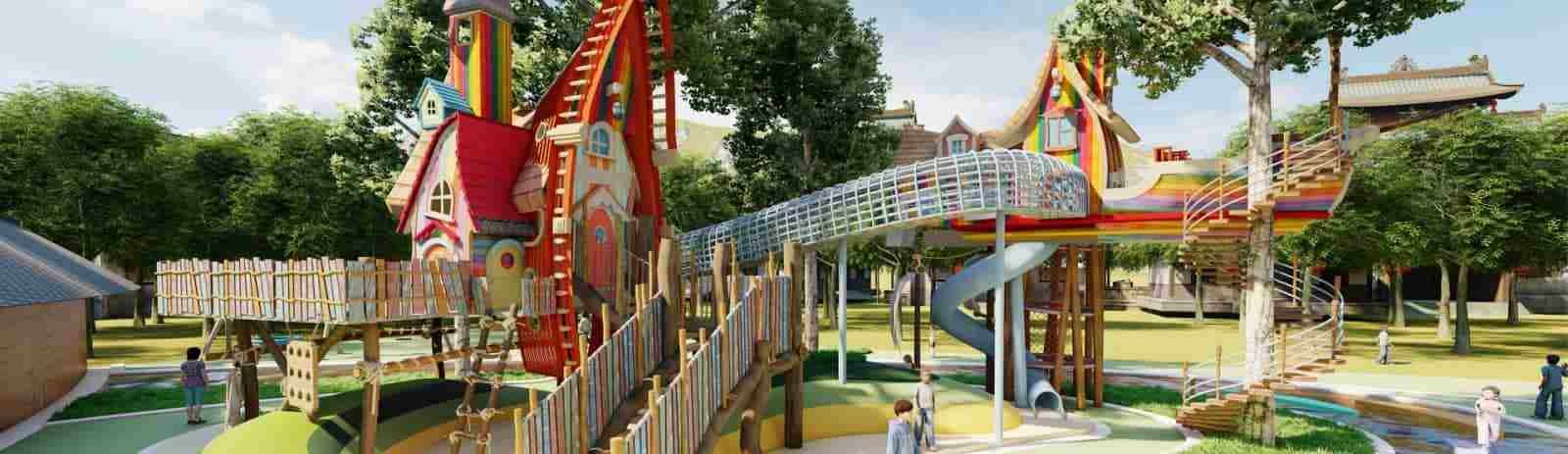
How to Create a Playground That Promotes Physical Activity
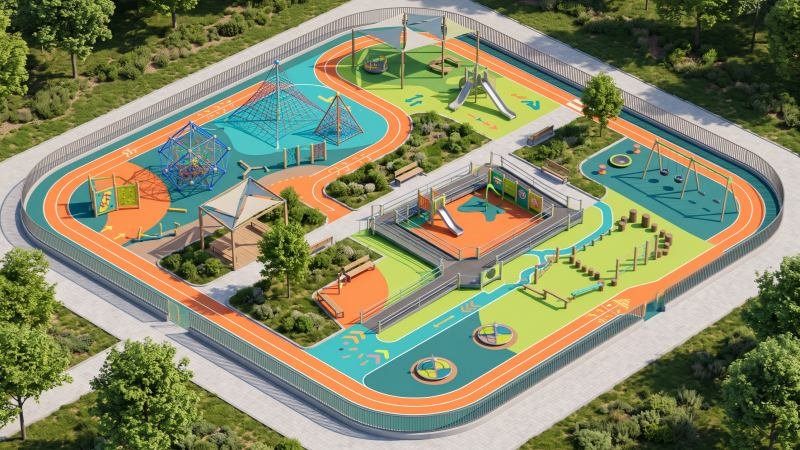
How can you design a playground that effectively guarantees high levels of physical activity for every child?
To create a playground that promotes physical activity, you must strategically select equipment targeting specific motor skills, design age-appropriate challenge zones, implement continuous movement layouts, and ensure fully inclusive accessibility. This comprehensive approach guarantees that users of all developmental stages and mobility levels remain actively engaged in high-energy, beneficial play.
Select Equipment That Targets Specific Motor Skills
What specific playground equipment should you select to effectively develop different motor skills in children?
To effectively develop specific motor skills, you must choose playground structures engineered for targeted physical exertion. Overhead apparatuses like monkey bars actively build upper body strength. Unstable surfaces, such as balance beams, greatly enhance spatial awareness. Finally, complex climbing nets and agility courses challenge core coordination, ensuring a comprehensive physical workout.

Upper Body Strength and Grip Development
Children need strong arms and hands to handle daily physical tasks. That means you need to spec out equipment that forces them to pull, hang, and swing.
Overhead ladders, commonly known as monkey bars, are highly effective. They require children to support their full body weight against gravity. The result? This action directly builds muscle mass in the arms, shoulders, and hands.
Ring treks are another excellent option. They add a swinging motion, and that dynamic movement significantly increases the physical demand on the user.
Equipment Examples for Upper Body Strength:
- Classic overhead ladders
- Trapeze rings
- Vertical climbing poles
When planning these structures, you must pay close attention to the equipment dimensions. For instance, the standard grip rung diameter usually falls between 0.95 and 1.35 inches. It is highly recommended to verify these exact dimensions with your equipment supplier to ensure they meet the specific ergonomic needs of your target age group and comply with regional safety standards.
Spatial Awareness and Balance Enhancement
How does a child learn to navigate space without falling? They practice on unstable or narrow surfaces. Spatial awareness involves understanding where the body is in relation to other objects. At the same time, balance is the ability to maintain a controlled body position. Both are crucial for active, healthy play.
To build these specific skills, you should incorporate playground elements that constantly challenge stability. Spinners stimulate the vestibular system—the sensory system that controls our internal sense of balance. Stepping pods require precise foot placement, while balance beams force children to continually align their center of gravity.
Consider this comparison of balance-focused equipment:
| Equipment Type | Primary Skill Targeted | Physical Action Required |
|---|---|---|
| Balance Beams | Linear stability | Walking heel-to-toe on a narrow surface |
| Stepping Pods | Weight transfer | Jumping and landing on separated targets |
| Stand-Up Spinners | Vestibular processing | Maintaining posture during rapid rotation |
By including these options, you force the body to adjust continually. The payoff? Children quickly improve their posture and stability. Do you want to maximize this physical effect? If so, place stepping pods at varying heights to instantly scale up the physical challenge.
Agility and Core Coordination Challenges
Agility is the ability to change direction quickly and easily. Core coordination involves using the stomach and back muscles to stabilize the body. To build these skills, playgrounds need complex, multidirectional structures.
Traditional stairs are entirely too predictable. Instead, you should deploy geometric rope nets and climbing boulders. These structures do not have a set path, forcing children to plan their own routes. They have to twist, stretch, and reach constantly. This unpredictable movement engages their core muscles instantly.
In the field, we know a tensioned cable structure relies on interconnected ropes for overall stability. In the exact same way, a child’s body uses core muscles to support and connect their limb movements.
You can also install timed obstacle courses to promote agility.
Components of an Agility Course
- Cargo Nets: These require cross-lateral movement where the opposite arm and leg move together.
- Wobble Bridges: These shifting pathways require quick footwork and continuous core engagement.
- Parkour Steps: These angled surfaces encourage leaping and sudden directional changes.
Using these complex structures ensures children do not just play passively. They actively work their core and improve their reflexes. The bottom line is they develop significantly better overall physical control.
Design Age-Appropriate Challenge Zones
How do you ensure your playground safely challenges users across vastly different developmental stages?
To properly challenge all users, you must design distinct play zones tailored to specific age groups. This requires scaling equipment height, physical complexity, and motor skill demands to match the developmental milestones of toddlers, preschoolers, school-age children, and teens. By segmenting the area, you maximize active physical participation while adhering strictly to targeted safety guidelines.
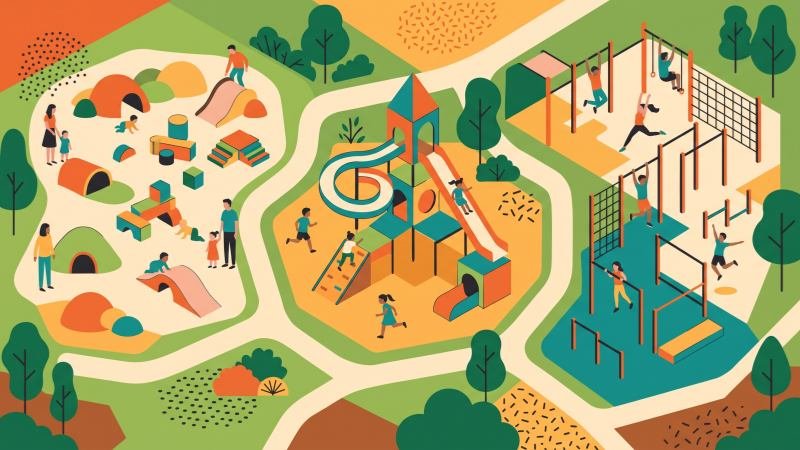
Low-Level Motor Play for Toddlers
Toddlers are just learning to control their bodies. Because of this, they need environments that encourage early movement, focusing on equipment that promotes crawling, pulling up, and early walking.
At this stage, high energy expenditure comes from simple repetition. Toddlers will repeatedly climb a small ramp and slide down. To capitalize on this, provide low-angle ramps, sensory play panels, and very short steps.
Safety is paramount for this age group. According to general industry safety standards, the maximum fall height for toddler equipment is typically kept under 32 inches. Always consult your manufacturer to confirm exact fall height specifications and required safety surfacing depths, as these ensure compliance with strict regional building codes.
Want to see a toddler’s confidence skyrocket? By keeping structures low to the ground, you eliminate their hesitation. With that fear gone, toddlers move much more freely and actively.
Intermediate Climbing and Sliding for Preschoolers
Preschoolers, generally ages two to five, possess much better balance. Are they ready for towering structures? No, but they still need moderate challenges. They require equipment that tests their growing strength without causing fear.
You must install structures with wider platforms and secure handholds. For instance, short rock-climbing walls with deep grips are excellent. They force preschoolers to stretch and pull, which builds muscle. On top of that, small spiral slides encourage children to climb back up quickly—creating a continuous loop of activity that burns serious energy.
A playground transfer station acts as an accessible, incremental stepping-stone. It provides secure, stair-like support for users as they safely navigate to slightly higher, more complex levels without requiring immediate vertical climbing. This support lets preschoolers practice their climbing skills securely before scaling up.
Complex Multi-Level Structures for School-Age Children
School-age children need serious physical exertion. They are significantly stronger and more coordinated. Because of this, they’ll burn out quickly on simple structures. To keep them moving, you must introduce complex, multi-level environments.
These children thrive on verticality and route planning. You should incorporate tall climbing towers, vertical rope webs, and challenging overhead bridges. These structures force them to use their entire bodies. Even better, multi-level designs naturally encourage games of tag and chasing. This social play drastically increases their cardiovascular activity.
Consider the differences in structural needs between age groups:
| Design Element | Preschoolers (Ages 2-5) | School-Age (Ages 5-12) |
|---|---|---|
| Platform Heights | Low to moderate elevations | High, multiple escalating tiers |
| Climbing Paths | Clear, single-route paths | Complex, open-ended routes |
| Physical Demand | Basic balance and pulling | Heavy lifting and agility |
By providing multiple levels, you ensure the play space remains physically demanding. The end result? Older kids will stay active much longer.
High-Intensity Fitness Stations for Teens
Teenagers rarely use traditional playground structures. But they still need outdoor physical activity. To engage this group, you need to pivot away from “play” and focus heavily on “fitness.”
You should design specific zones featuring high-intensity calisthenics equipment. For example, install pull-up bars, parallel bars, and plyometric jump boxes. These elements mimic adult outdoor gyms. Because of this mature design, teens are much more likely to actually use them.
Don’t overlook modern ninja-style obstacle courses, which are highly effective. They challenge a teen’s strength, speed, and endurance simultaneously. When you provide equipment that offers a genuine workout, teenagers will actively participate. At the end of the day, this specific zoning ensures your community space promotes rigorous physical health for older youth.
Implement Layout Strategies for Continuous Movement
How can you design a playground layout that prevents kids from standing still?
To ensure continuous movement, you must strategically arrange playground elements to create seamless physical transitions. This involves designing circular pathways that link equipment together. It also requires utilizing natural ground elevations to encourage climbing. Finally, you must reserve wide open zones for unstructured active games. By actively managing spatial flow, you eliminate physical bottlenecks and keep users in constant motion.
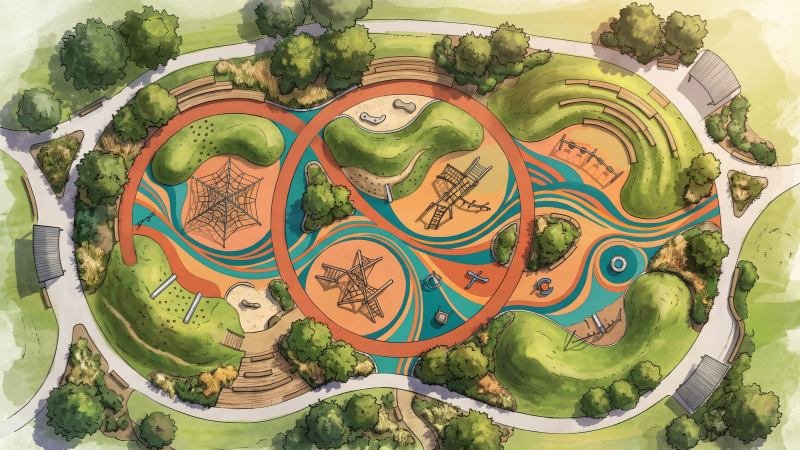
Create Circuit Loops Between Play Structures
Ever notice how kids stop moving the second they hit a physical dead end? A linear playground layout creates exactly that. When children reach the end of a line, they stop. To fix it, you must arrange your playground in a continuous loop.
Circuit loops connect play structures smoothly. They guide children naturally from one activity to the next, much like a well-designed track-and-field circuit keeps athletes moving forward without breaking their stride.
You must carefully plan the distance between elements. If structures are too far apart, the physical connection breaks. If they are too close, you risk collisions. According to general safety guidelines, the standard use zone between two independent, stationary play structures is typically 6 feet. Confirm exact use zone clearances with your equipment provider, as dynamic equipment like swings often requires much larger safety buffers.
Consider this layout comparison:
| Layout Type | Movement Pattern | Physical Activity Level |
|---|---|---|
| Linear Design | Start and stop | Low |
| Clustered Design | Random and chaotic | Medium |
| Circuit Loop | Continuous and flowing | High |
By placing pathways in a circle, you encourage continuous running. Kids will naturally chase each other around the loop. This layout alone dramatically increases their overall cardiovascular exercise.
Integrate Topography and Natural Slopes
Flat ground severely limits physical exertion. If you want to maximize activity, put the natural landscape to work. Hills, mounds, and slopes force children to work harder against gravity.
You can build artificial earth berms if your site is flat. Running up a steep hill requires significant leg strength. And going back down? Rolling or sprinting down the hill builds agility. You can even embed slides directly into these hillsides. Embankment slides eliminate the need for stairs, meaning children have to scramble up the grassy slope just to ride down again.
Benefits of Topographical Play:
- Increases cardiovascular heart rates
- Improves lower body muscle tone
- Reduces playground congestion
Plus, slopes naturally break up the flat landscape. They visually invite children to explore. Integrating natural elevations provides an intense physical workout without relying entirely on manufactured equipment.
Designate Open Multi-Use Spaces for Free Running
You should not fill every square inch of your playground with equipment. Sometimes, empty space is your most valuable asset. You must designate large, open zones.
Open spaces promote unstructured, spontaneous movement. Children need room to run freely, play tag, or kick a ball. These basic activities burn massive amounts of calories.
“Negative space in playground design is actually active space for a child’s imagination.”
Place these open zones near the edges of the main circuit loop. This prevents fast-running children from colliding with kids using stationary equipment. Use visual cues to define these areas—a sudden change in surface color or material effectively marks the boundary of a free-running zone.
When you provide clear, unobstructed space, children will invent their own high-energy games. When you get down to it, this strategic use of empty space guarantees a higher baseline of continuous daily movement.
Ensure Inclusive Design for Active Participation
How can you design a playground that ensures children of all physical abilities can actively engage in vigorous movement?
To ensure active participation for everyone, you must eliminate physical barriers through inclusive engineering. This requires installing compliant access ramps and smooth, unitary surfacing for seamless wheelchair navigation. Furthermore, you must integrate specialized adaptive equipment, allowing users with mobility limitations to actively exert themselves rather than remaining passive observers.
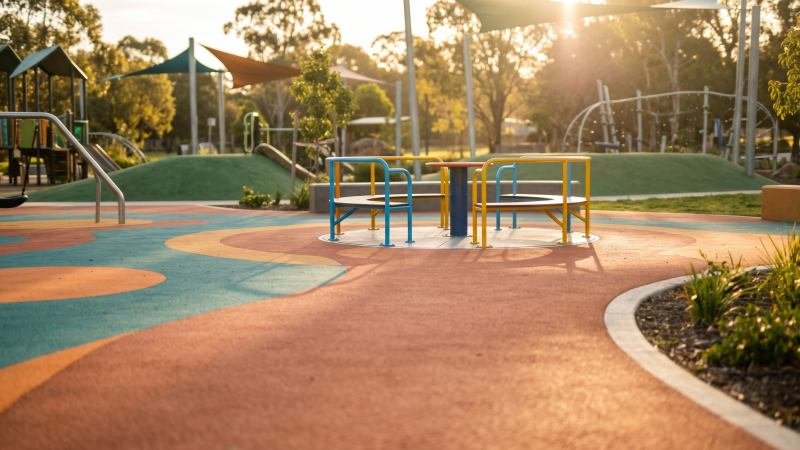
Install Accessible Ramps and Surfacing for Wheelchair Navigation
What good is a high-energy play structure if half the kids in the neighborhood can’t even roll up to it? A playground cannot promote activity if children cannot physically enter the space. Make no mistake, the ground surface is your most critical design element.
Loose materials, like sand or standard wood chips, trap small wheels, severely limiting a child’s ability to move independently. Instead, you must spec unitary surfacing.
Just as a professional running track provides a consistent, high-performance surface for athletes, poured-in-place (PIP) rubber or interlocking rubber tiles create a highly smooth, continuous route for mobility devices. This firm surface allows children using manual wheelchairs to propel themselves effortlessly. The immediate benefit? They get a significant upper-body workout just navigating the play area.
Playground designers need to take the exact same approach: pour seamless rubber surfacing so wheelchair casters can glide freely. From there, you must connect ground-level activity to elevated play structures using wide access ramps. Ramps allow children with mobility devices to reach the highest points of the playground. To maintain safety and usability, the standard wheelchair ramp slope is typically set at a maximum 1:12 ratio (one inch of rise for every 12 inches of run).
Key Surfacing Materials for Accessibility:
- Poured-in-place (PIP) rubber
- Interlocking rubber playground tiles
- Engineered wood fiber (EWF) with rigorous daily compaction
Utilize Adaptive Equipment for Users with Mobility Limitations
Inclusive design goes beyond just getting a child onto the playground. You must also provide equipment that encourages their active physical exertion. Adaptive equipment modifies traditional play structures so everyone gets in on the action.
For example, traditional swings require strong trunk control to maintain balance. Children with limited core mobility often cannot safely use them. But swap those out for molded bucket seats with high backs and secure harnesses, and you provide the necessary postural support. This means children can safely experience vestibular stimulation and actively practice leg pumping.
“True playground inclusion means designing spaces where a wheelchair user breaks a sweat right alongside their peers.”
You should also include flush-mounted merry-go-rounds. These unique spinners sit perfectly level with the rubber surfacing. This allows a wheelchair to roll directly onto the spinning platform. Once aboard, users can reach out and use their arms to pull the center wheel. This repetitive pulling action builds serious core and upper-body strength.
Consider this comparison of standard versus adaptive equipment:
| Equipment Type | Adaptive Modification | Physical Activity Promoted |
|---|---|---|
| Swings | High-back molded seats with harnesses | Vestibular motion and rhythmic leg extensions |
| Merry-Go-Rounds | Flush-mounted bases with roll-on access | Upper-body pulling and dynamic core stability |
| Sand/Water Tables | Raised, cantilevered structural designs | Reaching, grasping, and fine motor coordination |
By utilizing this specialized equipment, you remove the physical barriers to exercise. At the end of the day, this ensures every child gets a healthy, challenging workout regardless of their baseline mobility.
Conclusion
Designing a playground that genuinely promotes physical activity goes far beyond simply dropping equipment onto a plot of land. It takes a highly intentional, engineered approach that carefully targets motor skill development, scales challenges across age groups, facilitates continuous movement, and removes all barriers to entry. By implementing these structured layout strategies, you transform a standard play area into a vital community asset that drives long-term physical health and active participation for all children.
To explore customized equipment options or if you need expert assistance in planning your next project, please feel free to contact us.