-
Whatsapp: +86 15516933785
-
Email: hanlin@hanlinplayground.com
-
Address: Shangjie District, Zhengzhou City, Henan Province, China
-
Whatsapp: +86 15516933785
-
Email: hanlin@hanlinplayground.com
-
Address: Shangjie District, Zhengzhou City, Henan Province, China


The Benefits of Giant 3D Pin Screens in Children’s Museums and Science Centers
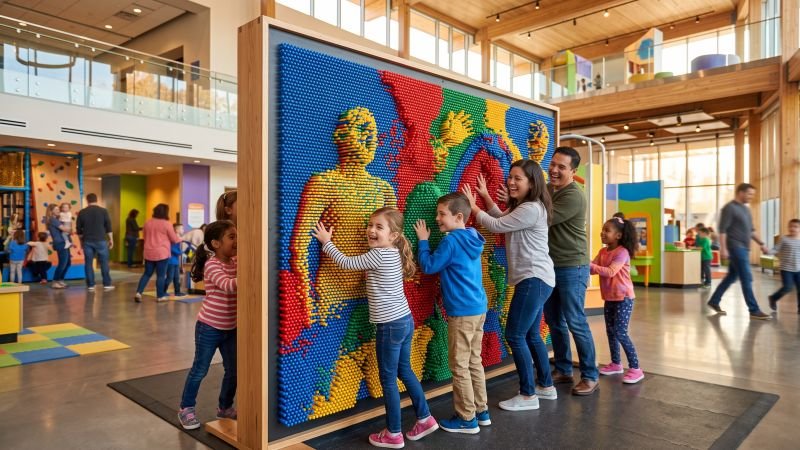
What are the primary advantages of installing giant tactile screens in interactive learning spaces?
Giant 3D pin screens provide significant educational, social, and operational benefits for children’s museums and science centers. They actively stimulate kinesthetic learning, foster multi-generational social engagement, and serve as durable visual landmarks. The real kicker is that these installations drive extended visitor dwell times and support community-focused grant funding initiatives.
Core Educational Outcomes and Developmental Growth
What specific developmental milestones do interactive tactile exhibits support in early childhood education?
Giant 3D pin screens directly support cognitive and physical development. They integrate tactile feedback with gross motor movement. These installations enhance spatial awareness and facilitate sensory processing. More importantly, they promote self-directed scientific inquiry. They serve as crucial tools for kinesthetic learning, allowing young visitors to physically model abstract concepts like topography.
Stimulating Kinesthetic and Whole-Body Learning
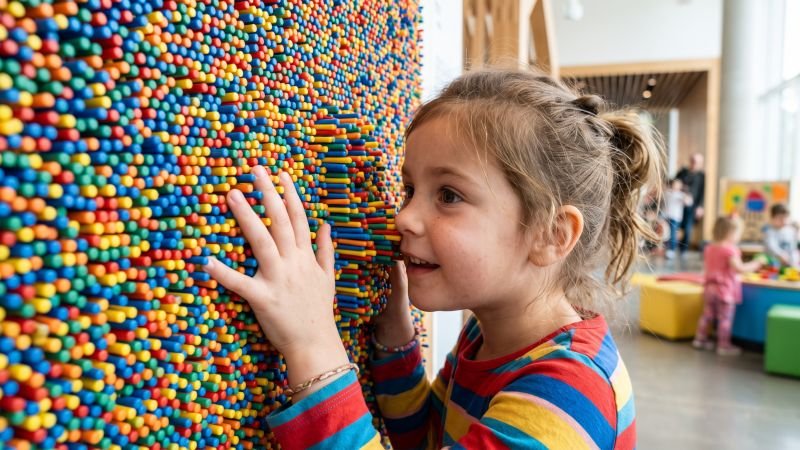
Kinesthetic learning requires physical movement to process information. Giant pin screens demand this exact type of active engagement. Visitors use their hands, arms, and entire bodies to manipulate the surface. The result? This action translates physical force into visual depth.
Think of this like a mechanical wave simulator in a physics gallery. In a wave simulator, pushing a lever creates a visible water ripple. Similarly, pressing against a pin screen physically maps the body’s contours into three-dimensional space. Children learn by doing. The Association of Science and Technology Centers (ASTC) emphasizes that physical interaction deepens memory retention.
When children push the heavy pins, they learn about resistance and force. Pushing thousands of individual pins requires a specific activation force. Because of this, children experience direct tactile feedback regarding mass and friction. The exact weight and resistance of the pins often vary based on manufacturing materials, allowing facilities to select a model that perfectly matches their target age group’s physical capabilities.
| Learning Modality | Exhibit Interaction Type | Developmental Benefit |
|---|---|---|
| Visual | Observing the 3D impression left behind | Enhances depth perception |
| Tactile | Feeling the texture of the pin heads | Improves fine motor skills |
| Kinesthetic | Using body weight to move the pins | Develops gross motor control |
Providing Safe Sensory Exploration for Neurodivergent Visitors
Why build an interactive space if it accidentally excludes a growing segment of your audience? Children’s museums actively design inclusive spaces for neurodivergent visitors. Sensory rooms often feature controlled, predictable stimuli. Giant pin screens fit perfectly into these inclusive environments because they offer deep pressure therapy and predictable tactile feedback.
This mechanism is similar to a tactile fossil replication station. Both exhibits allow visitors to explore textures at their own pace. They do this without causing overwhelming visual or auditory input. The movement of the pins produces a soft, rhythmic sound. Better yet, the visual result is immediate but never flashing or glaring. That’s exactly why it effectively prevents sensory overload for children on the autism spectrum.
“Predictable cause-and-effect exhibits provide a crucial anchoring effect for children experiencing sensory dysregulation in busy museum environments.”
Key Sensory Design Features
- Predictable cause-and-effect relationship.
- Total absence of loud digital sound effects.
- Self-paced interaction speed controlled entirely by the user.
- Cool, consistent surface temperature of the materials.
Encouraging Intuitive Trial-and-Error Problem Solving
Scientific inquiry relies entirely on testing hypotheses. Giant pin screens serve as a highly interactive canvas for this process. Children intuitively press objects or their hands into the wall. Then, they observe the resulting 3D shape. If the shape is incorrect, they simply wipe the pins flat and start the process over again.
This directly mimics the iterative design process found in museum maker spaces. In a maker space, a child might adjust a paper airplane’s wings after a failed flight. On a pin screen, they adjust their body position to fix a distorted physical impression.
There is zero cost to failure on a pin screen. This freedom encourages continuous, fearless experimentation. Beyond just playing, visitors quickly learn advanced spatial reasoning. They begin to understand how negative space works by observing the unpressed pins surrounding their physical impression. The payoff here is that they learn complex geometric principles through simple, repetitive play.
Transforming Visitor Engagement and Interaction
How exactly do large-scale tactile installations reshape the way families and groups interact with museum spaces?
Giant 3D pin screens transform visitor engagement by breaking down social barriers and encouraging collaborative play across all age groups. They act as central visual anchors that naturally draw crowds and generate high-volume social media sharing. What really seals the deal is how the instant tactile and visual response creates a continuous feedback loop, significantly increasing the average dwell time compared to static museum displays.
Fostering Spontaneous Multi-Generational Collaboration
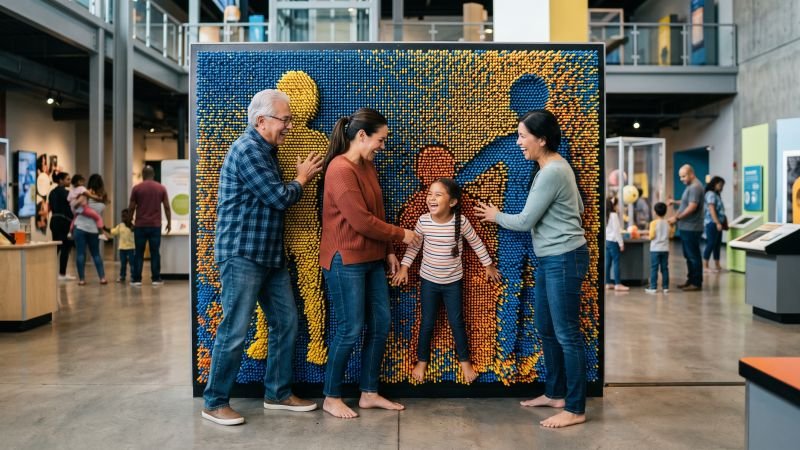
Why do adults engage with this exhibit just as much as toddlers do? The answer lies in simple nostalgia. Adults immediately recognize the concept from classic desktop pin art toys. This familiarity removes any intimidation factor. Before you know it, parents stop simply observing and start actively participating.
This behavior mirrors interactions at giant bubble engineering stations. In those exhibits, parents naturally step in to help children pull the heavy bubble wands. Similarly, on a giant pin screen, families work together to press complex shapes. Grandparents might press their hands while children push their entire bodies into the wall.
This creates spontaneous teamwork. It also encourages interaction among strangers. When the screen is large enough, multiple children can use it simultaneously. They start coordinating their movements to build a shared 3D mural. This dynamic shifts the museum experience from isolated observation to shared social play.
Creating a Highly Shareable Landmark Exhibit
Museum lobbies and main halls require a distinct visual centerpiece to capture attention immediately. The immense scale of these screens creates an instant landmark.
Think of this like a massive kinetic sculpture suspended from a museum lobby ceiling. Both installations serve as iconic visual anchors. However, the pin screen offers physical interactivity. Visitors naturally want to photograph their full-body impressions. This user-generated content acts as free marketing. Families share these unique photos on social media, driving word-of-mouth attendance.
The visual clarity of these shared photos depends heavily on the screen’s pin density. Generally, a higher pin count per square foot yields a much more detailed 3D impression. Because pin density, pin size, and overall screen dimensions vary significantly across different models, evaluating these resolution specifications carefully during the planning phase ensures the final installation meets your institution’s marketing goals.
| Exhibit Type | Primary Engagement Driver | Social Sharing Potential | Typical Visitor Action |
|---|---|---|---|
| Static Diorama | Visual Observation | Low | Reading plaques, moving on |
| Digital Touchscreen | Information Retrieval | Medium | Tapping, reading, individual play |
| Giant Pin Screen | Full-Body Interaction | High | Posing, collaborating, taking photos |
Driving Longer Dwell Times Through Immediate Feedback Loops
Dwell time is a critical metric for evaluating exhibit success. Keeping a visitor engaged for more than two minutes is often a challenge. The giant pin screen achieves this through an immediate feedback loop.
When a visitor pushes the pins, the visual result is instant. Even better, the surface can be wiped clean in exactly one second. This rapid reset cycle encourages continuous play.
“Exhibits that provide immediate, user-driven physical changes consistently demonstrate much higher dwell times than passive displays.”
This rapid feedback functions similarly to interactive digital floor projections. In those digital exhibits, stepping on the floor creates an immediate ripple of light. That fast response prevents boredom and prompts visitors to keep moving. On a pin screen, visitors test a shape, wipe it flat, and immediately try another pose. The net effect? The average dwell time increases drastically. Visitors stay longer because they are in complete control of the rapid experimental cycle.
Practical Operations and Facility Integration
What are the primary logistical requirements for maintaining large tactile installations on a busy museum floor?
Successfully integrating giant 3D pin screens requires a strong focus on durability, maintenance, and spatial planning. Facility managers must evaluate materials for continuous high-traffic use. On top of that, they must establish rigorous daily sanitation schedules. Not to mention the need to allocate adequate floor clearance to manage crowd flow safely around the interactive surface.
Evaluating Long-Term Durability in High-Traffic Zones
Children’s museums experience massive daily attendance. As any floor manager knows, interactive exhibits endure constant physical stress. Giant pin screens must withstand thousands of heavy impacts every single day. After all, have you ever seen a consumer-grade exhibit survive its first summer rush without catastrophic failure?
This physical demand is very similar to the wear on a heavy-duty water table exhibit. In both cases, the core structure must resist continuous, forceful visitor interaction. That’s precisely why manufacturers typically build pin screens using industrial-grade materials, often utilizing powder-coated steel frames and impact-resistant plastic pins.
However, the specific grade of plastic and the exact thickness of the steel frame can differ greatly between models. Because these structural materials vary significantly, it is highly recommended to verify the exact material specifications and stress-test ratings with your supplier to ensure the construction naturally meets your facility’s specific daily traffic volume.
Implementing Efficient Cleaning and Maintenance Protocols
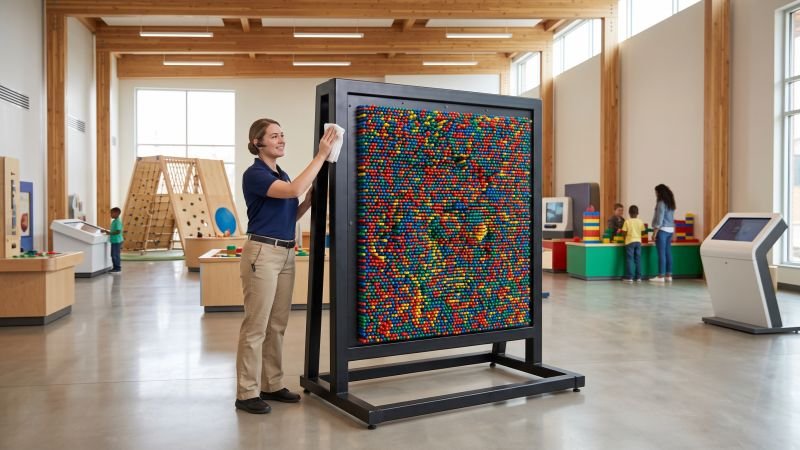
Tactile exhibits naturally attract germs. Visitors press their hands, faces, and bodies directly against the pins. Naturally, effective sanitation becomes a major operational priority. Facility teams need highly efficient cleaning protocols to maintain a safe environment.
“High-touch museum exhibits demand rapid, reliable sanitation methods that do not degrade the core mechanical components over time.”
Fortunately, most modern pin screens are specifically designed for easy maintenance. The plastic pins generally resist moisture and standard museum cleaning agents. Staff can usually sanitize the surface quickly using electrostatic sprayers. They can also use basic antibacterial wipes between field trip groups.
However, certain harsh chemicals might cause plastic degradation or color fading over time. To prevent accidental damage to the exhibit, always verify the list of approved cleaning solutions with your specific supplier before implementing a new daily sanitation routine.
| Maintenance Task | Frequency | Operational Focus |
|---|---|---|
| Surface Sanitation | Daily | Spraying pins with approved disinfectants |
| Mechanical Check | Weekly | Inspecting for bent, broken, or stuck pins |
| Deep Cleaning | Monthly | Wiping down the clear acrylic backing plate |
Managing Space Requirements and Floor Plan Placement
Giant pin screens require careful spatial planning. They are not simple, flat wall displays. Instead, visitors need room to step back, run forward, and push their bodies into the surface.
This specific spatial footprint mimics a large kinetic energy pendulum exhibit. Both of these installations require a generous safety perimeter. If you place the screen too close to a main walkway, active visitors might accidentally bump into passing traffic.
Because of this, exhibit designers must allocate substantial clearance space. You need adequate room on both the front and back sides of the screen. The pushing side needs space for visitors to gather and move. The viewing side needs empty space for the pins to extend fully outward. Proper floor plan placement actively prevents bottlenecks and ensures safe, uninterrupted interactivity.
Strategic Procurement and ROI Considerations
How can museum directors justify the significant capital investment required for large-scale interactive installations?
Procuring a giant 3D pin screen requires analyzing long-term return on investment rather than just the initial purchase price. Decision-makers must evaluate specific material grades to minimize future repair costs. Beyond the hardware, they must structure funding proposals to highlight community impact and increased visitor retention. This strategic approach ensures the exhibit functions as a sustainable asset for the institution.
Essential Material Specifications to Compare Among Vendors
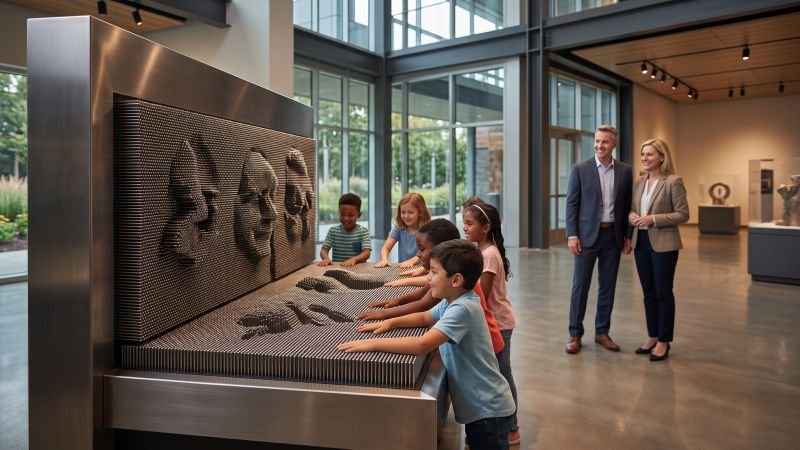
When investing in a permanent exhibit, evaluating the hardware is critical. You cannot simply look at the overall size. Instead, you must carefully compare the engineering specifications across different manufacturers.
Think of this process like specifying the structural load-bearing materials for a multi-level indoor playground. Choosing the wrong material can lead to premature failure under continuous use. Similarly, a poorly constructed pin screen will break quickly under the constant physical stress of energetic children.
You should specifically examine the pin composition. Most high-quality screens use Acrylonitrile Butadiene Styrene (ABS) plastic. ABS provides excellent impact resistance. While you’re evaluating the pins, look closely at the frame structure. How many times have we seen a cheap aluminum frame warp under the pressure of peak weekend crowds? A heavy-duty powder-coated steel frame offers superior longevity. Procurement teams must rigorously evaluate these exact pin dimensions, friction systems, and material grades to guarantee they meet commercial safety standards and minimize future maintenance costs.
| Component | Standard Specification | Premium Specification | Impact on ROI |
|---|---|---|---|
| Frame Material | Extruded Aluminum | Powder-Coated Steel | Reduces long-term structural warping |
| Pin Material | Hollow Polycarbonate | Solid ABS Plastic | Prevents individual pin breakage |
| Friction System | Rubber Grommets | Precision Spacers | Decreases maintenance replacement costs |
Framing the Value Proposition for Grant Applications and Donors
Why would a local philanthropic foundation fund what appears to be a giant toy? They fund it because you can prove its educational and community value. Securing capital for museum exhibits requires a compelling narrative. You must translate the physical exhibit into measurable institutional benefits.
When writing a grant proposal, do not focus on the hardware. Instead, focus entirely on the outcomes. Highlight how the installation directly supports STEM (Science, Technology, Engineering, and Mathematics) learning goals. You can position the screen as a practical tool for teaching spatial mapping.
This strategy mirrors how museums secure funding for interactive STEM maker spaces. Institutions do not just pitch the equipment; they pitch the resulting increase in collaborative learning and school field trip bookings.
“Successful grant applications always connect the physical exhibit to broader community initiatives, such as improving accessibility for visitors with disabilities.”
You must also emphasize the exhibit’s inclusive design. Grant committees actively look for projects that support diverse audiences. Mention that the screen provides a screen-free, highly accessible experience. This specifically appeals to donors focused on early childhood development and neurodiversity. By framing the purchase around these strong community benefits, you significantly improve your chances of securing full funding.
Conclusion
Integrating a giant 3D pin screen into a children’s museum or science center goes far beyond adding a simple novelty. It represents a strategic investment in hands-on, accessible education and sustained visitor engagement. By prioritizing durable materials, safe sensory exploration, and inclusive design, institutions can create a highly shareable landmark. At the end of the day, these tactile installations successfully bring multiple generations together, continuously enriching the community’s scientific curiosity and interactive learning experience.