-
Whatsapp: +86 15516933785
-
Email: hanlin@hanlinplayground.com
-
Address: Shangjie District, Zhengzhou City, Henan Province, China
-
Whatsapp: +86 15516933785
-
Email: hanlin@hanlinplayground.com
-
Address: Shangjie District, Zhengzhou City, Henan Province, China

How to Choose Quick-Setup Commercial Portable Playgrounds
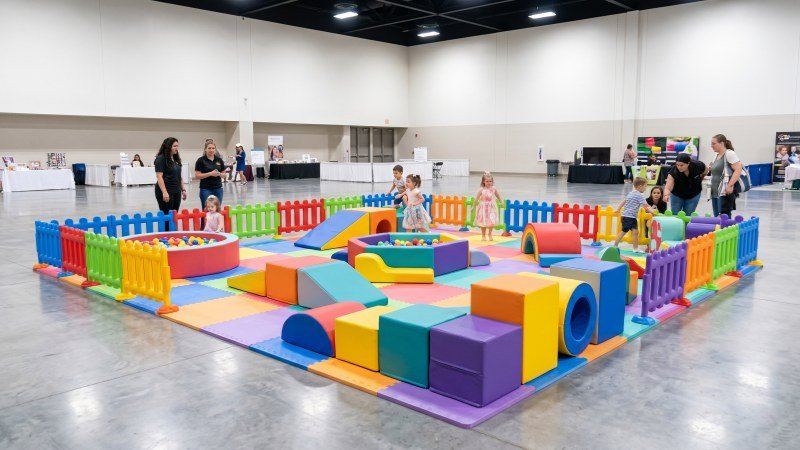
Are you wondering how to choose the right quick-setup commercial portable playground for your event or rental business?
To choose a quick-setup commercial portable playground, evaluate the true assembly time and staffing requirements for safe installation. Assess commercial-grade durability by looking for high-density plastics, heavy-duty PVC, and high weight capacity ratings. Finally, verify strict safety certifications like ASTM or EN standards, maximize portability through modular designs, and prioritize accessible, antimicrobial surfaces for fast daily maintenance.
Evaluating True Assembly Time and Effort
When a manufacturer claims a playground is “quick-setup,” what exactly does that timeline look like in a real commercial environment?
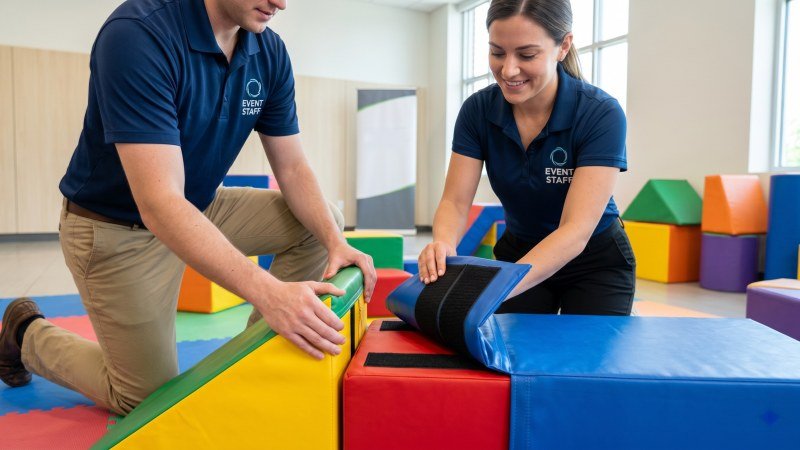
True assembly time for a commercial portable playground ranges from 15 minutes to two hours, depending on the system’s design. Buyers must evaluate the specific connection mechanisms, such as push-pin joints or bolted brackets, to determine actual labor requirements. Additionally, assessing staffing needs ensures that setup teams can handle the component weights safely and efficiently without causing event delays.
Tool-Free vs Tool-Required Interlocking Systems
Let’s break this down: you must understand how the playground pieces actually connect. It comes down to this: comparing tool-free and tool-required systems is vital for your buying decision.
Think of a tool-free playground system like commercial inflatable obstacle courses equipped with heavy-duty Velcro flaps and quick-release buckles. You align the pieces and lock them in place instantly. On the flip side, a tool-required system is similar to a permanent indoor soft play frame. This method requires manual ratchets, hex keys, and bolts for every single joint.
Here is a breakdown of how these two systems compare:
| Feature | Tool-Free Systems | Tool-Required Systems |
|---|---|---|
| Average Setup Speed | 15 – 30 minutes | 1 – 2 hours |
| Connection Mechanism | Snap-locks, Velcro flaps, push-pins | Hex bolts, steel brackets, tension straps |
| Required Labor Skill | Entry-level staff | Trained installation crew |
| Best Commercial Use | Daily mobile rentals, pop-up events | Long-term seasonal installations |
Tool-free systems use interlocking panels or heavy-duty industrial Velcro. As a result, they allow for rapid deployment and teardown. Tool-required systems take longer to build. The trade-off is they provide a rigid structure suitable for longer-term installations. Note that specific locking mechanisms and estimated setup times can vary widely based on the manufacturer’s engineering. Always verify the exact connection specifications and guaranteed setup times directly with your chosen supplier before purchasing.
Staffing Requirements for Safe Installation
Now, here’s the reality check: who is actually going to build this structure? Setting up a commercial playground is rarely a one-person job.
For instance, a standard 15-foot by 15-foot portable toddler zone typically requires two trained staff members. This team size ensures they can lift heavy base panels and stretch safety netting properly. Do not underestimate the physical effort required.
The Occupational Safety and Health Administration (OSHA) recommends a maximum lifting limit of 50 pounds per person. Because commercial-grade padded blocks or steel frame sections often exceed 60 pounds, a two-person lift is mandatory for safe installation.
Requiring more staff directly increases your labor costs per event. Bottom line: if your business model relies on solo operators, you must strictly source lighter, modular systems. These specific systems are carefully designed for single-person handling and assembly.
Assessing Commercial-Grade Durability and Materials
How can you tell if a portable playground will actually survive the daily abuse of hundreds of energetic children?
You evaluate commercial-grade durability by inspecting the core materials and structural engineering of the playground. High-density plastics and heavy-duty PVC vinyl provide the necessary tear strength. Meanwhile, metal frames ensure stability under heavy dynamic loads. Furthermore, verifying high weight capacity ratings and industrial wear resistance guarantees the equipment can withstand continuous commercial use without structural failure.
High-Density Plastics and Heavy-Duty PVC
Right out of the gate, buyers must carefully examine the primary materials covering the play structures. What exactly makes a plastic or vinyl truly “commercial-grade”?
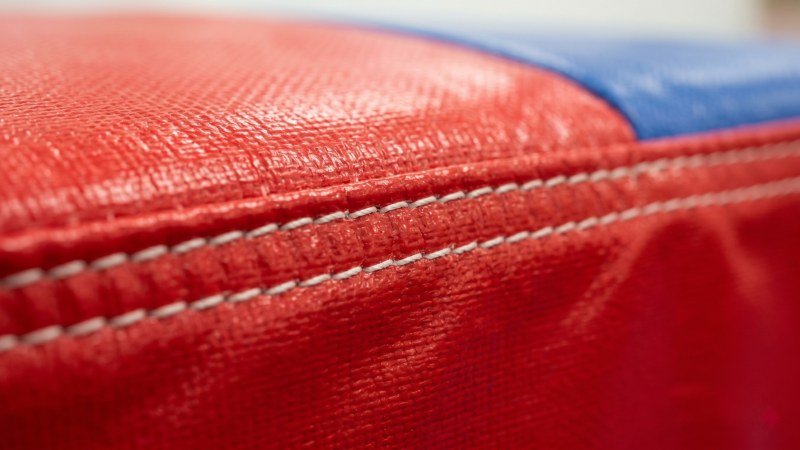
High-Density Polyethylene (HDPE) is the industry standard for solid plastic components. These components include hard slides and junction panels. HDPE naturally resists cracking under pressure. At the same time, soft play elements demand heavy-duty PVC vinyl. Specifically, professionals look for 18-ounce, 0.55mm thick PVC tarpaulin. This rugged material is identical to the thick, industrial vinyl used to build commercial inflatable bounce houses.
Residential playgrounds generally use thin nylon covers. Step up to commercial PVC, and you’re looking at a dense, woven polyester mesh core. This is exactly what prevents deep punctures from sharp toys or shoes. Because material thickness and exact denier counts often vary among manufacturers, be sure to confirm the specific PVC weight and thread density before making your investment.
| Component Type | Common Residential Material | Required Commercial Material |
|---|---|---|
| Soft Play Covers | 210D Nylon Fabric | 18 oz (0.55mm) PVC Vinyl |
| Solid Structures | Standard Polypropylene | High-Density Polyethylene (HDPE) |
| Safety Netting | Thin Cotton Blend | Heavy-Duty Knotted Polyester |
Frame Stability and Weight Capacity Ratings
Let’s talk internal framework—the skeleton that dictates your structural safety. A weak frame will eventually buckle under constant dynamic stress.
Commercial portable playgrounds typically utilize either galvanized steel or structural aluminum tubing. Steel provides maximum rigid strength for taller, multi-level structures. On the other hand, aluminum offers a much lighter alternative for rapid mobile deployment.
Weight capacity ratings are absolutely critical for commercial operations. You must specifically evaluate the structural load calculations, which combine dead loads, live loads, and high impact coefficients. Ever seen a poorly spec’d frame buckle under the momentum of a dozen jumping toddlers? It’s a liability nightmare. A child jumping or falling generates a momentary dynamic force that is multiple times their static body weight. Because of this, a commercial frame joint must be engineered with immense safety factors, requiring an ultimate failure load of thousands of pounds to safely accommodate multiple bouncing children simultaneously. Think of this requirement like the structural framework of a commercial trampoline park; the structure must support heavy, shifting dynamic forces without ever swaying or bending.
Wear Resistance for High-Traffic Environments
Then there’s the daily grind. Continuous daily operation creates massive physical friction on specific playground areas. How does the equipment resist this constant, heavy wear and tear?
Wear resistance relies entirely on advanced construction techniques. For instance, high-traffic zones like slide exits and entrance ramps always degrade first. That’s exactly why top-tier commercial manufacturers use double or triple stitching on all PVC vinyl seams. Not only that, but they also reinforce internal stress points with hidden nylon webbing.
This specific reinforcement technique is identical to how manufacturers build commercial trampoline park jump mats. They sew extra webbing layers into the mat edges to prevent premature fraying. Even better, high-quality portable units feature replaceable wear pads. Instead of replacing an entire structural foam block, operators can replace the damaged outer cover. However, to prevent severe choking hazards and maintain fire-retardant properties, these covers must feature concealed, anti-tamper zippers. Commercial manufacturers remove the zipper pulls during production and hide the tracks under heavy-duty, heavily stitched Velcro flaps so that children absolutely cannot access the internal polyurethane foam.
Verifying Safety and Compliance Standards
Ensuring your commercial portable playground legally protects your business while keeping children completely safe during a busy event is your top priority.
To verify safety and compliance, ensure the playground meets strict commercial standards, specifically ASTM F1918 or EN 1176. Furthermore, you must integrate certified impact-absorbing flooring to prevent critical fall injuries. Finally, obtain official documentation proving all materials are non-toxic and pass commercial fire-retardant tests to satisfy local safety inspectors.
Essential ASTM and EN Certifications for Commercial Use
What is the exact difference between a residential toy and a commercial asset? The answer lies entirely in safety certifications.
For commercial portable setups, you must look for ASTM F1918 compliance in the United States. This specific standard governs “Soft Contained Play Equipment.” Across the pond, European markets require EN 1176 certification. These rigorous standards test for entrapment hazards, sharp edges, and structural integrity under heavy loads. For example, inspectors check if a child’s head or fingers could accidentally get stuck in the safety netting.
Would you rig a commercial indoor rock climbing wall with standard backyard ropes? Of course not. So why accept residential certifications for a commercial business? It poses a massive danger and immediately voids your business liability insurance.
| Standard Code | Region / Scope | Commercial Suitability |
|---|---|---|
| ASTM F1918 | USA / Soft Contained Play | Yes (Mandatory for Insurance) |
| EN 1176 | Europe / Playground Equipment | Yes (Mandatory for Insurance) |
| ASTM F1148 | USA / Home Playgrounds | No (Residential Only) |
Impact-Absorbing Flooring Integration
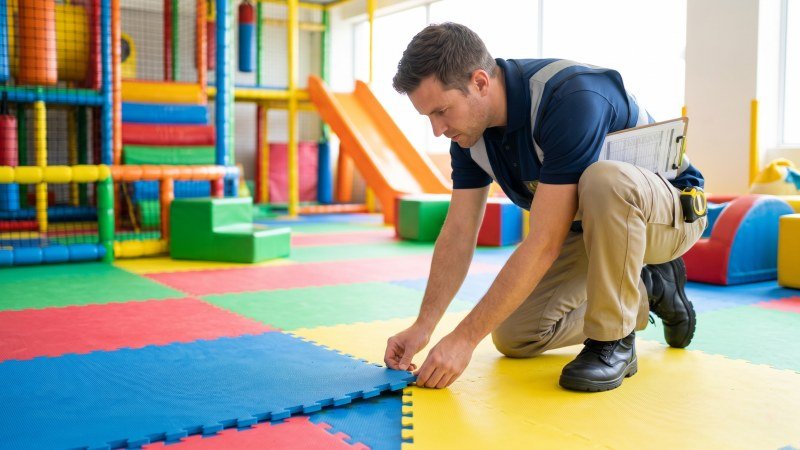
Falls are the leading cause of playground injuries. Let’s be clear: a quick-setup playground is essentially a hazard without proper safety flooring.
The commercial playground industry measures safety flooring using a metric called Critical Fall Height (CFH). The CFH rating of your floor must exceed the highest standing platform of your portable structure. For mobile soft play setups, operators frequently use interlocking EVA foam mats or heavy-duty vinyl crash pads. These specific materials must pass the ASTM F1292 standard for impact attenuation.
If your highest portable slide platform is three feet tall, your flooring must safely absorb a three-foot fall. Because foam densities and CFH ratings can vary significantly among different batches, always verify the exact impact attenuation specifications with your supplier before purchasing. Simply placing portable play structures on hard concrete or thin commercial convention center carpet is a major liability.
Non-Toxic and Fire-Retardant Material Checks
Commercial environments expose equipment to strict health and fire regulations. You cannot afford to overlook chemical safety.
For starters, all plastics and vinyl covers must comply with the Consumer Product Safety Improvement Act (CPSIA). This federal law mandates that children’s products must be completely free of harmful lead and phthalates.
Equally critical is fire safety—it’s completely non-negotiable for indoor events. Portable playgrounds used in shopping malls, convention centers, or banquet halls must meet commercial fire code standards. Specifically, the vinyl covers and netting should pass the NFPA 701 test for flame propagation. If a fire breaks out, the material must self-extinguish rather than melt or drip rapidly.
“Event operators frequently face unexpected shutdowns because they cannot produce fire-retardant certificates for their portable play structures during sudden fire marshal inspections.”
Do you really want to risk a total event shutdown over a missing fire cert? To cover your bases, you must always request the Material Safety Data Sheets (MSDS) and physical fire certificates from the manufacturer. You should carry digital and printed copies of these documents to every single commercial event to prove your compliance instantly.
Maximizing Portability and Space Efficiency
A massive commercial playground can quickly become a logistical nightmare when it is time to pack up and move if you do not plan ahead.
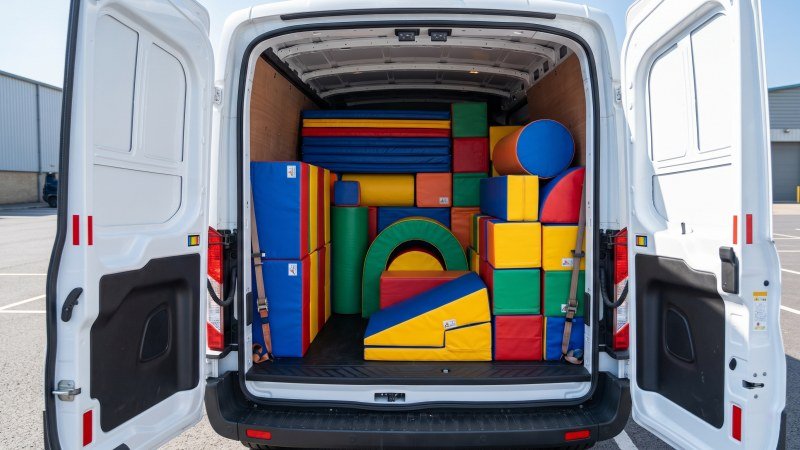
To maximize portability, calculate the exact folded dimensions and overall storage footprint of the equipment before purchase. Compact folding mechanisms allow large play structures to fit inside standard commercial cargo vans. Furthermore, utilizing modular layouts ensures the playground can easily adapt to different venue sizes, drastically increasing your overall operational efficiency and rental potential.
Folded Dimensions and Storage Footprint
Here is where logistics come into play: you must calculate the exact physical space the equipment requires when completely packed away. A commercial playground might cover 400 square feet during operation. But here’s the kicker: it must compress down significantly for daily transport.
Think of this process like managing a mobile carnival or a large-scale inflatable obstacle course. A massive attraction must systematically break down to fit perfectly inside standard transport vehicles. Similarly, your portable playground must collapse efficiently.
What happens when your newly purchased “portable” system refuses to fit into the cargo van you rented for the weekend? You lose time and money. Because of this reality, calculating the total cubic meters (CBM) of the folded equipment is absolutely critical. You must ensure the entire system fits inside your existing delivery vehicles. For example, a standard cargo van holds roughly 15 cubic meters of cargo. If your folded playground requires 18 cubic meters, you will unexpectedly need a larger box truck.
Folded dimensions heavily depend on internal foam density and frame designs. Be sure to calculate the exact storage footprint and CBM before finalizing your order. You should also consider the storage requirements at your local warehouse. Equipment that stacks vertically on standard industrial shipping pallets saves expensive warehouse floor space.
| Equipment Type | Set-Up Size (Sq. Ft.) | Average Folded Volume (CBM) | Required Transport Vehicle |
|---|---|---|---|
| Small Toddler Zone | 150 | 2 – 3 | Standard Minivan / SUV |
| Medium Modular Set | 400 | 8 – 10 | Standard Cargo Van |
| Large Multi-Level | 800+ | 15+ | 16-Foot Box Truck |
Modular Layouts for Different Venue Sizes
Now, think about adaptability. How does the equipment handle unpredictable event spaces? Every commercial venue features a completely different floor plan. If you want to maximize space efficiency, highly modular designs aren’t just nice to have—they’re required.
Modular layouts function exactly like scalable indoor laser tag arenas or modular ninja warrior courses. Operators can use the exact same padded panels and connectors for different events, reconfiguring the play area daily to fit the space.
For instance, you might book an event inside a large, open banquet hall. In this scenario, you can deploy a standard 20-foot by 20-foot square layout. The next day, you might operate inside a narrow retail mall corridor. Instead of panicking, you simply remove the corner connectors and arrange the exact same panels into a 10-foot by 40-foot rectangle.
“Businesses that invest in modular playground systems report a 30% higher booking rate because they can easily accommodate venues with restrictive or unusual floor plans.”
Even better, true modularity allows you to scale the playground up or down. If a client only pays for a small toddler birthday party, you can leave half the modules in your warehouse. On the flip side, you can connect multiple systems together for massive corporate family days. This specific flexibility maximizes your revenue potential without requiring multiple distinct equipment purchases.
Factor in Cleaning and Daily Maintenance
How can you maintain top-tier hygiene in a commercial portable playground without spending hours scrubbing after every single event?
You maintain hygiene by selecting play structures engineered specifically for rapid daily cleaning. This means choosing equipment manufactured with antimicrobial surface treatments and completely water-resistant fabrics to prevent mold growth. Furthermore, buyers must evaluate the structural design for accessibility, ensuring staff can easily reach all crevices and hidden corners for deep sanitization between commercial rentals.
Antimicrobial Surfaces and Water-Resistant Fabrics
Right at the surface level, evaluate the outer layers of the play equipment. You need surfaces that actively repel germs and liquids. Standard fabrics absorb sweat, juice, and saliva. As you’d expect, they quickly become breeding grounds for dangerous bacteria.
Think of this requirement like maintaining high-traffic commercial soft play centers or ball pits. A professional facility requires non-porous, medical-grade vinyl to prevent moisture from soaking into the internal foam core. Similarly, your portable playground needs heavy-duty, water-resistant fabrics.
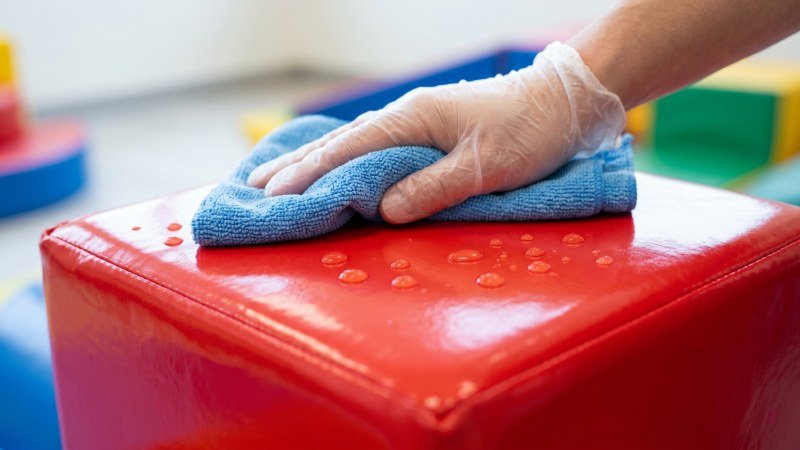
Commercial manufacturers often treat their vinyl with a specialized antimicrobial coating. This clear, non-toxic layer naturally disrupts bacteria cell walls. Therefore, it stops germs from multiplying during a busy event. Taking it a step further, 100% water-resistant vinyl allows your staff to spray liquid sanitizers directly onto the playground surface. The liquid simply beads up. Staff can quickly wipe it away without saturating the inner padding. Investing in these premium materials prevents permanent odors and heavily extends the usable life of your equipment.
Accessibility for Deep Sanitization
Now, look at the nuts and bolts of the physical engineering. A playground made of premium fabric is useless if your staff cannot physically reach the dirty areas. Daily maintenance must be fast to keep your operational labor costs low.
Consider the difficult task of cleaning a massive commercial ball pit. If the ball pit lacks a quick-drain system, staff must remove thousands of plastic balls by hand just to sanitize the floor. This clumsy process wastes valuable labor hours. In the exact same way, a poorly designed portable playground traps dirt in deep, unreachable crevices.
To avoid this, you must look for smart, accessible engineering. High-quality systems feature wide, flat seams. They specifically avoid deep gaps where food crumbs and moisture hide. Also, look for structures utilizing replaceable vinyl covers designed with strict commercial safety protocols. If a major spill occurs, authorized staff can use a specific tool to bypass the concealed, child-proof zippers, removing the dirty outer cover to attach a clean spare instantly.
| Design Feature | Maintenance Impact | Commercial Recommendation |
|---|---|---|
| Deep, stitched crevices | Traps dirt, moisture, and bacteria | Avoid |
| Flat, heat-welded seams | Wipes clean instantly with a single pass | Highly Recommended |
| Fixed, sewn-on covers | Requires tedious manual surface scrubbing | Avoid |
| Removable covers with concealed, anti-tamper zippers | Allows rapid replacement while strictly preventing foam access | Highly Recommended |
By prioritizing physical accessibility alongside rigorous safety design, your team can perform a thorough deep sanitization in minutes rather than hours. This specific focus on maintenance design directly protects your profit margins and guarantees a safe environment for children.
Conclusion
Selecting the right quick-setup commercial portable playground is a critical investment that directly dictates the success of your rental or events business. By carefully prioritizing fast but safe assembly mechanisms, commercial-grade materials, and rigorous safety certifications, you protect your customers and your liability. Let’s wrap this up: maximizing space efficiency and ensuring easy daily sanitization keeps your operational costs low, ultimately delivering a reliable and profitable play environment for years to come.