-
Whatsapp: +86 15516933785
-
Email: hanlin@hanlinplayground.com
-
Address: Shangjie District, Zhengzhou City, Henan Province, China
-
Whatsapp: +86 15516933785
-
Email: hanlin@hanlinplayground.com
-
Address: Shangjie District, Zhengzhou City, Henan Province, China

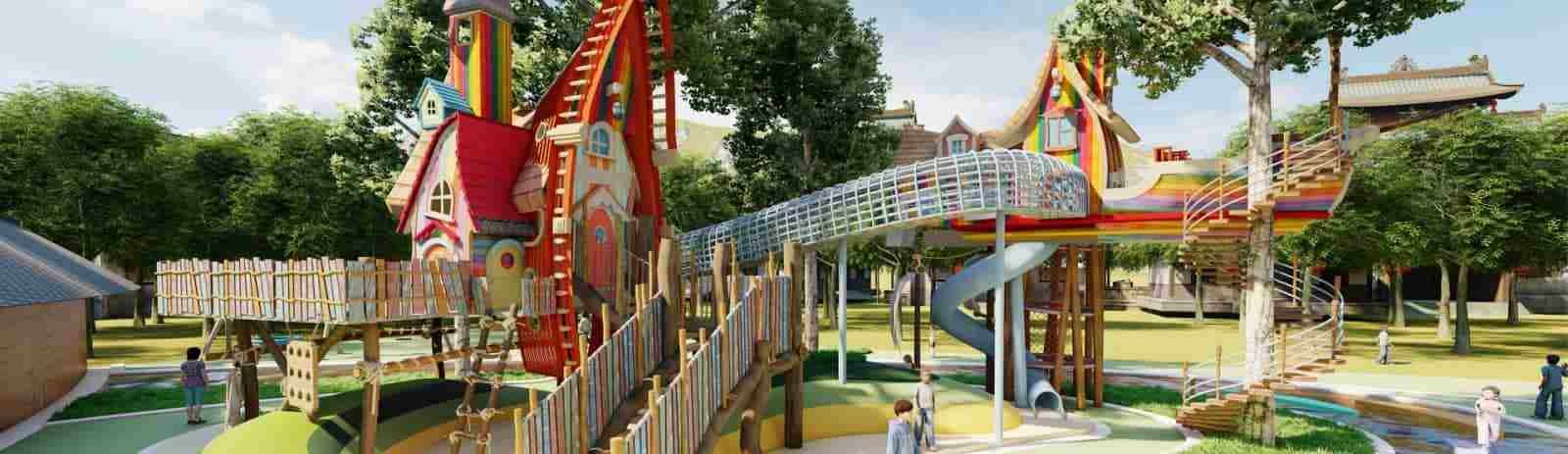
How Outdoor Playground Equipment Promotes Imaginative Play
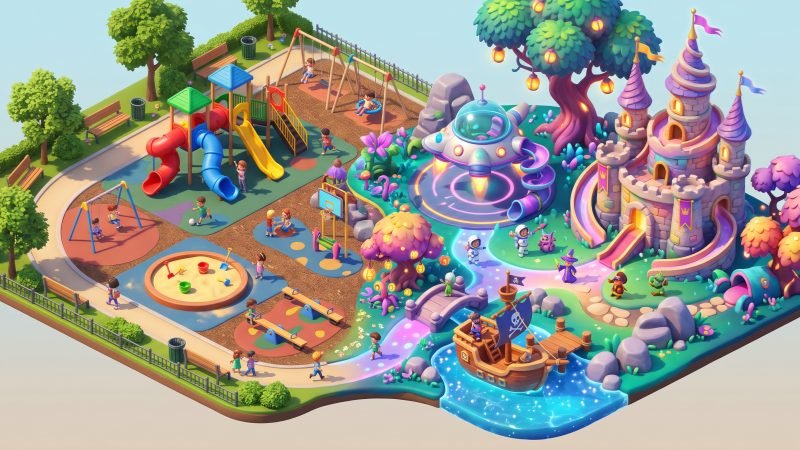
How exactly does outdoor playground equipment help children develop their imaginative play skills?
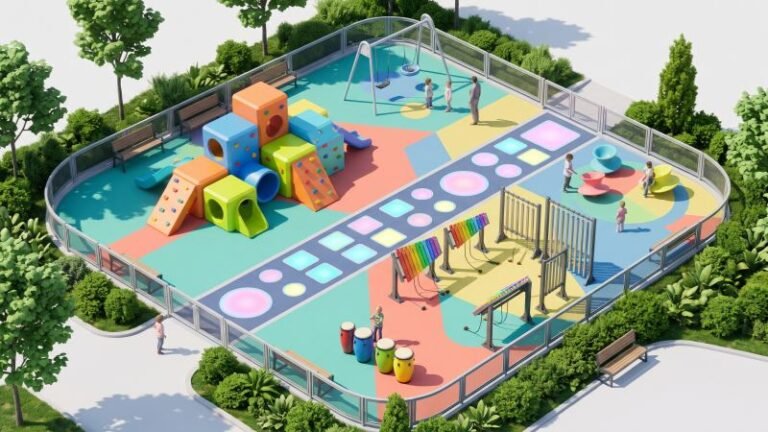
Outdoor playground equipment promotes imaginative play by providing a diverse mix of open-ended abstract structures, recognizable themed environments, interactive sensory panels, and semi-enclosed spaces. These physical elements act as powerful environmental catalysts, encouraging children to invent scenarios, assign roles, and engage in complex, self-directed storytelling and social cooperation.
Transforming Abstract Structures into Open-Ended Worlds
How do simple, shapeless playground structures inspire children to create complex imaginary games?
Abstract playground structures promote imaginative play by providing a “blank slate” environment where children are not limited by pre-defined themes. Because these structures lack specific identities, kids must actively use cognitive skills to assign meaning to their surroundings, transforming basic shapes into whatever their current storyline requires through self-directed storytelling.

Sandboxes as Flexible Foundations
Sandboxes offer a truly open-ended play experience. Unlike a slide that has one specific use, sand is a loose, moldable material. That means it naturally forces children to invent their own scenarios. Are they digging for buried treasure, or are they baking mud pies? The choice is entirely up to them.
“A sandbox is the ultimate unstructured play zone, requiring kids to build the physical setting of their imaginary world from scratch.”
To understand this, think about how a landscape architect grades a raw plot of land before installing safety surfacing and new playground equipment. Children do the exact same thing on a smaller scale inside the sandbox. Ever watch a group of kids excavate a sandpit? They engineer their own miniature terrains. They build mountains, carve out rivers, and construct roads. The end result? This physical building process directly drives their imaginative narrative.
Here are the primary ways sandboxes build imagination:
- Resource Management: Kids pretend sand is a valuable currency or a raw food ingredient.
- World-Building: Children physically shape the setting of their story before acting it out.
- Fluid Storylines: A sandcastle can quickly become a dinosaur footprint in a matter of seconds.
Geometric Climbing Domes
Geometric climbing domes are highly abstract. They consist solely of interconnected metal or plastic bars forming a hemisphere. Because they do not look like a specific real-world object, they become a powerful catalyst for the imagination.
Children rarely see a dome as just a climbing frame. Instead, the abstract geometry allows for endless interpretations. Will they defend it from the outside, or will they hide inside it?
Common Imaginative Interpretations
| Playground Structure | Abstract Shape | Common Imaginative Scenario |
|---|---|---|
| Climbing Dome | Intersecting Triangles | A giant spider web |
| Climbing Dome | Hollow Hemisphere | An alien spaceship or a meteor |
| Climbing Dome | High Peak | The summit of a dangerous mountain |
Look at the structural footprint: the physical design of climbing domes supports group storytelling. Multiple children can climb on the structure at once. Because of this, they have to communicate and agree on what the dome represents that day.
Note: Standard climbing domes typically range from 8 to 12 feet in diameter and have specific user capacity limits based on their materials. Always verify the exact weight ratings and dimensional specifications with your playground equipment supplier to ensure safety.
The real genius here? The lack of distinct features is the dome’s greatest strength. It does not dictate how a child should play. Without a script, the child’s mind has to fill in the blanks.
Triggering Role-Play with Themed Play Spaces
How do recognizable, themed playground structures instantly spark cooperative role-playing games among children?
Themed playground spaces promote imaginative play by providing immediate visual cues that establish a shared narrative framework. The physical setting is instantly recognizable. Thanks to this, children can bypass the initial world-building phase. They jump directly into complex character roles, social negotiation, and cooperative storytelling.

Forts and Castles
Why build a generic platform when you can build a castle? Forts and castles serve as powerful backdrops for dramatic narratives. They offer high vantage points and clear physical boundaries. Because of those defined sightlines, they naturally encourage games involving defense, royalty, or adventure. Children immediately understand the context. Within seconds, they’re assigning roles like guards, monarchs, or explorers.
To understand this effect, consider how a modular platform system works in playground design. The specific arrangement of structural posts, bridges, and decks directly dictates the physical flow of foot traffic. Similarly, a themed castle facade dictates the narrative flow of a child’s play. The structure provides a clear, undeniable starting point for the story.
“A strongly themed environment acts as a visual script, helping groups of children synchronize their individual imaginations instantly.”
Take the elevation changes, for example. The multi-level nature of these structures directly enhances the role-play. Elevated decks create a sense of authority or observation. Conversely, lower areas quickly become dungeons or secret passages.
Note: Deck elevations for themed structures typically range from 36 to 72 inches. Because safety fall heights and required safety surfacing zones vary heavily based on these dimensions, verify the exact specifications with your supplier during the planning phase.
Vehicles and Transportation Elements
Stationary playground vehicles transport children anywhere their minds can imagine. Structures resembling boats, trains, or rescue trucks provide a focused setting for motion-based role-play. Even though the physical equipment does not move, the narrative constantly travels.
Are they sailing a pirate ship across a stormy ocean? Perhaps they are driving a train through a snowy mountain pass? These structures usually include multiple interactive points. By design, this forces children to collaborate. One child cannot operate a large ship alone. That makes cooperative group play absolutely essential.
Common Vehicle Roles and Functions
| Equipment Feature | Assumed Role | Imaginative Function |
|---|---|---|
| Steering Wheel | Captain / Driver | Controls the direction of the narrative journey. |
| Rear Benches | Passengers / Crew | Reacts to the environment described by the driver. |
| Telesculptures | Navigator | Spots imaginary obstacles or destinations ahead. |
This specific type of equipment demands ongoing social coordination. Children must negotiate who gets to steer. They must also decide who sits in the back. The structural payoff? They practice vital communication skills while deeply immersed in their shared story.
Stimulating Scenarios with Sensory and Interactive Panels
How do stationary sensory panels and interactive boards ignite a child’s imagination during outdoor play?
Sensory and interactive panels promote imaginative play by providing immediate tactile and auditory feedback. Children seamlessly integrate this sensory information into their ongoing storytelling. These accessible components allow kids to manipulate their environment. In doing so, they turn abstract sounds and mechanical movements into crucial plot points for their imaginary scenarios.
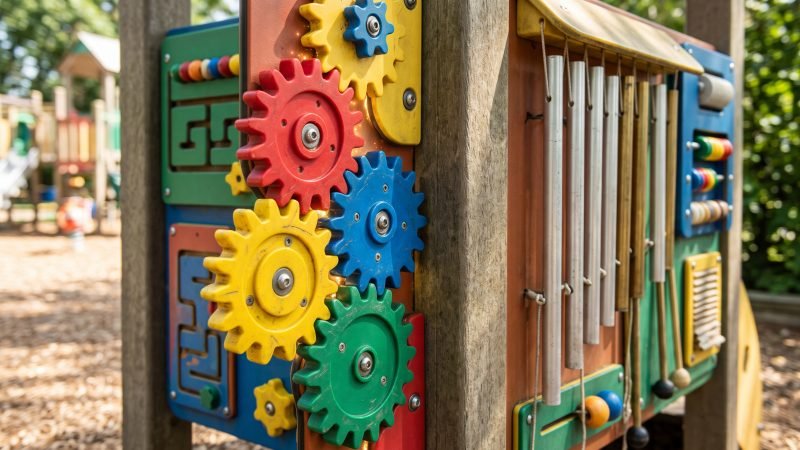
Musical Components
Ever notice how quickly a playground’s ambient noise spikes? Outdoor musical instruments do much more than just add to that noise. Equipment like playground chimes, marimbas, and bongo drums provide a soundtrack for imaginative play. A child is rarely just hitting a drum. Instead, they are sounding an alarm for their fortress. Perhaps they are sending a secret code to an alien spaceship.
To understand this, think about how brightly colored pour-in-place rubber surfacing is used to visually separate a specific play zone from the rest of the park. The distinct color immediately signals a change in the environment. Similarly, musical components cut through the chaotic background noise of the playground. They provide children with specific auditory cues to sharply define their imaginary worlds.
“Auditory stimulation transforms a static play space into a dynamic, living narrative.”
But it’s not just about making noise. These instruments encourage collaborative role-play. One child might play the chimes to simulate falling rain. Meanwhile, another child reacts to that sound by seeking imaginary shelter. The sound itself drives the plot forward.
Cause-and-Effect Activity Boards
Cause-and-effect boards include gear panels, sliding mazes, and spinning cylinders. These interactive elements require physical manipulation to produce a visual or mechanical result. Because of that immediate physical response, they naturally become control centers in a child’s mind.
When children spin a set of interlocking gears, they are not just watching plastic turn. Usually, they are operating a complex time machine. Alternatively, they might be fixing a broken robot. The physical action of turning a gear directly powers the fictional scenario.
Imaginative Functions of Activity Boards
| Board Type | Physical Action | Common Imaginative Scenario |
|---|---|---|
| Interlocking Gears | Spinning wheels | Operating a factory or powering a spaceship. |
| Sliding Mazes | Moving track knobs | Navigating a treacherous path or unlocking a vault. |
| Tic-Tac-Toe Grids | Flipping cylinders | Entering a secret password or cracking a code. |
These panels provide tangible proof that a child’s actions have consequences. If they turn the wheel, the gear moves. Hit the right combination, and suddenly their imaginary vehicle can finally take off. This direct, mechanical feedback loop keeps children deeply engaged in their creative storytelling.
Facilitating Dramatic Play in Semi-Enclosed Spaces
Why are partially enclosed playground spaces so effective at supporting deep, dramatic play?
Semi-enclosed playground spaces promote imaginative play by providing a sense of physical privacy away from high-traffic play zones. These sheltered areas naturally lower sensory input and limit outside distractions. When you drop the decibel level, children feel secure enough to engage in deep, sustained dramatic storytelling, often mimicking domestic life or social scenarios.
Under-Deck Hideouts
Elevated playground platforms naturally create a shaded, separated area underneath. This ground-level space serves as a perfect sanctuary for dramatic play.
Children often use these areas to play “house,” run a pretend store, or hold secret club meetings. Why is this specific space so effective? It physically removes the child from the chaotic energy of the slides and climbers above.
To understand this, think about how a large playground shade canopy provides physical relief from the intense summer sun. It creates a protected, comfortable zone below. Similarly, an under-deck hideout creates a sensory relief zone amidst a noisy playground. The result is a controlled micro-environment where children can concentrate fully on their complex, verbal role-playing without interruption.
Factor in built-in seating or counters, and these simple additions act as physical props for their domestic play.
Note: The usable space inside an under-deck hideout depends entirely on the platform height above it. To ensure these spaces meet ADA compliance standards for wheelchair accessibility, always verify the exact clearance dimensions with your playground equipment supplier.
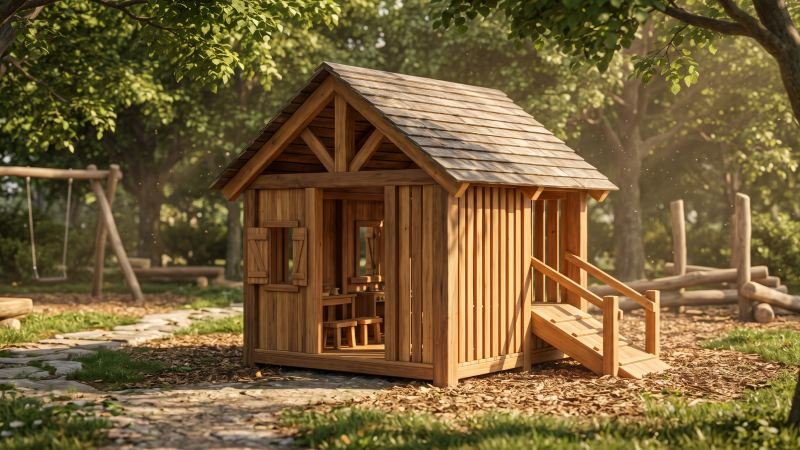
Freestanding Playhouses
Have you ever noticed how children flock to tiny, walled-off spaces? Freestanding playhouses are explicitly designed to mimic real-world architecture. They usually feature roofs, distinct walls, and open windows.
Because they are separated from the main playground structure, they offer a dedicated zone for domestic role-play. Children instinctively recognize a playhouse as a home, a cafe, or a workshop. That architectural cue means they instantly adopt corresponding roles like parents, chefs, or builders.
The physical boundaries of the playhouse easily define the rules of the imaginative game. For example, if a child is inside, they are “home.” If they are outside, they are “traveling.”
| Playhouse Feature | Physical Function | Dramatic Play Scenario |
|---|---|---|
| Open Window | Allows visibility and pass-through | Operating a drive-thru window or selling tickets. |
| Defined Doorway | Creates a distinct threshold | Welcoming guests or locking out imaginary monsters. |
| Slanted Roof | Provides physical shade | Seeking shelter from a massive imaginary rainstorm. |
At the end of the day, the distinct boundaries of a freestanding playhouse help children organize their social interactions. They can confidently assign roles, set narrative rules, and execute detailed storylines in a perfectly scaled environment.
Conclusion
When you look at the big picture, outdoor playground equipment is much more than a collection of physical obstacles; it is a vital tool for cognitive and social development. By thoughtfully combining open-ended structures like sandboxes with themed elements like castles, as well as integrating sensory boards and quiet hideouts, designers can create environments that cater to every type of creative mind. These well-planned play spaces provide children with the perfect physical canvas to build worlds, negotiate roles, and develop the imaginative skills that will serve them long after they leave the playground.