-
Whatsapp: +86 15516933785
-
Email: hanlin@hanlinplayground.com
-
Address: Shangjie District, Zhengzhou City, Henan Province, China
-
Whatsapp: +86 15516933785
-
Email: hanlin@hanlinplayground.com
-
Address: Shangjie District, Zhengzhou City, Henan Province, China

How to Finance an Indoor Playground
How exactly do you secure the funding needed to start a profitable indoor playground?
Financing an indoor playground requires calculating your total startup costs, choosing the right funding source like SBA loans or equipment leasing, and presenting a solid business plan to lenders. You must prepare detailed 3-to-5-year financial projections, organize your legal documents, and meet strict lender requirements for personal credit scores and owner equity to successfully secure your capital.
Calculating Your Total Startup Costs
What exact financial figure must you determine before applying for an indoor playground loan?
Calculating total startup costs requires adding the prices of play equipment, facility leases, site renovations, insurance, and initial working capital. Generally, an average indoor playground needs between $200,000 and $800,000 in upfront capital. You must determine this exact total cost first, because lenders require a precise funding amount before they will approve any financial backing.
Play Equipment and Custom Structures
Your main attractions are your biggest expense. Are you planning to install a massive multi-level soft play frame, or a series of trampoline zones? Just as a commercial laser tag arena spends most of its budget on laser vests and barrier walls, your playground budget relies heavily on the physical play structures.
Typically, commercial indoor play structures cost between $15 and $50 per square foot of play area. You must also pay for shipping, professional installation, and safety flooring. Because material costs, load-bearing parameters, and structural specifications can vary greatly depending on the manufacturer, always verify the exact dimensions, weight limits, and final pricing directly with your chosen supplier.
“Play equipment is your primary physical asset. Many lenders will use this specific equipment as collateral for the loan.”
| Equipment Type | Average Cost Range | Primary Financing Use |
|---|---|---|
| Soft Play Structures | $30,000 – $150,000 | Asset-based collateral |
| Trampoline Parks | $50,000 – $200,000 | Asset-based collateral |
| Ninja Warrior Courses | $20,000 – $80,000 | Asset-based collateral |
| Safety Mats & Flooring | $5,000 – $20,000 | Operational expense |
That’s exactly why locking in accurate quotes from equipment vendors early isn’t just good practice—it’s mandatory. This gives you a rock-solid foundation for your total funding request.
Facility Lease, Deposits, and Site Renovations
Where will your playground be located? Real estate costs consume a large portion of your startup budget. Unlike play equipment, building renovations cannot be easily repossessed by a bank. As a result, lenders look very closely at these construction numbers.
Right out of the gate, landlords will demand a commercial lease deposit. This often includes the first and last month of rent upfront. On top of that, you’ve got to prep the building for heavy foot traffic. This construction process is called the “build-out.”
Common Site Renovation Costs
- HVAC Upgrades: High-activity zones require powerful air conditioning systems.
- Restrooms: You must build ADA-compliant bathrooms to handle large crowds.
- Cafe Areas: Installing plumbing and electrical lines for a snack bar.
- Lighting: Upgrading dim warehouse lighting to bright, family-friendly fixtures.
Building renovations can quickly cost between $50 and $100 per square foot. If you rent a 10,000-square-foot empty warehouse, the build-out alone could demand $500,000. Make no mistake, you have to document these exact construction bids to prove to the bank your budget is anchored in reality.
Insurance, Licensing, and Initial Working Capital
You cannot open your doors without proper legal protection and cash reserves. Ever tried keeping the lights on when you’re already out of operating cash on day one?
Lenders will not finance a project if your runway is too short. They require you to hold “working capital.” This is a cash safety net. It covers rent, payroll, and marketing until your daily ticket sales can actually carry your daily expenses. Industry standards strongly suggest keeping three to six months of operating expenses in reserve.
Don’t overlook the invisible administrative costs before opening:
- Liability Insurance: Indoor playgrounds carry inherent injury risks. You must buy comprehensive general liability insurance.
- Business Licenses: Cities charge fees for local business permits, occupancy permits, and health department approvals.
- Point of Sale (POS) Systems: You need hardware and software to sell tickets and track digital liability waivers.
These background costs easily add another $30,000 to $60,000 to your startup needs. When you finally roll the equipment, the build-out, and the legal reserves into one master spreadsheet, you’ll know exactly the capital you need.
Top Funding Sources for Entertainment Centers
Which financial channels are most reliable for funding a new indoor play facility?
The primary funding sources for family entertainment centers include Small Business Administration (SBA) loans, specialized equipment financing, traditional commercial bank loans, private investor partnerships, and local business grants. SBA 7(a) loans offer excellent long-term rates, while equipment leasing provides rapid capital specifically for play structures. Choosing the correct source depends entirely on your specific timeline, credit strength, and the physical assets you need to purchase.
Small Business Administration (SBA) Loans
Why do so many playground founders choose government-backed loans? SBA loans are heavily favored because they lower the risk for traditional lenders. The government does not lend the money directly. Instead, they guarantee a large portion of the loan for the bank.
Think of the SBA guarantee as the heavy-duty safety netting under a high ropes course. If a climber falls, the net catches them. Similarly, if your business fails, the SBA repays the bank up to 85% of the lost money. This setup makes banks much more willing to approve your entertainment center startup.
Common SBA Loan Types
- SBA 7(a) Loans: Used for working capital, marketing, and general operational needs.
- SBA 504 Loans: Used strictly for major fixed assets, like buying commercial real estate.
Historically, SBA loans offer repayment terms between 10 and 25 years. However, exact interest rates and maximum loan amounts often fluctuate based on current federal policies and your chosen banking institution. Because of this, always verify the current rates directly with your chosen SBA-approved lender before pulling the trigger on an application.
Equipment Financing and Leasing Programs
Do you need funds specifically to buy your massive soft play frame or arcade machines? Equipment financing is a highly targeted solution. In this model, the loan is strictly tied to the physical assets.
Just as a modern family entertainment center might lease an entire arcade game lineup, you can finance your primary playground structures. The play equipment itself serves as the collateral for the loan. Miss a monthly payment? The lender simply repossesses the slides and climbing walls. Because the collateral is built-in, approval times are significantly faster than SBA loans.
“Equipment financing keeps your working capital free. It allows you to pay for the playground structures as they generate daily revenue.”
Because financing limits often depend on the projected lifespan of the assets, verify the exact warranty periods and structural durability with your equipment supplier to support your loan application and secure the best repayment terms.
Traditional Commercial Bank Loans
Are you an established business owner looking to open a second location? Traditional commercial bank loans might be your fastest route. Banks lend you a specific lump sum. Then, you pay it back monthly with interest.
Think your local bank is just going to hand over a massive check for an untested, empty warehouse? Unlike SBA loans, traditional bank loans lack government backing. Without that safety net, banks view them as inherently higher risk. Banks rarely approve these standard term loans for brand-new playground startups. They strongly prefer established entertainment franchises or operators with a proven track record of profitable ticket sales.
| Funding Type | Best Used For | Approval Difficulty | Typical Speed |
|---|---|---|---|
| SBA Loans | Overall startup capital | High | 60 – 90 Days |
| Equipment Financing | Buying play structures | Low to Medium | 7 – 14 Days |
| Traditional Bank Loans | Expansions and franchises | Very High | 30 – 60 Days |
Private Investors and Partnerships
What if traditional banks decline your application? You can pivot to private investors. This is known as equity financing. Instead of borrowing money and taking on monthly debt, you sell a percentage of your business.
For example, a local commercial real estate developer might fund your entire indoor trampoline park. In exchange, they take 30% ownership of the company. You do not have to make fixed monthly loan payments. The trade-off? You’ll be sharing your future profits as long as the doors are open. Finding a partner with experience in the family entertainment industry can also bring valuable operational guidance to your team.
Local Business Grants and Crowdfunding
Is there any way to secure funding without taking on debt or giving up equity? Yes, through grants and crowdfunding. While difficult to secure, these options provide capital that you do not have to repay.
Many cities offer economic development grants. Local governments want to revitalize empty retail spaces and create jobs. An indoor playground easily achieves both goals. Check with your local Chamber of Commerce for available small business grants.
Beyond that, community crowdfunding is surprisingly effective for family-focused builds. You can use platforms like Kickstarter to pre-sell annual passes or birthday party packages. A well-marketed campaign can raise $50,000 from local parents who want a safe play space in their neighborhood. This proves immediate market demand to future lenders.
Lender Requirements for Loan Approval
What specific criteria do financial institutions evaluate before approving your indoor playground loan?
Lenders evaluate your application based on four critical factors. They carefully review your business plan, financial projections, personal credit history, and cash equity. Banks need concrete proof that your entertainment center will generate consistent daily revenue. This revenue must comfortably cover your new monthly debt payments.

A Comprehensive Business Plan with Market Research
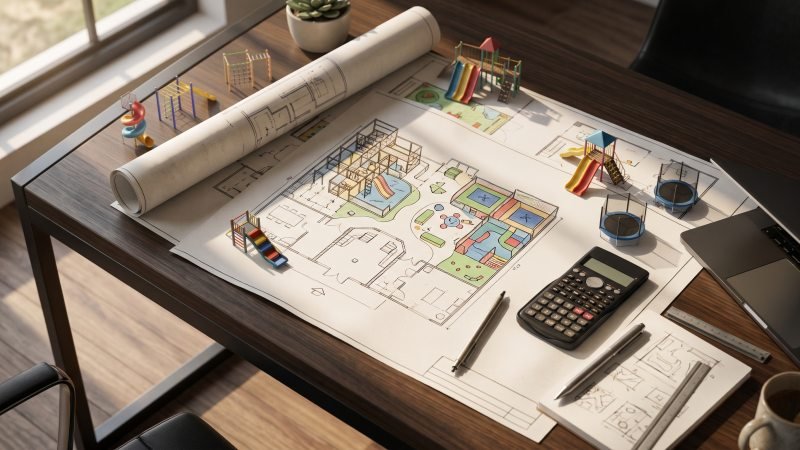
Your business plan is the ultimate blueprint for your facility. Just as a structural engineer requires a precise blueprint before approving a massive multi-level drop slide, a bank requires a business plan before approving your capital.
Lenders specifically look for deep local market research. They want to see exactly who will visit your facility. You must prove there are enough families with children aged 2 to 12 within a 10-mile radius. Banks are also going to dissect your competitor analysis. If there are already three trampoline parks nearby, you must explain how your specific play equipment stands out. Your business plan must clearly define your target audience, marketing strategy, and daily operational structure.
Realistic 3-to-5-Year Financial Projections
Banks do not lend money based solely on a good idea. They lend money based on expected mathematical profitability. Lenders will closely examine your financial projections for the first three to five years.
You must show a realistic balance between your expected income and operating expenses. How many weekend birthday parties will you book? How many walk-in tickets will you sell on a Tuesday morning? Lenders check these numbers against industry averages. If you project maximum capacity every single day, lenders will reject the application as unrealistic. They want to see that you have planned for slow seasons, equipment maintenance costs, and staff wages.
“Lenders look for a clear break-even point. They need to know exactly which month your ticket sales will finally surpass your monthly expenses.”
Strong Personal Credit Score and History
Even if your business plan is perfect, lenders still judge your personal financial habits. Your credit score serves as a historical record of your financial reliability.
For major funding options like SBA loans, lenders typically require a minimum personal credit score of 680. Push that score above 720, though, and you significantly improve your leverage. Lenders also calculate your personal debt-to-income ratio. If you already have massive credit card debt, banks will view you as a high-risk borrower. They want assurance that the founders know how to manage money responsibly before handing over hundreds of thousands of dollars.
Required Down Payment and Owner Equity
Lenders rarely finance 100% of an indoor playground project. They expect you to have “skin in the game.” This is called owner equity or a down payment.
If you aren’t willing to put your own skin in the game, why should a bank risk theirs? Typically, traditional lenders and SBA programs require a down payment of 10% to 20% of the total project cost.
| Total Project Cost | Required Equity (15% Average) | Loan Amount Provided |
|---|---|---|
| $300,000 | $45,000 | $255,000 |
| $500,000 | $75,000 | $425,000 |
| $800,000 | $120,000 | $680,000 |
Lenders will verify the source of this down payment. They usually require two months of bank statements to prove the cash belongs to you. You cannot borrow your down payment from another temporary lender. By providing strong owner equity, you significantly lower the bank’s risk and secure much better loan terms.
Step-by-Step Process to Secure Your Capital
What exact steps must you take to successfully move from needing startup money to getting the final cash deposited into your bank account?
To successfully secure your capital, you must strictly follow a three-step process. First, systematically organize all your required legal and financial documents into one comprehensive package. Next, aggressively compare interest rates and repayment terms from multiple lenders to find the most competitive offer. Finally, officially submit your application and patiently cooperate with the bank’s underwriting team to clear any final background checks before the funds are released.
Organize Your Legal and Financial Documents
You must prepare your paperwork completely before approaching any bank. Think of this process like assembling a large modular soft play structure. You must physically lay out every single steel pipe, safety net, and foam pad before you actually start building. Similarly, you must gather every individual financial document before building your loan case.
Lenders will instantly reject disorganized applicants. That means you need a bulletproof, professional digital folder containing your entire legal history.
Essential Paperwork Checklist
- Personal tax returns for the past three years.
- Official Articles of Organization for your LLC or Corporation.
- An Employer Identification Number (EIN) from the government.
- Proforma invoices from your playground equipment manufacturers.
These proforma invoices show the bank exactly how much the physical play structures will cost. Because steel and plastic raw material prices fluctuate frequently, equipment pricing can change. Knowing this, you need to verify the exact expiration date and final pricing of these quotes directly with your supplier before attaching them to your formal loan application.
Compare Rates and Terms from Multiple Lenders
You should never accept the very first loan offer you receive. Instead, you must aggressively shop around. Different financial institutions assess the family entertainment market differently. One bank might view a massive indoor trampoline park as too risky. However, another bank might specialize in funding community entertainment centers.
You must analyze the Annual Percentage Rate (APR). But don’t get tunnel vision on the base interest rate. You’ve got to scrutinize the repayment timeline and check for hidden operational restrictions.
| Loan Feature | Why It Matters For Your Playground |
|---|---|
| Annual Percentage Rate (APR) | Determines your exact monthly cash outflow for the life of the loan. |
| Loan Term Length | Longer terms lower monthly payments but cost more overall. |
| Prepayment Penalties | High fees charged if you pay off the play equipment loan early. |
By submitting your organized file to at least three different lenders, you force them to compete, which lets you negotiate terms that actually protect your daily cash flow.
Submit Your Application and Navigate Underwriting
After you submit your complete package, your file enters the “underwriting” phase. What exactly is underwriting? It is the final, intense background check performed by the bank’s financial experts.
Think of the underwriter as the third-party safety inspector who rigorously tests your multi-level play frame before opening day. They will aggressively stress-test your numbers to ensure nothing breaks under pressure. They will verify your personal bank statements line by line. Don’t be surprised when they call your specific equipment vendors directly to confirm those proforma invoices are authentic.
During this phase, the bank will constantly ask for additional explanations or updated paperwork. You must respond immediately. Delaying your response will directly delay your funding. Once the underwriter completely clears your file, you will receive a final status called “clear to close.” Once you clear that hurdle, you sign the final contracts. Then, the bank wires the startup capital directly into your operating account, and you can finally greenlight your equipment orders.
Conclusion
Getting an indoor playground funded isn’t magic; it comes down to engineering a bulletproof financial plan and knowing exactly which levers to pull. By accurately calculating your exact initial costs and thoroughly evaluating the various lending options—from SBA loans to equipment financing—you can lock in a capital solution tailored to your operational needs. Focus on building a robust business plan, maintaining strong credit, and patiently navigating the underwriting process. With the right financial backing in place, you can successfully turn your vision of a thriving family entertainment center into reality.